Get Kraft Mailer Boxes Lead Time and MOQ Before Ordering
Kraft Mailer Boxes Lead Time and MOQ: What Buyers Can Actually Control
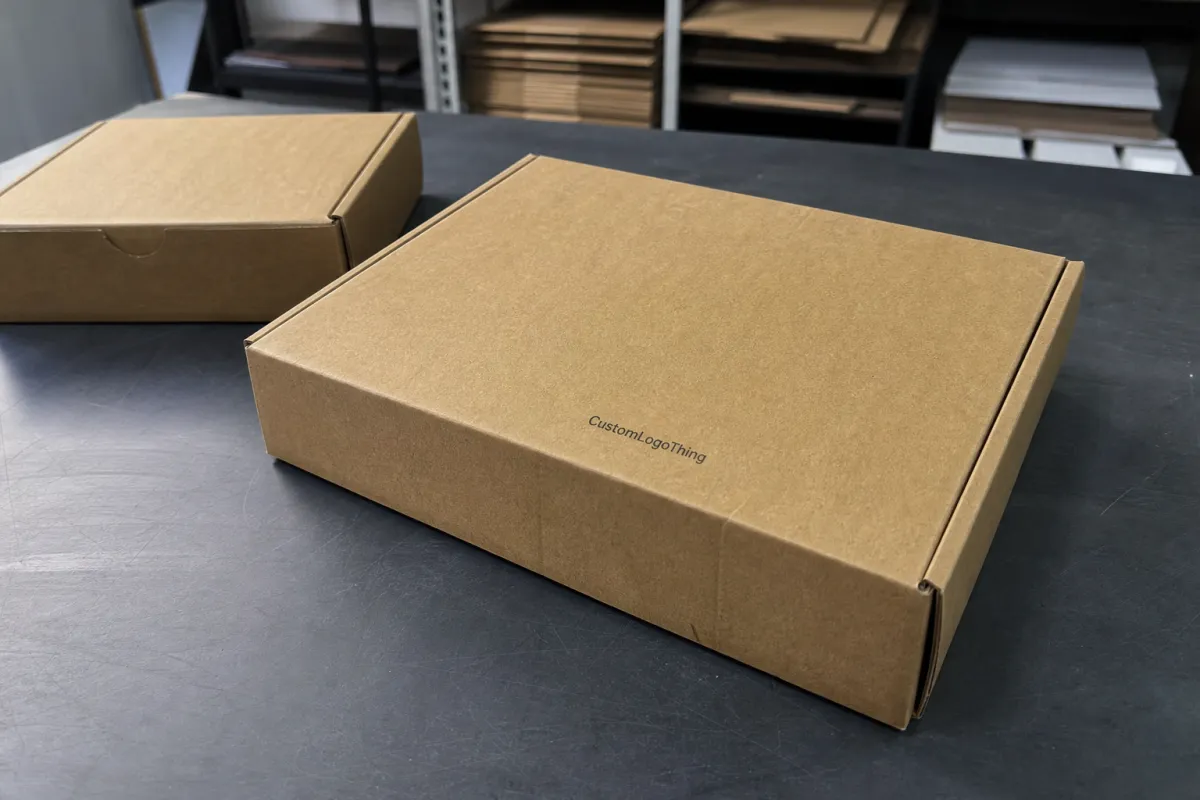
A brand can approve artwork before lunch and still miss a product launch by two weeks. That usually happens because kraft mailer boxes Lead Time and MOQ are not fixed catalog numbers. They move with box structure, flute grade, print coverage, finishing, order quantity, proof approval, freight lane, and how many details are locked before production planning begins.
A kraft mailer box is not just a brown box with a logo. It is protective ecommerce packaging that has to survive carrier handling, reduce void fill, present the product cleanly, and arrive flat-packed in a form that warehouse teams can store, fold, and load without losing time on every order.
Stock corrugated mailers can be useful when speed matters more than fit. If the size and board are already in inventory, they may ship in 2-5 business days. The trade-off is often hidden in the operation: more filler, higher dimensional weight, loose product movement, awkward packing, and a brand presentation that looks interchangeable. Custom kraft mailer boxes can solve those problems for cosmetics, candles, apparel accessories, coffee, wellness kits, sample programs, and other products where fit and presentation carry real value.
The common mistake is asking for “a price on 1,000 kraft mailers” before confirming internal dimensions, board grade, artwork format, or delivery deadline. That request can produce a rough estimate, but not a production-backed quote. The estimate changes after the dieline changes, then changes again when print coverage or freight assumptions are clarified. Buyers lose days in those revisions.
Buyer reality: the fastest quote is not always the most useful quote. A reliable quote is tied to confirmed dimensions, print method, MOQ, production time, freight assumptions, and approval milestones.
For most teams, the controllable part is preparation. If the supplier receives complete specifications at the start, the answer on cost, timing, and minimum order quantity becomes sharper. If half the details are still open, the quoted lead time is only a placeholder.
Product Details That Change Box Performance
Kraft mailer boxes are commonly made from corrugated board or heavy kraft paperboard formed into a self-locking structure. A standard roll-end front tuck mailer includes side panels, dust flaps, a hinged lid, and front locking tabs, usually without tape. The better versions feel simple because the engineering is doing quiet work: the product is held firmly, the box folds predictably, and the lid does not pop open under normal handling.
Board choice changes both protection and presentation. E-flute is thin and neat, often around 1.5 mm thick, and is widely used for retail-style ecommerce boxes where a clean fold and compact profile matter. B-flute is thicker, often near 3 mm, and gives better cushioning for heavier or more fragile products. Dense contents, sharp edges, glass jars, or multi-item kits may need a stronger corrugated grade, a different flute profile, or an insert that keeps pressure away from the corners.
Kraft does not mean plain. Buyers can choose natural brown kraft, white-lined kraft, outside print, inside print, spot color branding, flood coats, or a simple black logo on the lid. Minimal design can look premium when the board shade, ink density, and fold alignment are consistent. Heavy ink coverage can also work, but it may add drying time, increase scuff concerns, raise cost, and make color variation more visible on natural kraft stock.
Use case should lead the specification. A 2 oz cosmetic jar needs a different box than a 12 oz candle. A subscription kit with three SKUs, tissue, and an insert card needs a different internal layout than a folded T-shirt. Small electronics may need tighter void control and anti-scuff thinking. Coffee and wellness products may need a crisp presentation even if the kraft mailer is later packed inside a larger shipping carton.
Packing labor deserves more attention than it usually gets. One mailer may look slightly cheaper on paper but take longer to square up, fold, and lock. Another may cost a few cents more and save several seconds per shipment. If a structure saves 4 seconds per unit across 20,000 shipments, that is more than 22 labor hours removed from the packing bench. That savings belongs in the cost discussion.
Good-looking mailers still have to perform. If a box bows under product weight, crushes at the corners, leaves too much air around the contents, or fails to stay closed during normal handling, the cost appears later as refunds, reships, complaints, and sometimes dimensional weight penalties. For formal transport testing frameworks, buyers can review resources from ISTA and discuss suitable validation with their supplier.
Specifications to Confirm Before Requesting a Quote
A strong quote starts with unglamorous details: internal dimensions, product weight, target ship weight, board grade, flute type, print colors, coating, inserts, carton pack-out, delivery location, and deadline. Miss one of those, and the quoted lead time or MOQ may shift after the first estimate.
Internal dimensions matter more than outside dimensions because the product lives inside the box. Add tissue, a thank-you card, a label, a corrugated pad, or a molded insert, and the lid may start to bow. Too tight, and fulfillment teams fight the box. Too loose, and the product moves during transit, which can make the unboxing feel careless even if nothing breaks.
Board grade should match product weight and shipping channel. E-flute gives a slim, refined feel for lightweight goods. B-flute adds cushioning. Heavier contents may need a stronger board, a reinforced structure, or an insert that distributes weight more evenly. Recyclability claims also need care; broad claims should match the material composition, coatings, labels, and realistic local recycling access. The EPA recycling resources are a useful reference point for general recycling language.
Artwork readiness is another frequent delay. A vector logo file is better than a low-resolution PNG. Dieline-based artwork should include bleed, safe zones, barcode placement, panel orientation, and color references such as Pantone values when exact matching matters. Inside-panel printing needs extra review because orientation errors are easy to miss when the box is shown flat.
- Dimensions: internal length, width, and depth measured around the packed product, not the bare item.
- Material: natural kraft liner, white-lined kraft, E-flute, B-flute, or a supplier-recommended board grade.
- Print: one-color, two-color, CMYK, inside print, outside print, flood coat, or spot color branding.
- Finishing: varnish, matte coating, scuff resistance, inserts, labels, or special closure features.
- Logistics: carton quantity, pallet needs, delivery location, warehouse constraints, and packing-line requirements.
Automated or semi-automated packing lines should be discussed early. A mailer that works beautifully by hand can slow equipment if the fold memory, blank tolerance, locking tabs, or board stiffness are wrong for the line. That does not make the structure bad. It means the specification must match the fulfillment environment.
MOQ, Pricing, and Unit Cost Drivers
MOQ is usually driven by press setup, die-cutting setup, material purchasing, tooling, and finishing efficiency. It is not only a sales policy. A simple one-color kraft mailer may support a lower starting quantity than a full-color box with inside artwork, specialty coating, and a new custom die.
For many custom kraft mailer projects, practical starting MOQs often fall around 500-1,000 units for simpler specifications. More complex print, larger structures, specialty finishes, or custom tooling may push the sensible order quantity to 2,000-5,000 units or more. Supplier equipment, available tooling, material sourcing, and scheduling all matter, so those figures should be treated as planning ranges rather than guarantees.
Unit cost is shaped by size, board grade, print coverage, number of ink colors, tooling fees, setup charges, inserts, finishing, quantity, and freight destination. A small one-color kraft mailer might land around $0.45-$0.90 per piece at modest quantities, while larger or heavily printed mailers can move above $1.25-$2.50 per piece before freight. High-volume programs can bring the unit price down sharply, but only when the design is stable and the buyer has enough storage space to hold the inventory.
| Buying Scenario | Typical Quantity | Cost Behavior | Best Fit |
|---|---|---|---|
| Test launch | 500-1,000 units | Higher unit cost because setup charges and tooling fees spread across fewer boxes | New products, market tests, limited campaigns |
| Standard reorder | 2,000-5,000 units | Better bulk pricing if dieline, artwork, and board stay unchanged | Brands with predictable monthly fulfillment |
| Volume production | 10,000+ units | Lower cost per piece, with more exposure to storage needs and demand changes | Established SKUs with stable sales history |
Small runs protect cash flow. Large runs improve economics. Neither choice is automatically better. If a brand changes its product bundle every eight weeks, a 20,000-piece order can become dead inventory. If a brand ships the same hero product every day, ordering too small can create repeated setup charges, higher freight per unit, and avoidable stockouts.
Ask for tiered pricing rather than one isolated number. A practical request might compare 1,000, 3,000, and 5,000 pieces using the same board, print, and delivery address. That exposes the cost curve and makes it easier to decide whether the next quantity break is worth the added inventory. It also helps Custom Logo Things discuss Custom Packaging Products with the right production assumptions instead of guessing at the budget.
The better question is not “What is the lowest MOQ?” It is “Which MOQ gives us acceptable risk, landed cost, and reorder timing?” That framing leads to a more useful decision.
Production Timeline From Dieline to Delivery
A typical custom mailer order follows a sequence: consultation, box style selection, dieline creation, artwork placement, proofing, approval, material scheduling, printing, die cutting, folding, packing, quality control, and shipping. If a step is skipped during planning, it usually returns as a delay later.
For first orders, a practical timeline may include 1-3 business days for consultation and dieline setup, 1-4 business days for artwork revisions and proofing, then 10-20 business days for bulk production after approval. Domestic freight can add 2-10 business days depending on location, service level, carton count, and pallet volume. International lanes, customs review, port congestion, holidays, and peak parcel periods can add more time.
The slow stages are rarely mysterious. Incomplete artwork. Late dimension changes. Unapproved proofs. Specialty board availability. Heavy ink coverage. A barcode moved after dieline approval. A delivery address switched from a commercial warehouse to a residential location. Each change may look minor in an email, but production schedules are built from locked details.
Production time is not the same as door-to-door delivery time. The factory clock generally starts after final approval and material scheduling. It does not include internal debate over box size, sample testing, proof revisions, customs clearance, or the freight handoff after goods leave the production site.
Build a reverse calendar from the launch date. If boxes must be usable in the warehouse by the 20th, allow time for receiving, count verification, shelf placement, and a pack test with the fulfillment team. A ship date is not finished inventory. It is one stage between production and boxes ready for orders.
Repeat orders are usually more predictable. Dielines, artwork, tooling, packing standards, and QC checkpoints already exist. If the reorder uses the same specification, lead time and MOQ can often be confirmed faster because fewer assumptions need review. If the artwork, dimensions, board, or print coverage changes, treat the job like a partial first order.
Proofing, Sampling, and Quality Checks Before Production
A digital proof verifies layout, orientation, copy, logo placement, panel sequence, barcode position, and dieline fit. It is essential, but it has limits. A PDF cannot fully prove board feel, fold tension, scuff behavior, ink opacity, or how color will sit on natural kraft.
A physical sample is worth the added time for fragile products, premium retail launches, subscription kits, heavier contents, inside printing, or campaigns where the unboxing experience matters. A white ink logo on brown kraft, for example, can change noticeably depending on ink opacity and board shade. A screen preview will not show the whole result.
Practical quality checks should cover board thickness, flute consistency, fold alignment, tuck security, print registration, scuff resistance, glue or lock integrity, carton count, and random inspection before shipment. For shipping performance, some buyers use ASTM or ISTA-style thinking even when they do not run a full lab protocol for every order.
Many packaging failures are not design failures. They are specification gaps. The box looked correct on a dieline, but nobody tested it with the actual product weight, tissue, insert, label, and expected carrier movement. That is how a sharp-looking mailer becomes a crushed corner, a popped lid, or a product rattling inside a box that was half an inch too deep.
Test pack a sample before approving full production. Use the real product. Add the exact insert, label, tissue, tape, and any literature that will ship with it. Shake the packed box lightly. Stack several units. Check whether the lid bows, the tuck feels weak, the corners deform, or the product shifts. Fix those issues before bulk production, because a small delay before approval is cheaper than remaking thousands of boxes.
Sampling can feel slow when a launch date is close. Still, a 3-5 day sample review can prevent a 3-5 week problem if the first bulk run fails fit, print, or packing expectations. Buyers who skip sampling should at least understand what risk they are accepting.
How to Request a Quote Without Rework
The cleanest quote request is short, complete, and measurable. Send product dimensions, product weight, desired box style, order quantity range, print requirements, delivery location, launch deadline, and any existing artwork files. If you have current packaging that almost works, share photos and measurements. Even imperfect reference material helps define the problem.
Request three quantity tiers. For example: 1,000 pieces for launch, 3,000 pieces for a standard reorder, and 5,000 pieces for a volume run. One number tells you very little. Three numbers show where the unit cost drops enough to justify more inventory.
Confirm what the quote includes. Tooling fees. Proofing. Sampling. Bulk production. Packing cartons. Freight. Taxes or duties where applicable. A low product-only price can become less attractive once setup charges and delivery are added. A slightly higher quote may be clearer if it reflects more of the actual landed cost.
Share non-negotiables early: tight launch dates, FSC-related material preferences, specific board feel, color matching, barcode location, retail display expectations, automated packing requirements, or recyclable material claims. If a detail can block approval later, it belongs in the first request.
- Measure the packed product, not only the product by itself.
- Choose a target structure, or ask for guidance based on product weight and shipping method.
- Send vector artwork and color references before proofing begins.
- Ask for launch, reorder, and volume quantity pricing.
- Confirm production time and door-to-door delivery assumptions separately.
Custom Logo Things can support box style guidance, dieline assistance, material recommendations, print method selection, quantity planning, sampling options, and production coordination. For buyers comparing kraft mailers with Custom Poly Mailers, the right choice depends on product protection, brand feel, shipping weight, warehouse process, and how much rigidity the product needs.
A properly sized kraft mailer can improve presentation while reducing excess filler, packing time, and avoidable freight penalties. The operational benefit is often as important as the branding benefit. A box that cuts void fill by 30% and assembles 5 seconds faster may create more value than a tiny reduction in printed box price.
If you are still comparing options, review common questions on the Custom Logo Things FAQ page before sending specs. The fastest way to clarify kraft mailer boxes lead time and MOQ is to submit complete specifications and ask for a quote tied to production, approval, and delivery assumptions.
FAQ
What is the usual MOQ for custom kraft mailer boxes?
MOQ depends on box size, board type, print method, tooling, and setup requirements. A simple one-color kraft mailer may support a lower starting quantity than a full-color printed box with inside artwork or specialty finishing. For planning, many simple projects start around 500-1,000 units, while more complex work may make better economic sense at 2,000-5,000 units or more.
How long does kraft mailer box production usually take?
First orders often require 1-3 business days for consultation and dieline setup, 1-4 business days for proofing, and 10-20 business days for bulk production after approval, with freight added separately. Repeat orders can be faster if the same dieline, artwork, material, and packing standards are used.
Can I lower the unit cost without raising the MOQ too much?
Often, yes. The best lever may be simplifying print coverage, using a standard structure, avoiding unnecessary finishes, adjusting the size to reduce board waste, or ordering at a better quantity break. Do not reduce board strength below what the product and shipping channel require, because damage costs can erase the savings quickly.
Do kraft mailer boxes need a custom die or tooling?
A custom size or structure may require tooling, while some standard structures can use existing options. Tooling cost is most noticeable on small runs because it is spread across fewer units. Once established, the same dieline can often support more predictable repeat orders if the size and structure do not change.
What information should I send to get an accurate kraft mailer box quote?
Send internal dimensions, product weight, quantity targets, print colors, logo or artwork files, preferred material, delivery location, and deadline. Photos, samples, or measurements of current packaging are helpful. Include launch timing and reorder expectations so the quote can reflect both immediate cost and longer-term supply planning.


