Laminated Paper Bags Bulk Order: Request Specs and Pricing
A laminated paper bag order makes sense when the bag has to protect print, keep its shape, and still look sharp after handling. Once lamination, paper weight, handles, glue, and carton packing all enter the build, small spec choices can change cost, lead time, and finished quality. That is why buyers should compare complete constructions, not just headline prices.
Why bulk laminated bags can cost less per piece
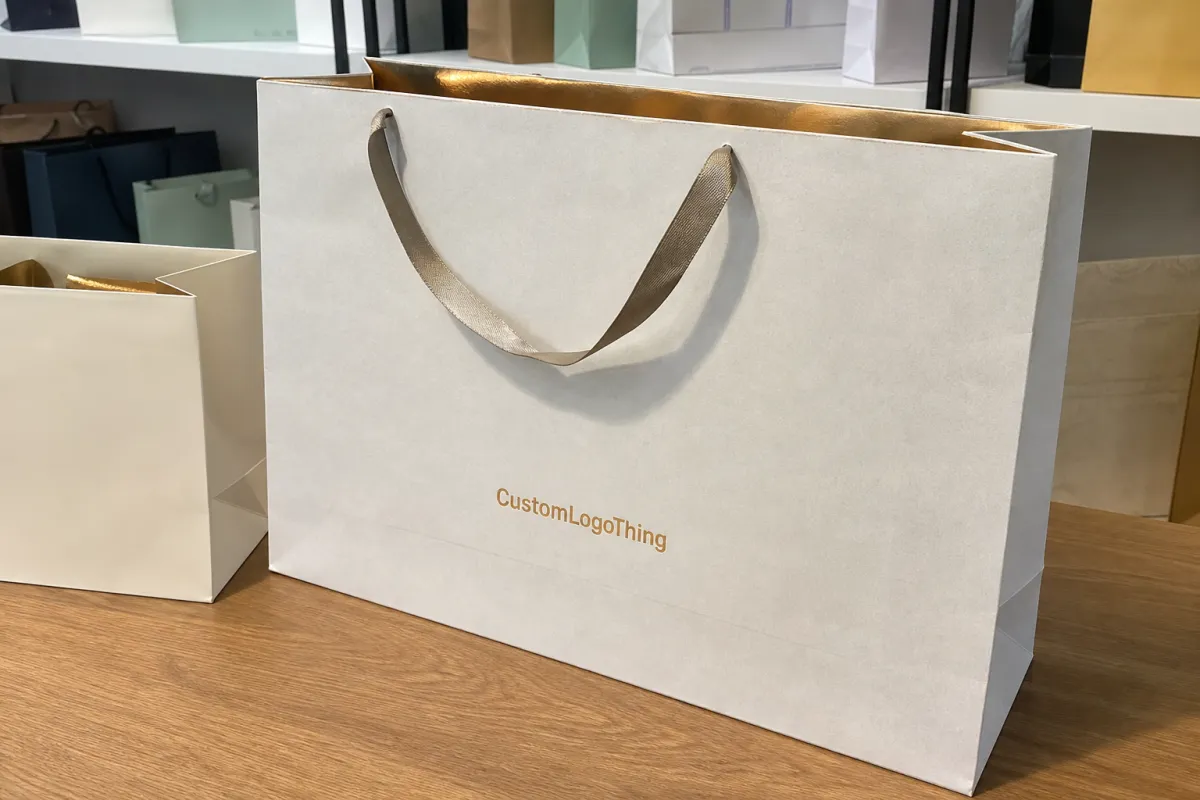
Bulk pricing works because setup costs do not rise at the same pace as quantity. Artwork preparation, die cutting, lamination, folding, gluing, and inspection each require labor before the first finished bag is packed. When the run is larger, those fixed steps are spread across more units, so the unit price usually falls.
That benefit depends on the build being stable. If the artwork is still changing, the handle style is not locked, or the dimensions are moving, the job absorbs more waste and more schedule risk. Buyers usually get cleaner pricing when the structure is finalized before quotes are compared.
Lamination is not only for appearance. It helps the printed surface resist abrasion, handling marks, and light moisture exposure during shipping or retail use. Gloss can make color feel brighter, while matte softens glare and fingerprints. The finish should match the use case, not just the mockup.
A bag has to survive handling as well as the proof. If it only looks right on screen, the spec is not complete.
For repeat packaging programs, the same build can be reordered across seasons with less disruption if the spec is documented carefully. That predictability is often worth more than a small one-time savings.
Paper stock, lamination, and handle choices that change performance
Paper stock sets the baseline for strength and print behavior. Kraft stock gives a practical, natural look and is often used for retail or gift packaging. Coated paper supports cleaner print, tighter detail, and deeper color. Rigid board adds structure when the bag needs to stand upright or carry heavier boxed contents.
Lamination changes both appearance and durability. Gloss film increases contrast and makes graphics pop. Matte film reduces glare and hides fingerprints better. Soft-touch creates a premium feel, but it can be more surface-sensitive and usually costs more. The right choice depends on how the bag will be used, stored, and handled.
| Build option | Best use | Performance note | Cost impact |
|---|---|---|---|
| Kraft + matte lamination | Natural brands, gift packaging, general retail | Balanced look with decent scuff resistance | Moderate |
| Coated paper + gloss lamination | Bright graphics, promotions, events | Stronger color pop and easier wipe-down | Moderate to higher |
| Premium board + soft-touch lamination | Luxury launches, presentation packaging | Excellent hand-feel, but more surface-sensitive | Higher |
| FSC-certified stock + standard matte | Brands with sourcing requirements | Supports documented fiber sourcing | Varies by paper grade |
Handle style also affects price and durability. Twisted paper handles are usually the most economical. Rope handles feel more substantial and are often chosen for premium retail bags. Ribbon handles work well for gifting or fashion packaging. Die-cut handles create a cleaner silhouette, but heavier loads often need reinforcement around the top fold.
That reinforcement is important when the bag carries dense or boxy items. Top patches, stronger mouth boards, or a better base insert can prevent handle failure more effectively than changing print or lamination alone. If the load is heavy, the structure should be designed around the weight first.
If sourcing requirements matter, ask about the stock, not just the finished bag. FSC certification applies to the fiber source and does not automatically cover every added component. Buyers responsible for compliance language should confirm exactly which materials are certified.
Size, print area, and finish details to finalize before quoting
Confirm the dimensions before requesting pricing: width, gusset, height, and handle drop. Those numbers affect material yield, cutting layout, carton fit, and how cleanly the bag can be packed flat. A small change in size can shift the die layout enough to affect both cost and lead time.
Print coverage matters just as much. A one-side logo is a very different production job from a full-bleed design with heavy solids. Laminated surfaces can make fold lines, glue zones, and registration issues more visible, so bleed and safe areas should be locked early. If artwork is still changing, that should be settled before production starts.
Finish details should also be fixed before quoting. Spot UV, foil, embossing, and similar effects can work well on paper bags, but they behave differently on matte and gloss films. Some treatments need tighter alignment than the artwork may allow. The more complete the spec, the less guesswork there is in the quote.
- Confirm dimensions: width, gusset, height, and handle drop.
- Define artwork: one-side, two-side, wraparound, or full coverage.
- Choose finish: gloss, matte, soft-touch, foil, or spot UV.
- Set color references: Pantone, CMYK target, and approved logo files.
- State packing needs: tissue, inserts, retail cartons, or shelf-ready pack-out.
It helps to send the dieline and final artwork together. That lets prepress review fold placement, glue zones, and bleed at the same time, which reduces rework and speeds up the quote to proof stage.
Pricing, MOQ, and quote drivers
Minimum Order Quantity depends on the full construction, not on one isolated feature. A simple bag with standard handles can usually start lower than a large presentation bag with heavy board, decorative finishes, and reinforcement. MOQ reflects setup and waste, but it also reflects how efficiently the line can run.
Pricing usually follows a few major variables: board weight, print color count, finish type, handle construction, reinforcement, and shipping pack-out. A straightforward laminated bag with moderate coverage and standard handles usually sits at the lower end of the market, while a premium presentation bag can move much higher. Indicative production-only unit pricing often falls in these bands: roughly $0.85-$2.10 for 1,000-2,000 pieces, $0.45-$1.25 for 3,000-5,000 pieces, and about $0.18-$0.95 for 10,000 or more.
The price spread is not just about quantity. A matte laminated kraft bag with a single-color print and twisted handles is far easier to produce than a soft-touch presentation bag with foil, rope handles, and reinforcement at the mouth. They may look similar from a distance, but the factory work is not the same.
Quotes also shift when freight, carton count, and proofing are not fully defined. A lower unit price can be misleading if it excludes carton labeling, special bundling, or the cost of shipping a large volume of empty bags. Buyers should ask whether the quote is ex-works, freight-inclusive, or something in between.
| Quantity tier | Typical build profile | Indicative unit cost | What usually changes |
|---|---|---|---|
| 1,000-2,000 | Short campaign, moderate print coverage | $0.85-$2.10 | Higher setup share, less efficient waste absorption |
| 3,000-5,000 | Retail launch or gift run | $0.45-$1.25 | Better spread on tooling, print, and finishing |
| 10,000+ | Program order or repeat distribution | $0.18-$0.95 | Lowest setup burden per bag, freight planning becomes more important |
A better way to compare quotes is to line them up by build spec, not just by total. If one supplier is quoting thinner board, a simpler handle, or less carton protection, the apparent savings may disappear once the bags are in use.
Process and lead time from proof to packed cartons
The usual workflow starts with a request for quote, then moves into artwork review, dieline confirmation, proof approval, production, finishing, inspection, and packing. Lead time only becomes meaningful after the files are approved. Until then, any schedule is still a forecast.
Prepress is often where the timeline is won or lost. Missing dielines, low-resolution logos, unclear bleed, or unapproved colors can stop the job before it reaches the press. That pause is cheaper than printing a defective run, but it is still avoidable if the files are complete at the start.
Sample approval can help when the structure or finish is new. A physical sample shows how the handle feels, how the lamination folds, and whether the bag stays square once assembled. It also reveals sheen shift, edge quality, and color behavior more clearly than a digital mockup. The tradeoff is time, since any change after approval usually pushes the schedule back.
Shipping should be planned alongside production. A job can finish on time and still arrive late if carton labeling, pallet staging, or freight booking is left too late. Receiving instructions matter, especially for large orders going to stores, warehouses, or event venues.
For long-distance freight, transport test guidance can help frame the conversation. The International Safe Transit Association publishes useful testing and handling references. Not every bag order needs formal testing, but the logic behind compression, vibration, and handling risk is worth considering.
Quality control, carton packing, and shipping prep for large runs
Large orders depend on repeatability. The checks that matter most are print registration, color consistency, lamination adhesion, fold accuracy, handle strength, and clean glue lines. A bag can look good in a sample and still fail in quantity if the line drifts or the packing is careless.
Carton packing is part of the product. If the bundle count is wrong or the cartons are packed too tightly, the bags can arrive with crushed corners, curled edges, or surface marks. If the cartons are too loose, the stacks move in transit and the lamination takes the damage. The goal is to protect the bag without deforming it.
Moisture control deserves attention too. Paper absorbs humidity, and lamination does not make the whole structure waterproof. For ocean freight, humid climates, or long warehouse dwell times, poly wrapping, corner protection, and pallet stability are worth discussing. Matte and soft-touch finishes also show scuffing more readily if cartons rub during transit.
Clear labels save time at receiving. Bundle counts, SKU numbers, carton markings, and pallet tags should match the purchase order. That sounds basic, but it is often the difference between a clean unload and an afternoon spent counting by hand.
- Inspect each run: registration, color, glue, and handle attachment.
- Check carton counts: keep bundle quantities consistent and labeled.
- Protect edges: use corner support or wrap where needed.
- Plan pallets: stack for stability, not just maximum fill.
- Match shipping terms: confirm the receiving site and delivery window early.
How to keep repeat bag orders consistent across runs
Repeat orders should be predictable. The bag should look the same, feel the same, and fold the same every time it is reordered. Consistency starts with documentation: approved artwork, exact dimensions, paper grade, lamination type, handle style, and packing notes all need to be stored together.
Material consistency matters as much as the artwork. If the same paper stock and lamination film are used again, the finished bag usually stays much closer to the original run. Natural variation still exists, but it stays manageable when the specification is controlled from the beginning.
Small changes should be treated as revisions, not casual edits. A new handle color, a slightly taller gusset, or a logo shift by a few millimeters can affect cutting and alignment. The safest path is a revised proof that shows exactly what changed.
For brands with standing packaging programs, the practical value is simple: store teams do not have to adapt to a different pack size, presentation stays uniform, and the second run is less likely to look like a different product family. Reordering is easier when the spec is settled and the files are current.
What to send next for a fast, accurate quote
The fastest quote comes from a complete spec. Send the width, gusset, height, handle drop, quantity tiers, paper preference, lamination finish, handle style, and print coverage. If any of those are still open, say so clearly so the quote can reflect the real options.
Artwork details should go with the spec. Vector files are best. Include brand color references, note whether the order is a first run or a reorder, and identify any artwork that crosses folds, seams, or gussets. If the job uses more than one print side, make that explicit.
Timing belongs in the first message too. A delivery date, destination ZIP or postal code, receiving hours, and any store-opening or event deadline help determine whether the order is feasible in the requested window. If a sample is needed, specify whether you want a material sample, a digital proof, or a production sample.
The practical version is simple: send the full spec, not the rough idea. A complete request makes it easier to compare builds, understand MOQ, and lock production without back-and-forth that burns the schedule.
FAQ
What MOQ should I expect for laminated paper bags bulk orders?
MOQ depends on the bag size, print complexity, lamination type, and handle style because each change affects setup and waste. Simpler builds can often start lower, while premium finishes usually need larger runs to stay economical. It helps to request pricing at two or three quantity tiers so the break point is visible before you commit.
How does lamination affect the unit cost of paper bag bulk orders?
Lamination adds a finishing step, but it can reduce scuffing, moisture marks, and visual damage during shipping and handling. Gloss and matte finishes usually price differently, and specialty effects raise the cost faster than standard film. Larger runs spread the setup cost across more bags, which is why the per-unit price tends to drop.
What artwork files do you need for a laminated paper bag bulk order?
Vector artwork is best, along with outlined fonts and clear brand color references. A confirmed dieline helps prevent placement issues, especially around folds, handles, and glued seams. Include bleed and safe-area expectations so prepress can review the file without delays.
What lead time is normal after proof approval for bulk laminated paper bags?
Lead time starts after artwork, dieline, and proof details are approved. Printing, lamination, cutting, gluing, and final inspection all affect the schedule, so the timeline varies by build. Shipping distance and carton requirements can add time, so confirm the destination early.
Can I reorder the same laminated paper bags without starting over?
Yes, if the structure and artwork stay the same and the tooling information is already on file. Reorders move faster when the previous size, stock, finish, and color references are documented clearly. If you need a change, ask for a revised proof so the update is handled as a controlled revision.

