Buyer Fit Snapshot
| Best fit | Laminated Retail Sleeves with Logo projects where brand print, material claims, artwork control, MOQ, and repeat-order consistency need to be specified before quoting. |
|---|---|
| Quote inputs | Share finished size, material target, print colors, finish, packing count, annual reorder estimate, ship-to region, and any compliance wording. |
| Proofing check | Approve dieline scale, logo placement, barcode or warning zones, color tolerance, closure strength, and carton packing before bulk production. |
| Main risk | Vague material claims, crowded artwork, missing packing details, or unclear freight terms can make a low unit price expensive after revisions. |
Fast answer: Laminated Retail Sleeves with Logo: Material, Print, Proofing, and Reorder Risk should be specified like a repeatable production item. The safest quote records material, print method, finish, artwork proof, packing count, and reorder notes in one written spec.
Production checks before approval
Compare the actual filled-product size with the drawing, then confirm tolerance on folds, seals, hang holes, label areas, and retail display edges. Reserve space for logos, QR codes, warning copy, and material claims before decorative graphics fill the panel.
Quote comparison points
Review material grade, print process, finish, sampling route, tooling charges, carton quantity, and freight assumptions side by side. A quote is only useful when the supplier can repeat the same color, closure quality, and packing count on the next order.
Laminated Retail Sleeves with Logo: A Practical Guide
A good retail package does not need to shout to earn attention. Sometimes a thin wrap, sized correctly and finished well, changes the read on shelf more than a complete carton redesign ever could. That is the practical advantage of laminated retail sleeves with logo: they sharpen brand presence, protect the printed surface from scuffs, and give a standard pack a more finished look without forcing the whole structure to change.
I have watched buyers, brand managers, and production teams get pulled in three directions at once: presentation, durability, and cost. The sleeve sits in the middle of that triangle. It can carry the logo, campaign copy, a barcode, regulatory text, and sometimes a QR code without asking for a new base pack. It can also survive the messy parts of retail life, which are never as neat as the mockup on a screen. One packaging supplier I spoke with described most damage complaints as "surface wear problems," not structural failures. That lines up with what I have seen on press checks too. The box stays intact; the face gets rubbed, dinged, or dulled.
For Custom Logo Packaging work, laminated retail sleeves with logo are best understood as a small-format packaging system, not decoration. The sleeve has to fit, print cleanly, fold correctly, and still look sharp after shipping, stocking, and a few hands touching it in store. That is a narrow target. It is also very doable when the spec is honest and the timeline has a little breathing room. The brands that get the best result usually plan for how the packaging behaves in the real world, not just how it looks under studio lights.
What Do Laminated Retail Sleeves with Logo Actually Do?
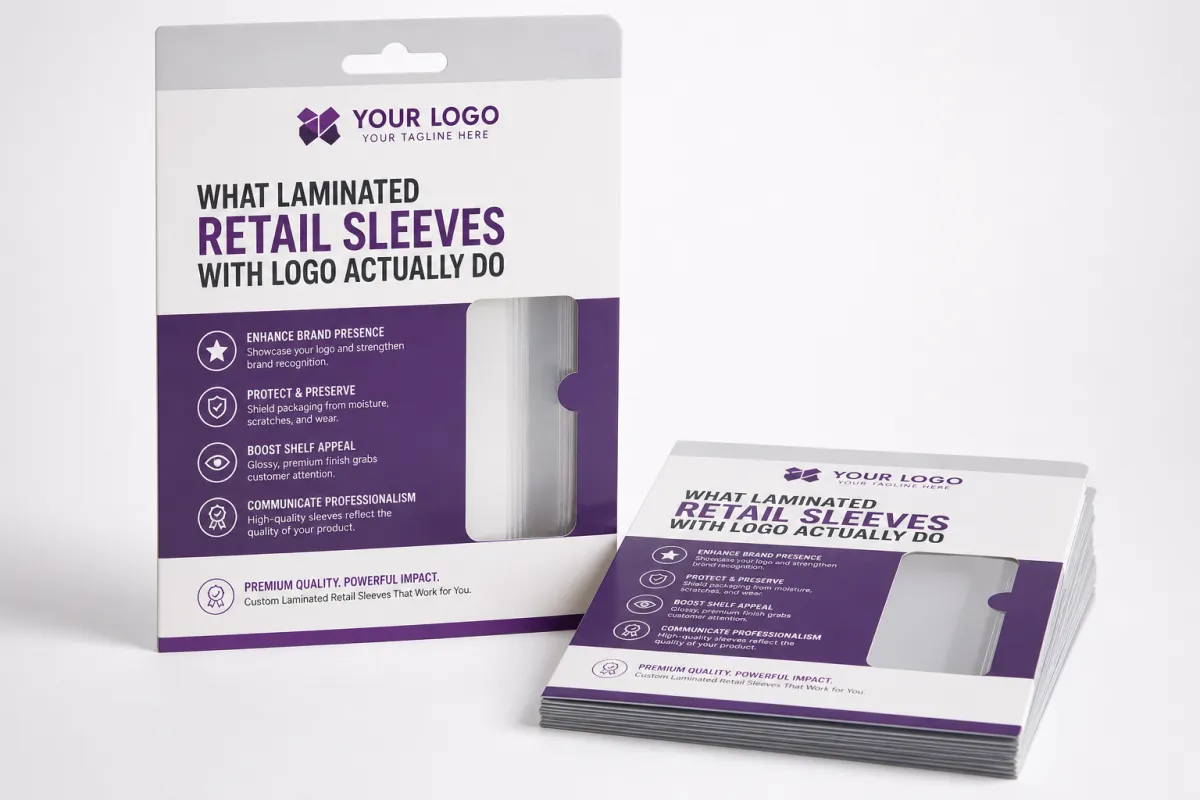
At the simplest level, laminated retail sleeves with logo are printed outer wraps that slide over, band around, or partially enclose a product carton, tray, or kit. Their job is to add branding and information without rebuilding the base package underneath. That makes them useful for multi-packs, seasonal promotions, gift sets, subscription boxes, and display kits where the outer look needs to change more often than the inner structure.
The shelf effect is immediate. A plain carton can do the job, sure, but a laminated sleeve adds contrast, texture, and control over reflection. Gloss laminate pushes color harder and makes a pack feel more energetic. Matte laminate lowers glare and usually feels calmer, sometimes almost editorial. Soft-touch sits in a different lane altogether; it brings a velvety handfeel that reads premium before the shopper even reads a word. Designers spend a lot of time debating finish because finish changes how fast a package is understood. A shopper glances, sorts, and moves on. The surface has already done a chunk of the work.
That finish matters because retail is rough on paperboard. Boxes are stacked, rubbed, palletized, restacked, and sometimes reopened by store staff who are just trying to get through the shift. laminated retail sleeves with logo add scuff resistance and a bit of moisture protection. They do not make a package waterproof, and I would never sell them that way, but they do help the printed layer survive the abuse that happens between the warehouse and the shelf. That difference is not small.
They also solve a very common marketing problem: how do you launch a new flavor, a limited edition, or a seasonal bundle without changing the whole pack? A sleeve handles that nicely. The base carton stays stable. The outer branding changes. For a lot of teams, that is the sweet spot between speed and presentation. It is usually cheaper than redesigning a full carton structure every time a campaign changes direction, and in categories with short launch windows, that matters more than people admit in meetings.
Practical rule: if the product needs stronger shelf presence, a cleaner retail finish, or a temporary campaign layer, laminated retail sleeves with logo often make more sense than a full custom carton rebuild.
They fit especially well in seasonal promotions, pharmacy or beauty multipacks, food and beverage sample sets, and retail programs that need fast visual impact. A brand can use laminated retail sleeves with logo to unify several SKUs, separate premium tiers, or make a standard pack look custom for a specific channel. They also work well for die-cut packaging sleeves that need to adapt to more than one product family.
One thing gets overlooked a lot: communication space. A carton often runs out of room once legal copy, ingredients, warnings, and distributor marks are added. The sleeve gives back surface area for messaging, QR codes, benefits, language variants, or a promotion code. That extra panel space can be the difference between a cluttered label and a clean presentation. On crowded shelves, that is not a minor detail. It is a buying decision waiting to happen.
They also help brands keep the base structure stable while rotating seasonal art, regional language, or channel-specific copy. That matters in categories with frequent SKU turnover, because the outer wrap can change while the underlying carton stays the same. In practice, laminated retail sleeves with logo let teams move faster without giving up consistency. Fast is nice. Predictable is better.
How Laminated Retail Sleeves with Logo Are Made
The production flow for laminated retail sleeves with logo usually starts with artwork setup and ends with folding, gluing, or flat packing for the next assembly stage. The route changes by format, but the quality risks show up in familiar places: poor dielines, weak file prep, color mismatch, and finishing choices approved too quickly because everybody is in a hurry.
First comes the dieline. That template defines trim size, folds, glue areas, and any window or opening details. If the sleeve wraps a box, the dieline has to account for board thickness and assembly tolerance. If it bands a product tray, it has to sit snugly without crushing the contents. A few millimeters can matter more than a buyer expects. I have seen a sleeve that was only slightly off create extra handwork at the packing table, and handwork is never cheap once the line starts moving. If the board is too thin, the sleeve is gonna feel flimsy. If it is too thick, the fold may fight back. Neither one is fun to fix after approval.
Then comes print production. Digital printing is often used for short runs, test launches, and variable artwork because it avoids long plate setup and handles revisions well. Offset printing still makes sense for larger orders where color consistency and crisp detail are priorities. After print, the finish is applied. Strictly speaking, lamination is usually a film layer, while coating is a separate process, but buyers often group them together because both affect surface protection and appearance. For laminated retail sleeves with logo, that protective layer is doing more than adding shine; it helps the print survive handling, packing, and shelf display.
Appearance usually falls into three common directions. Gloss laminate makes colors feel brighter and tends to boost visual punch. Matte laminate lowers glare and can improve readability under store lighting. Soft-touch laminate is a more tactile option, and it works best when the brand wants a restrained, premium feel. None of these is universally better. The right choice depends on how the sleeve needs to look after shipping and handling, not just on the proof image. A package viewed under studio lighting can tell a very different story once it reaches fluorescent aisles and a few fingerprints.
File prep is where many delays begin. Print-ready files should include bleed, safe zones, accurate dielines, and barcode placement that stays clear of folds and seams. Fine text needs enough contrast to survive the coating and the substrate. Logos should be supplied in vector format whenever possible. Color should be prepared using the printer’s preferred profile or conversion standard, not guessed from a screen. If you have ever watched a deep navy go muddy after a finish change, you already know this stage is not the place to improvise.
For brands that need help judging whether the packaging will survive distribution, testing standards matter. ISTA procedures are widely used to simulate drop, vibration, and compression stresses before the job goes live. You can read more at ISTA. If the sleeve or board is sourced with responsible forestry claims, FSC certification is another useful checkpoint. I would treat both as part of due diligence, not marketing gloss.
Approval checkpoints can move the schedule more than the press run itself. A digital proof is fast, but it only shows layout and rough color. A physical sample takes longer, yet it gives a much better sense of finish, fold behavior, and fit. If the project has tight branding rules, compliance copy, or a fixed retail launch date, the sample stage is usually worth it. That is especially true for laminated retail sleeves with logo, because the whole point is how the surface reads and feels in the hand.
One useful workflow is to approve structural fit first, then lock print, then confirm final finishing. It sounds plain, but teams skip that order all the time because everybody wants one clean sign-off. That is how a sleeve gets approved in theory and rejected in practice. With laminated retail sleeves with logo, a careful process usually beats a fast one. A few extra days in prepress can save weeks of correction later.
Laminated Retail Sleeves with Logo: Cost and Pricing Factors
Pricing for laminated retail sleeves with logo usually comes down to five things: quantity, material thickness, print coverage, finish choice, and whether the sleeve is flat, folded, or custom-shaped. That sounds basic, but the unit price can swing a lot once those variables start interacting. A simple sleeve in a large run behaves very differently from a decorated sleeve in a short seasonal batch. Die-cut packaging sleeves with unusual folds or windows tend to sit higher in the price range because they ask more from tooling and setup.
Small runs cost more per unit because setup work gets spread across fewer pieces. A job at 1,000 sleeves may carry a noticeably higher unit cost than the same design at 10,000 pieces, simply because press setup, finishing setup, and inspection time do not shrink with the order. Larger volume helps amortize fixed costs, which is why repeat campaigns and standard sizes often price much better. The economics are not mysterious; they are just less forgiving than buyers want them to be.
Material choice is the next major lever. A 14 pt C1S board will behave differently from an 18 pt stock, and a soft-touch laminate usually adds cost compared with a standard gloss film. If the sleeve needs special fold performance, extra score lines, or a heavier protective board, the price moves again. None of that is unusual. It is simply the real cost of making laminated retail sleeves with logo feel good and hold up in transit.
There are also costs people forget to ask about. Sampling can add a few dozen dollars or more, depending on the method. Custom dies and cutting forms may carry separate charges. Freight matters, especially if the order is headed to a distribution center several states away. Rush fees can show up if the launch date gets squeezed. Artwork corrections after proof approval can trigger reprints that erase any savings from the original quote. A price that looks cheap on paper can quietly become the most expensive option in the room.
| Option | Typical Use | Relative Cost | Durability / Shelf Impact |
|---|---|---|---|
| Gloss laminate | Promotions, high-color graphics, mass retail | Low to moderate | Bright appearance, good scuff resistance |
| Matte laminate | Premium packaging, restrained branding | Moderate | Low glare, good readability |
| Soft-touch laminate | Luxury or gift-oriented packs | Moderate to high | Distinct tactile feel, strong premium cue |
| Custom die-cut sleeve | Specialty shapes, display packs | Moderate to high | Better fit and branding control, more setup |
Comparing quotes only by unit price is where buyers get tripped up. A low-cost quote may exclude proofing, finishing, or freight. Another quote may include those items but use a heavier stock or a more stable production path. The better comparison is total landed cost: unit price, setup, sampling, shipping, and the cost of a reprint if the sleeve does not fit or the color lands badly.
There is also a hidden performance cost. If a cheaper sleeve scuffs in transit or looks flat on shelf, the brand may pay later in markdowns, returns, or weaker sell-through. That is hard to quantify, but it is real. For laminated retail sleeves with logo, durability and shelf presence should be treated as part of the price, not an add-on after the fact. A few cents saved up front can disappear fast if the package fails to hold attention at the Point of Sale.
Here is a useful planning range for buyers working at mid-size volumes: many simple sleeve programs fall somewhere around $0.18-$0.45 per unit at 5,000 pieces, depending on size, print coverage, and finish complexity. Short-run or heavily customized work can be higher. Those figures are not a promise, but they are a more realistic starting point than a vague "affordable" claim. The quote should also be read in context. A sleeve that protects a $40 product has a different value profile than one wrapping a low-margin impulse item.
If a supplier gives you a price in seconds, ask what it includes. Does it cover dieline adaptation? Is a physical proof included? What happens if the artwork changes after approval? Those questions help you compare laminated retail sleeves with logo on a real apples-to-apples basis. A clean quote is useful, but a complete quote is better.
Step-by-Step Timeline for Laminated Retail Sleeves with Logo
A reasonable timeline for laminated retail sleeves with logo starts with the brief and ends with delivery, but the steps often overlap. A buyer who understands the sequence is less likely to panic when a proof round or sample approval adds time. The key is knowing where the bottlenecks usually appear.
Step one is intake. The supplier needs finished dimensions, target quantity, artwork files, preferred finish, and delivery location. If any of those items are missing, the quote will be less accurate and the schedule will be fuzzy. This is also the moment to clarify whether the sleeve is for a carton, tray, multipack, or folded kit. In more than one project I have reviewed, that simple question revealed that everyone had been picturing a slightly different package.
Step two is artwork development. Some jobs move quickly because the brand already has a dieline and a usable design system. Others need layout adjustments, barcode placement, copy cleanup, and print checks. If the sleeve uses heavy ink coverage, metallic effects, or small reversed text, allow time for a proof review that does more than confirm the logo is present. A clean visual check is not enough when the production risk sits in the details.
Step three is proofing. A digital proof may come back in a day or two. A physical sample can take longer, but it reduces risk. For laminated retail sleeves with logo, the sample is useful because the laminate changes how graphics feel in hand and how they read under light. That is where a matte surface may prove too dull, or a gloss finish may turn out too reflective for the store environment. A sample can also reveal whether the board score is too tight or whether the sleeve slips more than expected.
Step four is production. Straightforward runs can move in roughly 7-12 business days after approval, while more complex jobs may need 12-20 business days or more. Specialty laminates, detailed die cuts, or very tight color matching extend the timeline. If the job requires assembly or kitting, that is another layer to plan for. A campaign that looks quick in a spreadsheet may still need a full manufacturing week once finishing is included.
Step five is finishing, packing, and shipping. Sleeves may ship flat, nested, or pre-glued depending on how they will be used. Flat-packed sleeves are easier to store and move, but they require assembly later. Pre-glued sleeves speed up packing lines yet can increase shipping volume. This is one of the places where laminated retail sleeves with logo become a logistics decision as much as a design decision. Warehouse space, line speed, and carton count all matter here.
A practical buffer plan is smart. For a launch or retail reset, most teams should build in at least one extra week beyond the quoted lead time. That margin absorbs proof revisions, freight delays, and last-minute copy changes. For seasonal or promotional work, the buffer should be larger because the date is not flexible and the retailer will not care why the cartons are late. The calendar rarely forgives packaging delays.
From a packaging buyer’s point of view, speed is only useful if it does not break fit or finish. I would rather approve laminated retail sleeves with logo a few days earlier than rush through a sample and spend the next week fixing a fit issue. Once the sleeve reaches the line, correction gets expensive very quickly.
Common Mistakes When Ordering Laminated Retail Sleeves with Logo
The most common mistake with laminated retail sleeves with logo is ordering to the wrong dimensions. Buyers sometimes measure the product carton itself and forget to account for folds, seams, insert depth, or the way the sleeve will sit once it is assembled. A three-millimeter error can be enough to create a loose fit or a damaged edge. That sounds tiny until you watch a production line reject a whole tray of sleeves.
Artwork mistakes are just as common. Low-resolution logos look soft after print. Thin text can vanish on coated stock. Dark colors may build up differently than expected once a laminate is added. If the design uses reversed type, small legal copy, or a barcode on a fold, the file needs a careful preflight check before approval. Production errors often begin as design shortcuts.
Skipping proof review is another expensive habit. A team that signs off too quickly can miss the exact issue that becomes a production headache later: a barcode too close to a seam, a product claim that does not fit the panel, or a Pantone expectation that the chosen print method cannot actually hit. With laminated retail sleeves with logo, proof discipline is not bureaucracy. It is risk control.
There is also a logistics mistake that buyers make when they focus only on the artwork. If the sleeves arrive flat, does the packing line have time and space to assemble them? If they arrive pre-glued, is the warehouse ready to store the finished units? If the sleeve is meant for kitting, has the sequence been tested? These questions sound operational, but they affect whether the packaging program works at all. The supply chain is part of the design, whether teams like that fact or not.
Finish choice can create problems too. A soft-touch laminate may look excellent under controlled light and still scuff faster than expected if the sleeves rub in transit. A high-gloss finish can look vivid and still show fingerprints or glare in a store with harsh overhead lighting. The point is not that one finish is bad. The point is that laminated retail sleeves with logo should be selected for the actual channel, not just for the mockup.
Finally, some teams underestimate the importance of storage. A sleeve that is easy to ship may still need dry, flat storage with enough room to avoid crushing corners or warping scores. Humidity and stacking pressure can affect board behavior. If the packaging will sit in a warehouse for weeks, that needs to be part of the order plan. The cheapest packaging spec can become the priciest one if it arrives deformed.
The fastest way to avoid these issues is to treat the supplier like a technical partner, not a print button. Share the product dimensions, the retail channel, the assembly method, and the distribution route. That context helps the vendor advise whether laminated retail sleeves with logo should be simpler, thicker, flatter, or more durable than the first draft suggests. It also saves a lot of awkward back-and-forth later.
Expert Tips for Better Retail Performance
Finish should match the category. Gloss suits high-energy promotions, food launches, and packs that need visible color pop. Matte suits skincare, apparel, and premium gift sets where restraint matters. Soft-touch works best when the unboxing moment is part of the value proposition. For laminated retail sleeves with logo, the finish is not a cosmetic extra; it is part of the message.
Design around the shopper’s first glance. In most retail environments, the brand needs to be readable from three to six feet away. That means the logo, product name, and one clear benefit should sit in the most visible zone of the sleeve. Long paragraphs of copy rarely help. A cleaner hierarchy usually sells better than a crowded layout, especially when laminated retail sleeves with logo are used on a shelf with competing graphics. Retail research keeps circling back to the same truth: most decisions happen in seconds, not minutes.
Think about the sleeve as a logistics tool. If the packaging will be kitted, bundled, palletized, or hand-applied, the format should support that work. A sleeve that saves design space but slows assembly can become a net loss. I have seen simple layout choices save minutes per case, and that matters when a fulfillment line is moving thousands of units. One minute per case sounds trivial. Multiply it by a large rollout and the number stops being trivial.
Standardizing a few sizes can cut waste. Brands that build three or four reusable sleeve formats often get more value than brands that invent a new shape for every promotion. A modular design system also helps creative teams move faster because the logo zone, copy block, and seasonal panel are already defined. That is one of the most practical ways to make laminated retail sleeves with logo more efficient over time. Consistency has a cost advantage that is easy to underestimate.
There is also a sustainability angle. If the sleeve is printed on FSC-certified board and sized to reduce offcuts, the environmental case improves. If a brand also wants to reduce shipping waste, flat-packed sleeves and right-sized cartons help. The EPA has useful guidance on packaging and containers at EPA packaging resources, and that mindset applies here too: use enough material to do the job, not far more than necessary.
One more buyer tip: create a small internal checklist for every reorder. Confirm finished size, finish type, ink colors, barcode location, and assembly method before you release the next batch. Reorders are where people get complacent. With laminated retail sleeves with logo, complacency tends to show up as a mismatch between the old approved spec and the new job ticket.
Honestly, the best sleeve programs are the boring ones behind the scenes. They are not flashy in the production room. They are simply consistent, well-measured, and easy to assemble. That is why they keep working when the campaign gets bigger or the launch window gets tighter. A package does not need drama. It needs to arrive, fit, and hold up.
Next Steps Before You Request a Quote
Before you ask for pricing on laminated retail sleeves with logo, gather the basics: finished dimensions, quantity, artwork files, target finish, deadline, and delivery location. If possible, include a photo of the product or carton the sleeve will cover. That one image often prevents a round of clarification emails and makes the quote much more accurate. In packaging work, context saves time almost every time.
Ask vendors a few direct questions. What exactly is included in the price? Does the quote cover proofing, die setup, finishing, and freight? What happens if the artwork needs revision after approval? Which proof method do they use, and how much time does it add? Those questions matter because laminated retail sleeves with logo are easy to price badly if the scope is vague. A polished quote can still hide gaps if the buyer does not ask where the edges are.
Compare suppliers on more than one column. Lead time, color control, finish quality, assembly support, and shipping terms should sit next to unit price. A slightly higher quote can still be the better deal if it reduces rework, protects the print surface, and arrives on time. The cheapest number is not always the lowest risk. A brand that values launch certainty usually ends up valuing those hidden costs more than the headline number.
Then review your current packaging stack with a practical eye. Which products need more shelf presence? Which kits get handled too often? Which launches need a temporary brand layer without changing the main carton? Those are the situations where laminated retail sleeves with logo usually make the most sense. Once you spot them, the next brief writes itself.
If the goal is cleaner retail impact, better scuff resistance, and a more controlled presentation without redesigning everything underneath, laminated retail sleeves with logo are a strong place to start. Give the supplier clear specs, allow time for proofing, and judge the quote by total value rather than unit price alone. The best next move is simple: lock the dimensions, choose the finish for the real retail environment, and approve a physical sample before the full run goes to press.
Frequently Asked Questions
What are laminated retail sleeves with logo used for?
They add branded protection and a more polished presentation to retail packs, multipacks, kits, and promotional packaging. They are especially useful when you want fast shelf impact without redesigning the entire package structure.
How much do laminated retail sleeves with logo cost?
Pricing usually depends on quantity, size, laminate finish, print coverage, and whether custom cutting or folding is needed. Per-unit cost drops as volume rises, but total cost should also include setup, proofing, freight, and any rush charges. As a planning range, many mid-size jobs land somewhere around $0.18-$0.45 per unit at 5,000 pieces, though complex work can sit above that.
How long does it take to produce laminated retail sleeves with logo?
Timing depends on proofing rounds, print method, finishing steps, and shipping distance. Simple jobs move faster; custom sizes, specialty finishes, or sample approvals add extra days or weeks. A straightforward run may take about 7-12 business days after approval, while more complex projects can stretch to 12-20 business days or more.
What files should I send for laminated retail sleeves with logo?
Vector logo files, editable dielines, and print-ready artwork with correct bleed and safe zones are the best starting point. Include barcode placement, legal copy, and any color references so production can avoid last-minute corrections.
Are laminated retail sleeves with logo better than labels or inserts?
They are stronger when you want premium presentation, scuff resistance, and a larger branding surface than a simple label can provide. Labels or inserts may be better for ultra-low-cost or very simple applications, but sleeves usually offer more visual control and a more finished retail read.


