Buyer Fit Snapshot
| Best fit | Logo Packaging Bulk Order projects where brand print, material claims, artwork control, MOQ, and repeat-order consistency need to be specified before quoting. |
|---|---|
| Quote inputs | Share finished size, material target, print colors, finish, packing count, annual reorder estimate, ship-to region, and any compliance wording. |
| Proofing check | Approve dieline scale, logo placement, barcode or warning zones, color tolerance, closure strength, and carton packing before bulk production. |
| Main risk | Vague material claims, crowded artwork, missing packing details, or unclear freight terms can make a low unit price expensive after revisions. |
Fast answer: Logo Packaging Bulk Order: Pricing, Specs, and Timing should be specified like a repeatable production item. The safest quote records material, print method, finish, artwork proof, packing count, and reorder notes in one written spec.
Production checks before approval
Compare the actual filled-product size with the drawing, then confirm tolerance on folds, seals, hang holes, label areas, and retail display edges. Reserve space for logos, QR codes, warning copy, and material claims before decorative graphics fill the panel.
Quote comparison points
Review material grade, print process, finish, sampling route, tooling charges, carton quantity, and freight assumptions side by side. A quote is only useful when the supplier can repeat the same color, closure quality, and packing count on the next order.
Logo packaging bulk order pricing looks tidy right up until a factory sheet from Shenzhen starts adding freight, tooling, and one more proof than anybody planned for. I remember one buyer who thought they had shaved $0.04 off a unit cost on paperboard, then paid $1,260 more after a late carton change triggered a second die proof, a revised master carton, and a rebooking fee from Ningbo to Long Beach. The lesson was ugly but useful: a logo packaging bulk order saves money only when the size is locked, the board is specified, and the timeline is realistic. Otherwise you are buying delay in a bigger stack.
I have spent enough time in Shenzhen, Dongguan, and Foshan to see the same pattern repeat with annoying precision. The cheapest Price Per Unit is usually not the smallest run; it is the run where setup costs are spread over 3,000, 5,000, or 10,000 pieces instead of 500. One client split a 12,000-piece order into three emergency batches because they wanted to stay flexible. The result was three proof rounds, two air shipments, and a final invoice that landed about $1,870 above the original bulk quote. Flexibility can be useful. In packaging procurement, it can also be a very expensive habit.
If you are planning a logo packaging bulk order for retail packaging, e-commerce shipping, gift sets, or wholesale distribution, the winning formula is practical: Choose the Right structure, lock the exact specifications, and compare quotes line by line. That sounds plain because it is plain. A 350gsm C1S artboard folding carton with matte lamination and one-color black logo is a very different purchase than a rigid set-up box with a foam insert and gold foil. The difference is not cosmetic; it is measurable in dollars, days, and claims from the warehouse.
Logo Packaging Bulk Order: What You Actually Save
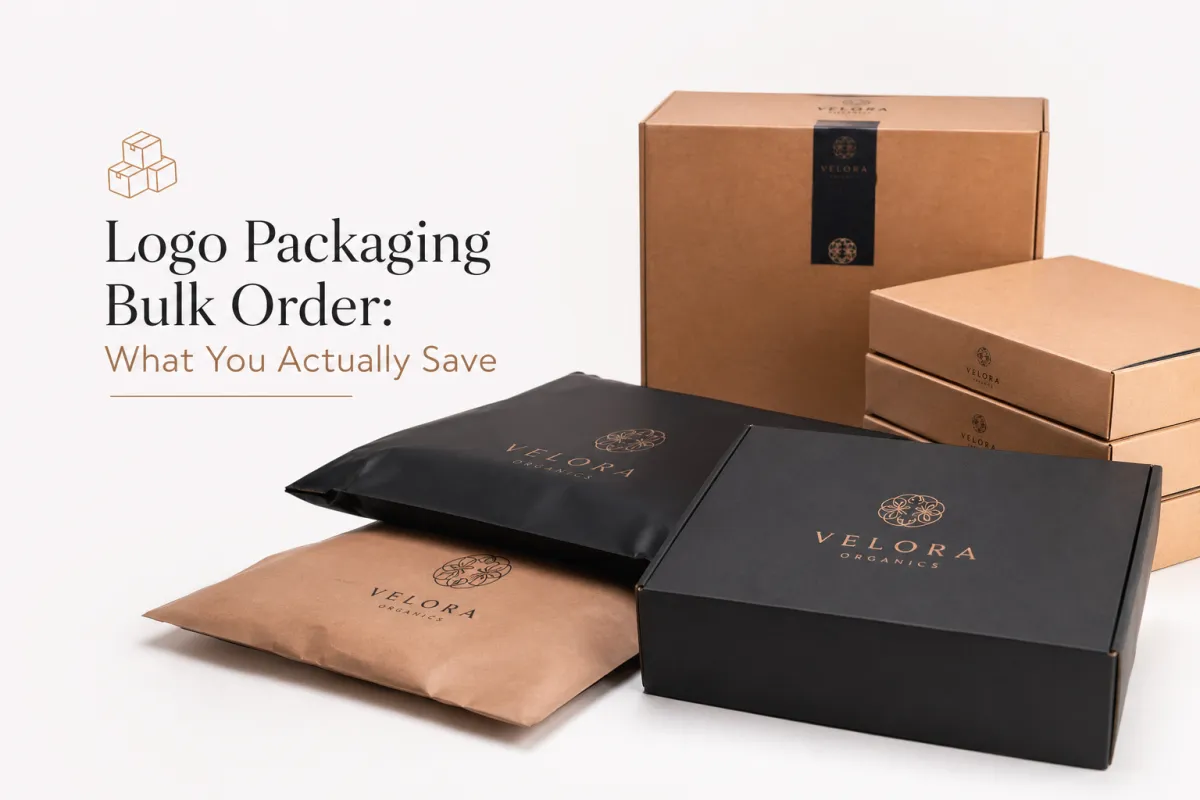
The savings in a logo packaging bulk order come from fixed costs being diluted across volume, not from magic or vendor generosity. A printer still needs plates, press setup, die-cut registration, color checks, and a first-article approval before the run turns into saleable boxes. Whether you order 500 units or 5,000 units, those steps still happen. The difference is that on 5,000 units, a $480 setup charge becomes $0.096 per box, while on 500 units it becomes $0.96 per box. That arithmetic is dull, but dull is where the money hides.
Freight behaves the same way. A palletized shipment from Shenzhen to Los Angeles or Rotterdam is usually cheaper per unit than five smaller partial shipments, especially when cartons are nested efficiently and master cases are sized correctly. I once watched a supplier cut 11% off the landed cost simply by moving from four retail cartons per master case to three and reducing dead space in each outer shipper by 18 mm. Same logo. Same print method. Different geometry. Packaging has an uncanny talent for turning a few millimeters into real money.
A logo packaging bulk order also reduces the chance of reprints. If your dieline is stable and the product dimensions are locked at, say, 82 mm x 54 mm x 21 mm, you are less likely to discover a last-minute fit failure after 2,000 boxes are already packed. One millimeter may sound trivial in a meeting. On a production line in Dongguan, one millimeter can mean cracked lids, crooked closures, or a pallet of cartons that no longer stack to the promised 1,200 mm shipping height.
One plant manager in Guangzhou told me something I still repeat to clients: "The press still wakes up for a 600-piece run." He was talking about the same operator time, prepress checks, and inspection work whether the job is 600 boxes or 6,000 boxes. That is exactly why a logo packaging bulk order becomes easier to justify once you compare setup costs against unit price. I have won more budget approvals with that sentence than with any glossy sales deck, which says something uncomfortable about how procurement really works.
Set expectations early with quantity, dimensions, artwork readiness, finish, and delivery date. If those five details are fuzzy, every quote will wobble. Suppliers in Guangdong, Zhejiang, and Jiangsu will pad for uncertainty because they have to; a missing insert spec or an unclear closure style changes material usage and labor. That is not a penalty. It is risk pricing. The real penalty is usually paid by the buyer who sent a two-line brief and expected a precise answer.
"We thought the lowest quote was the win until we compared landed cost. The bulk order saved us about $1,100 after freight, sample revisions, and one avoided reprint." - A subscription box client in Los Angeles
Choosing the Right Packaging for a Logo Packaging Bulk Order
A logo packaging bulk order is not one product. It is a set of decisions about structure, durability, shelf impact, and how much abuse the box will take between the factory in Dongguan and the customer in Chicago. A box that sits on a retail shelf for 90 days has a different job than a mailer that needs to pass a 3-foot drop test. A luxury gift set in a rigid box has different economics than a 2,000-unit weekly e-commerce subscription pack. Those differences are not minor. They decide the board grade, the glue pattern, the finish, and the freight plan.
These are the formats I see requested most often, along with the jobs they actually solve:
- Folding cartons for cosmetics, supplements, candles, and small electronics.
- Rigid boxes for jewelry, premium gifts, and launch kits with higher perceived value.
- Mailers for subscriptions, influencer kits, and direct-to-consumer shipments.
- Shipping boxes for wholesale distribution and warehouse-to-warehouse movement.
- Tissue paper, stickers, inserts, and branded tape for protection, finishing, and repeat logo placement.
The right choice depends on function, not vanity. For a candle brand shipping 1,000 units a month from California, a corrugated mailer with a one-color exterior might be the cleanest solution. For a skincare brand running retail in Austin and online in Toronto, a 350gsm C1S artboard carton with soft-touch lamination and spot UV on the logo may make more sense. Same logo. Different duty cycle. Different cost structure. Same purchase order, very different outcome.
Logo placement matters too. On a Custom Printed Box, the front panel is obvious, but I have seen more memorable branding come from the inside flap, a side panel, or a two-color wrap that only reveals itself after opening. That approach is especially useful for premium packaging, where the outside needs to stay restrained and the inside can carry the surprise. I like that kind of restraint because it shows discipline; a box that shouts too loudly usually has less substance behind the noise.
When buyers ask me how to choose, I give them a simple filter: does the package need to survive transit, survive retail handling, or simply look polished on a counter? Those are three different engineering problems. A mailer that protects a 2.4 lb product during UPS handling in Memphis needs different board strength than a shelf carton for a 120 g candle. If you overbuild the first one, you pay for air. If you underbuild the second one, you pay for damage claims and replacements. I have seen both mistakes happen in the same week, which is kind of a packaging rite of passage.
| Packaging Type | Typical MOQ | Common Price Range | Best Use | Main Cost Driver |
|---|---|---|---|---|
| Folding Carton | 1,000-5,000 | $0.15-$0.62/unit | Retail shelf products | Board grade, print complexity, and finish |
| Rigid Box | 500-3,000 | $1.10-$4.80/unit | Gift sets and premium packaging | Wrap material, inserts, and manual assembly |
| Mailer Box | 500-10,000 | $0.32-$1.25/unit | E-commerce and subscription boxes | Corrugated grade and print area |
| Shipping Box | 300-5,000 | $0.26-$2.10/unit | Wholesale distribution | Board strength and box size |
| Labels, Stickers, Tissue, Tape | 1,000-20,000 | $0.01-$0.22/unit | Package branding and finishing | Material, adhesive, and color count |
If you need a fast starting point, review our Custom Packaging Products and match the format to product weight, retail placement, and shipping method. For recurring procurement, our Wholesale Programs usually reduce one-off chaos and make the second and third quote much easier to compare. I have seen teams burn an afternoon reconciling three nearly identical quotes that differed only by board thickness and freight terms, and frankly, that is a deeply avoidable way to spend a Tuesday.
The most common packaging mistake I see is simple: the buyer chooses a box shape before they know the shipping requirement. That order is backwards. Start with product weight, pack-out method, and freight profile, then choose the structure. If the product ships from Shenzhen to New York, that matters. If it is sold across a retail network in Texas, that matters too. Your future self will be grateful when the first pallet leaves the dock without a surprise crack or a repack fee.
Specifications That Matter in a Bulk Logo Packaging Order
Specs are where a logo packaging bulk order stops being an idea and becomes a production file. If you are vague about dimensions, material, finish, or print method, the sample may look acceptable while the full run fails on line speed or fit. I have watched that happen when someone approved a "close enough" mockup instead of a production dieline. The phrase "basically the same size" is how you end up with an expensive rework and a very quiet conference call.
The must-have specs are simple, but they need exact numbers:
- Dimensions for length, width, and depth, including any insert allowance in millimeters.
- Material type such as 300gsm, 350gsm C1S artboard, E-flute, B-flute, or SBS board.
- Print method such as offset, digital, flexo, or screen printing.
- Color count including Pantone references if the brand color has to match across 10,000 units.
- Finish such as matte lamination, gloss varnish, foil stamping, embossing, or spot UV.
- Cut style and closure style, especially for tuck tops, auto-lock bottoms, or magnetic rigid boxes.
- Insert requirements for paperboard, molded pulp, EVA, or foam.
Tolerances matter more than most people expect. In a logo packaging bulk order, a 2 mm error can create stacking problems in a warehouse in New Jersey or a sloppy fit on a retail shelf in Berlin. I once saw a sleeve design that looked elegant on screen and failed in production because the closure overlap was too narrow for the selected board. The issue was not dramatic; it was worse than that. It was preventable. A tighter spec would have saved two days, one reproof, and several very tired people.
Artwork prep is just as important as the board choice. The factory needs vector files, outlined fonts, bleed, and a safe area. AI, EPS, or a print-ready PDF is best. If you send a 72 dpi JPG and hope the printer can "fix it," the edges will show it. Color references should be listed in Pantone or CMYK, and if the logo color is non-negotiable, approve a physical proof from the plant in Guangdong. Screens lie. Paper does not. I have learned that in Shenzhen, Dongguan, and on one very unforgiving proof table in Chicago.
For structural packaging and transit-sensitive product packaging, I prefer standards over guesswork. ISTA procedures help define realistic drop and vibration testing, while ASTM methods are useful when board strength or print durability matters. If your packaging program is tied to responsible sourcing, the FSC chain-of-custody system is worth asking about. Those references are not decorative. They reduce expensive arguments after the shipment lands, which is usually when everyone would prefer not to be arguing at all.
Here is the quality checklist I use before production starts on a logo packaging bulk order:
- Approve a sample or prototype using the actual board grade.
- Confirm the print file, dieline, and bleed are locked before plate making.
- Check color against the brand standard, not a monitor image.
- Verify fold lines, glue zones, and insert fit with a real product sample.
- Run a carton drop test or transit test if the package ships more than 1,000 miles.
- Sign off on the final carton count and overage allowance, usually 2%-3%.
When I visited a box line in Dongguan last spring, the operator showed me how a one-color job could run clean for hours while a four-color job needed more frequent cleaning, alignment checks, and ink adjustment. That is why print complexity affects price so directly. A logo packaging bulk order with one PMS logo and no interior print is not just easier to buy; it is easier to hold consistent across the run, and consistency is what keeps the press crew from muttering at 6:40 p.m.
The short version: the more precise the spec, the less the supplier has to guess. Guesswork is expensive. Precision is boring. Boring saves money. I will take boring every time if it keeps the carton count accurate and the reprint invoice away from my inbox.
Pricing and MOQ for a Logo Packaging Bulk Order
Pricing for a logo packaging bulk order is built from five levers: quantity, material grade, print complexity, finish, and shipping destination. I would add a sixth lever that most quotes quietly depend on: how ready your files are. A clean dieline and final artwork can save two to four days in prepress. A messy file can cost as much as a minor tooling revision, which is one of those inconvenient truths no one wants to hear until the calendar starts slipping.
MOQ, or minimum order quantity, is not a punishment from the supplier. It exists because setup costs do not vanish just because a buyer wants a smaller run. A 500-piece custom printed box order can carry a much higher per-unit price than a 5,000-piece run because the plates, die, proofing, and labor are spread over fewer units. That is why a logo packaging bulk order often makes more sense than three small orders across a quarter. Split orders feel safer. They usually cost more and create more places for errors to hide.
Here is a practical way to think about price bands. These are examples, not promises, because board prices in Zhejiang and freight rates from Shenzhen to the U.S. West Coast move every month:
- 500 units of a rigid box can land around $1.75-$4.80 per unit depending on magnets, inserts, and hand assembly.
- 1,000 units of a folding carton may land around $0.24-$0.68 per unit with one-color print and standard matte finish.
- 5,000 units of a mailer box might fall to $0.15-$0.42 per unit if the board is standard and the logo uses one or two colors.
- 10,000 units of labels or stickers can often drop under $0.05 each when the art is ready and the size is standard.
That is why low MOQs can be misleading. The number looks friendly, but the unit price tells the truth. I have seen a buyer celebrate a 700-piece quote at $1.38 per unit, then discover a 3,000-piece quote at $0.58 per unit with the same finish and a better freight rate from Ningbo. The larger logo packaging bulk order looked bigger on paper, but the total spend was lower and the margin improved immediately. Finance tends to like that version more than the one with the charmingly small MOQ.
There are also hidden costs that can alter a quote quickly. If a supplier does not list these clearly, ask for them in writing:
- Dieline creation or structural design fee
- Plate charges for offset or flexo printing
- Mockup or sample cost
- Sample shipping from Guangdong or Zhejiang
- Import fees or duties
- Rush freight versus standard sea or ground shipping
Compare quotes apples to apples. That means the same quantity, the same dimensions, the same board, the same finish, the same print count, and the same delivery terms. If one supplier quotes FOB Shenzhen and another quotes DDP Chicago, you are not comparing the same purchase. I still see this mistake in packaging procurement meetings, and it can waste an afternoon. A cheap unit price with expensive freight is not cheap. It is just dressed up to look that way, like a discount tag that waits until checkout to admit there is a shipping charge.
There is also a practical cutoff point where a logo packaging bulk order starts to pay off more clearly. For many folding carton jobs, that happens around 1,000 to 3,000 pieces. For rigid boxes, the payoff may arrive later because hand labor is higher and assembly is slower. For mailers, savings can begin earlier if the artwork is simple and the board is standard. There is no single magic number. I trust the math more than folklore, and the math usually has a quieter voice.
If you want a fast quote that is actually useful, give your supplier three things: quantity, exact size, and target delivery date. Those three inputs reveal most of the price structure immediately. Everything else sharpens the final number. I have seen quotes become much less mysterious the moment those three items arrive in the email, which is a useful reminder that clarity is often the cheapest line item on the page.
How Do You Compare a Logo Packaging Bulk Order Quote?
Start with landed cost, not the headline unit price. A fair comparison for a logo packaging bulk order uses the same quantity, board grade, print count, finish, insert spec, and shipping term. If one supplier quotes FOB Shenzhen and another quotes DDP Chicago, normalize freight, duties, and sample charges before you decide which number is better.
The fastest way to sort a quote is to check these five items:
- Quantity and whether the supplier included overage or a true net count
- Material and whether the board grade matches across quotes
- Finish and whether lamination, foil, embossing, or UV is included
- Prepress costs such as dieline, plates, samples, and proofing
- Freight terms and whether the shipment is quoted as pickup, port-to-port, or delivered
If one quote is dramatically lower, something is usually missing. I have seen a supplier leave out inserts, quote a thinner board, or assume a longer production window to make the pricing look sharp. None of those tricks help a logo packaging bulk order land on time. They only delay the surprise until production is already moving, which is the worst possible moment to discover the missing line item.
A good quote should also tell you what happens if the order changes. Ask about revision fees, reproof charges, and split shipment costs. Those details matter when artwork is still moving or when the buyer wants to stage deliveries by warehouse. A crisp quote makes it easier to approve the job and easier to hold everyone accountable later. That is the kind of clarity that keeps procurement meetings short, which is rare enough to deserve appreciation.
Process and Timeline for a Bulk Logo Packaging Order
A logo packaging bulk order follows a predictable path if the buyer stops changing the target every 48 hours. The cleanest projects move from inquiry to delivery through nine stages: quote request, spec review, dieline confirmation, artwork prep, proof approval, sampling, production, inspection, packing, and shipping. Every delay I have seen comes from one of three places: unclear dimensions, late artwork, or repeated proof changes. The fourth cause is someone disappearing for a week and returning with "just one tiny tweak," which in packaging usually means another hour of layout work and another round of sighing.
Typical timing looks like this:
- Quote review: 1-2 business days if the brief includes size, quantity, and finish.
- Dieline and spec confirmation: 1-3 business days.
- Artwork prep and prepress: 2-5 business days, longer if logos need cleanup.
- Sampling or prototype: 3-7 business days for simpler builds, longer for rigid boxes with inserts.
- Production: 7-20 business days depending on quantity and finish.
- Inspection and packing: 1-3 business days.
- Shipping: 3-7 days by air, 18-35 days by sea, depending on destination and port congestion.
Could a logo packaging bulk order move faster? Yes, sometimes. But only certain parts can be rushed. You can expedite courier shipping. You can often speed up proof approval if the brand team responds the same day. You cannot skip plate making, curing time, or the die-cutting queue without paying more and risking quality. I have seen buyers ask for a five-day turnaround on a job that needed offset print, foil stamping, embossing, and a glued insert. That is not a schedule. That is a wish with a stopwatch attached.
One client in the health and wellness space wanted a launch window that left almost no room for error and sent three rounds of artwork changes in 48 hours. We still hit the ship date, but only because we locked the board spec on day one and refused to change the structure after sampling in Guangdong. That saved the order. The lesson was simple: a logo packaging bulk order moves quickly when the buyer stops redesigning it midstream. The factory can work at speed; it cannot work at speed and chaos at the same time.
The bottleneck checklist is worth repeating because it protects both time and budget:
- Measure the product before you ask for a quote.
- Confirm whether the package is retail-facing or transit-only.
- Send final artwork, not a draft with "placeholder" labels.
- Approve the sample before the production run starts.
- Keep one person responsible for sign-off so feedback does not loop endlessly.
Factories are not slow by default. They are slow when the inputs are sloppy. That is the blunt truth. A lot of complaints about lead time are really complaints about indecision, and I say that with affection because I have watched both sides of the table, often on the same project. The difference between a 12-day run and a 22-day run is usually a late file, not a mysterious factory mood.
If your project includes mixed SKUs or repeat seasonal orders, ask for a production calendar and pin it to the campaign dates. A logo packaging bulk order that looks cheap on a quote sheet can turn expensive if it misses a launch by ten days. Missing a launch date hurts more than paying $0.03 extra per unit. Sales teams tend to remember that part very clearly, usually while standing near a stack of unsold inventory.
Why Buy Your Logo Packaging Bulk Order From Us
We keep this process practical at Custom Logo Things. No smoke. No fake urgency. Just a logo packaging bulk order quote built on consistent specs, direct factory communication, and enough production discipline to avoid surprises when volume scales from 500 units to 5,000. I know that sounds like a low bar, but anyone who has chased a "quick" packaging job through three departments knows how valuable a low bar can be when the calendar is already crowded.
I have stood in enough factories to know where cost is won or lost. I have watched an operator waste half a shift because a spec sheet omitted insert depth by 4 mm. I have also seen a supplier save a client about $900 by switching from a complicated four-color exterior to a one-color logo with an embossed mark. That is the kind of decision that matters: material grade, press complexity, and whether the box is trying too hard. Sometimes the humble one-color carton in 350gsm C1S artboard wins because it looks better and costs less, which is almost offensively efficient.
When we negotiate with material and finishing suppliers, we look for three things: stable board supply, predictable color, and repeatable lead times. If a paper mill in Zhejiang cannot hold caliper within tolerance, I do not care how polished the sales pitch sounds. If a foil line in Dongguan cannot keep registration tight across 4,000 units, the risk climbs fast. A logo packaging bulk order only works if the line can repeat the same result on piece 1 and piece 5,001. Otherwise the math starts to wobble and the whole margin story gets a little theatrical.
That is why buyers come to us for branded packaging that is meant to work in the real world, not just look good in a rendering. We help with packaging design, material selection, and production planning so the first sample lines up with the final cartons. If your team wants a quick starting point, our Custom Packaging Products page shows the main formats we produce, and our FAQ answers the file and sampling questions before the quote stage becomes messy. I would rather clear up the boring stuff on day one than have everyone discover the problem after the cartons are already on a truck to a fulfillment center in Ohio.
What buyers usually care about is not mysterious. They want responsive quoting, clear updates, and boxes that arrive ready to use instead of ready to fix. That means they need:
- Clear communication about material, finish, and timeline
- Fair pricing based on real quantity, not vague estimates
- Quality checks before shipment
- Reliable logistics with honest transit dates
- Packaging consistency across reorders
One more thing: I do not pretend every job deserves the largest possible volume. Sometimes a smaller run is smarter, especially if the artwork may change or the launch is untested. I would rather tell you that upfront than force a giant logo packaging bulk order that your team will regret three months later. Trust is built in that moment. Not by overselling, and not by pretending every brand has frozen artwork on day one. I have seen too many "perfect" plans collapse because nobody wanted to admit the launch still had moving parts.
For buyers who want to align packaging with sustainability goals, we can also discuss board sources, recyclable finishes, and lower-waste ship formats. The point is not to slap an eco label on a box and call it finished. The point is to choose a package that matches the brand, the product, and the operation. If that means a lighter board with a better insert, fine. If that means fewer coatings and cleaner recycling, even better. A 350gsm C1S carton with a paper-based insert can do more for a program than a heavy, overbuilt box wrapped in unnecessary plastic.
Next Steps for a Logo Packaging Bulk Order Quote
If you want a quote that is accurate on the first pass, gather the basics before you send the request. A logo packaging bulk order quote gets sharper when you include quantity, product dimensions, material preference, print count, finish preference, and delivery location. If you have a target launch date, include that too. A supplier can work around a deadline if they know it early. Surprises are what create overtime, and overtime is where budgets go to make bad choices.
Here is the brief I wish every buyer would send:
- Order quantity for each SKU, including any overage target of 2%-3%.
- Exact product size and package outer size in millimeters.
- Artwork files in AI, EPS, or print-ready PDF.
- Preferred material and finish, such as 350gsm C1S artboard with matte lamination.
- Any insert, divider, or foam requirement.
- Shipping address and delivery target, whether it is Los Angeles, Chicago, or Rotterdam.
If the fit is tight or the shipment is international, ask for a sample or prototype before approving the full run. A cheap mistake is still a mistake. I learned that on a client project where a beautifully printed carton failed a fit test because the bottle shoulder was 3 mm taller than the drawing. The entire run would have been wrong. The sample saved the order. That is why I push testing on every serious logo packaging bulk order. A few extra days in sampling can save a warehouse full of regret and a freight bill that nobody wants to explain.
Compare at least two or three quotes with identical specs. If one number is much lower, check what was removed. Did they leave out the finish? Did they quote a different board? Did they forget freight? Did they quietly assume a longer lead time? Price comparisons only work when the inputs match. Otherwise you are comparing a real quote to a magician's trick, and the trick usually ends with someone paying for shipping twice.
For brands scaling into repeat procurement, ask about ongoing supply options so packaging design, pricing, and delivery rhythm stay stable. A smarter buying process is not glamorous, but it protects margin. And margin is what pays for the next launch, the next campaign, and the next inventory buy. That is the unromantic part of packaging, and I actually respect it because it tells the truth with a spreadsheet instead of a slogan.
Send the full brief for your logo packaging bulk order and we will return a clear quote, realistic timeline, and sample plan. Simple. Clean. No surprises. If the project is headed to production in Guangdong or Jiangsu, we will tell you the lead time; if it needs sea freight to the U.S. East Coast, we will say that too, usually in days instead of marketing adjectives.
What is the minimum MOQ for a logo packaging bulk order?
MOQ depends on the material and print method, but custom printed packaging usually starts higher than stock packaging because setup costs have to be spread out. For folding cartons, 1,000 pieces is common; for rigid boxes, 500 pieces can be workable; for branded stickers, 5,000 or 10,000 pieces is normal. Ask for quotes at two or three quantities so you can see where the unit price drops enough to justify the larger logo packaging bulk order. I have seen the lower MOQ look friendly and still lose on total cost by a wide margin.
How long does a bulk logo packaging order take from approval to delivery?
Simple runs can move in 10-15 business days after artwork approval, while custom structural packaging often needs 15-30 business days before shipping even starts. A more exact estimate is 12-15 business days from proof approval for a standard folding carton and 18-25 business days for a rigid box with inserts. Add transit time on top of that, especially if you are using sea freight from Shenzhen or Ningbo. Late artwork changes are the biggest timeline killer, so lock specs before production begins if you want the schedule to hold for your logo packaging bulk order.
Can I mix sizes in one bulk logo packaging order?
Yes, but mixed sizes usually mean separate tooling, separate proofs, or separate production runs, which can reduce the savings you expected. If you need multiple SKUs, ask for a grouped quote so you can compare the cost of one combined logo packaging bulk order versus separate runs. Sometimes the combined order wins by $0.06 per unit. Sometimes it does not. The quote should show that clearly, not hide it behind cheerful averages and vague wording.
What artwork files do you need for a logo packaging bulk order?
Vector files are best, ideally AI, EPS, or PDF with outlined fonts and correct bleed so the printer can keep edges sharp. If the design is not print-ready, ask for a dieline and a prepress review before you approve anything. That one step prevents a lot of grief on a logo packaging bulk order, especially if the logo sits near a fold line or a glue flap. A blurry logo on a premium box is the sort of problem that makes every reviewer suddenly find the table interesting.
How do I compare two logo packaging bulk order quotes fairly?
Check the same quantity, dimensions, material, print colors, finish, and shipping terms before deciding one quote is cheaper. Also confirm whether setup charges, samples, and freight are included, because a low unit price can hide a very expensive total. If one supplier quotes FOB and another quotes delivered pricing, normalize those terms before you call either logo packaging bulk order quote a winner. I always tell buyers to compare landed cost, not headline cost, because the headline can be very misleading.
If you want help sorting out the numbers, send the brief, the dieline, and the target delivery date. I would rather review a complete logo packaging bulk order once than guess at it three times, especially when the production is running through Shenzhen or Dongguan and the clock is already counting down.


