A stitched patch can look clean on a screen and still feel too heavy once it lands on a knit cuff. That is why a Logo Patch Beanies woven label quote should begin with construction details, not just the artwork. Fabric, label size, attachment method, knit density, and intended use all affect how the final beanie reads in hand.
The practical truth is simple: the flatter the branding, the easier it is to keep the silhouette tidy. A woven label usually suits small logos, fine text, and retail packaging better than a bulky patch. It sits lower on the fabric, does less to distort the cuff, and usually looks more considered on everyday headwear than a large appliqued badge.
That does not make patches a mistake. Some brands want the heavier, more workwear-like look, and a patch can deliver that immediately. But if the goal is a polished beanie that feels light, readable, and wearable, woven labels tend to win the brief more often than not.
Why woven labels often beat oversized patches on beanies
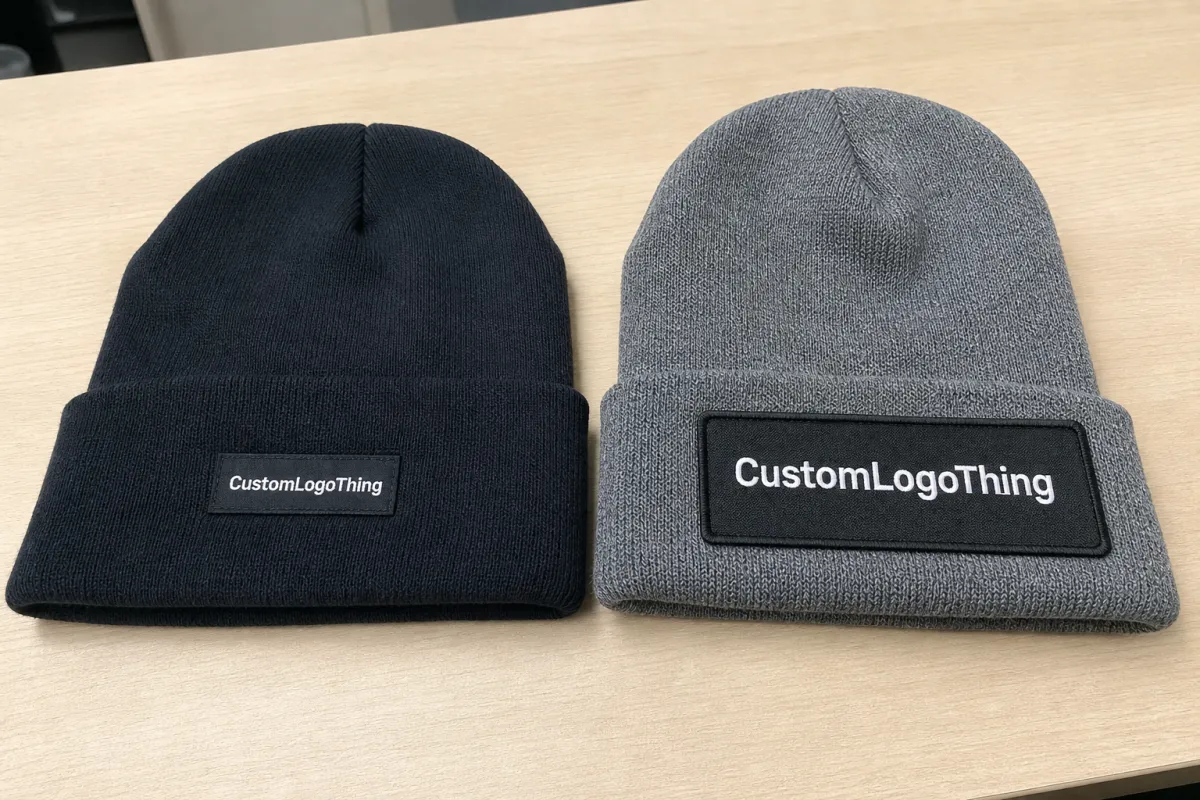
Oversized patches are good at claiming space. Woven labels are better at keeping it. On a beanie, especially one with a softer cuff or a thinner knit, a large patch can pull the front panel out of proportion. The result is not always dramatic, but it shows up in photographs, on shelves, and after the hat has been folded into cartons a few times.
A woven label behaves differently. It adds branding without building too much height, which matters on garments that already have stretch, fold lines, and seam tension competing for attention. That lower profile is part of why labels work so well for minimalist brands, corporate programs, and private-label retail pieces that need to look calm rather than loud.
There is also a readability issue. Tiny text and narrow letterforms often survive woven construction better than thick embroidery on a small patch. Once the logo starts asking for tight spacing or fine line work, a patch can become a compromise. A woven label still has limits, but the print-like clarity is often stronger for compact marks.
If the logo needs to stay readable after stretching, shipping, and wear, the build has to survive more than the mockup phase.
The material pairing matters too. A 100% acrylic cuffed beanie has a very different surface behavior from an acrylic-wool blend or a recycled polyester knit. Slicker yarns can make heavy patches sit awkwardly. Softer yarns can let a label shift if the stitch path is too close to the edge. A good quote should reflect that reality instead of assuming every beanie behaves the same.
For buyers comparing label structures, our Custom Labels & Tags page is a useful reference point before requesting pricing. It helps narrow the conversation to construction, finish, and attachment rather than vague requests for “something nicer,” which is not really a production spec.
Patch construction and label placement that change the final look
Placement changes the personality of a beanie faster than most people expect. Center-front branding gives the strongest shelf presence. Side placement feels quieter and often more premium. Cuff placement is the safest choice for flat application because the fold gives the label a stable area and reduces distortion around the logo.
The construction itself changes the tone as well. A woven label sewn on the cuff is light and controlled. A merrow-edge patch adds a more finished perimeter and usually signals a more traditional streetwear or workwear direction. A flat-sewn patch looks cleaner on some silhouettes, while a folded label tucked into a seam keeps the outside surface less crowded. Each option has a different visual weight, and that weight shows up immediately on soft knitwear.
Front, side, and cuff placement
Front placement is strongest for visibility, but it also leaves less room for error. If the patch is too large, too close to the edge, or not centered correctly, the eye catches it straight away. Side placement is easier to keep understated, though it can wander visually on slouchier styles. Cuff placement remains the most reliable choice for most bulk orders because the flat area is predictable and easier to sew consistently.
On looser knits, the label can shift slightly once the beanie is worn, stretched, or packed. That is one reason placement should be approved on a physical or stitched sample whenever the order is headed for retail or a visible branded program. A clean mockup is helpful, but it does not show how a label behaves under tension.
Another point that affects the final look is seam allowance. If the artwork sits too close to a seam line, fold, or rib change, the label can wrinkle or curl. For compact logos, this matters more than buyers usually expect. A design that is perfectly balanced in a digital proof can look cramped once the fabric is folded and stitched.
The cost follows the same logic. A single cuff label is usually the most economical placement. Add a front patch, a side label, and retail folding, and the order becomes a multi-step job. That extra handling should appear clearly in the quote. If it does not, the price is probably incomplete.
Beanie specs: yarn, knit, patch size, and attachment method
Beanie specs matter because they control both appearance and pricing. A 2x2 rib cuffed beanie gives the label a stable surface and is usually the easiest base for woven branding. A double-layer knit adds structure and warmth, but it also creates a thicker attachment zone. Slouchy styles are softer and more relaxed, yet they are less forgiving if the logo needs to sit perfectly still.
Yarn choice changes the job as well. Acrylic is common because it is consistent, easy to knit, and usually friendly to budget-conscious programs. Acrylic-wool blends feel warmer and more elevated, though they may require tighter quality checks because the fabric hand can vary more. Recycled polyester is increasingly common for sustainability-led programs, but it can behave differently under heat sealing and may need testing before attachment.
For woven-label beanies, the cleaner the build, the easier the production. A label that is 1.5" x 0.5" may work for a simple wordmark. A taller label closer to 3" x 1" gives more room for a logo lockup, but it can overpower a smaller cuff. The right size depends on both the fabric and the artwork, not on the designer's favorite ratio.
- Label size: common ranges are 1.5" x 0.5" to 3" x 1", depending on logo detail.
- Color count: one- or two-color labels usually cost less and reproduce more cleanly.
- Attachment: sew-on is the most common; heat-seal can help on the right fabrics, but it needs testing.
- Beanie style: cuffed, slouchy, double-layer, and custom knit silhouettes all change how the label sits.
Attachment method is one of the easiest places to lose control of quality. Sew-on is predictable and usually the safest option for bulk programs. Heat-seal can speed application, but only if the fabric tolerates the temperature and pressure without glossing or warping. Fold-over labels need a clean seam path. If the construction leaves no consistent anchor point, the label may twist over time.
Practical quality checks are straightforward. The label should sit flat after stitching, not buckle at the corners. The border should be clean, with no loose threads catching on the knit. If the order requires exact brand colors, Pantone references should be supplied rather than vague color names. A dark navy that is “close enough” on a screen can look very wrong on fabric.
For larger shipping programs, packing standards matter too. Carton count, folding method, and polybag choice affect how the beanies hold up in transit. ISTA testing standards are a useful reference for package handling and compression, especially if the order is going to retail distribution or warehouse fulfillment. A beanie is not fragile in the glassware sense, but a crushed cuff or twisted label can still make the product look cheaper than it is.
Pricing, MOQ, and unit cost factors that shape your quote
A useful quote usually comes down to five variables: quantity, label size, color count, attachment method, and whether the beanie itself is stock or custom made. A stock acrylic cuffed beanie with a small sewn woven label is a low-complexity order. A custom knit cap with a patch, a private label, and special folding instructions is a different business entirely.
MOQ exists because setup has to be paid for somewhere. The label file still needs digitizing, the materials still need cutting or weaving, and the sewing line still needs a configuration. For stock beanies with a single woven label, MOQs often start around 100 to 300 pieces. More custom builds commonly land in the 300 to 500 piece range, sometimes higher if the knit itself is being developed from scratch. Lower counts are possible, but unit price usually climbs once setup is spread across too few units.
There is a useful rule of thumb: once quantity increases from 200 to 500 pieces on a simple stock program, the unit cost may drop roughly 20% to 35%, depending on label complexity and finishing. That drop is not magic. It is just setup cost being divided more efficiently. Once the job adds special stitching, extra packaging, or a more complex logo, the savings flatten out.
| Build option | Typical MOQ | Typical price effect | Best use |
|---|---|---|---|
| Simple woven label on stock beanie | 100-300 pcs | Lowest setup burden; often adds about $0.20-$0.55 per piece at volume | Corporate giveaways, retail basics, team merch |
| Embroidered or merrow-edge patch | 200-500 pcs | Higher labor and attachment cost; often adds about $0.40-$1.10 per piece | Workwear, heritage branding, bold logos |
| Folded woven label with custom placement | 300+ pcs | Moderate cost increase if the logo has fine detail or multiple positions | Premium merch, minimalist branding |
| Custom knit beanie with branded label or patch | 300-500+ pcs | Highest setup investment; often starts around $2.50-$6.00 per piece before packaging details | Private label programs, retail collections |
Setup fees are common and should be visible. A woven label setup might be modest, while a custom patch or knit development can carry a higher one-time charge. Sample fees may be credited later on larger orders, but that should be confirmed rather than assumed. The cleanest quote breaks out base unit price, setup, sample cost, and any add-ons such as retail folding, barcode stickers, or carton labeling.
That breakdown matters because “cheap” is not the same as “accurate.” A quote that hides packing, trimming, or special placement is not really cheap; it is incomplete. Buyers usually discover the gap later, often at the exact moment they least want to renegotiate.
Process, lead time, and sample approval steps for production
A solid quote should come with a production path. First the artwork is reviewed. Then the proof is prepared. After that comes sample approval if the order needs it, followed by bulk production, packing, and shipment. If any of those stages are skipped or blurred together, the order is more likely to drift off spec.
Lead times depend on the build and the responsiveness of the artwork review. Digital proofs often take 1-2 business days once the full spec set is in hand. Physical samples usually take 5-10 business days, though complex label shapes or heavier seasonal demand can stretch that window. Bulk production for stock beanies with simple woven labels often lands around 12-20 business days after approval. Custom knit programs take longer, sometimes much longer, because the fabric itself has to be developed and checked.
There are a few common delays that buyers can prevent:
- Artwork arrives in a format that cannot be used cleanly, such as a low-resolution JPG.
- Brand colors are not tied to Pantone references or another fixed standard.
- Label placement changes after proofing, which forces a new layout.
- Quantity changes after pricing has already been built.
- The sample is held while finish details are still open.
Physical samples are worth the time when the beanie is meant for retail, trade shows, or any program where people will handle it closely. A proof shows layout. A sample shows behavior. Does the label curl? Does the cuff relax too much after stitching? Does the embroidery pull the knit? Those are the questions a flat PDF cannot answer.
The fastest order is usually the one that gets approved once, with no midstream changes to size, placement, or packaging.
There is a reason experienced buyers ask for one clean approval stage instead of a chain of revisions. Each change has to be rebuilt, checked, and re-quoted if it affects labor or materials. That does not make the supplier slow. It makes the job honest.
Artwork prep and quote mistakes that waste budget
Most quote problems begin with artwork that was never meant to live on knitwear. A logo built for a website header or a print ad may look fine on a screen, then lose legibility once it is reduced to label size. Tiny letterforms disappear. Thin outlines break. Gradients become meaningless because woven labels need simplified color logic, not decorative shading.
That is not a flaw in the product. It is just a reminder that textiles have different limits from digital art. A logo that reads well at 2" wide on fabric is usually more useful than a logo that tries to preserve every detail and ends up muddy. In many cases, the stronger move is to simplify the mark so it stays clear after stitching.
Common mistakes keep repeating because they feel minor at the start and expensive later:
- Sending a JPEG instead of a vector file.
- Requesting a quote for 200 pieces, then changing to 500 pieces after pricing is done.
- Choosing label dimensions before measuring the usable cuff space.
- Ignoring whether the beanie is stock, custom knit, or private label.
- Leaving out packaging requirements such as barcode stickers, retail folding, or carton marks.
Another issue is assuming a patch is always the “stronger” option. That may be true for a large, simple mark. It is not true for every logo. Fine text, small symbols, and compact brand lockups often perform better as woven labels because the weave can preserve detail without building too much bulk. If the logo starts to lose clarity, the bigger patch is not helping. It is just taking up more space.
Good quote requests include the file, the beanie style, the label dimensions, the color count, the quantity, and the delivery location in one message. If the order needs inserts or tags, those belong in the same note. The more complete the brief, the fewer assumptions need to be made, and the less the budget gets chewed up by revisions that should have happened earlier.
What a reliable supplier should show before production
A reliable production partner does not just return a price. They show how the order will be built, where the risk sits, and what will be checked before bulk sewing begins. That matters because the difference between a neat sample and a disappointing run is usually found in the paperwork, not in the final shipment.
Look for proof that the label dimensions, stitch path, attachment method, and placement are all documented before production. If the sample shows a centered cuff label, the bulk run should show the same placement. If the proof specifies a one-color woven label with a matte finish, the sample should not quietly become glossy or oversized. Small changes are not always obvious in email, but they are obvious on the finished goods.
Quality control should focus on practical points:
- Label alignment: centered, level, and consistent across the order.
- Seam finish: no loose thread bundles, uneven edges, or puckering around the stitch line.
- Color consistency: close to the approved standard across the run.
- Packing accuracy: correct counts, correct folding, and correct carton labeling.
The best suppliers also flag limitations instead of hiding them. A thick patch may not sit cleanly on a soft slouchy knit. Heat seal may not be suitable for a recycled yarn blend. Fine type below a certain size may blur once woven. Those caveats are useful. They stop the order from becoming an argument later.
That is the real value of a clean production process: fewer surprises, fewer corrections, and a bulk run that matches the approved sample closely enough to ship with confidence. Not perfect in a theoretical sense. Consistent in a commercial one.
What to send for a fast quote and how to place the order
The fastest way to get a usable quote is to send the whole job at once. A partial brief tends to produce partial pricing, and partial pricing usually creates more work for everybody. For Beanies with Woven labels or patches, the first message should include the logo file, beanie style, label size, color count, quantity, delivery address, and any packaging or retail requirements.
Here is the cleanest order checklist:
- Vector logo file, or the best artwork available.
- Beanie style: cuffed, slouchy, rib knit, double-layer, or custom knit.
- Label type: woven label, embroidered patch, merrow-edge patch, or mixed build.
- Exact placement and label dimensions.
- Quantity by size or color, if the order is split.
- Shipping address and any carton or retail instructions.
If the logo changes after the first round, ask for a revised quote instead of trying to force the old one to fit. The same goes for quantity changes. A quote built around 200 pieces will not behave the same way at 500 pieces, especially when setup fees and finishing steps are involved. That is normal. What creates problems is pretending nothing changed.
Once the spec sheet is complete, the order path becomes straightforward: confirm the layout, approve the sample if one is needed, and lock production before the calendar starts moving. For buyers comparing label styles before requesting pricing, our Custom Labels & Tags page can help clarify the options without adding noise to the process. The more clearly the build is defined up front, the more likely the final run is to match the brief instead of the mood board.
FAQ
How do I get a logo patch beanies woven label quote that is accurate?
Send the logo file, beanie style, label size, color count, quantity, and shipping location in one message. If you need retail folding, barcode stickers, inserts, or carton labels, include those too so the quote reflects the full job.
What MOQ should I expect for woven label beanies?
Stock beanies with a small woven label often start around 100-300 pieces. More custom knit programs usually sit closer to 300-500 pieces or more because setup and development costs need enough volume behind them.
Are woven labels better than embroidery for beanies?
Woven labels usually handle small text, narrow lines, and compact brand marks more cleanly. Embroidery can look stronger for bolder logos, but it may lose detail on small areas or softer knit fabric.
How long does production usually take after approval?
Digital proofs often take 1-2 business days. Physical samples can take 5-10 business days. Bulk production for stock beanies with simple woven labels commonly falls in the 12-20 business day range after approval, with custom knit programs taking longer.
Can I change the label placement after I get the quote?
Yes, but placement changes can affect labor, appearance, and final pricing. Confirm the new placement before production so the sample and the bulk order match.


