For chocolate brands, packaging has to do more than hold product. It has to signal quality before anyone lifts the lid, and that is why a Logo Patches Material guide for chocolate brands is more than a style decision. A patch on a gift box, sleeve, sampler pouch, or staff apron can make a straightforward presentation feel considered and premium. Choose badly, though, and the packaging starts to look generic, even if the chocolate inside is excellent.
That mistake is more common than it should be. Buyers often focus on mockups and ignore how materials behave once the box is handled, stacked, chilled, shipped, and opened under retail lights. Chocolate is a packaging-heavy category: seasonal launches, corporate gifting, artisan bars, and short-run samplers all ask different things from the same logo patch.
The practical question is not “Which patch looks nicest on a screen?” It is “Which patch survives the real job?” That job may involve a kraft paper carton, a rigid box, a corrugated mailer, or a reusable apron. It may also involve cold storage, humidity swings, and customers who touch the package more than once. In other words, the material choice matters a lot.
What Logo Patches Actually Do on Chocolate Packaging
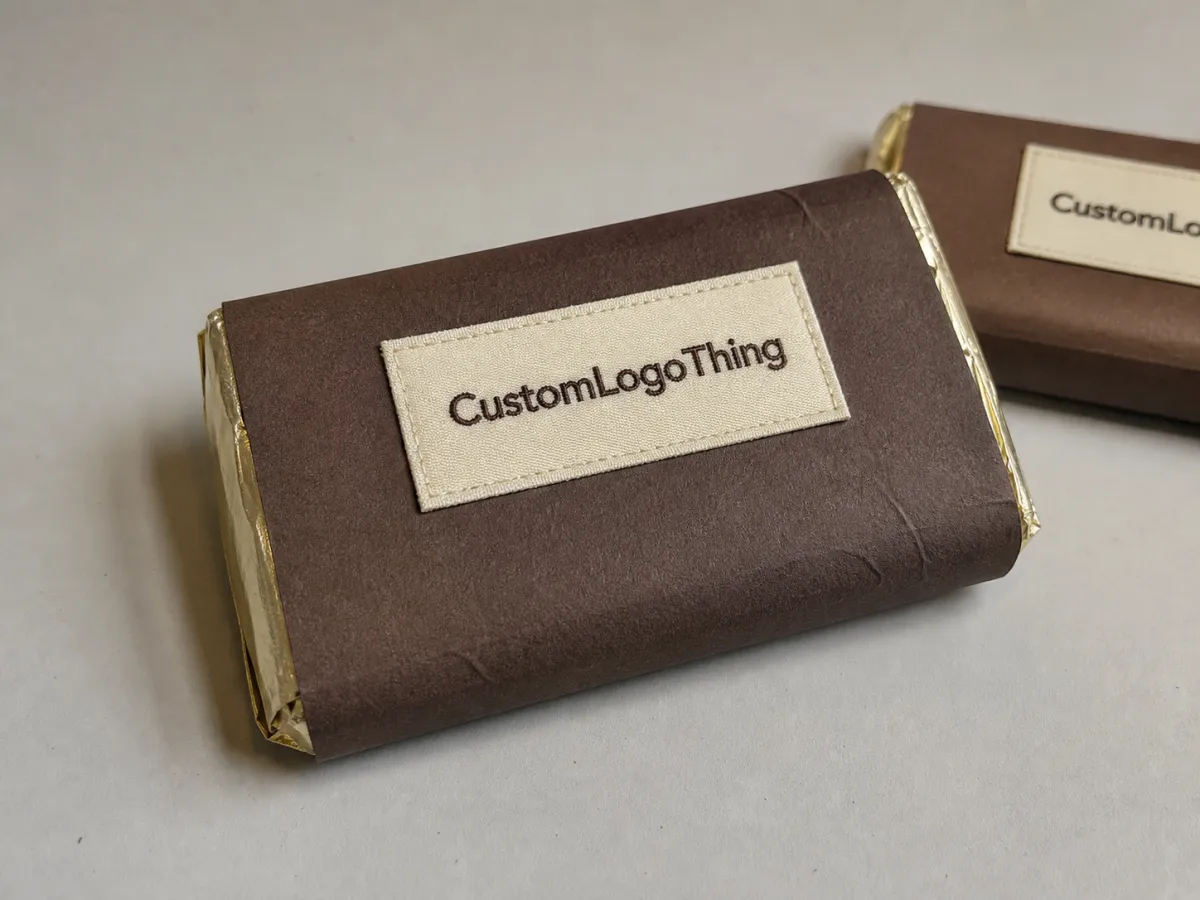
On chocolate packaging, a patch acts like a small brand marker with a lot of responsibility. It can sit on a paper box, a display sleeve, a gift bag, or a textile accessory and say, without words, that the product was made with intent. That sounds simple. In production terms, it rarely is.
The first job is decorative branding. Texture, dimension, and contrast help a package stand out on a shelf or in a gift set. The second job is functional. Patches can seal a sleeve, identify a seasonal collection, mark a limited edition, or help differentiate one SKU from another. For brands with multiple bar flavors or gift formats, that kind of visual sorting is useful.
Common uses for chocolate packaging include:
- Closure tabs on sleeves or tuck-top boxes
- Front-panel logos on rigid gift cartons
- Seal accents for holiday or limited-run collections
- Staff uniforms for retail counters and tasting events
- Sampler pouches and gift bags
- Corporate gifting and launch packaging
Material choice changes the message quickly. A woven patch can make plain kraft paper feel boutique. A heavy PVC patch can push the same box toward a promotional look. The size may be identical, but the brand signal is not.
The main material families are embroidered, woven, leatherette or PU, PVC or rubber, felt, and paper-based or laminated options. Each has a different balance of detail, feel, durability, and cost. For chocolate brands, that balance matters because packaging has to fit the product price point, the launch timing, and the overall tone of the brand.
How Patch Materials Behave on Food and Gift Packaging
Chocolate packaging sits in a tricky space. The patch is usually outside direct food contact, but it still has to work around foil wraps, coated cartons, insulated shippers, and repeated handling. A patch that curls, cracks, or loses adhesion after a chilled shipment is not rustic. It is a defect.
Different materials read differently in hand. Embroidery gives a raised textile feel that suggests craft and heritage. Woven patches are flatter and sharper, so they handle small typography and detailed marks better. Leatherette and PU create a smooth, upscale surface that suits minimalist chocolate branding. PVC and rubber are durable and high-impact, but they can feel sporty or utilitarian if the design is not restrained.
Attachment method matters just as much as the face material. In packaging applications, the backing often determines whether the patch is useful or frustrating.
- Sew-on: best for aprons, reusable bags, and textile wraps
- Iron-on: workable on fabric-based packaging, less useful on coated board
- Adhesive-backed: practical for boxes and sleeves if the adhesive matches the surface
- Velcro: useful for reusable displays or switchable seasonal marks
- Clip or rivet: niche, but useful on premium reusable carriers
Not every material reproduces small text well. Chocolate brands often like elegant script, fine serif lettering, or seal-style logos with narrow strokes. Those details can disappear at a small size. If the logo relies on hairline lines or long copy, woven or printed leatherette usually performs better than dense embroidery.
A patch should support the package, not fight it. If it distorts the closure, hides a fold, or turns the logo into visual noise, the spec is wrong.
Shipping and storage deserve attention too. Chocolate may move through cold rooms, insulated cartons, and outer mailers made from corrugated cardboard. If the patch sits on the outer package, it needs to hold color and shape through abrasion, compression, and temperature changes. That is basic packaging survival, not a luxury detail.
Key Factors That Decide the Right Material
Brand position comes first. A bean-to-bar maker selling single-origin bars at a specialty counter usually needs something different from a corporate gifting program shipping 2,000 holiday boxes. The same logo can be executed several ways, but only one usually fits the margin and the tone.
Use case is the next filter. Is the patch staying on a display box? Is it going on a reusable apron? Is it part of a sample mailer that gets thrown away after one opening? Durable materials make sense when the package is handled often or reused. For one-time seasonal packaging, lower-cost paper-based or laminated options may be better, especially if the rest of the pack already uses kraft paper or recycled board.
Logo complexity matters more than most buyers expect. If the design includes tiny type, thin lines, gradients, or intricate flourishes, embroidery is rarely the best first choice. Woven patches and printed leatherette handle detail more reliably. Bold, iconic logos can look excellent in embroidery because the texture adds presence without needing fine detail.
Sustainability claims need verification. Buyers ask for FSC certified cartons, post-consumer waste content, and biodegradable packaging compatibility for good reason. But a patch is a separate component, so ask for documentation on the base material, thread, adhesive, and any coating. “Eco-friendly” is not a specification.
Finish affects perception too. Matte patches usually feel calm and premium. Gloss or metallic accents can work well for festive collections, but they may reduce legibility under strong retail lighting. A debossed leatherette patch on a matte box often reads more upscale than a shiny patch with too much contrast.
One more practical point: think about the whole packaging structure, not the patch alone. If the outer carton dents in transit or the sleeve has weak geometry, the best patch in the world will not rescue the presentation. Packaging is a system. The patch is one part of it.
Logo Patches Material Guide for Chocolate Brands: Best Options by Use Case
Below is the part most buyers need: a direct material-to-use-case breakdown. Not theory. Not mood-board language. Just the practical comparison that helps chocolate packaging stay coherent.
| Material | Best For | Strengths | Tradeoffs | Typical Cost Feel |
|---|---|---|---|---|
| Embroidered | Heritage branding, bold logos, gift boxes, aprons | Rich texture, craft feel, strong visual depth | Weak on tiny text and thin lines | Mid-range |
| Woven | Clean typography, detailed logos, sleek packaging | Sharp detail, flatter finish, readable at smaller sizes | Less tactile than embroidery | Mid-range to efficient premium |
| Leatherette/PU | Luxury bars, artisan gifting, boutique branding | Modern, upscale, works well for deboss or print | Can look too polished for rustic brands | Often efficient for luxury looks |
| PVC/Rubber | Durable promo packs, bold contemporary brands | High durability, strong color presence, good wear resistance | Can feel less refined for premium chocolate | Moderate to higher with mold complexity |
| Felt | Seasonal, handmade, rustic, limited-edition packaging | Soft, warm, craft-driven appearance | Less durable in humid or high-handling settings | Usually lower to mid-range |
| Paper-based / laminated | Short-run promos, fast launches, lightweight seals | Low cost, quick testing, easy to print | Lower durability and less premium feel | Lower cost |
Embroidered patches
Use embroidery when you want texture and tradition. It works well for premium gifting, artisanal collections, and heritage-inspired chocolate brands. Thick outlines and strong silhouettes usually reproduce well. Tiny text does not. If the logo is full of fine type or detailed ornament, embroidery can turn into visual clutter.
Woven patches
Woven patches are often the safest choice when detail matters. They give cleaner text, a flatter surface, and a slightly more refined look than embroidery. For chocolate brands with elegant wordmarks or seal-style logos, woven usually offers the best balance between readability and finish.
Leatherette and PU patches
These work especially well on black, cream, or deep brown cartons where a boutique finish matters. They can be debossed, printed, or combined with subtle surface effects. The result feels upscale without relying on heavy texture. One caution: if the brand identity is rustic or handmade, a leather-look patch may feel too polished.
PVC and rubber patches
PVC and rubber are built for durability and strong visual impact. They are useful for contemporary brands, promotional sets, and packaging that needs to take abuse. The downside is tone. Unless the design is minimal and intentional, the material can drift toward athletic or utility aesthetics, which is not always the right fit for premium chocolate.
Felt patches
Felt reads warm and handmade. That makes it appealing for holiday collections, rustic gift boxes, and small-batch chocolate makers. The downside is wear resistance. In humid storage or high-handling environments, felt can show fatigue sooner than woven or leatherette options.
Paper-based or laminated options
These are useful when speed and budget matter more than long-term wear. Think promotional packaging, sampling programs, or test launches. If you need something closer to a label than a true patch, this can be the right compromise. It is not the answer for repeated handling, but it can be smart for short-term campaigns.
Quick material fit by packaging style
- Rigid luxury box: woven or leatherette
- Kraft sleeve: woven, felt, or paper-based
- Reusable apron: embroidered or woven with sew-on backing
- Seasonal gift set: leatherette, woven, or paper-based depending on price point
- Bold promotional pack: PVC or rubber
If you need a broader packaging comparison alongside patch choices, reviewing carton structure, insert design, and finish choices helps prevent mismatches later. A good patch cannot compensate for weak packaging mechanics.
Cost, Pricing, MOQ, and Unit Cost Basics
Most buyers ask about cost first. Fair enough. The honest answer is that pricing depends on size, material, stitch count, shape, backing, finish, and whether the patch is standard or custom-shaped. Still, some patterns hold across the category.
Simple woven and embroidered patches generally sit in the middle of the pricing range. Leatherette can be cost-efficient if the look is premium but the construction is simple. PVC and molded options often climb as tooling complexity rises. A rectangle is cheaper to make than a complicated custom outline. That is true more often than clients want to hear.
For chocolate brands, a useful pricing mindset looks like this:
- Simple woven or embroidered patch: usually the most balanced choice for cost and appearance
- Leatherette/PU: often strong value when the goal is a luxury look without heavy construction
- PVC/rubber: typically higher once molding or custom tooling is involved
- Paper-based options: lower upfront, but not built for repeated handling
MOQ matters too. Custom patches often require minimums, especially if you want custom shapes, special finishes, or molded parts. Standard sizes and simpler builds usually reduce that threshold. For seasonal chocolate packaging, that can be the difference between a manageable run and an expensive pile of leftover inventory in January.
Hidden costs show up in predictable places:
- Artwork digitizing
- Mold or tooling charges
- Sample or pre-production fees
- Rush production costs
- Protective packaging for fragile finishes
Unit cost is not total cost. A cheaper patch can become the more expensive option if it forces a packaging redesign, increases waste, or requires extra inventory. For brands with holiday peaks, lead time and flexibility often matter more than saving a few cents on each unit.
Quote by application, too. A patch for a fabric apron, a rigid gift box, and a retail sampler pouch may need different backings and finishes. If the brief leaves out the application, the quote will usually be less reliable. That creates avoidable revision cycles.
Process and Lead Time: From Artwork to Delivery
The production sequence is usually straightforward: artwork review, material selection, digitizing or tooling, sample approval, bulk production, and shipping. Delays happen when one of those steps is rushed or when the artwork is not ready. Clean files move faster. Changes to logo size, color, or backing after sampling tend to slow everything down.
Woven and embroidered patches usually move faster because they are less tooling-heavy. Molded PVC and specialty multi-layer builds take longer because they require more setup and sample control. If your launch is tied to a seasonal chocolate release, build in buffer time. Holiday schedules compress quickly, and every supplier feels it.
Prepare these items before requesting a quote:
- Final logo files in vector format
- Color references, ideally with Pantone targets
- Exact size in millimeters or inches
- Backing preference
- Where the patch will be applied
- Packaging deadline and launch date
Test-fitting is easy to skip and expensive to ignore. A patch can look perfect in a proof and still interfere with a box fold, lid closure, or sleeve tension. Check it on the actual packaging surface before approving full production. That applies whether the base is kraft paper, coated board, or a reusable textile wrap.
Sample packing also matters. If the supplier ships samples loosely, edges can bend, adhesives can age poorly, and glossy finishes can scratch. That does not prove the bulk order will fail, but it is worth paying attention to. Sample care often reflects overall production discipline.
For buyers balancing quality and timing, one clean sample made a little slower is usually better than a dozen rushed options that all need adjustments. Packaging production rewards consistency more than speed in the wrong places.
Common Mistakes Chocolate Brands Make With Patch Materials
The biggest mistake is choosing from renderings alone. A patch can look excellent in a mockup and still fail in real life because it is too bulky, too shiny, too fragile, or too hard to read at size. Chocolate brands often make this mistake when they want to move the package upmarket quickly. Sometimes the better premium move is restraint.
Another common error is using embroidery for tiny text. Brands often try to fit a logo, tagline, and decorative frame into one small patch. The result may be technically well made and still unreadable. If the consumer has to squint, the design has already lost.
Thickness causes trouble more often than people expect. A bulky patch can interfere with closure, stack poorly in display trays, or make a box front look uneven. On high-end gift packaging, that breaks the clean silhouette. Even a few extra millimeters can change how a product sits on shelf.
Proof checks are frequently too shallow. Color accuracy, edge finish, and attachment strength should all be checked before bulk production. If the patch peels at the corners or twists during handling, the problem usually started earlier in the process. That is exactly why pre-production samples exist.
There is also the “cheap looks cheap” problem. Saving a small amount per unit can make a premium chocolate box look like a giveaway item. That may be acceptable for a playful seasonal promotion, but it can undercut a luxury position immediately. Packaging does not get a second chance to create that first impression.
Finally, brands sometimes forget whether the patch needs to work on packaging, apparel, or both. That changes backing type, flex behavior, wash resistance, heat tolerance, and even the best base material. If one patch is meant for both a retail box and a staff apron, a compromise spec often disappoints both uses. Two versions are sometimes the cleaner solution.
Expert Tips and Next Steps for Choosing the Right Patch
Start with the chocolate’s price point. A $6 seasonal truffle box should not carry the same patch spec as a $28 luxury bar set. Packaging has to match the product economics. If the box says premium but the patch eats too much of the margin, the project stops making sense.
Order two samples if possible. One for visual approval and one for testing on the actual package. That second sample matters more than people think because a patch that looks flat and clean on a desk can behave differently once folded, wrapped, or handled by customers.
Keep the logo readable at small size. Simplify line work. Avoid thin type. Remove unnecessary detail. Packaging is not a poster. It has to be understood quickly, often at arm’s length and under retail lighting.
Ask for side-by-side quotes on at least two materials. Compare appearance, unit cost, MOQ, and turnaround. Woven versus leatherette is a useful comparison for many chocolate brands because it often reveals whether the goal is detail or texture. The answer becomes obvious once both samples are in hand.
Test under real conditions:
- Cold storage or chilled delivery
- Shipping vibration in outer cartons
- Repeated handling at retail
- Display lighting in stores or at events
If sustainability is part of the brand story, specify recycled materials, ask about FSC certified cartons, and confirm whether the patch materials support biodegradable packaging goals. A recycled carton paired with an unverified patch spec is not a complete sustainability answer.
For broader packaging reference, the FSC and ISTA resources are useful for material and transit expectations, especially where chocolate moves through mixed packaging systems. They will not choose the patch for you, but they help separate real constraints from guesswork.
The next step should follow a simple order: request a sample, confirm the artwork, lock the backing method, then schedule production before the seasonal window closes. That sequence reduces revisions and keeps the packaging plan realistic. The most useful Logo Patches Material guide for chocolate brands is the one that fits the product, the budget, and the timeline—not just the prettiest mockup.
FAQ
What is the best logo patch material for chocolate brands with premium packaging?
Leatherette/PU and woven patches are usually the strongest premium options. Leatherette creates a modern luxury look, while woven handles cleaner detail and small text better. The right choice depends on logo complexity and the overall tone of the packaging.
Are embroidered patches a good choice for chocolate box packaging?
Yes, if the logo is bold and the patch is meant to signal craft or heritage. No, if the logo includes tiny text or fine details. Embroidery works best as a visual accent rather than a carrier for a lot of information.
How much do custom logo patches usually cost for chocolate brands?
Cost depends on size, material, stitch count, shape, and backing. Simple woven or embroidered patches are usually more affordable than molded specialty options. Expect setup or tooling fees on custom shapes and specialty finishes.
What lead time should chocolate brands plan for custom patches?
Allow time for artwork approval, sampling, and bulk production. Woven and embroidered options are usually faster than molded specialty patches. Seasonal launches need extra buffer because revisions can quickly affect the schedule.
How do I choose the right patch material if I’m unsure about durability?
Think about handling, shipping, temperature changes, and how often the package will be opened. Test two samples on the actual packaging surface before placing the full order. When in doubt, choose the material that balances readability, attachment strength, and finish.