For coffee brands, Logo Patches Unit Cost for coffee is never just a number on a quote sheet. It is a decision about how a small branded element will carry across aprons, caps, hoodies, totes, and retail Packaging Without Looking like an afterthought. A well-built patch can make a garment feel finished and retail-ready, even when the base item itself is fairly simple.
That matters because coffee businesses usually need one brand mark to work in several contexts at once: staff uniforms, product merch, seasonal drops, and reusable carry items. The same patch may need to sit on a structured cap one week and a soft hoodie the next, which means buyers have to think beyond appearance and into application, durability, and repeatability. The patch becomes a separate production decision, not just decoration.
In practical buying terms, patches are useful because they can be produced independently, stocked in batches, and applied later as demand changes. That flexibility helps when onboarding new café staff, planning wholesale orders, or testing a small merch release before committing to a larger run. It also gives brands a little more control over unit economics, especially when the same design can be adapted across more than one product line.
Why coffee brands use patches to add premium shelf and staff appeal
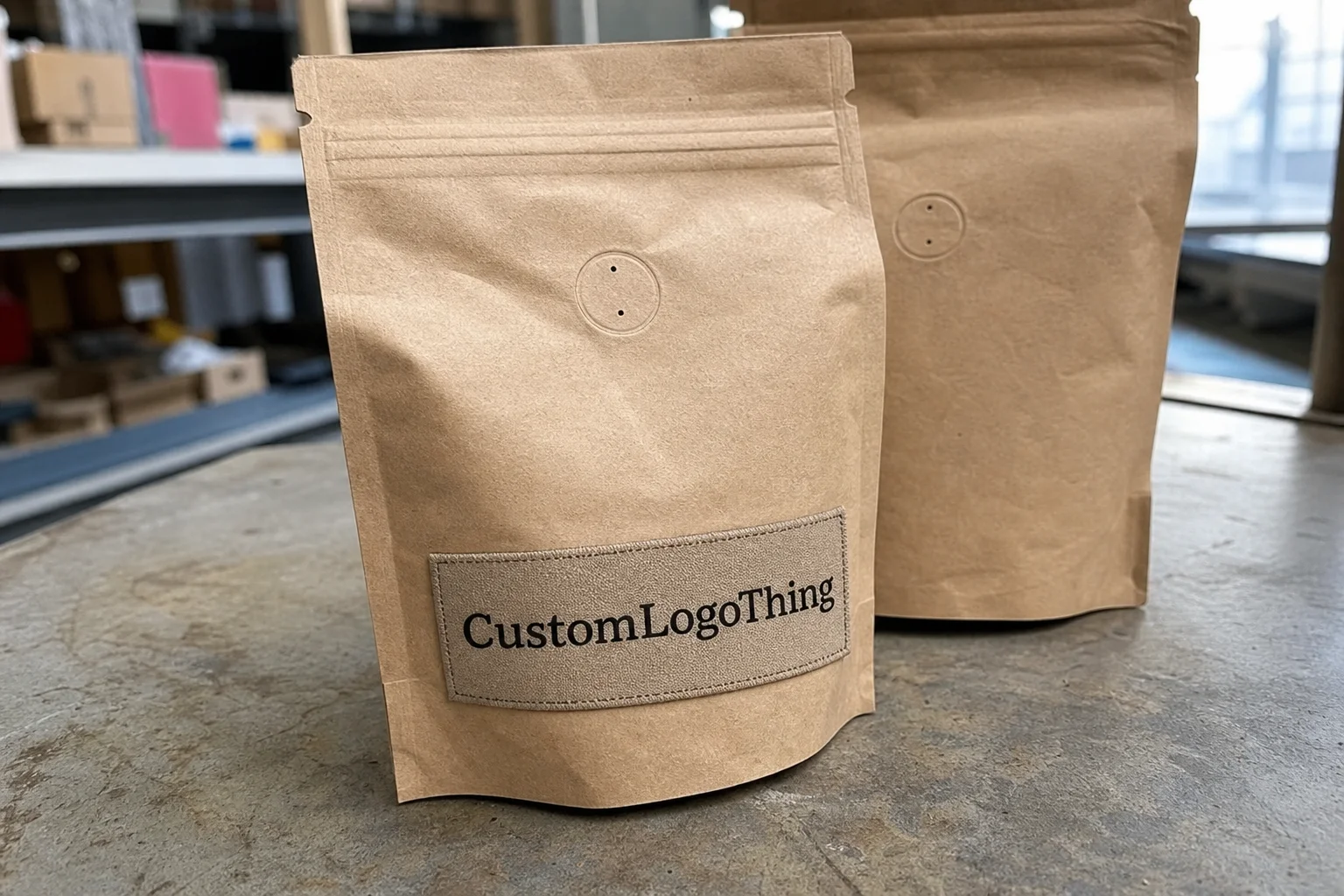
A sewn or heat-applied patch changes perception quickly. A plain apron is functional, but once a textured logo sits on the bib or chest, the item reads like part of a branded system rather than a generic uniform. That shift is easy to miss on a product mockup and obvious when the piece is in hand.
Coffee roasters and cafés use patches because they create a consistent visual language across apparel and accessories without requiring the same decoration method everywhere. A woven patch may be the best fit for a cap front, while an embroidered version brings more texture to an apron, and a PVC patch can support a cleaner, more modern retail look for limited-edition merch.
There is a very real inventory advantage here as well. Patches can be ordered separately from garments, which means a brand can hold finished patch stock and apply it only when needed. That is helpful for seasonal programs, staggered store openings, and wholesale apparel orders that may move at different speeds. It is also easier to keep one patch spec consistent than to rework the decoration process on every new garment style.
Patch construction can sometimes be a better fit than direct embroidery or printed labels when the logo needs sharper edge definition, a raised profile, or a more premium retail cue. Direct embroidery is still strong for many jobs, but very small type can get crowded, and stitching can distort on certain fabrics. A patch keeps the graphic intact before it touches the garment, which often makes the final result more controlled.
“For coffee merch, the patch is often the part customers notice first. If it feels solid and intentional, the whole item tends to feel more valuable.”
That is why Logo Patches Unit Cost for coffee should be judged against what the patch does for the product, not just against the raw material price. A slightly higher per-piece cost may be justified if the patch improves brand visibility, survives repeated wear, and works across more than one apparel program.
Patch styles, materials, and backings that work on coffee merch
Most coffee brands narrow their patch options to a few familiar constructions: woven, embroidered, PVC, leatherette, felt, and printed fabric. Each has a different look and a different cost profile, so the right choice depends on whether the goal is heritage character, durability, or a more polished retail finish.
Woven patches are a strong option when the logo includes fine detail, small lettering, or thin line work. Because the threads are woven tightly, they reproduce artwork more cleanly than traditional embroidery on compact cap patches or sleeve placements. They tend to be a good fit when legibility matters more than deep texture.
Embroidered patches bring a classic uniform feel and a more tactile surface. They work well on aprons, work jackets, and hats when the logo can be simplified slightly. If the mark has bold shapes and limited small text, embroidery usually holds up well and gives the garment a sturdy, familiar look.
PVC patches suit brands that want a cleaner, molded finish with sharp color blocks and raised edges. Because they are formed rather than stitched, they can support a contemporary or industrial aesthetic that fits some modern cafés and roasters. They are often chosen for outerwear, cap fronts, and merch where the brand wants a more defined, high-contrast badge.
Leatherette patches are common in premium merchandising because they give a refined surface without the variability of real leather. A debossed or printed leatherette patch can look elevated on hoodies, tote bags, and café apparel, especially when the brand palette leans toward warm neutrals and understated surfaces.
Felt patches lean softer and more heritage-driven. They can work well for natural-toned brands, especially when the packaging, interior materials, and apparel all use matte finishes and muted colors. They are less rigid visually, which can be a strength if the brand identity is meant to feel approachable and tactile.
Printed fabric patches are useful when the artwork includes gradients, complex illustrations, or full-color details that would be difficult to reproduce cleanly in stitches. For certain merch graphics, they are simply the most practical way to preserve the original artwork without overcomplicating the build.
Backing choice often matters just as much as the face material. Sew-on patches remain the most versatile and dependable option for aprons, denim, canvas, and outerwear. Iron-on or heat-press compatible backs can save time during application, but performance depends heavily on fabric type and garment construction. Adhesive backs are usually better for temporary positioning or special retail uses, while Velcro makes sense when staff need removable branding. For heavy-use café apparel, sew-on is often still the safest choice.
Edge finish changes both appearance and durability. A merrowed border gives a more traditional frame, while a laser-cut or heat-cut edge can look cleaner on modern shapes. Stitch density, border type, and thread quality all affect how a patch holds up through repeated laundering, folding, and daily wear.
Coffee brands tend to favor subdued tones, matte finishes, and tactile materials because those choices sit naturally beside kraft packaging, stoneware cups, wooden counters, and soft interior palettes. If the merchandise line is meant to feel warm and grounded rather than flashy, the patch should follow the same language.
Size, shape, and placement specs that affect unit cost
Patch size is one of the clearest cost drivers. A 2-inch chest patch uses less material, less stitch time, and less molding area than a 4-inch jacket back patch, so the unit cost changes accordingly. Many buyers assume the difference is small until they compare line items and see how quickly size affects the quote.
Shape matters too. Circles, rectangles, and shields are usually less expensive than custom outlines with tight corners, cutouts, or layered sections. The more the production team has to manage the border and the edge geometry, the more labor and tooling complexity gets built into the order.
Common placement areas for coffee apparel and accessories include the chest, sleeve, cap front, apron bib, tote panel, and hem tag zone. Each location has its own practical limits. A cap front needs a patch that sits cleanly on a curved, structured surface, while an apron bib can take a larger patch if the fabric and seam layout allow it.
Artwork quality also affects cost. Clean vector files reduce redraw time and help the supplier keep edges crisp. Tiny text, hairline rules, and tightly packed color separations can cause production problems if they fall below practical manufacturing limits. Very small lettering, especially on compact patches, should be reviewed carefully because what looks readable on screen may blur once it is built in thread, mold, or print.
Useful spec choices that often keep costs under control:
- Simplified logo shapes are usually easier to produce.
- Thicker lines reproduce more reliably than fine lines on small patches.
- Fewer color changes often reduce complexity.
- Standard sizes generally have less setup friction than unusual dimensions.
If the same logo needs to appear on hoodie chest placements, cap fronts, and tote bags, it may need different treatments for each item. A simplified version can lower cost per piece and still improve legibility, especially on smaller placements where too much detail would be lost anyway.
logo patches unit cost for coffee: pricing, MOQ, and what changes the quote
This is usually the question behind the search for logo patches unit cost for coffee: what does each patch actually cost, and what pushes that number up or down? The answer depends on size, material, color count, backing type, border complexity, and total quantity. Those factors do not act in isolation, which is why two quotes that look similar on paper can behave very differently once production starts.
Lower MOQ orders almost always carry a higher per-piece cost. That is not a hidden penalty; it is simply how setup charges, digitizing, proofing, and tooling fees get spread across fewer units. A run of 100 patches will usually cost more per piece than a run of 1,000 with the same artwork because the fixed front-end work does not shrink with the order size.
Bulk pricing works the way most packaging and apparel buyers expect. The more units you order, the lower the cost per piece becomes, especially when the same patch is used across several styles or accessory lines. If a coffee brand can standardize one patch for aprons, caps, and totes, the economics tend to improve because the design work and setup are shared.
Sample or prototype costs should be handled separately from production pricing. A proof sample may carry its own charge, and some suppliers will credit that amount back against the final order while others will not. It helps to ask that question early, before the sample is approved, so the budget does not get distorted later.
For a practical reference, patch style and order size usually influence pricing in the following way. Exact numbers vary by supplier and artwork, but the pattern is fairly consistent.
| Patch type | Typical use | Relative unit cost | Common MOQ behavior |
|---|---|---|---|
| Woven sew-on | Caps, aprons, tote bags | Lower to mid | Usually friendly for moderate runs |
| Embroidered | Uniforms, hoodies, jackets | Mid | Often practical at mid-range volumes |
| PVC | Modern merch, outerwear | Mid to higher | May require tooling and minimums |
| Leatherette | Premium retail apparel | Mid to higher | Often best when quantities justify setup |
| Printed fabric | Detailed artwork, full color graphics | Lower to mid | Can work well for flexible order sizes |
A useful quote request includes the artwork file, dimensions, quantity, backing preference, application surface, and whether the patch will be sewn, heat-applied, or used another way. If the supplier has to guess any of those details, the pricing will be less reliable.
Simple woven patches in moderate quantities often sit below molded or premium-finish options, while PVC and leatherette usually move higher because of tooling, finish complexity, or extra setup. The goal is not to buy the cheapest patch possible; it is to match the construction to the job and avoid paying for features the garment does not need.
Logo patches unit cost for coffee also rises when artwork requires custom dies, special edge treatments, or layered construction. Those features can be worthwhile for a signature merch line, but they should be requested intentionally rather than slipping into the quote by default.
Process, timeline, and production steps from artwork to delivery
The production flow is usually predictable if the artwork is ready. It starts with artwork review, then material recommendation, proofing, sample approval, mass production, finishing, quality check, and packing. That sequence sounds straightforward, but delays usually show up at the handoff points, especially when the logo file needs cleanup or the buyer changes direction after proofing.
Vector artwork moves faster than raster art. A clean AI, EPS, or editable PDF file lets the supplier assess line weight, color separation, and border shape without redrawing the logo from scratch. If the only file available is a low-resolution image, extra time is often needed for conversion and revision.
Turnaround depends on several variables: sampling time, number of artwork revisions, order volume, and whether the patch needs sewing, heat backing, or special finishing. A straightforward order with clear artwork and standard backing can move on a much more predictable schedule than a multi-material patch with strict color matching.
Color matching is another area where buyers should stay realistic. If the patch needs to align closely with packaging, menu boards, or a larger apparel system, the supplier may need to tune the thread, print, or molded color against a reference. That can take longer, but it also protects brand consistency across the line.
For simple runs, a timeline of about 12–15 business days after proof approval is common, though complex builds can take longer. Sample timing adds another layer, especially when a physical proof is required before the full order is approved.
Final packing can be handled in several ways. Some buyers want bulk-packed patches for in-house application. Others want pair sets or labeled bundles for distribution to multiple café locations. If the patches are being applied to garments before shipment, the packing method should be confirmed early so the receiving team can move quickly.
For shipping consistency and transit protection, suppliers who work to recognized testing practices such as ISTA methods or applicable material standards tend to be more consistent about packaging and handling. That does not make every job identical, but it does reduce avoidable damage in transit.
Quality checks that matter for café uniforms and retail merch
Patch quality is not judged only by how it looks on a proof. A good supplier checks stitch density, edge seal quality, adhesive performance, and color consistency before anything ships. Those are the details that decide whether the patch still looks clean after washing, bending, folding, and daily use.
Wash testing matters a great deal for café uniforms. Aprons, hoodies, and jackets move through regular laundry cycles, and a patch that looks perfect on day one can fail if the backing softens, the edge frays, or the thread loosens after repeated washing. If the garments will be cleaned often, performance under laundering should be part of the approval process.
Fabric compatibility is another practical issue. Cotton twill aprons, fleece, denim, and structured caps all behave differently. A sew-on patch is often forgiving, but heat-applied backs need more care because garment construction, fiber content, and surface texture all affect how well the adhesive bonds.
Buyers should also agree on tolerances. Small variations in thread shading, border finish, or placement can happen in normal production, especially on larger orders. A careful supplier will discuss acceptable variation up front instead of pretending every piece will be identical to the millimeter.
For brands that care about sustainability cues in packaging and merch, it is fair to ask about material sourcing and supporting components as well. If sustainability is part of the story, organizations like the FSC provide useful benchmarks for responsibly sourced fiber materials used in packaging inserts and labels, even if the patch itself is a different category.
Quality control protects more than appearance. It keeps staff looking aligned, protects a retail drop from uneven presentation, and helps wholesale apparel orders arrive with the same brand feel across every unit. That consistency is what customers usually notice, even if they cannot name the process behind it.
Best next steps to place a coffee patch order with confidence
Before asking for a quote, gather the logo file, desired size, patch style, and the garments or accessories the patch will be attached to. That simple step saves time because the supplier can recommend a suitable construction from the start instead of guessing later.
If you are comparing budgets, request two or three material options. A premium finish, a mid-tier option, and a more budget-friendly build will usually show the real trade-off between appearance and unit cost. That comparison is especially useful for Coffee Brands That need one patch for staff uniforms and another for retail merchandise.
Confirm the MOQ, sample cost, turnaround, and application method before approving the order. Those four details are where misunderstandings usually happen, and they are also the details that make logo patches unit cost for coffee more predictable. If a quote looks unusually low, check whether setup charges, tooling fees, or application support were excluded.
It also helps to plan the patch around the actual use case. A staff apron patch does not need the same finish as a limited-edition tote bag patch, and a Subscription Box Insert may benefit from a lighter or smaller build than a retail hoodie. Matching the spec to the job keeps the order efficient and avoids unnecessary cost.
If you are ready to move, ask for a quote with exact quantities and application details rather than rough guesses. That is the cleanest way to judge logo patches unit cost for coffee, because real specs always beat assumptions.
Practical apparel and packaging decisions are easier when the numbers are real. Give the supplier the file, size, quantity, and use case, and you will get a quote that reflects the actual unit cost, not a vague estimate built on incomplete information.
What affects logo patches unit cost for coffee orders the most?
Patch size, material, number of colors, border style, and backing type are the biggest cost drivers. Order quantity matters because setup costs are spread across more units at higher volumes. Artwork complexity can also raise cost if the logo has small details or layered elements.
Which patch material is best for coffee aprons and merch?
Woven patches work well for fine logo detail and a clean retail look. Embroidered patches add texture and a classic uniform feel. PVC or leatherette can suit premium merch, while sew-on or heat-applied backings are common for aprons and apparel.
Is there usually a minimum order quantity for coffee logo patches?
Yes, most custom patch orders have an MOQ because production setup and proofing take time. The MOQ depends on patch style, size, and whether the order is a sample run or full production. Larger orders usually lower the unit price.
How long does it take to produce custom coffee logo patches?
Timeline depends on artwork approval, sample sign-off, and production volume. Simple designs move faster, while detailed logos or special finishes may add time. Choosing a standard backing and clear artwork helps keep turnaround more predictable.
Can coffee brand patches be applied to different fabrics?
Yes, but the best backing depends on the fabric and the end use. Sew-on options are versatile, while heat-applied or adhesive styles need compatibility checks. Testing on the final garment fabric is the safest way to confirm performance.


