Buyer Fit Snapshot
| Best fit | Logo Poly Mailers for Apparel Brands projects where brand print, material claims, artwork control, MOQ, and repeat-order consistency need to be specified before quoting. |
|---|---|
| Quote inputs | Share finished size, material target, print colors, finish, packing count, annual reorder estimate, ship-to region, and any compliance wording. |
| Proofing check | Approve dieline scale, logo placement, barcode or warning zones, color tolerance, closure strength, and carton packing before bulk production. |
| Main risk | Vague material claims, crowded artwork, missing packing details, or unclear freight terms can make a low unit price expensive after revisions. |
Fast answer: Logo Poly Mailers for Apparel Brands: Film, Print, MOQ, and Carton Packing should be specified like a repeatable production item. The safest quote records material, print method, finish, artwork proof, packing count, and reorder notes in one written spec.
Production checks before approval
Compare the actual filled-product size with the drawing, then confirm tolerance on folds, seals, hang holes, label areas, and retail display edges. Reserve space for logos, QR codes, warning copy, and material claims before decorative graphics fill the panel.
Quote comparison points
Review material grade, print process, finish, sampling route, tooling charges, carton quantity, and freight assumptions side by side. A quote is only useful when the supplier can repeat the same color, closure quality, and packing count on the next order.
Logo Poly Mailers for Apparel Brands: What to Know Before You Order
Most apparel brands put real effort into fit, fabric, photography, and product pages, then let the shipment leave the building in a plain bag that does very little for the brand itself. That is the quiet advantage of Logo Poly Mailers for apparel brands: they are light, practical, and they turn a routine shipment into a branded moment without slowing the packing table or pushing freight costs out of range.
If you sell tees, hoodies, leggings, swimwear, or mixed apparel bundles, logo poly mailers for apparel brands can do three jobs at once: protect the garment, reduce shipping weight, and make the order feel more intentional the second it lands on a doorstep. If you are comparing packaging formats, you can also review our Custom Poly Mailers, broader Custom Packaging Products, and real-world Case Studies for packaging decisions that held up in production and did not fall apart once orders started moving.
This is not about adding decoration for decoration’s sake. It is about choosing a mailer that suits the product mix, the packing speed, and the budget, instead of paying for details nobody notices or sizing that creates waste. Logo poly mailers for apparel brands are simple on the surface, yet the better ones are selected with the same care you would give a print run, a fabric spec, or a reorder schedule.
Logo poly mailers for apparel brands: why they matter fast
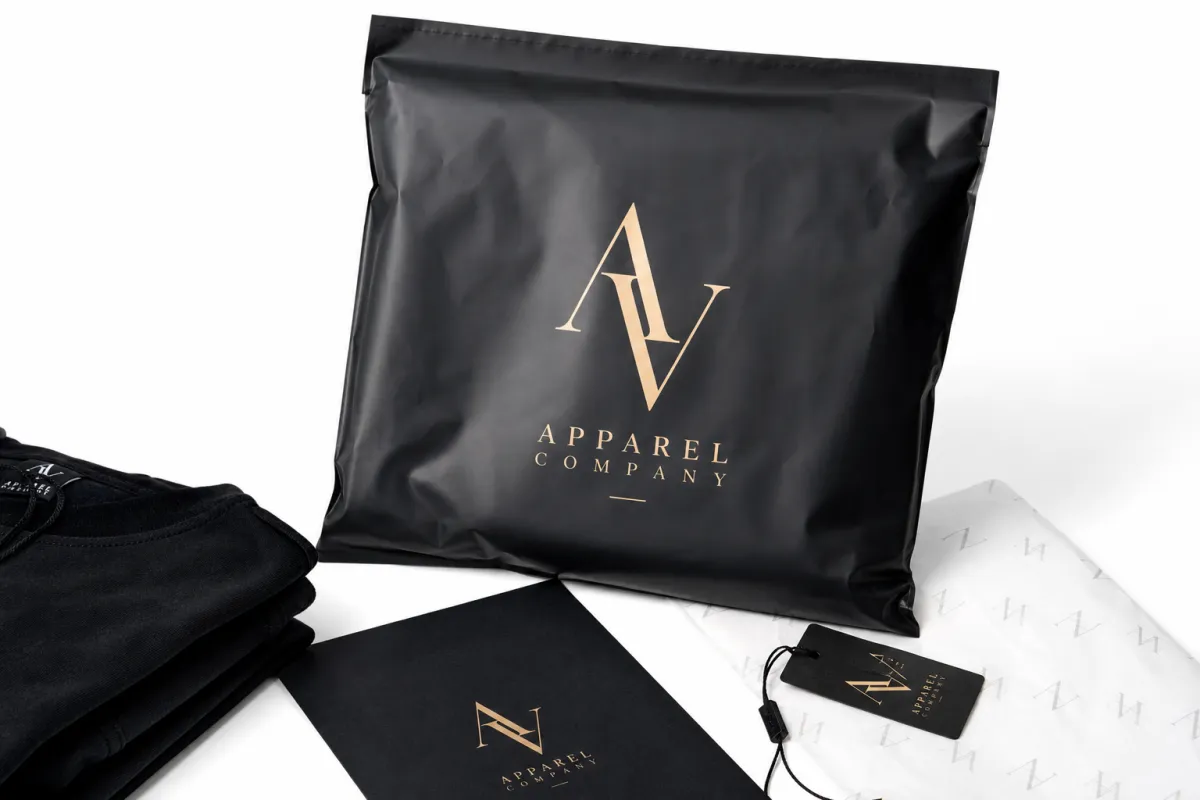
The package looks small. The effect usually is not. A plain mailer says, “we shipped your order.” A branded one says, “we paid attention.” For logo poly mailers for apparel brands, that difference matters because the mailer is often the first physical brand touchpoint a customer sees, and in some cases it gets seen more often than the hang tag, the insert card, or the garment itself before the bag is opened.
There is a practical side too. A poly mailer is lighter than a box, takes less shelf space, and usually costs less to move through carrier networks. That matters for low-ticket apparel where packaging overhead can eat margin quickly. If a brand can keep a shipment in a flat, self-sealing mailer instead of moving to corrugated boxes, the savings can be meaningful across hundreds or thousands of orders, especially during launches or seasonal drops where every cent gets felt.
Logo poly mailers for apparel brands also help the product feel more finished. A tee folded neatly inside a printed mailer with a simple logo, a clean color block, or a repeating pattern reads as more deliberate than the same tee tucked into a generic shipping bag. The effect stays subtle, and subtle is usually what people remember when they open a package on a couch, at a desk, or in a dorm room with a phone nearby.
From a brand point of view, the mailer is inexpensive advertising that already travels with the order. From a fulfillment point of view, it is a packaging format that does not ask the team to slow down. That combination explains why logo poly mailers for apparel brands show up so often in DTC clothing, boutique fashion, streetwear, activewear, and subscription apparel orders.
The mistake most brands make is spending months refining the product and then treating the outer package like an afterthought. You can finish a garment beautifully and still make the whole order feel forgettable if the outer mailer looks like every other parcel in the stack. Logo poly mailers for apparel brands fix that without much drama, provided the size, thickness, and print are chosen with some discipline.
I have seen that mistake repeat often enough to call it a pattern: the product gets all the polish, then packaging gets whatever is left in the budget. That is backwards. The bag is part of the experience, and if the brand voice is sharp, the package should be too.
How logo poly mailers for apparel brands work in fulfillment
In a warehouse or packing room, the process usually stays straightforward. Fold the garment, place it in tissue or a sleeve if your brand uses one, slide it into the mailer, press the self-seal strip, apply the shipping label, and hand it to the carrier. When the packaging is chosen properly, logo poly mailers for apparel brands do not slow the line down. They disappear into the workflow and leave the team with one less thing to think about.
That matters more than it sounds. A good mailer should be easy to grab, easy to seal, and hard to split open by accident. Standard custom printed mailers often use co-extruded LDPE film, usually in the 2.5 mil to 4 mil range, with a peel-and-seal adhesive strip. For most garment orders, that gives enough strength to keep the package clean and intact without turning the pack station into a wrestling match with plastic film.
Printing helps operationally too. Staff can sort branded mailers by size or SKU faster than unbranded bags in some setups, especially when the print includes a bold panel, a color cue, or a simple side mark. That matters in apparel operations where order mix shifts during a launch and the team needs to move quickly. Logo poly mailers for apparel brands are not only for the customer-facing side of the shipment; they can make the back-of-house process cleaner as well.
For higher-volume teams packing 200 to 500 orders per day, even a small gain in speed matters. If the mailer size is right, the adhesive holds, and the design does not require extra handling, the team can keep the line moving without adding a branded box, extra tape, or decorative fillers. That is the real advantage. Not drama. Not theater. Just faster packing with a better-looking result.
A mailer should do two things well: hold the product together and make the brand look intentional. If it does both, it earns its place.
For brands that want a more structured carrier handoff, it also helps to think about transit performance. Packages that travel through rough sortation or mixed carrier networks should be specified with enough film strength and seal quality to survive normal handling. If you need a benchmark for parcel testing, the ISTA site is a useful reference point for distribution testing methods, and that is a better conversation than guessing whether a thin bag will survive a hard week in transit.
The short version: logo poly mailers for apparel brands support unboxing without making fulfillment clumsy. If they force extra folds, extra labels, or extra staff training, they are the wrong mailer. If they slide into the existing process and make the shipment look more deliberate, they are doing the job.
Logo poly mailers pricing, MOQ, and unit cost basics
Price is where people get surprised, mostly because they compare the wrong things. A plain stock mailer and a custom printed mailer are not the same product, and logo poly mailers for apparel brands can vary a lot depending on size, print coverage, film thickness, and order quantity. The cleanest way to think about it is this: the more you customize, the more you pay, but the per-unit gap usually narrows as volume rises.
Typical minimums for custom print jobs often start around 1,000 to 3,000 pieces, though many factories are more comfortable at 3,000 to 5,000 units for better pricing and cleaner production setup. At lower volumes, the setup cost gets spread across fewer bags, so the unit price climbs quickly. That is why small brands sometimes look at a quote and assume the supplier is being dramatic. Usually, the math is just the math.
For a practical range, simple one-color branding on a standard garment mailer can land around $0.18-$0.32 per unit at 3,000 to 5,000 pieces. Two-side print, extra artwork, or heavier film can push that into the $0.24-$0.42 range. Full-coverage graphics, matte finishes, or specialty effects can reach $0.34-$0.62 or higher, depending on the order size. Smaller runs under 1,000 pieces can easily cost more per unit than that, especially if the design is custom and the bag size is not a stock format.
Here is a cleaner way to compare logo poly mailers for apparel brands:
| Option | Typical MOQ | Typical Unit Cost | Best Use |
|---|---|---|---|
| One-color logo on one side, 2.5-3 mil film | 1,000-3,000 | $0.18-$0.32 | Core apparel orders, clean branding, tighter budgets |
| Simple two-color print, standard thickness | 3,000-5,000 | $0.24-$0.42 | Brands that want stronger shelf impact without overpaying |
| Full-coverage print or specialty finish | 5,000-10,000+ | $0.34-$0.62 | Higher-volume apparel labels with stronger visual branding needs |
| Premium thick film, larger size, extra protection | 3,000+ | $0.30-$0.55 | Hoodies, heavier garments, mixed-item orders |
Then add the hidden costs people forget to mention until the invoice lands: freight, sample fees, setup charges, rush fees, and any special carton packing requirements. Samples may cost a little upfront, but skipping them is how brands end up buying thousands of bags that are the wrong shade of white, too glossy, too thin, or annoying to seal cleanly. Logo poly mailers for apparel brands are not expensive because they exist; they become expensive when the buying team ignores the real cost structure.
There is also a cash flow question. A 5,000-piece order at $0.28 per unit is $1,400 before freight and extras. A 10,000-piece order at $0.22 per unit is $2,200, which sounds higher until you notice the unit economics improved and the brand has more packaging inventory on hand. For apparel brands with stable SKUs and repeat ordering, larger runs often make sense. For brands still testing size mix or launch cadence, smaller runs protect you from dead stock and a pile of packaging that sits too long in a corner.
If you are comparing suppliers, ask for a breakdown of print coverage, film thickness, carton pack count, and lead time. That keeps you from comparing apples to plastic bags. Logo poly mailers for apparel brands should be priced as a complete packaging decision, not just a unit number on a quote sheet.
Production steps and timeline for logo poly mailers
The production path is usually simple, but each step can add friction if the details are sloppy. First comes artwork review. Then a digital proof. Then approval. After that, the factory prints, cures or finishes the film, cuts or folds the bags, packs them into cartons, and ships the order. For logo poly mailers for apparel brands, the biggest delays usually happen before printing starts, not after the line is already running.
A realistic timeline for a straightforward order is often 12 to 15 business days from proof approval to completed production, though some factories can move faster on a simple one-color run and others need more time if the line is busy or the order involves custom sizing. Add transit time on top. Air freight can land in 3 to 7 business days, while ocean shipping obviously takes longer and is better for larger replenishment runs than for a launch deadline.
Where do delays come from? Blurry artwork. Tiny logos that do not reproduce well. Slow proof approvals. Last-minute color changes. A shipping address that looks like it was typed in a hurry and never checked. Those are the classic blockers. The factory can only move as fast as the weakest step in the approval chain, and logo poly mailers for apparel brands are no exception.
If the parcels will face rough carrier handling, ask whether the supplier has tested the packaging against a relevant distribution profile. That does not mean every mailer needs heavy lab certification, but it does mean somebody thought about the trip instead of only the mockup. For general packaging sustainability and waste context, the EPA recycling guidance is also a useful reference when you are deciding whether your packaging claims match real-world disposal behavior.
Proof approval is the real speed bottleneck. Clean vector artwork, clear Pantone references, and a single decision-maker on the brand side can cut days off the timeline. Messy files do the opposite. The same goes for launch planning. If your promo calendar is set and the mailer has not been approved, you are not waiting on packaging. You are choosing to create a problem later.
Logo poly mailers for apparel brands reward the organized buyer. The earlier you lock the size, the better the art file, and the cleaner the sign-off, the fewer surprises you buy for yourself.
Key factors when choosing logo poly mailers for apparel brands
Good selection starts with the product, not the packaging catalog. A tee, a hoodie, a pair of leggings, and a two-piece bundle do not pack the same way, which means logo poly mailers for apparel brands should be chosen by packed dimensions, not by the flat garment label size alone. If you choose the wrong size, the package either looks stuffed or arrives with too much empty space and a fold that never quite sits right.
Size first
For light apparel, common sizes like 10 x 13 inches or 12 x 15.5 inches can work well. Hoodies often need 14.5 x 19 inches or similar. Larger multi-item orders may need 19 x 24 inches or bigger. The right size should let the garment fold cleanly, leave room for tissue or an insert, and still seal without strain. If one size cannot cover most orders, use two. That is usually cheaper than forcing every SKU into one bad fit.
Thickness and film
For many clothing brands, 2.5 mil to 3 mil film is enough for standard shipments. Go heavier if you are shipping bulkier garments, multiple items, or products that need more puncture resistance. Thinner bags save a little money and storage space, but they can feel flimsy and may split if the order is packed hard or handled roughly. Logo poly mailers for apparel brands work best when the film feels like packaging, not a temporary promise.
Print style and readability
Simple logos usually print cleaner than dense, photo-style art. One-color prints are often the best cost-to-impact ratio, especially if your brand mark is strong. Dark-on-dark and light-on-light artwork can look elegant on screen and disappointing on film, so ask for a proof or sample before you commit. A mailer needs to be readable at arm’s length, in poor warehouse light, and in a customer’s hallway.
Brand feel matters too. Matte film reads softer and less shiny. Gloss can look louder and more retail-forward. Clear windows or transparent panels are less common in apparel shipping, though they can work for certain product lines. Storage space also matters, because a case of mailers does not behave like a stack of folded tees. It takes room, and plenty of brands forget to plan for that until cartons are already arriving.
If sustainability claims are part of the pitch, be careful. Poly mailers are often recyclable only through specific collection streams, not standard curbside bins. If you are making any environmental claim, match it to what your customers can actually do. That is basic honesty, not marketing poetry. For disposal guidance, the EPA resource above is a better baseline than wishful thinking. If you ever use paper inserts or outer labels, a certified source like FSC can support paper-based material choices, but the claim still has to fit the actual component.
Logo poly mailers for apparel brands should fit your products, your staff, and your brand tone. Cute on a mockup is not enough. It has to work in a real packing room.
Common mistakes with logo poly mailers that waste money
The easiest way to waste packaging budget is to treat every SKU like a separate project. Brands order one mailer for tees, another for hoodies, another for outerwear, another for bundles, and suddenly storage is messy and purchase orders are annoying. A better move is to map the top three packed products and see whether two mailer sizes can cover 80% to 90% of orders. Logo poly mailers for apparel brands should simplify the operation, not create another inventory headache.
Another common mistake is overdesigning the print. A brand may pay extra for metallic effects, four colors, or full wrap coverage even though the customer sees the package for five seconds before opening it. If the logo and color system are already strong, a cleaner print is often better. Simple usually beats busy more often than the design team wants to admit.
Skipping samples is lazy and expensive. I will say that plainly. A sample catches size issues, film feel, adhesive problems, and color mismatches before the full order ships. If you are placing 5,000 or 10,000 bags, a sample is not a luxury. It is insurance. Logo poly mailers for apparel brands should be proofed in the hand, not only on a screen.
- Buying the wrong size and forcing awkward folds or extra air inside the bag.
- Approving artwork too fast and discovering that the logo is too small, too dark, or too low-contrast.
- Forgetting storage space and ending up with cartons stacked in the wrong place.
- Ordering too late and paying rush charges that erase the savings you thought you found.
- Ignoring adhesive strength, which is a great way to create returns-related headaches nobody wants.
There is also the “looks cheap because it is cheap” trap. Brands sometimes choose the lowest unit price, then pay for it through damaged perception, slower packing, or a weak seal that leads to rework. A package that saves two cents but creates ten cents of labor is not a win. It is a spreadsheet trick with a clean row and a messy outcome.
In practice, the best logo poly mailers for apparel brands are the ones that reduce friction at the packing table and look right in the customer’s hands. That combination is harder to buy than a plain bag, but it is worth it.
Expert tips and next steps for logo poly mailers
Start with an audit. Pull your top three apparel SKUs, measure the packed dimensions, and check how often each order type appears. If two sizes cover most shipments, that is usually the sweet spot. If one size works for almost everything, even better. Logo poly mailers for apparel brands should reflect actual order behavior, not a theoretical product catalog that only looks tidy on paper.
Next, gather artwork in vector format. EPS, AI, or a clean PDF will usually save time and reduce errors. Confirm the brand colors you want to match, decide whether the print should be one side or two, and ask for a digital proof before you place the order. If color matters a lot, ask for a printed sample too. That extra step catches the sort of mistakes that are easy to ignore on a laptop and painful to fix on freight day.
Quotes should be compared side by side, and not just on unit cost. Look at MOQ, shipping method, lead time, sample cost, print coverage, and whether the supplier can keep the same spec on reorder. That is the real comparison. The cheapest line item can turn into the priciest order once freight and delays are added. Logo poly mailers for apparel brands need to be evaluated as part of your packing system, not as an isolated purchase.
A packaging quote is only good when it is complete. If the price looks low but nobody mentioned freight, samples, or lead time, the quote is missing the part that costs you later.
If you want a practical next move, compare a simple logo mailer and a slightly upgraded version side by side. Look at the real differences in hand feel, print clarity, and carton count. Often the middle option is the one that makes the most sense. It is branded enough to matter, sturdy enough to survive transit, and not so expensive that it starts eating margin.
For brands still building their packaging program, the smartest path is usually simple: choose a mailer that fits the top-selling apparel items, keep the artwork clean, and reorder before inventory gets tight. That avoids rush fees and keeps the packing room calm. It also keeps your packaging from becoming a monthly panic event, which nobody needs.
Use the packaging pieces that fit your business now, then scale them as your order volume grows. If you need a starting point, our Custom Packaging Products page shows the range, and the Case Studies page gives a better sense of how packaging decisions play out once real orders start moving. For a product-specific path, revisit our Custom Poly Mailers page and compare the formats with your packed dimensions in hand.
Choose logo poly mailers for apparel brands that match your products, your budget, and your fulfillment speed. That is the whole game. Not the fanciest bag on the screen. The one that works every day, keeps the brand sharp, and does not waste money pretending to be more complicated than it needs to be.
FAQ
What size logo poly mailers work best for apparel brands?
Start with your most common packed item, not the flat garment size. Leave room for folding, tissue, inserts, and a clean seal without forcing the product. If you ship multiple categories, test two sizes rather than squeezing everything into one.
Are logo poly mailers for apparel brands expensive?
Not usually on a per-order basis, but price depends on quantity, print complexity, and material thickness. Smaller orders carry a higher unit cost because setup and production overhead get spread across fewer bags. The real question is whether the branding lift and packing efficiency justify the difference.
How long does production usually take for custom logo mailers?
Simple orders move faster than full-coverage custom prints with complex artwork. Proof approval is the main speed bottleneck, so clean files and fast sign-off help a lot. Build extra time into launches if you need new sizing, samples, or freight shipping.
What should apparel brands check before ordering logo poly mailers?
Confirm the garment mix, packed dimensions, and how many SKUs the mailer needs to cover. Check artwork quality, logo placement, and whether the print still looks good after handling. Ask for MOQ, unit cost, shipping Cost, and Turnaround before comparing suppliers.
Do logo poly mailers for apparel brands need samples first?
Yes, if you care about color accuracy, seal quality, or whether the size actually fits your products. Samples catch avoidable mistakes before you pay for a full run. A sample is cheaper than discovering a bad fit after 5,000 bags show up.
Pick logo poly mailers for apparel brands that match your packed size, print strategy, and reorder rhythm.
If you only act on one thing, make it this: measure the packed dimensions of your top-selling apparel items, choose two mailer sizes that cover most orders, and request samples before you place the full run. That one step usually tells you more than any quote sheet ever will.


