Buyer Fit Snapshot
| Best fit | Lotion Packaging Bottles Custom projects where brand print, material claims, artwork control, MOQ, and repeat-order consistency need to be specified before quoting. |
|---|---|
| Quote inputs | Share finished size, material target, print colors, finish, packing count, annual reorder estimate, ship-to region, and any compliance wording. |
| Proofing check | Approve dieline scale, logo placement, barcode or warning zones, color tolerance, closure strength, and carton packing before bulk production. |
| Main risk | Vague material claims, crowded artwork, missing packing details, or unclear freight terms can make a low unit price expensive after revisions. |
Fast answer: Lotion Packaging Bottles Custom: Design, Cost, Timing should be specified like a repeatable production item. The safest quote records material, print method, finish, artwork proof, packing count, and reorder notes in one written spec.
Production checks before approval
Compare the actual filled-product size with the drawing, then confirm tolerance on folds, seals, hang holes, label areas, and retail display edges. Reserve space for logos, QR codes, warning copy, and material claims before decorative graphics fill the panel.
Quote comparison points
Review material grade, print process, finish, sampling route, tooling charges, carton quantity, and freight assumptions side by side. A quote is only useful when the supplier can repeat the same color, closure quality, and packing count on the next order.
What Are Lotion Packaging Bottles Custom?
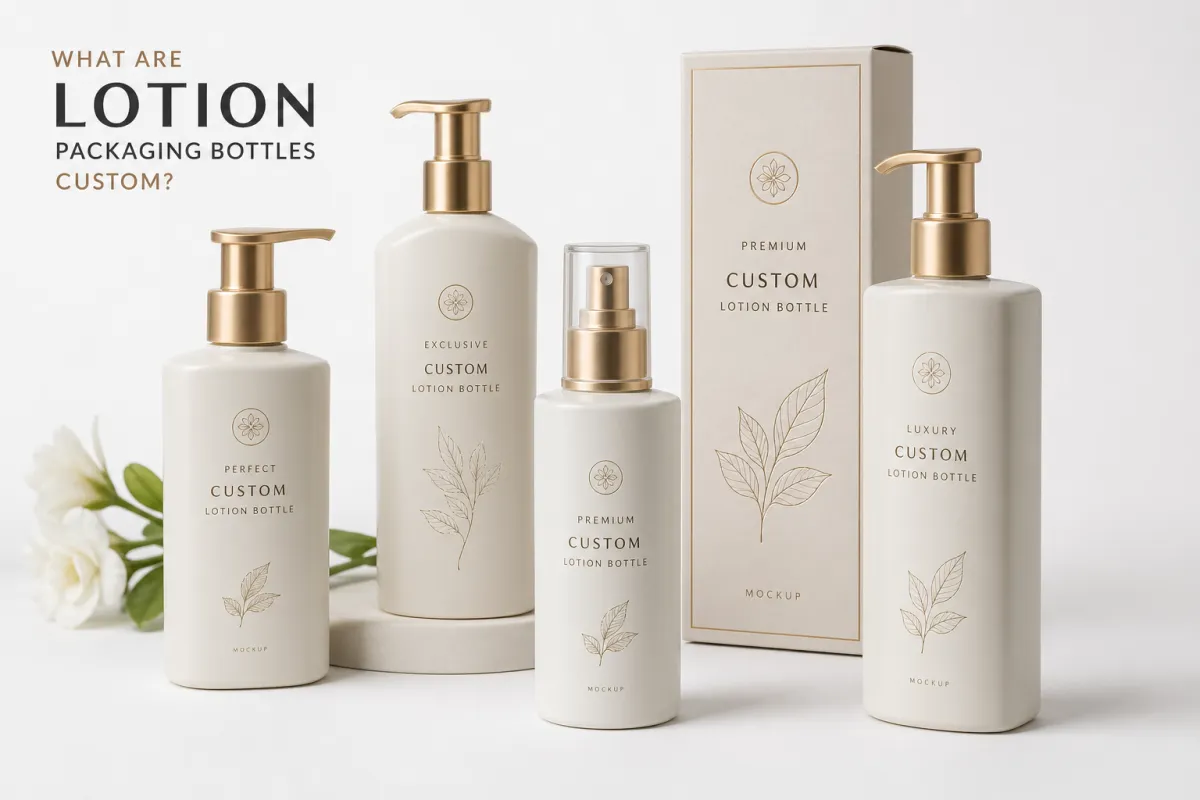
Most buyers decide how a lotion feels before they ever open it, and the bottle is usually the first clue. I remember handling a $9 hand cream that suddenly felt like a prestige item simply because the neck finish was clean, the panel width was 48 mm instead of 32 mm, and the cap closed with that soft, exact click packaging people recognize by sound. That is the real force of lotion Packaging Bottles Custom: they shape the first judgment in about three seconds, long before anyone studies the ingredient list or checks whether the formula uses 5% shea butter or 12% glycerin. For brands comparing custom lotion bottles, the difference often shows up faster than they expect.
At its simplest, lotion Packaging Bottles Custom means the container is built around the brand position, the formula viscosity, the dispensing method, and the shelf impact you want in retail packaging or DTC product packaging. A 50 mL travel bottle for prestige skincare behaves very differently from a 500 mL family-size body lotion bottle on a bathroom shelf in Chicago or Manchester. The same holds for a pump bottle designed for a silky emulsion versus a thicker cream that needs a wider orifice and a stronger spring rated at 0.35 N to 0.45 N. Packaging is never just a container; it is a small, stubborn machine with a branding job.
Buyers often fixate on one variable and overlook the others. I remember a client meeting in Shenzhen where the team had fallen in love with a frosted oval bottle, but the formula was a 12,000 cP body lotion with shea butter and oat extract. The bottle looked elegant on a mood board, yet the first test fill pushed air back through the pump because the dip tube and actuator were not matched to the product. That is why Lotion Packaging Bottles custom is never only about appearance. It is package branding, dispensing behavior, and shelf logic in one decision.
The business result matters as much as the design. A better bottle can raise perceived value, reduce shipping damage, and support repeat purchase behavior if the shape is easy to grip and the pump stays consistent after 40 or 50 actuations. For refill programs, a straight-wall PET bottle with a 1.2 mm wall can be easier to clean and reuse than a decorative shape with a narrow waist and a 15 mm shoulder radius. For branded packaging, that practical choice can be the difference between a one-time purchase and a product that earns space in the cabinet. I think that last point gets ignored because it sounds less glamorous than a render, but the shelf does not care about glamour. It cares about whether the thing works and arrives intact.
I see buyers underestimate how much the bottle does for the formula. A hand cream in plain packaging may sell on claims alone, but a premium skincare line usually needs a stronger visual signal. When the package has the right finish, the right opacity, and the right cap, the formula feels more trustworthy before the customer even squeezes it. That is exactly why lotion packaging bottles custom comes up so often in packaging design meetings in Los Angeles, Guangzhou, and Dongguan. I have sat in enough of those meetings to know the conversation usually starts with "Can we make it look expensive?" and ends with "Can the pump actually move this cream at 1.0 cc per stroke?"
If you are comparing options, think in three layers: the functional layer, the branding layer, and the logistics layer. Functional means viscosity, dosage, and leakage control. Branding means panel size, color, and decoration. Logistics means carton count, pallet height, and freight weight. A bottle that wins in all three categories is usually the one that survives launch without an expensive redesign. For many teams, that is where Custom Packaging Products becomes useful, because the right base component often shortens the path from concept to shelf by 2 to 4 weeks.
How Do Lotion Packaging Bottles Custom Projects Work?
The cleanest lotion packaging bottles custom projects start with a brief that answers the messy questions early. I want to know the fill volume, the formula viscosity, the target market, the neck finish, the launch date, and the MOQ before anyone opens a CAD file. If a supplier has to guess whether the bottle should be 100 mL or 150 mL, or whether the closure is 24/410 or 28/410, the schedule starts slipping immediately. That is not theory; I have seen a three-week delay come from a single missing neck specification on a project in Ningbo, and the fix was only one sentence long. The most reliable custom lotion bottle programs usually look boring on paper, which is a compliment in packaging.
The workflow usually runs in five stages. First comes the brief. Then concept drawings or a catalog search for stock bases. After that, a sample or prototype is produced, followed by compatibility testing with the formula, the pump, and the liner. Only then do you move to artwork approval and mass production. On a simple semi-custom job, I have seen the full cycle close in 18 to 25 business days. With a new mold, custom color matching, and a decoration package, it can stretch to 45 business days or more, especially if the supplier is already booked on another line in Zhejiang or Jiangsu. Factory calendars have a funny way of behaving like airport tarmacs: everything looks available until it suddenly is not.
One of the most common pressure points is the sample round. A bottle may look perfect until the customer tests a heavier lotion, then discovers that the actuator needs more force or that the pump draws air after the bottle tilts at 30 degrees. Another delay appears during closure matching. A cap can fit the neck finish mechanically and still fail visually because the wall thickness makes the shoulder look uneven. That is why I insist that lotion packaging bottles custom projects include compatibility tests before final approval. If the sample stage feels slow, I usually tell clients to endure it now or pay for it later. Later is always more expensive.
There is also a scheduling truth that new buyers rarely expect: factories do not build one job at a time. They batch by resin, color, decoration, and closure type. If your order needs a custom pearlized PET body and a matte black PP pump, you may be waiting for a production window that fits both components. I once watched a line in a contract filling plant in Dongguan stall for half a day because the carton spec changed from 12 bottles per shipper to 24, which altered the pallet pattern and the receiving checklist. Small changes are rarely small in packaging, which is a polite way of saying packaging can be fussy in the most inconvenient ways.
For transit confidence, I like to point clients to the shipping-test logic used by ISTA. Their methods are useful because lotion leaks, cracked shoulders, and cap failures often show up after vibration, drops, and temperature swings rather than during a calm bench inspection. If your supplier can show test data, the project becomes much easier to defend internally. That matters especially for lotion packaging bottles custom when the launch goes into retail packaging or export channels from Shanghai, Rotterdam, or Atlanta.
When I visited a supplier floor outside Ningbo, the engineer told me something I have never forgotten: "A bottle is only custom after it survives the formula." He was right. A beautiful rendering is only the opening line. The real work happens when fill line speed, torque, liner compression, and shelf presentation all agree on the same bottle. A line running 60 bottles per minute does not care how elegant the mockup looks in a PDF.
Materials, Pumps, and Shapes That Affect Performance
Material choice changes more than cost. It changes weight, clarity, barrier performance, recyclability, and how the bottle feels in the hand. For lotion packaging bottles custom, the common options are PET, PCR PET, HDPE, glass, and aluminum, and each one behaves differently once the lotion is filled and shipped. A clear 250 mL PET bottle may look sharp on a shelf in Seoul, but a thick white HDPE squeeze bottle may be better for a family lotion that gets used in the shower every day. The right material usually looks obvious in hindsight, which is not helpful when you are staring at six samples and one of them looks prettier in the conference room light.
Here is the broad comparison I give clients when they ask for a practical starting point. PET usually wins on clarity and cost. PCR PET adds a sustainability story but can bring color variation and higher resin cost. HDPE is a workhorse for squeeze formats and thicker formulas. Glass feels premium, though it adds weight and breakage risk. Aluminum offers a strong visual cue and good light protection, but it is not the easiest path for every pump system. For brands that care about recycled content and paper components, I also point them to the FSC standard when carton and label sourcing matter alongside the bottle itself. In practice, a 350gsm C1S artboard carton with an FSC-certified liner can support the bottle story as much as the resin choice.
| Option | Typical Use | Approx. Unit Cost | Strengths | Tradeoffs |
|---|---|---|---|---|
| PET bottle | Body lotion, hand cream, travel sets | $0.18-$0.42 at 5,000 pcs | Clear, lightweight, easy to decorate | Lower barrier than glass, can scratch |
| PCR PET bottle | Sustainability-led skincare | $0.22-$0.48 at 5,000 pcs | Recycled-content story, familiar handling | Color drift, supply inconsistency |
| HDPE bottle | Squeeze lotion, family-size formats | $0.16-$0.35 at 5,000 pcs | Durable, good for thicker formulas | Less premium clarity |
| Glass bottle | Luxury skincare, spa retail | $0.60-$1.40 at 5,000 pcs | Heavy, premium feel, strong shelf signal | Breakage, freight weight, higher insurance risk |
| Aluminum bottle | Travel, premium protection, niche lines | $0.55-$1.10 at 5,000 pcs | Light-blocking, distinctive look | Decoration limits, dent risk |
Pump and closure choice matter just as much. A lotion with a medium viscosity may work beautifully with a 24/410 pump that dispenses 0.8 cc per stroke, while a thicker cream may need 1.2 cc and a wider orifice. Flip-top caps are fast for everyday body lotion. Disc-top caps work well for squeeze bottles. Airless systems are excellent for preserving sensitive formulas, but they add cost and usually increase the complexity of lotion packaging bottles custom orders by a noticeable margin. I have seen buyers shave $0.07 per unit simply by moving from an airless package to a standard pump, but that only works if the formula does not need extra protection. The savings look wonderful in a spreadsheet; the ruined formula looks less wonderful in a warehouse.
Shape is the hidden variable. A round bottle ships efficiently because it nests well, but an oval or asymmetrical profile gives a stronger shelf presence and more room for branded packaging. Wall thickness affects both feel and durability, especially on shoulder-heavy shapes. A bottle with a 1.0 mm wall can look elegant but feel flimsy if the resin choice is too soft. A bottle with 1.4 mm walls can survive rougher handling, yet it may add 8 to 12 grams per unit, which matters when you are loading 20,000 pieces into a container leaving Yantian or Long Beach. That kind of weight difference sounds tiny until freight invoices arrive and everyone suddenly becomes a mathematician.
Decoration is where package branding becomes visible. Silk screening gives you crisp logos on a smooth panel. Pressure-sensitive labels can carry more color, but they introduce placement tolerance and adhesive questions. Hot stamping works well on matte surfaces if you want a metallic accent. Color matching with masterbatch is effective, although a custom color run may require minimums that feel oversized for a smaller launch. One buyer I worked with asked for a deep amber body, a matte silver cap, and a white logo, which sounded simple until we discovered the logo panel had a slight curve that distorted the type at 6-point size. Packaging is full of tiny betrayals like that.
That is why I tell teams to think about lotion packaging bottles custom as one system, not five separate parts. The bottle, the pump, the liner, the label, and the outer carton all interact. A label that looks elegant on a flat render may wrinkle once applied to a shoulder radius of 18 mm. A pump that passes leak testing may still feel too stiff for a spa customer using one hand in a shower. Good packaging design handles those details early, before they become warehouse problems and customer complaints on day three of the launch.
How to Budget for Lotion Packaging Bottles Custom
Budgets get clearer when you separate the parts. For lotion packaging bottles custom, I usually break the quote into six buckets: unit cost, tooling, decoration, testing, freight, and secondary packaging. If you treat the quote as one number, you miss the levers that actually move it. A bottle might be $0.24 each, but add a custom color, a silk-screen logo, a specialty pump, and a shipper change, and the landed cost may rise by 35% before anyone notices. That is the sort of surprise that makes finance teams stare at invoices as if the paper itself has committed a crime.
Tooling is the first surprise. A stock bottle base with a standard neck finish may require little or no tooling, while a full custom mold can land anywhere from $3,500 to $18,000 depending on complexity and cavity count. A 4-cavity mold in Zhejiang will usually cost less than an 8-cavity mold in a high-automation plant near Guangzhou, but the lead time and scrap rate can shift the math. Decoration is the second surprise. A one-color silk screen is often inexpensive in volume, but a multi-pass print with metallic ink and a matte spray finish adds labor, rejects, and setup time. If your formula demands compatibility testing, add another week or two and a few hundred dollars in sample and lab time. That is normal, not a warning sign. In packaging, normal often just means "prepare to wait and pay attention."
MOQ is where many first-time buyers get caught. A supplier may quote 10,000 pieces because the color batch, closure run, and carton allocation all point to that threshold. Another supplier may accept 3,000 pieces but charge a higher unit price because they are pulling from stock components. The cheapest quote is not always the best deal. I have seen a brand choose a low unit price, only to discover they needed a second production run within 60 days because the design did not fit the shelf test and had to be revised. Saving $400 up front and then paying for a rush order is not savings; it is just a delayed headache.
To make the tradeoffs visible, I like to use a simple matrix. Compare target margin, acceptable unit price, expected volume, and lead-time tolerance side by side. If you can tolerate 6 extra business days, a semi-custom option may save enough money to improve your launch ad budget by $2,000 or more. If your margin is already tight, a $0.06 increase in bottle cost can matter more than a fancy cap that adds shelf sparkle. That is how lotion packaging bottles custom should be evaluated: not as a vanity purchase, but as a margin decision.
Here is the practical range I see most often for a 5,000-piece run of lotion packaging bottles custom:
- Stock bottle with label: $0.18-$0.32 per unit, 10-15 business days after approval.
- Semi-custom bottle with custom color and standard pump: $0.28-$0.55 per unit, 15-25 business days after approval.
- Fully custom mold with decoration package: $0.55-$1.40 per unit, 30-45 business days or longer.
Secondary packaging can quietly change the economics too. A bottle that requires a wider carton may increase corrugate by 8% and pallet height by 2 inches. If you are also ordering Custom Printed Boxes, that outside dimension affects the entire packing line. I have watched a finance team focus on a $0.03 label savings while ignoring the extra freight cost from a heavier glass bottle, which ended up adding $1,100 on a single domestic lane from Dallas to Newark. Shipping math has a way of exposing bad assumptions, and it does so without any sympathy at all.
If the brand story depends on premium tactile feel, I recommend spending on the bottle surface before spending on fancy extras. A matte shell, a precise pump, and a clean closure line often do more for perceived value than a complex secondary seal. For many launches, lotion packaging bottles custom work best when the budget favors fit, fill reliability, and freight efficiency over decorative clutter. That is the part people rarely hear from suppliers, because it is not as glamorous as a shiny render, but it is usually the better business decision.
Step-by-Step Guide to Ordering Custom Lotion Bottles
Step one is defining the formula, audience, and shelf position before you look at samples. A 30 mL prestige hand cream needs a different bottle than a 300 mL family lotion. If your texture is thick, creamy, or particulate-heavy, say so in grams per minute or centipoise, not just "medium thickness." That one detail changes whether the supplier recommends a pump, a flip-top, or an airless format for lotion packaging bottles custom. I know that sounds technical, but it saves you from the classic "why is the pump fighting the formula?" complaint later.
Step two is narrowing the technical shape of the quote. Ask for the material, the neck finish, the size range, the closure type, and the decoration method. A supplier can quote faster when they know whether you need PET, PCR PET, or HDPE, and whether the closure is 24/410 or 28/410. If you are planning a launch in retail packaging, include the carton dimensions now, not after samples arrive. A 2 mm difference in bottle diameter can change how 12 units fit in a tray and how 48 trays fit on a pallet. I have seen this tiny mismatch turn a tidy packing plan into a pile of awkward recalculations.
Step three is requesting dielines, samples, and compatibility tests. A lot of launches either get smarter or get expensive there. I once worked with a brand that approved a lovely 150 mL oval bottle in two days, only to find the lotion crept up the neck after seven days in a warm warehouse at 32 degrees Celsius. The fix was simple: a different liner and a slightly stiffer pump spring. But the delay cost them 11 business days. Good lotion packaging bottles custom ordering always includes a fill test, a leak test, and a storage test before the final sign-off.
Step four is approving artwork and the production schedule at the same time. If the logo sits 6 mm too low, the bottle may still work, but it will look wrong on a shelf. If the decoration uses four Pantone colors and a metallic accent, give the supplier enough time to align the print cylinders. This is also the point where I advise brands to confirm quality checks in writing: AQL level, torque range, pump output, and carton count. Small details like these save big arguments later. They also keep people from pointing at each other when something drifts by 2 mm and suddenly becomes "a brand issue."
Step five is planning the factory handoff. Fill-line trials, receiving inspection, and case pack sizing all need to happen before the first pallet ships. If your co-packer fills at 40 bottles per minute, they will want stable dimensions and a closure that does not jam the line. If you are using a manual or semi-automatic filling setup, the bottle base should sit flat enough that the operators are not constantly adjusting it. That kind of operational detail is exactly where lotion packaging bottles custom prove their value in facilities from Mexico City to Melbourne.
In one client meeting, a sales director asked why I was spending so much time on a bottle sample that looked "close enough." I told her the same thing I tell every team: close enough is expensive later. A packaging issue on day one is a logistics issue; a packaging issue after launch is a brand issue. The difference can be thousands of dollars in rework, expedited freight, and lost confidence, especially if the product is already scheduled for a retailer reset in 14 days.
Common Mistakes That Slow Launches or Raise Costs
The biggest mistake I see is choosing the bottle before confirming viscosity and pump compatibility. A lotion that flows at 8,000 cP is not the same as a cream at 18,000 cP, and the wrong pump can lead to weak output, stringing, or clogging. I once saw a launch delayed because the team liked a slim pump on the render, then discovered it could not handle the formula after three days of cold storage at 5 degrees Celsius. For lotion packaging bottles custom, the bottle cannot be separated from the formula. Try to do that, and the project will punish you for it.
Another common error is treating decoration as a last-minute task. A label that looks fine in a PDF may not fit a curved panel with a 14 mm shoulder radius. Color placement can drift 2 to 3 mm during application, which is enough to make a premium package look off-center. If the brand also wants Custom Printed Boxes, the box artwork and the bottle artwork should be reviewed together. Otherwise the package branding story splits into two different visual languages, and the whole launch starts looking oddly stitched together. A mismatch between a warm ivory bottle and a cool gray carton can feel small in a file and glaring on a shelf.
Freight is the third hidden trap. A glass bottle may cost less in unit terms than some decorated plastics, but the pallet weight and breakage risk can turn that saving upside down. The same holds for aluminum if the shape dents during transit. I have seen brands compare bottle prices without accounting for the full landed cost, only to discover the "cheaper" option required more corrugate, stronger dividers, and higher insurance. That is not a small difference on a 10,000-unit run. It is the kind of difference that eats into a marketing budget before anyone has a chance to object.
The fourth mistake is approving a sample too quickly. A bottle that looks perfect on a desk can fail after two weeks in a hot storeroom, especially if the formula separates or the liner absorbs scent. Real testing needs real conditions: 40 degrees Celsius storage, 3-foot drop simulation where appropriate, and line compatibility during filling. If the supplier cannot explain how they test, that should slow you down, not speed you up. For many lotion packaging bottles custom projects, a one-week delay at the testing stage prevents a month of rework later.
Here is the hard truth I learned during a negotiation with a pump supplier in Guangzhou: everyone in the chain is looking for margin somewhere. If the bottle team hides a weak closure, the filling team pays for it. If the artwork team squeezes too much copy into a small panel, the label team pays for it. Good sourcing means asking where the risk lands, not just where the price lands. That mindset is what separates efficient lotion packaging bottles custom sourcing from optimistic guessing.
One more thing: do not ignore the carton and shelf footprint. A bottle that looks elegant in isolation can become awkward when packed 6 across in a retail shipper or 24 per master carton. If the shelf width is 300 mm and your bottle plus label equals 310 mm in practice, the plan fails. Numbers like that matter more than adjectives, which is why the best packaging design conversations sound like manufacturing, not marketing. A single extra millimeter can be the difference between a clean shelf plan and a reorder of 8,000 cartons.
Next Steps for Lotion Packaging Bottles Custom Orders
If you are getting ready to source lotion packaging bottles custom, start with a brief that lists the non-negotiables: dosage, grip, finish, target price, fill volume, and the brand story the bottle must tell. I would also include the formula type, the planned neck finish, the preferred decoration method, and the launch deadline. A one-page brief can save a week of back-and-forth, especially when you are comparing suppliers across three time zones. It also stops the conversation from drifting into vague opinions, which is where good projects quietly go to die.
Next, request samples from two or three suppliers so you can compare the actual feel, clarity, closure quality, and print consistency. Put them on a shelf under the same light. Fill them. Shake them. Wipe them down with alcohol. Test the pump 20 times. That is the real difference between a nice render and a bottle that can live in the market. For lotion packaging bottles custom, the best sample is the one that survives handling, not just approval. A factory in Guangzhou may send a perfect photo; your desk test will tell you whether the pump burps at stroke 11.
Then build a buffer into your schedule if you need custom color matching, tooling, or multiple rounds of revision. I usually recommend a 10% time buffer on simple orders and a 20% buffer on full custom projects. That sounds cautious, but it is far cheaper than paying for air freight because a pump arrives three days late. If your line also needs Custom Packaging Products for cartons, inserts, or related components, coordinate them at the same time so one delay does not stall the whole launch. A carton approved on Tuesday and a bottle approved on Friday can still create a bottleneck if the print files do not match the final 110 mL fill volume.
My final opinion is straightforward: lotion packaging bottles custom sit at the intersection of brand, function, and budget. The strongest bottle is not always the fanciest one. It is the one that fills cleanly, ships safely, looks intentional on shelf, and keeps the unit economics intact. I have seen brands gain more traction from a well-chosen 24/410 PET bottle than from an expensive but awkward glass concept. That should tell you something about how buyers really behave in retail from Dallas to Düsseldorf.
If you remember only one thing, make it this: the right lotion packaging bottles custom project does not begin with decoration. It begins with the formula, the user, and the line that has to run it. Get those three aligned, and the rest becomes much easier to price, sample, and approve. A bottle built around an 18,000 cP cream and a 1.2 cc pump will outperform a prettier bottle built on guesswork every time. Pick the bottle around the product, not the other way around, and you will save yourself a lot of kind of unnecessary drama.
FAQ
How long do lotion packaging bottles custom orders usually take?
Stock bottles can move in 10 to 15 business days after approval, but lotion packaging bottles custom with tooling, revised artwork, or new closures often take 30 to 45 business days. Lead time also depends on whether the supplier needs compatibility testing, whether the decoration uses multiple colors, and whether the factory already has the resin or pump in stock. I always recommend keeping at least a 1- to 2-week buffer before launch so a sample change or freight delay does not push the schedule. I learned that lesson the hard way after a pump shipment arrived exactly late enough to ruin a very optimistic calendar.
What material works best for custom lotion packaging bottles?
PET is a strong choice for clarity, light weight, and a cost range that often starts around $0.18 per unit in volume. HDPE works well for squeeze formats and thicker formulas because it is durable and practical. Glass can feel premium, but it adds shipping weight and breakage risk, which makes it less forgiving for many lotion packaging bottles custom programs. The best material depends on viscosity, shelf positioning, and whether you need a luxury cue or a workhorse package. My honest view? Start with the formula, not the fantasy.
What drives the price of lotion packaging bottles custom most?
MOQ, tooling, and decoration usually move the price more than anything else. A full custom mold can add several thousand dollars upfront, while a custom color, specialty pump, or multi-pass print can raise the unit price by $0.05 to $0.20 or more. Freight and testing matter too, especially when the bottle is heavy or fragile. For lotion packaging bottles custom, the cheapest quote often becomes expensive once you add cartons, labels, and shipping. I have seen more than one "great deal" turn into a spreadsheet-shaped headache.
Can one custom lotion bottle work for different formulas?
Sometimes, but only if the formulas are close in viscosity, filling behavior, and barrier needs. A bottle that works for one light lotion may fail with a thicker cream or a formula that separates in heat. Test each version with the same bottle, pump, and liner before you commit. In practice, lotion packaging bottles custom are more reliable when the package is chosen around the most demanding formula, not the easiest one. That rule saves everyone a lot of unnecessary improvisation later.
What should I send suppliers before requesting a quote?
Share fill volume, formula type, target market, expected order quantity, decoration preference, and launch deadline. If you already know the neck finish, closure type, and color direction, include those too. The more specific your brief, the more accurate the quote and timeline will be for lotion packaging bottles custom. I have seen a one-page brief cut the quoting cycle from a week to two days because it removed the back-and-forth on basics. Suppliers like clarity more than mystery, which is refreshing for everyone involved.