For apparel teams that need packaging to look polished without overcommitting to inventory, frosted garment bags Low MOQ Custom order is a practical place to start. The frosted finish gives the bag a cleaner, more premium read than a fully clear sleeve, while the lower minimum order keeps the risk manageable during a launch or seasonal update.
The appeal is not cosmetic alone. Semi-opaque film softens hanger hardware, fold marks, and transit scuffs, which helps the package look intentional even when the garment itself is basic. That matters for capsule drops, boutique labels, uniforms, and limited editions where the packaging has to support the product rather than compete with it.
Low-MOQ custom packaging also serves established brands that need a short-run solution. A new silhouette, a temporary retail program, or a separate packaging system for premium inventory can all justify a smaller order, especially if the team wants proof before scaling up.
Why a low MOQ frosted garment bag order works for small runs
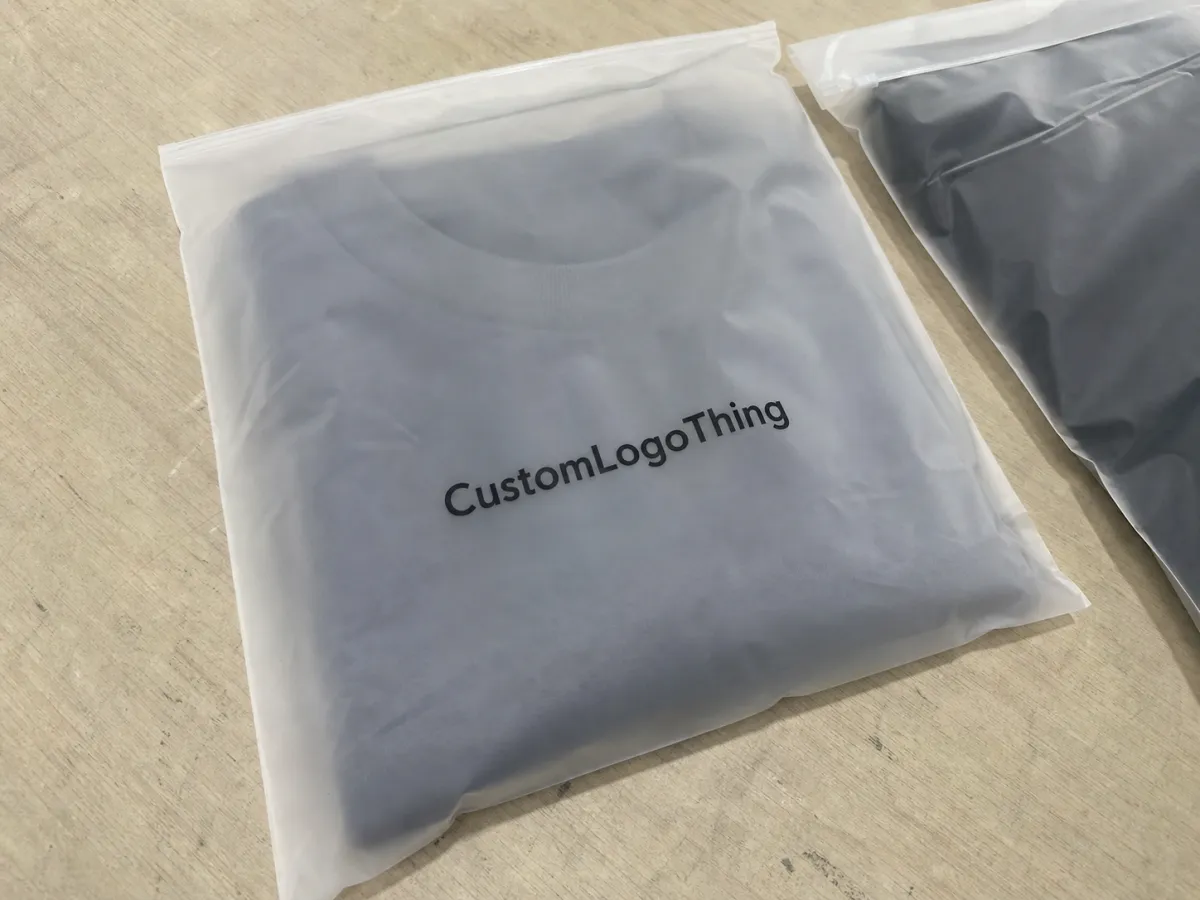
A low minimum makes sense whenever the packaging spec is still being tested. Frosted film sits in a useful middle ground: it allows the garment to remain identifiable, but it hides enough detail that the bag reads cleaner than a plain clear sleeve. For retail presentation, that difference is larger than it sounds.
Clear film tends to reveal every crease, label edge, and shipping mark. Frosted film gives the eye less noise. A folded shirt looks more deliberate. A coat or blazer looks less bulky. Even in a stock room, the softer finish can make a line of hanging garments appear more organized.
Low MOQ is also a good way to catch design errors before they become expensive. Buyers can confirm whether the hanger hole sits correctly on the rack, whether the closure works with the actual packing method, and whether the bag width is generous enough for the garment’s shape. Those details are easy to underestimate from a flat spec sheet.
The strongest use cases usually fall into a few categories:
- Capsule launches with short sales windows
- Boutique or DTC brands that want premium-looking packaging without excess stock
- Test runs for a new print, size, or closure style
- Seasonal programs where garment bulk changes quarter to quarter
That is why frosted garment bags Low MOQ Custom Order often works better than waiting for a large run to justify the spec. You learn faster, and the packaging remains easy to adjust.
One practical advantage is flexibility across SKUs. A brand may need the same visual language for shirts, dresses, and outerwear, but each garment asks for a different bag size and maybe a different gusset. Small runs make those adjustments possible without forcing the whole inventory into a single compromise.
Film thickness, finish, and sizing details buyers should check
The most important choice is the film. Frosted garment bags commonly use polyethylene film in the 2.5 to 4 mil range for apparel applications, with heavier builds available when the bag needs more body or puncture resistance. Thinner film is cheaper and lighter, but it can wrinkle more easily. Thicker film usually looks better on a hanger and feels more substantial in the hand.
Opacity matters just as much as thickness. Some frosted bags are only lightly translucent; others are much closer to a milky semi-opaque finish. If the goal is to soften what is inside, ask for a sample or a close proof reference. A small difference in opacity can change how the entire packaging line reads on the rack.
Sizing should follow the garment, not a generic template. A shirt bag may work at around 24 x 40 inches with no gusset. Dresses often need extra length. Coats, uniforms, and layered products usually need a wider body and a gusset in the 2 to 4 inch range so shoulders do not press tightly against the film.
Useful measurements to confirm before quoting:
- Width: enough for the widest garment point and the hanger shoulders
- Length: enough coverage below the hem without creating wasted film
- Gusset depth: especially important for coats, uniforms, and structured pieces
- Hanger hole placement: should match rack spacing and display use
- Closure type: adhesive flap, zip closure, or open-top sleeve
Closure choice affects more than convenience. An adhesive flap is common for single-use packing and keeps the structure simple. A zip closure can support reuse and easier access, but it adds cost and usually changes the production setup. For simple retail presentation, many buyers do not need the extra hardware. For storage or repeated handling, it can be worth it.
Material language should stay precise. If a supplier cannot explain the film gauge, closure film, or how the hanger hole is reinforced, that is a warning sign. For this kind of packaging, the difference between “looks fine” and “fits well” often comes down to one dimension or one material assumption.
Industry references from groups such as Packaging Professionals and ISTA are useful for keeping the discussion grounded in measurable terms. They do not replace a proper pack spec, but they help separate actual requirements from vague preferences.
Print placement, branding, and finish options that change the look
On frosted film, print can feel refined or clumsy depending on contrast and placement. The same logo that looks sharp on a white carton may disappear on a semi-opaque bag if the strokes are too fine. The proof has to be judged on the actual substrate, not on a clean digital screen.
Small, disciplined branding usually performs best. A logo placed in the upper chest area of the bag is often easier to read than a large field of copy. For premium apparel, the bag should support the product quietly. If the artwork is too busy, the frosted finish loses its benefit and the bag starts to feel promotional.
One-color print is the most common low-MOQ solution because it keeps setup controlled and usually offers better price stability. Two-color work can be effective when the brand mark truly needs depth, but each added color increases complexity. Full-surface graphics can be useful for larger retail programs, yet they rarely make sense for a first run unless the visual system is already locked.
Ask for these proof details early:
- Ink finish: matte or glossy
- Logo placement: front-only, dual-side, or alternate positions
- Size fields: useful for sorting and warehouse handling
- Barcode or SKU space: important for scan-based workflows
- Warning or care copy: only if the program requires it
There is a simple rule that saves a lot of trouble: the logo should be legible from arm’s length when the bag is hanging, folded, or stacked. Many artwork problems only show up when the package is viewed in the way it will actually be used. A proof that looks polished on a monitor can still fail when the line is printed on frosted film.
Buyer rule of thumb: if the bag will be seen in a showroom, stockroom, or shipping carton, check whether the mark reads cleanly at a glance, not only when zoomed in on the artwork file.
Simple shapes, solid marks, and restrained typography usually age better than decorative detail. That is especially true on semi-opaque film, where fine gradients and thin outlines can break down once production begins. If the brand system allows it, understated usually wins here.
Cost, MOQ, and unit pricing: what drives the quote
Pricing for frosted garment bags usually comes down to film gauge, size, gusset depth, closure type, print coverage, and quantity. Those are the levers. Change one and the quote moves. Change three and the order may need to be reworked from scratch.
Low MOQ pricing is shaped by setup more than many buyers expect. Screen work, plate charges, proofing, and file preparation are spread over fewer pieces, so the unit cost stays higher on a smaller order. The bag itself may not be dramatically different from a larger run, but the economics are.
Indicative ranges for frosted garment bags low moq custom order projects often look something like this:
| Quantity tier | Typical use | Indicative unit price | What usually happens to setup |
|---|---|---|---|
| 500 pieces | Launch test, sample program, small boutique run | $0.85-$1.60 | Setup cost is spread across few units, so the unit price stays high |
| 1,000 pieces | Small replenishment or seasonal line | $0.55-$1.05 | Setup still matters, but the cost starts to soften |
| 5,000 pieces | Retail rollout or repeat SKU | $0.28-$0.62 | Volume lowers the cost pressure per unit |
Those figures are directional, not universal. A plain sleeve with one-color print may land near the lower end. A thicker bag with a zipper closure, gusset, and dual-side branding will usually move higher. Shipping is separate, and for international orders it can be a meaningful part of landed cost.
The most useful quote is not a single number. Ask for tiered pricing so you can compare a trial run against a more efficient replenishment quantity. That comparison often shows whether it is worth ordering slightly more upfront to reduce the per-unit cost later.
It also helps to frame the bag inside the broader packaging budget. A garment bag does not exist alone; it sits beside hang tags, cartons, labels, inserts, and the labor needed to pack everything. Sometimes the bag looks expensive on paper until it is compared with the value of a cleaner presentation and fewer damaged goods in transit.
Process and timeline from artwork approval to shipment
Most custom garment bag orders follow a predictable sequence: confirm the spec, submit artwork, review the proof, approve sample or preproduction output if needed, then move into production and packing. Delays usually come from slow approvals or incomplete information, not from the press or bag line itself.
A simple low-MOQ run often needs about 12 to 20 business days after proof approval before it is ready to ship. If a physical sample is required, add that time in front of production. If the order ships by air, delivery is faster but freight is higher. Sea freight is less expensive for larger quantities, though it adds transit time and can extend the full project by several weeks.
If the packaging needs to survive distribution rather than only storage, it is reasonable to ask whether cartons or pack-out methods have been checked against ISTA drop and vibration profiles. That does not mean every garment bag needs lab testing. It does mean the buyer should think about what happens after the bags are packed, stacked, and handled.
These are the approval steps that usually affect timing most:
- Send complete dimensions and artwork the first time.
- Confirm print colors and closure type in writing.
- Review the proof quickly and mark changes clearly.
- Approve samples without introducing new spec requests.
- Release production as soon as signoff is complete.
One overlooked issue is file readiness. If the art file is low resolution, uses the wrong color references, or lacks clear placement notes, the proof stage becomes a troubleshooting stage. That is where a one-day review becomes a one-week exchange. Buyers who prepare the artwork properly usually save more time than buyers who chase a lower quoted price.
Common ordering mistakes that increase waste or delay the job
The biggest problems are usually simple. A bag can look right on a quote sheet and still fail if the garment was never measured properly. A slim shirt and a padded jacket do not occupy the same volume, even if the hanger width looks similar. That is where many first orders go wrong.
Spec drift is another familiar issue. A buyer may request one size, then widen the gusset, change the closure, or expand the logo after the quote has already been prepared. Each change can trigger a revised proof, a new setup, or a longer delivery date. One change is manageable. Several changes turn a low-MOQ order into a moving target.
Artwork is a separate source of trouble. Thin lines, vague color references, and files built for screen use can fail on frosted film. The substrate does not hide weak artwork; it can make contrast problems more obvious. For retail-facing packaging, a preproduction check is usually cheaper than fixing a full run after the fact.
Watch for these avoidable mistakes:
- Choosing bag width before measuring the actual folded garment
- Ignoring hanger hardware that needs extra clearance
- Changing closure type after the quote is issued
- Assuming the proof color will match without checking contrast
- Leaving barcode or size fields until the last minute
Material claims deserve attention too. A frosted poly bag is not the same thing as a paper-based or certified fiber package. If sustainability language is part of the brief, the bill of materials should match the claim. For related paper components, look for verified sourcing through FSC. The packaging spec should be factual first and promotional second.
One more trap: buyers sometimes accept a sample that looks acceptable in isolation but does not behave well in the real packing flow. If the line packs quickly, a closure that is slightly awkward can create labor friction. If the bag hangs on a rack, a hole that sits even a little off-center can make the whole display look careless. Those are the small errors that become visible at scale.
How to evaluate suppliers before you place the order
Price should not be the only filter. A lower quote can disappear quickly if the supplier communicates poorly, misses the size, or sends a proof that does not reflect the actual bag. For a low-MOQ project, the margin for correction is smaller, so the supplier’s process matters as much as the price.
Look for consistency in the basics: film thickness, print registration, closure performance, and pack count accuracy. If the vendor cannot explain how they control those points, that is worth taking seriously. A supplier that understands packaging as a repeatable system is usually easier to work with when the order scales later.
Good service shows up in simple ways. Does the team ask for garment measurements instead of guessing from a name like “shirt bag” or “coat bag”? Do they separate setup, sample fees, and freight from the unit price? Do they send a proof with actual dimensions, not just a generic mockup? Those are the signs that the process is real.
A short review checklist helps keep the conversation disciplined:
- Material consistency across the full quantity
- Proof accuracy before production starts
- Response speed during spec confirmation
- Sample support for fit and finish checks
- Repeatability if the order grows later
If a supplier also handles related branded packaging, that can simplify the program. Garment bags, hang tags, labels, and cartons work better when the visual system is coordinated from the start. The main advantage is not convenience for its own sake; it is fewer mismatched decisions across the packaging line.
Buyer note: a good supplier answers directly, confirms specs in writing, and flags risk before production starts. That is more valuable than saving a few cents on the first order.
Next steps to request a quote and lock your specs
To get a usable quote, send the details that affect fit and cost. Start with bag dimensions, garment type, quantity, print file, closure preference, and shipping destination. If the bag is for hanger display, say so. If it is for storage or shipping, say that too. Those uses often need different constructions.
If you can include a garment photo or folding method, do it. That gives the supplier a better chance of verifying fit instead of guessing from dimensions alone. It also helps identify whether the bag needs a gusset, a different hanger hole placement, or a thicker film.
A clean approval path usually looks like this:
- Confirm dimensions and material spec.
- Review the digital proof for logo, size, and placement.
- Approve a sample or preproduction unit if the launch is sensitive.
- Lock the timeline and shipping method.
- Release production and keep the final proof on file.
That sequence protects the budget and makes the next order easier. It also reduces the chance that the true spec lives only in email. When a replenishment order is needed, the team can compare the first run with the exact approved version instead of reconstructing the project from memory.
If you are comparing a test run with a larger buy, ask for tiered pricing rather than a single quote. The difference in unit cost between 500 pieces and 1,000 pieces, or between 1,000 pieces and 5,000 pieces, is often enough to shape the entire packaging decision. That is where the real commercial value of the lower MOQ shows up.
For brands that need a neat presentation without a large inventory gamble, frosted garment bags low moq custom order gives a measured way to test fit, print, and cost before scaling. The useful part is not the phrase itself; it is the control it gives over the first production run.
What is the minimum order for frosted garment bags with custom printing?
Minimums vary by size, print method, and closure type, so the quote should show the exact MOQ for the spec you choose. Low-MOQ orders usually carry setup charges, which is why the unit price is higher than it would be on a larger replenishment run. Ask for two or three quantity breaks so you can compare the trial order with a more economical production tier.
How do I get a frosted garment bags low MOQ custom order quote?
Send the bag dimensions, artwork, quantity, closure preference, and delivery destination in one request. If possible, include a garment photo or folding method so the supplier can verify fit instead of guessing the size. Request the quote in writing with setup charges, sample fees, and shipping terms separated from the unit price.
Can I approve a sample before full production starts?
Yes, and for retail-facing packaging it is usually the safest way to confirm size, print clarity, and closure performance. Some suppliers provide digital proofs first, then a physical or preproduction sample if the order complexity calls for it. Use the sample to verify fold depth, hanger hole placement, and whether the frosted finish matches the brand look you want.
Which specs matter most for apparel bags in a low MOQ order?
The main choices are film thickness, size, print area, and closure style because they affect both fit and cost. If garments vary in bulk, gusset depth matters just as much as the printed logo. For retail display, logo clarity and film opacity often matter more than decorative extras.
How long does a low-MOQ custom order usually take?
Lead time depends on proof approval speed, print method, and whether the order needs a sample before production. A simple order with fast approvals usually moves faster than a complex job with multiple revisions or special finishing. If shipping time matters, ask whether the quote reflects factory completion only or total door-to-door timing.

