For buyers comparing running caps with logo Low MOQ Custom Order options, the cheapest blank is rarely the smartest purchase. The better choice is the cap that keeps logo placement, crown shape, and fit consistent from sample to final carton. On headwear, small inconsistencies stand out fast. A logo that looks crisp on screen can still feel awkward once it is stitched onto a curved panel, and a cap that fits poorly will sit in a drawer no matter how strong the branding is.
That matters across a surprisingly wide range of use cases. Staff kits need something wearable for long shifts. Event organizers want an item people will actually put on after the booth visit. Clubs often test a short merch run before committing to a larger order. Retail buyers may launch a first drop to see which colors move and which logo placements read best from a distance. Those are all good reasons to start with a smaller production run rather than buying deep inventory and hoping demand fills in later.
There is also a practical budget argument. A low-MOQ run reduces risk, but it does not have to look “small.” If the cap body, decoration method, and packing spec are chosen carefully, a short run can still look like a deliberate branded product, not an improvised giveaway. That is especially true for running caps, where the buyer is balancing comfort, visibility, and price in a category that gets judged in motion.
One useful rule: the wearer has to keep the cap on. If the crown sits too high, the visor feels stiff, or the front panel buckles around the logo, the branding cannot rescue it. Good headwear starts with the fit, then the decoration, then the packaging. That order matters more than many first-time buyers expect.
Running caps with logo low MOQ custom order: where small runs win
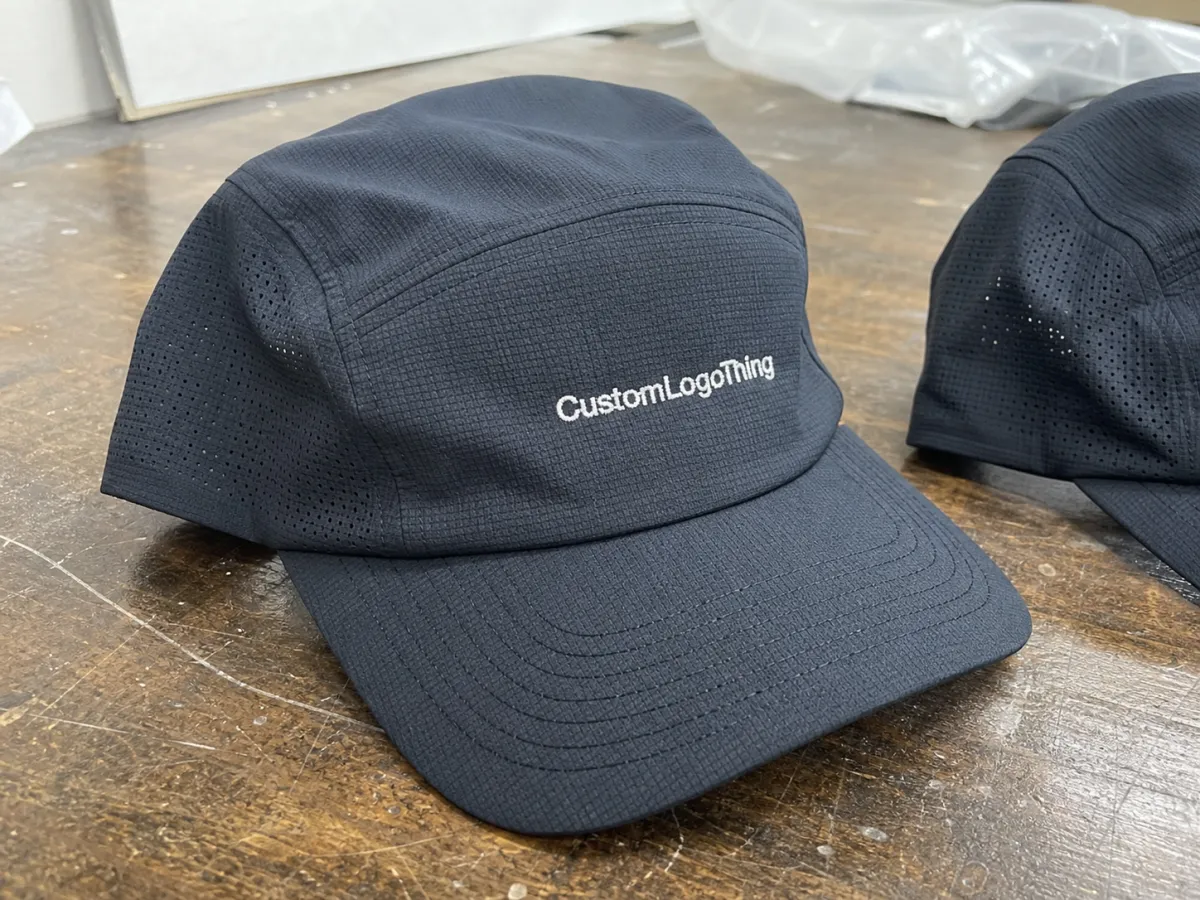
Small runs make more sense than they used to. A running caps with logo Low MOQ Custom order can protect cash flow, reduce leftover stock, and still deliver a polished result if the cap body and decoration method are chosen with care. The strongest low-volume orders tend to share one trait: the sample and the final goods look like they came from the same decision set. When the logo is reworked three times, the closure changes late, and the fabric shifts from one approval to the next, the end result usually feels inconsistent.
Running caps are a good category for lower quantities because they have a clear job. They are meant to be worn, not merely displayed. That means buyers can prioritize comfort and legibility over novelty. A lightweight cap in a predictable color often performs better than a complicated shape that photographs well but wears badly. In simple terms, running caps reward discipline.
Buyers also tend to overestimate how much product they need. For a pilot merch run, 100 to 300 units is often enough to test color preference, logo placement, and price response. For internal use, a smaller quantity can cover a season without leaving stale inventory behind. The math is different from apparel basics because headwear has less size complexity, which makes short runs easier to manage than shirts or outerwear.
There is a connection here to packaging that is easy to miss. If the cap is going into a bundle with inserts, cards, or custom printed boxes, the presentation spec should be set at the same time as the cap spec. Packaging and headwear are often ordered by different people, yet the customer sees them as one product. A cap in a branded mailer with sloppy folding or mismatched labeling still feels unfinished. For broader ordering terms, the Wholesale Programs page is useful for repeat runs and volume planning, while Custom Packaging Products can help with bundled kits and presentation details.
Price should be examined as a system, not a single number. A cap that costs a little more per unit but lands with clean stitch work, a better fit, and fewer revisions often ends up cheaper in practice because it avoids rework, replacements, and unhappy recipients. That is not theory; it is what happens when the purchase is used in the real world instead of just approved on a screen.
Cap construction and logo decoration choices that change the result
The base cap does most of the work. A structured front gives the logo a flatter, cleaner field and usually feels more formal. An unstructured front is softer and more casual, which can be better for lightweight running use. Five-panel caps are popular for centered logos because the front panel is uninterrupted. Six-panel caps have a more familiar athletic look and often sit more naturally on different head shapes. For running, a low-profile crown usually wears better than a tall, rigid shape, especially on longer sessions or in warm weather.
Brim shape changes the experience more than buyers often expect. A pre-curved visor feels ready to wear and suits everyday sports use. A slightly flatter brim can give the logo a broader visual stage. Dark underbrims reduce glare and are worth considering if the cap will be worn outdoors in strong sun. That is a small detail, but small details add up on performance headwear.
Fabric choice matters just as much. Polyester performance fabrics dry faster than cotton and are usually the safest choice for active use. Nylon has a cleaner technical feel and good abrasion resistance. Cotton twill looks familiar and can print or embroider nicely, but it absorbs more moisture and is less ideal for hard running. Mesh backs improve ventilation, though the mesh density needs to be checked so the cap does not look cheap or collapse under stitching.
Decoration method changes both the price and the final impression. Embroidery is the default for a reason: it is durable, stable, and familiar to most buyers. Woven patches can capture finer details and feel more premium, but they add an extra manufacturing step and need good edge control. Heat transfer works for flatter graphics and smaller quantities, though abrasion and sweat exposure should be tested before approval. Woven labels and side tabs are useful for secondary branding, but they are rarely strong enough to carry the main identity on their own.
Logo size is where many orders go wrong. A dense design with tiny type can look sharp in a file and muddy on a cap front. Stitch count affects both cost and readability. On running caps, a simpler mark usually reads better from several meters away and survives wear better than a crowded design. A clean logo on one location is usually stronger than multiple placements fighting for attention.
| Decoration method | Best use | Typical low-MOQ fit | Price impact | Wear notes |
|---|---|---|---|---|
| Embroidery | Most logos, team wear, long-term use | Usually strong for small to mid-size runs | Moderate setup, stable unit cost | Durable and reliable under regular use and washing |
| Woven patch | Fine detail, premium presentation | Good when the same logo repeats across the run | Higher setup and application cost | Sharp look, but patch edge and placement must be controlled |
| Heat transfer | Simple graphics, lighter branding | Useful for smaller runs with flat art | Lower setup, depending on film and size | Check abrasion resistance before approval |
| Woven label / side tab | Secondary branding | Easy to add to many runs | Low to moderate | Best as an accent, not the main brand mark |
Quality control should reflect how the cap will be used. For a running cap, that means checking stitch tension, panel symmetry, logo centering, sweatband finish, and whether the closure sits flat against the back of the head. It is also worth checking the cap under daylight, not only under indoor lights, because thread color can shift more than expected. If the cap will be worn outdoors, a wash and rub test on the logo area is a sensible extra step. The goal is not perfection in the abstract; it is a product that still looks intentional after real wear.
If the caps are part of a shipment that includes inserts, cards, or retail packaging, packing method should be specified early. Bulk packing, folded packing, and label placement all affect how the order arrives. For shipping-heavy programs, standards from ISTA are a useful reference because they push buyers to think about compression, vibration, and transit handling, not just decoration. A cap can survive the factory and still arrive crushed if the carton spec is weak.
Specs to confirm before you request a sample or quote
The fastest quotes come from the clearest specs. Before production starts, lock in the cap style, fabric, color reference, closure, logo placement, and decoration method. That sounds basic because it is, yet it is where many delays begin. A request for “black cap with logo” still leaves too much open: cotton twill or polyester, structured or soft front, low profile or mid profile, one logo or two, retail packing or bulk. Each of those choices changes pricing and timing.
Artwork needs just as much discipline. A vector file such as AI, EPS, or PDF is best because it preserves edges and makes scaling predictable. If brand color accuracy matters, include Pantone references. If the logo has minimum size rules, state them clearly. For embroidery, tiny lettering may need simplification before digitizing; otherwise the finished stitch can fill in and lose legibility. A good artwork file is not just a design asset. It is a production tool.
Fit deserves more attention than it usually gets. Running caps are worn by people with different head sizes, hair volume, and comfort preferences. Adjustable closures such as hook-and-loop, plastic snaps, elastic drawcords, and low-profile buckle systems all create a different feel. A softer closure may be more forgiving for a mixed audience, while a firmer system can help the cap hold shape. If the order is for field staff, event teams, or club members, asking about the typical head range is worth the time.
Packaging should be stated before the first proof. Some buyers want bulk cartons for internal distribution. Others need each cap polybagged, labeled, and boxed for retail or direct mail. If the caps are being bundled with other items, the packout spec belongs in the initial quote, not after approval. The same is true for insert cards, barcode labels, and carton markings. When the buyer defines the whole pack early, the production team can build around it instead of retrofitting it later.
A practical spec sheet for a low-MOQ cap order usually includes:
- Cap style: five-panel or six-panel, structured or unstructured, low-profile or mid-profile
- Fabric: polyester performance mesh, nylon, cotton twill, or a blended cloth
- Color: Pantone reference or a clear visual sample, not just a color name
- Decoration: embroidery, patch, transfer, or woven label
- Logo size: exact width and height, plus placement position
- Packaging: bulk, folded, polybagged, or retail-ready
For brands that care about the full presentation, recycled paper inserts or FSC-certified carton components can be added without changing the cap itself. That distinction matters. The headwear does not need to become complicated for the packaging to be more thoughtful.
Pricing, MOQ, and quote structure for smaller cap runs
Low-MOQ pricing follows the same basic forces as any custom textile order, but the spread is wider because setup is divided across fewer units. Decoration method is usually the biggest variable. A simple embroidered logo on a stock cap body can be straightforward. Add a patch, multiple thread colors, a second logo location, or a custom underbrim, and the price moves quickly. Material choice matters too: technical fabrics and structured builds usually cost more than basic soft caps.
For a practical benchmark, small custom runs often land in these rough ranges before freight, depending on the base cap, logo size, and finish:
- Basic embroidery on stock running caps: about $3.80-$6.50 per unit on 100-300 pieces
- Patch decoration: about $4.90-$8.50 per unit on similar quantities
- Heat transfer or printed mark: about $3.20-$5.90 per unit when the artwork is simple
- Setup or digitizing: often $25-$75 for embroidery, more if the design needs major cleanup
Those figures are not fixed. A cap with three thread colors and a tiny side mark can cost more than a larger one-color logo if the supplier has to pause for extra proofing or re-digitize the art. Still, the ranges help buyers see the relationship between complexity and total spend. That relationship is often more useful than a single quoted number.
A quote should separate the base product from the added services. Look for unit price, setup or digitizing, sample cost, freight, and any assumptions about rework. If a supplier says the price includes “all decoration,” ask what that means in practice. One logo location? One revision? One sample? Clear language saves time later. Hidden assumptions are usually what make a small order feel expensive.
MOQ is not just a factory rule. It is the point at which the supplier can run the job without wasting fabric, thread, or labor time. That is why mixing colors or sizes can change the minimum. If all caps share the same logo and the same body construction, a supplier may allow more flexibility. If each color requires a different trim or stitch file, the order becomes a series of separate runs. On repeat buys, the structure often fits neatly into a wholesale program, which helps keep restocks predictable.
Savings usually come from restraint. One logo location. One cap body. One color family. Artwork that does not need repeated revision. Buyers sometimes ask for a highly detailed decoration and then wonder why the quote rises. Simpler art is not only cheaper to make; it is easier to read on a runner in motion, which is ultimately the point of the cap.
Process and lead time for custom logo cap production
The production sequence is usually direct: artwork review, proof preparation, buyer approval, material sourcing, decoration, finishing, inspection, and packing. What slows the schedule is rarely machine time. It is the back-and-forth on proof details, especially when the logo needs to be resized, recolored, or moved a few millimeters after the first mockup.
Lead time depends on stock availability and decoration method, but many low-MOQ cap orders move in roughly 12-18 business days after proof approval if the base cap is in stock and the artwork is final. If the cap body must be made from scratch or special trims are needed, the schedule stretches. Peak season also matters. Sports events, holiday promotions, and retail launches compress production windows in a way buyers feel immediately.
Digital proof and physical sample are not interchangeable. A proof confirms layout, logo scale, and color placement. A physical sample tests fit, stitch quality, patch application, and how the fabric behaves under the logo. If the artwork has fine type or the cap color sits close to a brand tone, a sample is often worth the time. It reduces the chance that the full run misses the mark for a small, preventable reason.
A proof tells you the logo sits where it should. A sample tells you whether the cap actually wears the way the buyer expected, which is the part that matters after the order leaves the box.
Shipping timing is its own stage. Domestic delivery may take only a few business days once packing is done, but freight method and destination can change the window quickly. Heavy cartons, mixed pack counts, and seasonal carrier congestion all affect arrival. If the order is tied to a retail rollout or event date, the ship date should be treated as a milestone, not an estimate. The same logic used for product packaging applies here: test the route, not just the item.
Some teams also want to know whether the caps can survive mail-order handling. That is a fair question. If the order is going direct to customers, carton strength, fold memory, and label placement matter. Shipping tests modeled on ISTA principles can help buyers think clearly about the package as a system rather than assuming a box will protect itself.
There is a small but useful production detail that often gets missed: perspiration and colorfastness should be considered together. A dark thread may look sharp in the proof, then show a slight sheen or rub mark after handling. Light colors can pick up scuffs more easily during packing. Good production teams check the decoration under both bright and neutral light, because headwear gets judged in moving daylight, not only in a proof room.
How to place the order and avoid delays on a low-MOQ run
The cleanest way to move a running caps with logo Low MOQ Custom order from inquiry to quote is to send one complete brief, not a trail of partial updates. Start with quantity, delivery target, cap style, logo file, color choice, packaging needs, and shipping address. If the caps must arrive pre-labeled or individually bagged, that needs to be stated before the first proof is drawn.
Approval works best when one person owns the decisions. Small changes to stitch color, logo width, or closure type can reset timing, especially if the factory has already scheduled fabric cutting or digitizing. It is better to review one clear proof carefully than to send scattered revisions across email and chat. That keeps the production team focused and reduces the odds of a late-stage correction.
Here is a practical order checklist that avoids the most common stalls:
- Final quantity and any tolerance for backup units
- Target delivery date and whether it is fixed or flexible
- Cap style, fabric, closure, and color reference
- Vector logo file with placement notes
- Packaging preference: bulk, polybagged, or retail-ready
- Shipping address and receiving hours
If you need to compare a few possible builds, ask for them side by side. For example, one version can be an embroidered five-panel cap, another a woven-patch six-panel cap, and a third a printed version. That makes the unit cost differences easy to read and usually shows where the money is going. It also helps the buyer decide whether the premium option improves the product or just makes the quote look more polished.
One more practical point: if the caps are part of a larger launch that includes printed cartons, inserts, or mailer packaging, align the cap order with the rest of the kit before production starts. It is cheaper to sync the graphics once than to revise them after the caps are already in motion. A small order can absorb a mistake less easily than a large one, because every revision is spread across fewer pieces.
There is no mystery formula here. Buyers who send a complete brief, ask for a physical sample when the logo or fit is delicate, and keep the decoration simple usually get better results. That is how a running caps with logo low MOQ custom order turns into a usable quote without unnecessary back-and-forth.
What is a realistic MOQ for running caps with logo low MOQ custom order?
MOQ varies by cap style and decoration method, but smaller runs are often possible when the artwork is simple and the same logo is used across the full order. Embroidery and patch applications usually have different minimums than printed decoration, so the best MOQ depends on the exact build. A clear quote should state whether mixed colors, mixed sizes, or one-off samples are allowed inside the same order.
Which decoration method works best for low-MOQ running caps?
Embroidery is usually the most durable and the most common choice when the logo must hold up through sweat, washing, and regular wear. Patches can work well when the logo has small details or needs a more premium finish, though they may add cost and setup time. Printed decoration can suit flatter, simpler graphics, but it should be checked carefully for abrasion and long-term wear.
Can I mix cap colors or sizes in one low-MOQ custom order?
Sometimes yes, but the answer depends on fabric availability, decoration setup, and whether each color or size creates a separate production run. Mixing options is easier when the logo placement stays the same and the cap body construction does not change. Ask for the split pricing upfront so the final unit cost is clear before approval.
What artwork files do you need for a custom cap quote?
A vector file is best, such as AI, EPS, or PDF, because it keeps the logo sharp and helps the factory size the decoration correctly. If the logo must match brand standards, include Pantone references, placement notes, and any minimum size rules. A low-resolution image can work for an initial conversation, but it usually slows proofing and makes the quote less exact.
How fast can a low-MOQ running cap order ship after approval?
Timing depends on decoration complexity, material stock, and whether a sample or proof needs confirmation before production starts. Orders move faster when artwork is final, colors are confirmed, and shipping details are ready before production begins. If the delivery date is fixed, share it at the quote stage so the supplier can confirm whether the schedule is realistic.

