Buyer Fit Snapshot
| Best fit | Luxury Rigid Boxes Manufacturer projects where brand print, material claims, artwork control, MOQ, and repeat-order consistency need to be specified before quoting. |
|---|---|
| Quote inputs | Share finished size, material target, print colors, finish, packing count, annual reorder estimate, ship-to region, and any compliance wording. |
| Proofing check | Approve dieline scale, logo placement, barcode or warning zones, color tolerance, closure strength, and carton packing before bulk production. |
| Main risk | Vague material claims, crowded artwork, missing packing details, or unclear freight terms can make a low unit price expensive after revisions. |
Fast answer: Luxury Rigid Boxes Manufacturer: Board, Finish, Dieline, and Unit Cost should be specified like a repeatable production item. The safest quote records material, print method, finish, artwork proof, packing count, and reorder notes in one written spec.
Production checks before approval
Compare the actual filled-product size with the drawing, then confirm tolerance on folds, seals, hang holes, label areas, and retail display edges. Reserve space for logos, QR codes, warning copy, and material claims before decorative graphics fill the panel.
Quote comparison points
Review material grade, print process, finish, sampling route, tooling charges, carton quantity, and freight assumptions side by side. A quote is only useful when the supplier can repeat the same color, closure quality, and packing count on the next order.
Luxury Rigid Boxes Manufacturer: The Premium Packaging Guide
A Luxury Rigid Boxes manufacturer changes the way a product is judged before anyone even touches the item inside. The box is part of the first impression, and that moment is short; people size up premium packaging in seconds, long before they have opened the lid, checked the weight, or read the copy. Fragrance, jewelry, spirits, and high-end technology all depend on that quick signal of quality, which is why the right luxury rigid boxes manufacturer is doing far more than building a container. The work shapes perception, presentation, and the odds that the box gets kept, gifted, or photographed later.
Choosing a supplier works best when the decision stays practical. Structure, print control, insert fit, finish consistency, and lead time all affect the outcome in ways that are easy to miss during a quote review. A luxury rigid boxes manufacturer can make a project feel polished or expensive in the wrong way depending on those details. I have seen projects that looked excellent on a screen but felt off in the hand because one small structural choice was left vague, and that kind of miss is fixable only if the brief is clear from the start. For a wider view of the packaging range, review Custom Packaging Products and learn more about the people behind the work at About Custom Logo Things.
What a luxury rigid boxes manufacturer actually does
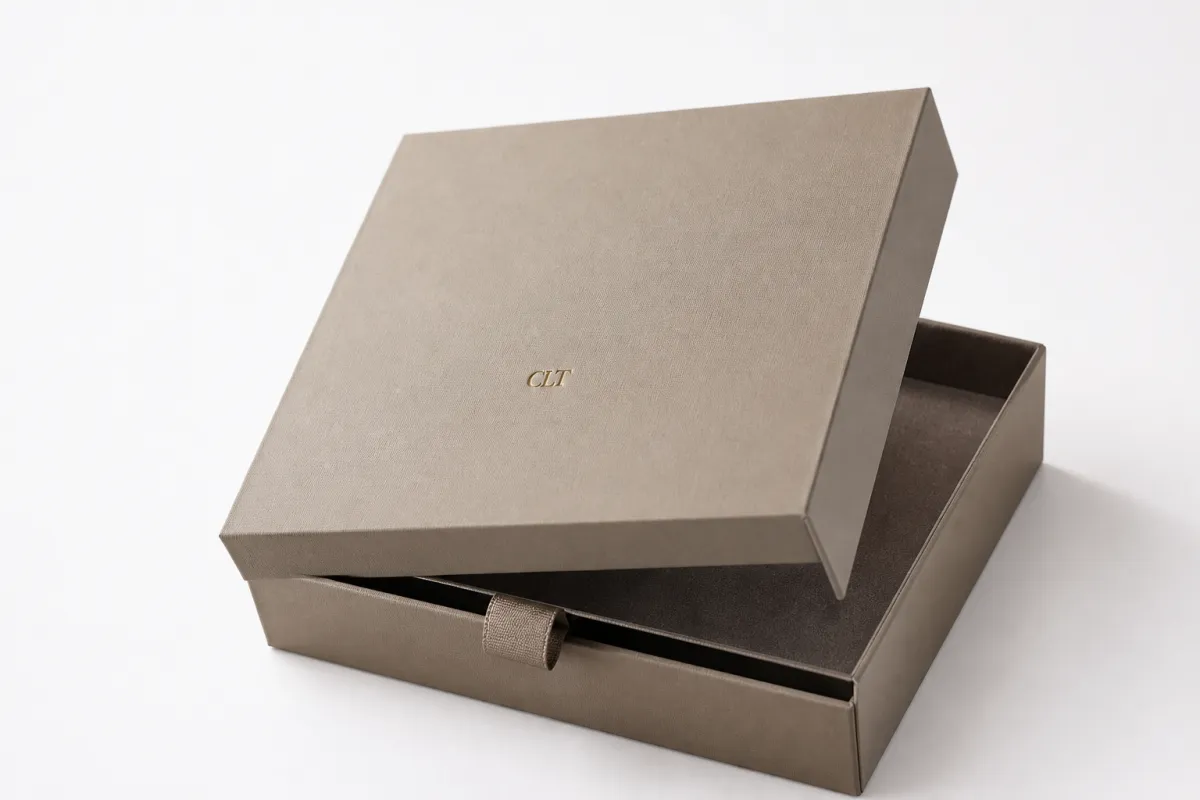
A luxury rigid boxes manufacturer builds packaging with thickness, weight, and a clean edge profile that separate it from folding cartons almost immediately. The core is usually dense paperboard wrapped in printed paper, specialty paper, leatherette, fabric, or another decorative surface. That construction gives the box its stiffness and that unmistakable premium feel in the hand. Buyers notice it right away, and that reaction often shapes the value judgment before the product is even seen.
From a packaging buyer's point of view, rigid boxes sit in a different lane from retail cartons and corrugated shippers. Folding cartons are efficient for shelf display and lower unit cost. Corrugated packaging is designed for transport strength. A rigid box is selected when the unboxing moment needs to carry part of the brand promise. A luxury rigid boxes manufacturer usually serves products where tactile quality and presentation matter as much as protection: cosmetics, fragrance, jewelry, watches, premium accessories, gift sets, spirits, and PR kits.
The outer shell gets most of the attention, yet the shell alone never tells the whole story. Board grade, wrap material, closure style, insert design, and finishing all influence the final result. A luxury rigid boxes manufacturer is really building a packaging system, not just a lid and base. If one element is under-specified, the box may still look expensive on screen and feel ordinary in real use. That gap is where premium packaging often goes sideways.
High-performing rigid boxes tend to share a few practical traits:
- Board thickness chosen for stiffness and resistance to denting, not only to hit a target cost.
- Insert design matched to product weight, product shape, and how the item shifts during opening.
- Wrap paper selected for print clarity, scuff resistance, and handling durability.
- Closure style chosen for brand tone and user experience, not only for assembly speed.
- Finishing used with restraint so the box feels refined instead of crowded.
Many packaging teams spend too much energy on surface decoration and not enough on structure. A luxury rigid boxes manufacturer can only solve part of the problem if the brief stays vague. When a product shifts inside the box, when the lid feels loose, or when the closure lands awkwardly, the premium effect drops fast. Strong briefs describe how the box should feel in use, not only how it should appear in a mockup.
There is a logistics layer as well. Rigid boxes are heavier, less compressible, and often more expensive to ship than flat cartons. That affects storage, freight planning, and damage exposure. A careful luxury rigid boxes manufacturer will ask where the packaging is going, how it will move, and what kind of handling it must survive. Export transit, courier handling, pallet stacking, and warehouse storage all change the structural demands. A box that looks beautiful in a showroom can fail in a shipping lane if nobody planned for the real route.
For brands that sell experience as much as product, this format is a practical investment. A well-made rigid box can support higher price points, stronger gifting behavior, and more social sharing. That is why a luxury rigid boxes manufacturer is not supplying packaging in a narrow sense; the supplier is helping shape perceived value before the product is even used.
How the process, timeline, and lead time work
The production path usually starts with a brief, then moves into structural design, dieline approval, prototype development, material sourcing, print setup, lamination, cutting, wrapping, assembly, and quality control. A reliable luxury rigid boxes manufacturer defines each stage before work begins. That matters because the timeline is never just one number. Sample lead time and mass-production lead time are different, and buyers who treat them as the same often miss launch dates.
A simple sample cycle may take 5-10 business days for a straightforward rigid structure, with longer timing if the insert is custom or the finish includes foil, embossing, or specialty paper. Mass production can run 12-25 business days after sample approval, depending on order size, the number of finishing steps, and whether the required paper stock is already available. A luxury rigid boxes manufacturer that gives one timeline without separating sample and production is usually compressing the real work into a number that looks tidy but does not tell the full story.
One design change can reset the schedule. Move a magnet, change the insert depth, add a window cutout, or switch from matte lamination to soft-touch, and the project may need a new proof, a revised dieline, or a fresh material order. A careful luxury rigid boxes manufacturer will push for design lock before full production starts because those details are not cosmetic extras. They directly affect timing, tooling, and the ability to keep the run moving.
The most common delay points are easy to predict:
- Artwork revisions after dieline approval.
- Paper stock shortages or unexpected color-matching issues.
- Insert tooling that takes longer than planned.
- Late signoff on the pre-production sample.
- Freight booking pushed too close to launch.
"The launch usually slips because one decision stayed open too long, not because the box itself was slow."
A useful planning rule is to connect packaging milestones to launch, freight, and inventory dates. If the product reaches a warehouse three weeks before the campaign, the box should already be approved and in motion. A luxury rigid boxes manufacturer can move faster when the schedule is steady, but packaging teams still need to avoid changing the product while packaging development is underway.
For transit-sensitive projects, ask whether samples can be evaluated against a test method such as ISTA distribution testing. Those standards are not a magic shield, yet they create a more disciplined conversation about drop risk, compression, and shipping abuse. The International Safe Transit Association explains the framework clearly at ISTA. That kind of testing becomes especially useful when a luxury rigid boxes manufacturer is producing premium packaging that must survive real logistics, not only look polished in a photo.
Good scheduling also depends on clean ownership. One person should approve structure, another should approve artwork, and one person should sign off on the final fit. If too many people can reopen the file, the timeline stretches. A luxury rigid boxes manufacturer can keep a project moving, but the buyer side has to stay equally organized.
Key factors that change quality, structure, and feel
Board thickness is never just a technical line on a spec sheet. It changes rigidity, edge definition, stacking strength, and the way the box feels in the hand. A thinner board can lower cost, yet it may flex, dent, or collapse under a heavy product. A stronger board creates a more immediate sense of value. That is one reason a skilled luxury rigid boxes manufacturer asks about product mass before recommending materials. A 60-gram cosmetic jar and a metal watch do not belong in the same build, even if their dimensions are similar.
Wrap paper carries just as much influence. Coated papers hold detail well and print cleanly. Uncoated stocks feel warmer and more natural. Textured papers add depth, though they can soften very fine print. Soft-touch lamination creates a velvety feel, while gloss and matte behave differently under handling and storage. A luxury rigid boxes manufacturer weighs appearance against performance because the same finish that photographs beautifully may also scuff faster in transit or on a retail shelf.
Insert choices deserve more attention than they usually get. EVA foam gives a precise fit and a very controlled presentation for electronics or accessories. Molded pulp supports sustainability goals and can still look refined when the design is handled well. Paperboard inserts work well for lighter products or tighter budgets. Fabric-lined trays are common in jewelry and gift packaging, where the reveal itself carries some of the luxury. A good luxury rigid boxes manufacturer will not force one insert style onto every project. The product, the weight, the shape, and the way the customer lifts the item all influence the best solution.
Closure styles create different experiences and different cost profiles. Lift-off lid boxes feel classic and are easier to produce. Magnetic flap boxes signal higher perceived value and open with a controlled snap, though the magnets add cost and can complicate assembly. Drawer boxes work well for layered reveals, but the pull force and tray fit need careful control. Shoulder-and-neck constructions create a satisfying opening moment and stronger structure, while hinged lids are a natural fit for presentation kits. A luxury rigid boxes manufacturer usually recommends the closure after weighing both brand tone and production load.
Finishing is where many brands overspend or underspend. Foil stamping can highlight a logo with sharpness, yet too much foil starts to feel crowded. Embossing adds depth without extra color. Debossing reads subtle and refined. Spot UV creates contrast, though it works best on the right coated surface. Ribbon pulls and window cutouts can add visual interest, but they also add assembly steps and weak points if they are not planned carefully. A luxury rigid boxes manufacturer should explain those tradeoffs directly rather than treating every effect as automatic value.
Material choice also intersects with sustainability. FSC-certified paper and board are available in many packaging programs, which matters for brands with formal sourcing policies. The Forest Stewardship Council explains the certification system at FSC. If sustainability is part of the brief, a luxury rigid boxes manufacturer should be able to show chain-of-custody documents or at least explain what is certified in the build and what is not.
Premium packaging is rarely about adding every available feature. The stronger result usually comes from choosing the few details that matter most for the product, the shelf, and the customer. A strong luxury rigid boxes manufacturer knows where to spend and where restraint creates a better result.
Luxury rigid boxes manufacturer pricing, MOQ, and quote basics
Pricing typically rises with size, board grade, wrap paper selection, finish complexity, insert design, order quantity, and shipping method. Shape matters too. A simple lift-off lid with a basic insert is far easier to build than a magnetic rigid box with foil, embossing, a ribbon pull, and a custom foam tray. That is why a luxury rigid boxes manufacturer needs a spec sheet before quoting with confidence. Without dimensions and finish detail, the number often becomes a placeholder rather than a real estimate.
MOQ exists because setup time is real. Plates, tooling, die cutting, wrapping setup, and assembly preparation all take labor, even when the order is small. If a supplier accepts a low MOQ, the unit price may rise to cover overhead, or the material options may shrink. A luxury rigid boxes manufacturer with a flexible minimum is not automatically cheaper; sometimes the supplier simply charges more per unit to offset the smaller run.
Quote comparison takes discipline. A 1,000-unit quote for a magnetic rigid box is not the same as a 1,000-unit quote for a lift-off lid, even if the headline numbers are close. The only fair comparison is spec-for-spec: same dimensions, same board thickness, same paper, same insert, same finish, same quantity, same shipping assumption. A luxury rigid boxes manufacturer that sends a quote without the full spec sheet makes comparison harder than it should be.
Hidden costs deserve attention early. Sampling fees can appear if multiple prototype rounds are needed. Tooling or plates may be charged separately. Freight and duties are often excluded from the first quote. Rush charges can appear if the schedule tightens. Revision costs may apply if artwork changes after approval. A luxury rigid boxes manufacturer should disclose those points upfront, because the lowest quote on paper can become the most expensive project once revision cycles begin.
A simple rule helps here: complexity and quantity pull in opposite directions. Higher volume usually lowers unit cost, but extra finishes can eat into that saving quickly. A large run with foil, embossing, soft-touch, and a custom insert may still cost more than a smaller run with simpler construction. That is why the cheapest-looking luxury rigid boxes manufacturer quote is not always the lowest-risk choice.
| Box style | Typical MOQ | Sample lead time | Production lead time | Typical unit price range |
|---|---|---|---|---|
| Lift-off lid rigid box | 500-1,000 pcs | 5-8 business days | 12-18 business days | $1.20-$2.40 |
| Magnetic closure rigid box | 500-1,500 pcs | 7-12 business days | 15-25 business days | $1.80-$4.50 |
| Drawer-style rigid box | 1,000-2,000 pcs | 7-10 business days | 15-22 business days | $1.60-$3.80 |
| Shoulder-and-neck rigid box | 1,000-3,000 pcs | 8-14 business days | 18-28 business days | $2.20-$5.50 |
Those ranges are not universal. Product size, print coverage, paper selection, and freight terms can move them up or down. Even so, they give a useful starting point when a buyer wants to judge whether a quote from a luxury rigid boxes manufacturer sits in the right range or wanders far outside it.
If a quote lands much lower than every other offer, ask what was left out. If it lands much higher, ask whether the supplier assumed a more complex build than intended. A luxury rigid boxes manufacturer should be able to break the price into structure, wrap, finish, insert, and logistics so the money trail is visible rather than buried.
How to choose and brief the right supplier
Start with capability, not promises. Ask whether the supplier has produced the box style, insert type, finish, and quantity you need. A luxury rigid boxes manufacturer that mainly produces simple mailers may still be a capable vendor, but that does not make it the right fit for a finely tuned presentation box. The right supplier should be able to show matching examples, explain tolerances, and discuss assembly risks in plain language.
Sample evidence matters. Request photos of prototypes and production runs that resemble your project. Better still, ask for a sample library or physical samples if the supplier can provide them. A luxury rigid boxes manufacturer with a strong portfolio should not rely on generic glossy images alone. You want to see finishes close to your own brief, not a polished box from a completely different category.
Communication structure is another filter. Who answers questions? Who owns revisions? Who signs off on the proof? A supplier that is unclear at quote stage often becomes slower once the file enters production. A good luxury rigid boxes manufacturer will say who handles structure, who handles print, and who oversees final inspection. That clarity makes it easier to solve issues before they turn into delays.
A short but complete brief saves time. Include exact dimensions, product weight, closure preference, finish priorities, budget range, launch date, and the purpose of the packaging. Is it retail? Is it gifting? Is it PR? Is it shipping plus display? Those answers matter because a luxury rigid boxes manufacturer builds differently for each use case.
Use this practical checklist before you send the request:
- Dimensions of the product, including any irregular points.
- Product weight and whether the item is fragile.
- Target quantity and whether you need a pilot run first.
- Print method and any exact color requirements.
- Finish priorities such as foil, matte, soft-touch, or embossing.
- Packaging purpose such as retail, gifting, subscription, or promotion.
- Sustainability goals such as FSC paper or reduced foam usage.
One more thing to ask about is tolerance management. In premium packaging, a millimeter can matter. If the insert is loose, the product rattles. If the lid is too tight, opening feels awkward. If the magnetic closure is misaligned, the box loses some of its premium character. A reliable luxury rigid boxes manufacturer will talk about fit issues before they become complaints.
For brands that need a broader packaging plan, it helps to compare the premium box against the rest of the packaging stack. The strongest packaging programs align outer packaging, retail presentation, and shipping protection instead of treating them as separate jobs. That is where a luxury rigid boxes manufacturer becomes especially useful: not just as a box supplier, but as part of the brand's physical presentation system.
Common mistakes that quietly inflate cost and damage results
The most expensive mistake is designing artwork before the structure is locked. A layout can look excellent on a screen and still fail once it lands on the dieline. Text may sit too close to an edge. A logo may cross a wrap seam. A finish may interfere with a fold. A luxury rigid boxes manufacturer can correct some of that, but the fix usually costs time and sometimes money.
Vague specifications are another budget trap. If board thickness, insert type, finish, or closure style is not defined, the quote may not mean much. One supplier might assume a 2 mm board and paper insert; another might quote a 3 mm board with EVA foam and a magnetic flap. Both numbers can look reasonable until it becomes clear they are not the same product. That is why a luxury rigid boxes manufacturer needs detailed inputs before anyone compares prices.
Freight and customs are often ignored for too long. A box that looks cheap at the factory can become expensive once it is packed, shipped, stored, and moved through import paperwork. Damage risk matters too. If the box is delicate, poorly packed, or stacked badly in transit, replacement costs can erase the savings from a low quote. A luxury rigid boxes manufacturer should be asked about outer packing and transit protection, not only the box itself.
Overdesign is a subtler problem. Extra foil, oversized inserts, complex closures, and multiple special finishes can make a box feel luxurious on paper, but they also increase assembly complexity and the chance of error. Sometimes the better move is to simplify one element and sharpen another. A luxury rigid boxes manufacturer with real experience often recommends exactly that.
Skipping the final sample signoff is risky. One missed detail on closure strength or insert fit can affect an entire production run. If the sample is wrong, the production version will be wrong faster than most teams expect. That is why the final approved sample should be treated as the control sample, not just another checkpoint. A careful luxury rigid boxes manufacturer preserves that reference and uses it to keep the run consistent.
There is also a sustainability mistake that shows up often: choosing greener materials without checking the actual supply chain. Recycled content, FSC certification, and lower-impact inserts all sound good, but they still need proof and compatibility with the product. A luxury rigid boxes manufacturer should be able to explain whether the board, wrap, adhesive, and insert all fit the stated sustainability goal. If the story sounds tidy but the documentation is thin, keep asking questions.
Premium packaging is judged at the point of use. A box that photographs well but opens awkwardly can create a strange kind of disappointment. A strong luxury rigid boxes manufacturer helps prevent that by balancing aesthetics, structure, and handling. That balance is what separates packaging that merely looks expensive from Packaging That Actually feels expensive.
Next steps before you contact a luxury rigid boxes manufacturer
Before you request quotes, gather three things: exact product dimensions, launch timing, and a rough budget range that reflects the shelf position you want. That is the fastest way to help a luxury rigid boxes manufacturer quote with less guesswork. If the supplier has to interpret every detail, more time gets spent in revision than in decision-making.
Create a one-page brief that includes closure style, insert preference, finish priorities, sustainability requirements, and shipping conditions. If the box has to survive export transit, say so. If it is for gifting, say that too. A luxury rigid boxes manufacturer will respond better when the purpose is clear because purpose drives structure more than people expect.
Ask for at least three comparable quotes and one pre-production sample. Then compare the evidence, not just the price. How fast did the supplier respond? Did the sample match the spec? Did they explain tradeoffs clearly? A luxury rigid boxes manufacturer that communicates well during quoting usually performs better once production starts, though not always. That is why the sample matters so much.
Build an approval checklist for structure, print, color, tactile finish, and product fit. Assign one person to own final signoff. That single decision maker can save days of back-and-forth. A luxury rigid boxes manufacturer can quote and produce more accurately when the approval chain is clean and decisions are not drifting between departments.
If you want to reduce risk further, ask for the production sequence in writing. Who checks artwork? Who checks fit? Who confirms finish? Who inspects the finished run? Those questions sound simple, yet they expose the supplier's process quickly. A luxury rigid boxes manufacturer with a clear process usually has fewer surprises once the order moves into production.
Do that homework first, and the next luxury rigid boxes manufacturer you brief can price more accurately, move faster, and deliver packaging that feels intentional rather than improvised. The real goal is not just a premium-looking box; it is a packaging decision that supports the product, protects the margin, and makes the brand feel more considered from the first touch.
What does a luxury rigid boxes manufacturer do differently from a carton supplier?
They build thicker, more structural packaging designed to feel premium, not only to hold a product. They also handle more complex wrapping, inserts, and finishing steps that folding-carton suppliers may not specialize in.
How long does a luxury rigid boxes manufacturer usually need for samples and production?
Sampling can take several rounds if the structure, print, or insert needs refinement. Production lead time depends on material availability, finishing complexity, and quantity, so it helps to ask for separate sample and mass-production schedules.
What drives luxury rigid boxes manufacturer pricing the most?
Box size, board thickness, wrap material, insert complexity, and finishing options usually have the biggest impact. Quantity matters too: higher volume lowers unit cost, but added complexity can erase some of that savings.
What MOQ should I expect from a luxury rigid boxes manufacturer?
MOQ varies by supplier and box style, but Custom Rigid Boxes often need a higher minimum than standard cartons. Ask whether the MOQ is set by labor, tooling, or material sourcing so you can judge whether it is flexible.
How do I compare two luxury rigid boxes manufacturer quotes fairly?
Match the exact spec sheet first: dimensions, board, paper, finish, insert, and quantity must be identical. Then compare hidden items like sampling, tooling, freight, and revision fees so the lowest quote does not become the most expensive project.