Buyer Fit Snapshot
| Best fit | Mailer Boxes Cost Per Unit projects where brand print, material claims, artwork control, MOQ, and repeat-order consistency need to be specified before quoting. |
|---|---|
| Quote inputs | Share finished size, material target, print colors, finish, packing count, annual reorder estimate, ship-to region, and any compliance wording. |
| Proofing check | Approve dieline scale, logo placement, barcode or warning zones, color tolerance, closure strength, and carton packing before bulk production. |
| Main risk | Vague material claims, crowded artwork, missing packing details, or unclear freight terms can make a low unit price expensive after revisions. |
Fast answer: Mailer Boxes Cost Per Unit: What Really Drives It Down should be specified like a repeatable production item. The safest quote records material, print method, finish, artwork proof, packing count, and reorder notes in one written spec.
Production checks before approval
Compare the actual filled-product size with the drawing, then confirm tolerance on folds, seals, hang holes, label areas, and retail display edges. Reserve space for logos, QR codes, warning copy, and material claims before decorative graphics fill the panel.
Quote comparison points
Review material grade, print process, finish, sampling route, tooling charges, carton quantity, and freight assumptions side by side. A quote is only useful when the supplier can repeat the same color, closure quality, and packing count on the next order.
Mailer Boxes Cost Per Unit: What Really Moves the Number
Mailer Boxes Cost Per unit can look simple right up until the quote hits your inbox. A few millimeters in size, one extra print color, or a custom insert can move the number faster than most buyers expect, and that is before freight, setup charges, and damage risk get involved.
I have watched plenty of packaging budgets get squeezed by boxes that looked affordable on paper and then got expensive in practice. A carton that saves 8 cents but adds tooling, slows packing, or shows up with a higher crush rate is not really saving money. It is just moving the cost to a different line item, kinda like a shell game with corrugated board.
A low box price only helps if the cartons arrive intact, pack fast, and do not leave you with a pile of dead inventory.
That pattern comes up all the time. Buyers focus on the printed price per piece, then get surprised by the actual bill once shipping, samples, and the mismatch between MOQ and warehouse space show up. Mailer boxes cost per unit is shaped by practical variables, not random supplier mood. Board choice, dimensions, print coverage, finish, order size, and production method do most of the work.
For a launch, a rebrand, or a subscription shipment, the real job is to separate the box price from the total package cost, then decide what matters for the product. A plain kraft shipper, a retail-ready printed mailer, and a custom insert box sit in different price bands for good reason. If those differences are ignored, the quote gets messy fast.
Why mailer boxes cost per unit can swing fast
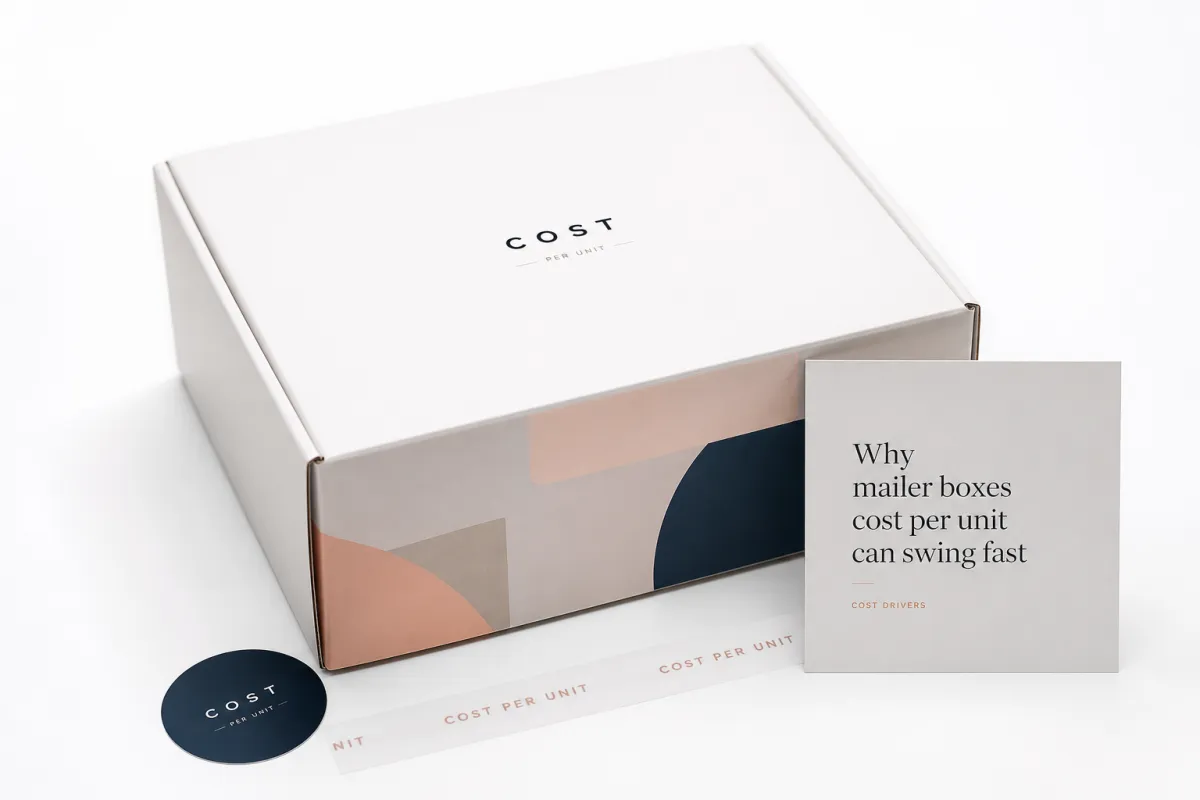
Mailer boxes cost per unit can change more than people expect because a mailer box is not just a folded carton. It combines board usage, cut pattern, folding behavior, print process, and freight efficiency. A quote for 1,000 boxes can look reasonable until the box grows by a quarter inch and the production layout changes enough to waste more board on each sheet.
The blunt version is this: the lowest box quote often ignores the rest of the shipment. A 6 x 4 x 2 kraft mailer with one-color print might price well, but if the product rattles inside and needs extra void fill or arrives dented, the actual cost rises. Mailer boxes cost per unit has to be judged alongside packing speed, product protection, and how many replacements you end up shipping later.
Another trap is staring only at the box price and ignoring landed cost. If a supplier offers $0.48 per unit but freight adds $320 to the order, the landed cost on 1,500 boxes jumps by about $0.21 per box before setup charges or taxes. That is not a rounding error. That is how budgets get stretched quietly.
One more print color can matter more than many buyers expect. A single-color kraft box may sit in one price tier, while a full-color retail mailer with inside print, matte lamination, and a custom insert lands in a completely different tier. Mailer boxes cost per unit reacts to labor, setup, and waste. The box does not care about the mood board.
The pricing pattern usually follows the same order every time: board grade first, then dimensions, then decoration, then volume. A heavier corrugated board or a cleaner self-locking structure raises the unit cost. A larger order spreads fixed costs farther and pulls the number down. Straightforward idea. Consistent enough to frustrate anyone hoping for a shortcut.
In my own quoting work, the biggest surprises usually come from small spec changes nobody thought would matter. A half-inch of extra depth, a tighter insert fit, or a second print location can move the quote enough to change the buying decision. That is why a careful spec review saves more money than haggling over a single line item.
Mailer boxes cost per unit: what you're actually paying for
Mailer boxes cost per unit comes from a stack of choices, and each one pushes the number in a different direction. Start with the board. A plain kraft mailer, an E-flute corrugated mailer, and a heavier B-flute option do not price the same because they do not behave the same. Thicker board uses more raw material, usually handles shipping better, and can be worth the extra spend if the product is fragile or premium-priced.
Box style is the next lever. A simple tuck mailer with standard dust flaps is easier to produce than a reinforced self-locking style with a more complex die-cut profile. Cleaner folding and stronger closures can reduce damage and speed packing, but they also raise mailer boxes cost per unit. That tradeoff is not a problem by itself; it just needs to be intentional.
Print coverage is another major driver. Outside print only is usually cheaper than inside print plus outside print. Full-coverage artwork with heavy ink density, tight registration, and coatings adds labor and make-ready time. If you print only a logo, one URL, and a short message on kraft board, mailer boxes cost per unit stays much lower than it would for a full retail presentation box.
Finishing matters too. A matte aqueous coat is not the same as soft-touch lamination, and neither is the same as spot UV, foil, or embossing. These finishes can elevate the box, but they also add cost per piece because they require more passes or additional tooling. The buyer has to decide whether the product truly needs that treatment or whether the finish is just decorative habit.
Custom inserts and dividers deserve their own warning label. A die-cut insert can be worth every cent if it keeps a bottle, jar, or component from bouncing around, but inserts can add $0.08 to $0.35 per unit depending on material, complexity, and quantity. That means mailer boxes cost per unit can look fine until you add the thing that actually protects the product.
The simplest way to read a quote is to treat it as several quotes folded together. It is a material quote, a structure quote, a print quote, and often a logistics quote wearing the same hat. If you compare only the headline figure, you are not comparing the same package.
When the job is simple, a cleaner spec usually wins. When the product is delicate or the box has to carry the brand experience, spending a little more can be the right move. The point is not to chase the lowest number blindly; it is to spend where the box actually earns its keep.
| Mailer box option | Typical quantity | Typical price range per unit | What drives the cost |
|---|---|---|---|
| Plain kraft mailer, no insert | 1,000-5,000 | $0.32-$0.78 | Simple board, minimal print, lower make-ready time |
| One-color printed mailer | 1,000-5,000 | $0.40-$0.95 | Ink, setup charges, and some added waste from registration |
| Full-color retail mailer with coating | 2,000-10,000 | $0.85-$1.85 | Higher ink coverage, finish, and tighter quality control |
| Mailer with custom insert or divider | 2,000-10,000 | $1.05-$2.40 | Additional die-cutting, insert tooling, and more handling |
That table is not a promise. It is a realistic range, and the final number still depends on the exact spec, quantity, and freight lane. It does show the shape of the market. Mailer boxes cost per unit rises as structure, decoration, and protection increase. There is no magic trick. Just physics and labor.
For brands comparing packaging families, it helps to look at the broader box mix. A mailer may be the right balance for ecommerce, but some product lines should be paired with Custom Packaging Products that include cartons, inserts, or presentation packaging instead of forcing one box style to do everything. If your shipment is light and flexible, you may also compare the box against Custom Poly Mailers for lower freight and simpler fulfillment.
Mailer boxes cost per unit by specification
Mailer boxes cost per unit changes quickly when the specification changes. Size is the biggest lever because box dimensions affect both material usage and production layout. A small box that nests efficiently on a sheet may produce very little waste, while a slightly larger box can force a new layout and leave more scrap on the floor. Two mailers that look nearly identical on a sample table can carry very different cost per piece.
Dimensional thresholds are real. Move from a 9 x 6 x 2 mailer to a 10 x 8 x 3, and you may cross a sheet-efficiency line that changes the whole quote. The difference is not always dramatic, but it happens often enough that experienced buyers ask for a size check before they ask for decoration options. Mailer boxes cost per unit is often more sensitive to size than to the logo itself.
Board caliper and flute type matter next. An E-flute mailer is popular because it gives decent printability and a cleaner outer profile. B-flute is stronger and bulkier. If the product is heavy, fragile, or shipped through rough parcel handling, that extra board can save damage claims. If the product is light, the heavier board may simply inflate the unit cost without adding real value.
Printing choices shift the number again. A single outside print color on kraft is usually the cheapest decoration path. Add inside print, and the press work becomes more involved. Add full-coverage art, and waste and drying time rise. Add spot-color matching or tight brand shades, and proofing gets more careful. Mailer boxes cost per unit rises at every step because production gets more exacting.
There is also a difference between print systems. Digital short runs can make sense for lower quantities and faster artwork changes, while offset or flexo can be more efficient for larger bulk pricing tiers. The right method depends on the quantity, artwork complexity, and target unit cost. A 500-piece run and a 10,000-piece run should not be priced with the same logic. That would be lazy estimating.
One practical detail buyers sometimes skip is how the box folds in real life. If the design is fussy, fulfillment staff lose time on every unit, and that labor cost sneaks into the total package cost even if it never appears on the packaging invoice. The neatest-looking quote is not always the best one for a busy warehouse.
Spec changes that usually move the price
- Length, width, and depth: bigger boxes use more board and may reduce sheet yield.
- Board grade: lighter kraft saves money; heavier corrugated board improves protection.
- Print coverage: one-color logo work is cheaper than full-wrap art or inside printing.
- Finish: matte coat is usually cheaper than soft-touch, foil, or spot UV.
- Insert design: more complex inserts add tooling fees and labor.
- Closure style: self-locking and reinforced structures can increase setup charges.
Use that list as a triage tool. If mailer boxes cost per unit is too high, ask which spec is actually driving it before cutting the whole order apart. Often the best savings come from standardizing one dimension, simplifying the insert, or reducing print coverage rather than stripping the box until it looks cheap.
A useful decision rule is simple: if a spec change improves protection, reduces packing time, or supports the retail experience, it may justify the extra spend. If it only adds decoration, ask whether the customer will notice. Pretty is not the same as profitable, and a fancy box that damages the product is just expensive cardboard.
Pricing and MOQ: how to compare real quotes
Mailer boxes cost per unit falls as quantity rises because fixed costs spread out. That part is easy, but buyers still get tripped up because they stare at the unit line and miss the rest. MOQ, or minimum order quantity, determines how much setup cost gets loaded onto each box. A 1,000-piece run carries far more setup burden per unit than a 10,000-piece run.
That means mailer boxes cost per unit is not a flat number. It usually drops in steps. A short run might sit around $0.78 each, a mid-volume order might fall to $0.52, and a larger run might land near $0.39 depending on size and print method. The curve is why smart buyers ask for tiered pricing instead of one lonely quote.
Compare the whole quote, not just the headline cost per piece. The right comparison includes setup charges, tooling fees, plate charges if applicable, proofing, inserts, freight, taxes, and lead time. If one supplier gives you a lower unit price but charges more for tooling or ships from farther away, the supposed savings can disappear quickly.
Fake bargains show up often. A quote with a low price per box can hide expensive freight, an oversized master carton count, or a minimum order that leaves you with more inventory than you can store. Mailer boxes cost per unit only matters if the order fits your cash flow and your warehouse. A cheap order that sits for six months is not cheap.
I usually tell buyers to ask for at least three quantity breaks, because that is where the truth shows up. The lowest tier is for testing, the middle tier usually shows the realistic production cost, and the larger tier tells you whether your demand can support a better price. If the price barely moves as volume rises, the setup may be unusually light; if it drops sharply, there is probably room to plan inventory more intelligently.
| Quantity | Example unit cost | Typical setup impact | Buying note |
|---|---|---|---|
| 500 | $0.90-$1.35 | High per-box burden from setup charges | Good for testing, not always ideal for cost control |
| 2,500 | $0.55-$0.92 | Moderate spread of tooling fees and prep | Often the first practical bulk pricing tier |
| 5,000 | $0.38-$0.72 | Lower per-piece setup burden | Usually a better balance of cost and storage |
| 10,000+ | $0.28-$0.58 | Setup cost spreads widest | Best for stable SKUs and repeat demand |
A smart quote request asks for multiple tiers: 500, 1,000, 2,500, 5,000, and 10,000 if the project is large enough. That gives you the real slope of the pricing, which is what you need for planning. If mailer boxes cost per unit drops sharply at 5,000 but only slightly at 10,000, the extra inventory may not be worth tying up cash.
Ask for landed cost as well. That means the box, the insert, the print, the setup, the freight, and any destination charges. If you are comparing one supplier to another, compare the same spec, the same shipping address, and the same approval stage. Otherwise you are comparing a polished quote to a fantasy.
For product launches, I usually recommend asking for two or three spec options at the same MOQ. One should be the lean version, one should be the balanced version, and one should be the premium version. That makes it very obvious where mailer boxes cost per unit is being driven by actual performance and where it is being driven by nice-to-have decoration.
Process and timeline from quote to delivery
Mailer boxes cost per unit is easier to control when the process stays clean. A good workflow starts with a proper spec check, not a guess. Get the product dimensions, target quantity, print coverage, insert needs, and shipping destination on paper first. That one step prevents most of the ugly surprises that show up later as rework, rush fees, or delayed delivery.
Then comes quoting and proofing. A straightforward mailer job can often move from quote to artwork proof in a couple of business days if the dieline is already available and the artwork is print-ready. If the dieline is missing or the dimensions are still changing, the schedule stretches immediately. Mailer boxes cost per unit rises when the order has to be revised after the first estimate because the production team has to rework the spec.
Sampling and approval matter more than some buyers want to admit. A physical sample is not just a nice extra. It catches structural issues, print placement problems, and insert fit issues before the full run is committed. If the product has a tight tolerance, a sample can save far more than it costs. That is especially true for fragile goods, glass, supplements, cosmetics, or subscription kits with multiple components.
Typical timing depends on the method. Simple short-run printed mailers can often ship in about 10-15 business days after proof approval. More complex runs with custom inserts, coatings, or large quantities may take 15-25 business days or more, plus transit time. If your launch date is fixed, build in a buffer. Packaging rarely behaves like the only variable in the calendar, and it should not be the one that breaks it.
For shipping and testing discipline, it helps to use recognized frameworks instead of guesswork. ISTA publishes package testing standards that many brands use to judge transit performance, and FSC explains chain-of-custody basics for responsible fiber sourcing. If you want to check the underlying standards, see ista.org and fsc.org. Those references do not price the box for you, but they do help you avoid sloppy assumptions.
Packaging teams also need to know exactly what is approved early. Final dimensions, artwork, finish choice, and insert style should be locked before production starts. Last-minute changes are expensive because they trigger fresh proofs, new tooling, or extra press setup. Every one of those changes pushes mailer boxes cost per unit in the wrong direction.
One more reality check: if a supplier promises a very fast turnaround on a highly customized box without asking for artwork or dielines, that is a warning sign. Fast is useful. Guessing is not. A disciplined process protects both the schedule and the budget, and it usually keeps the warehouse team from muttering under their breath later.
Why choose us for mailer boxes
For Custom Logo Things, the strongest position is practical value. That means transparent pricing, clear specs, and no mystery charges hiding in the fine print. Buyers do not need another glossy pitch. They need a quote they can actually compare, a sample that matches the brief, and a straight answer on what is driving mailer boxes cost per unit up or down.
A good packaging partner should make the spec conversation easier, not harder. If the board is too heavy for the product, say so. If the insert is overbuilt, say so. If the artwork is pushing the quote into a higher tier, say so. That kind of honesty saves time and keeps unit cost under control. Packaging is already full of noise; the quote should not add more.
There is also value in being able to scale in steps. Many brands do not need 20,000 boxes on day one. They need a clean 1,000-piece test run, then a 2,500-piece replenishment, then a larger bulk pricing order once demand is proven. A supplier that can support that progression keeps mailer boxes cost per unit aligned with the business instead of forcing a giant commitment too early.
Clear guidance matters too. A buyer should know whether the box needs a standard corrugated mailer, a retail-facing printed carton, or a more flexible mailer paired with a separate product insert. If the product is light and low-risk, a simpler structure can keep the cost per piece in line. If the product is premium or fragile, the structure should do the job properly and protect the margin by preventing damage.
Our best advice is not complicated: Choose the Right board, keep the dimensions efficient, print only what earns its keep, and compare each quote on a landed-cost basis. That is how you keep mailer boxes cost per unit honest instead of pretending the first number is the whole story.
If you want a deeper packaging comparison, pair mailer quotes with the rest of your packaging stack. Sometimes the smartest savings come from using one mailer style for ecommerce and a different presentation box for retail. That split keeps the unit cost in line without flattening the brand experience.
There is also a trust piece that matters here. A supplier should tell you when a spec change only adds polish and when it actually adds protection. That honesty may cost a sale in the short term, but it protects the brand in the long term. Good packaging is supposed to move product safely, not just photograph well.
What a good quote should include
- Exact dimensions and board type
- Print method, color count, and coverage area
- Finish, insert details, and any special closures
- MOQ tiers with unit cost at each level
- Setup charges, tooling fees, and freight estimates
Next steps to get the right quote
Mailer boxes cost per unit gets much easier to pin down once the request is clean. Before you ask for pricing, gather the product dimensions, target quantity, print intent, insert needs, and shipping destination. If the product has a fragile surface or odd shape, include that too. A decent spec sheet saves time, reduces revision loops, and keeps the quote focused on the real job.
The order of decisions matters. Pick the box size first, because that drives board usage and freight efficiency. Then decide on print coverage. After that, compare MOQ tiers and landed cost. That sequence is usually better than obsessing over foil, lamination, or other decoration before the carton even fits the product. Fancy finishes do not help if the box is oversized and wasteful.
Ask for two or three options if you are serious about cost control. One version should be stripped back and efficient. One should be brand-forward but restrained. One can be the premium version if the retail shelf or unboxing experience truly needs it. That side-by-side view makes it obvious where mailer boxes cost per unit is being spent on function and where it is being spent on visual extras.
Here is the practical checklist I would use before approving a run:
- Confirm product dimensions and weight.
- Lock the box style and insert requirement.
- Request pricing at several quantities.
- Compare setup charges, tooling fees, and freight.
- Check whether the artwork is print-ready.
- Approve a sample before the full run.
That is the whole picture. Mailer boxes cost per unit stops being a mystery once size, print, MOQ, and logistics are on the table. A clean spec, a realistic quantity, and a quote that includes the real landed cost will beat a flashy headline price every time. The cheapest quote only matters if the order works in the warehouse, survives transit, and supports the margin.
If you are ready to compare specs, start with the box size, then ask for a couple of print and MOQ options. That is the fastest path to a quote that makes sense, and it is the best way to keep mailer boxes cost per unit under control without making the packaging look cheap. It also gives you a clearer buying decision, which is usually where the real savings hide.
What affects mailer boxes cost per unit the most?
Box size usually has the biggest impact because it changes board usage and freight efficiency. Print coverage and finishing come next, especially when you move from plain kraft to full-color retail packaging. MOQ matters a lot because setup cost gets spread across fewer boxes on small runs, so mailer boxes cost per unit is often highest at the lowest quantities.
How low can mailer boxes cost per unit go at higher quantities?
Unit price usually drops as quantity rises because setup and production prep get spread over more boxes. The biggest savings often show up once you move from short-run pricing into a more efficient production tier. Ask for quantity breaks at several levels so you can see where the price curve actually improves instead of guessing at bulk pricing.
Does custom print increase mailer boxes cost per unit a lot?
Yes, but the size of the increase depends on color count, ink coverage, and whether you print inside, outside, or both. Simple single-color print on kraft is usually much cheaper than full-coverage artwork with coatings. If branding matters more than decoration, a restrained print layout often gives the best cost-to-impact ratio.
How can I reduce mailer boxes cost per unit without making the box look cheap?
Standardize the box size so you avoid custom tooling changes and waste from awkward dimensions. Simplify the print layout and use fewer finishes unless the product really needs them. If inventory space allows it, increase MOQ to pull the cost per unit down, because mailer boxes cost per unit usually improves when fixed costs are spread across a larger run.
What should I compare besides mailer boxes cost per unit in a quote?
Compare setup charges, proofing fees, freight, lead time, and any die or plate costs. Check whether the quote includes inserts, coatings, and shipping to your actual destination. Use landed cost, not just unit cost, or you will compare the wrong number and end up with a cheap-looking quote that costs more in practice.
Is a sample really worth the extra step?
Usually, yes. A sample catches fit issues, folding problems, and print placement mistakes before a full run is made. For product launches, that small delay can save a much bigger headache later, because a box that looks fine in a render can behave very differently once it is folded, packed, and shipped.

