Buyer Fit Snapshot
| Best fit | Mailer Boxes Price Per Unit projects where brand print, material claims, artwork control, MOQ, and repeat-order consistency need to be specified before quoting. |
|---|---|
| Quote inputs | Share finished size, material target, print colors, finish, packing count, annual reorder estimate, ship-to region, and any compliance wording. |
| Proofing check | Approve dieline scale, logo placement, barcode or warning zones, color tolerance, closure strength, and carton packing before bulk production. |
| Main risk | Vague material claims, crowded artwork, missing packing details, or unclear freight terms can make a low unit price expensive after revisions. |
Fast answer: Mailer Boxes Price Per Unit: What Drives Real Costs should be specified like a repeatable production item. The safest quote records material, print method, finish, artwork proof, packing count, and reorder notes in one written spec.
Production checks before approval
Compare the actual filled-product size with the drawing, then confirm tolerance on folds, seals, hang holes, label areas, and retail display edges. Reserve space for logos, QR codes, warning copy, and material claims before decorative graphics fill the panel.
Quote comparison points
Review material grade, print process, finish, sampling route, tooling charges, carton quantity, and freight assumptions side by side. A quote is only useful when the supplier can repeat the same color, closure quality, and packing count on the next order.
Two mailer boxes can sit side by side on the same desk, look nearly identical, and still carry very different mailer boxes price per unit once board grade, flute profile, print coverage, and quantity enter the picture. That gap is why a packaging buyer should treat mailer boxes price per unit as a full production decision, not just a box cost. The real spend also includes freight, storage, assembly time, and the cost of getting the brand presentation right the first time.
For a packaging buyer, the smartest quote is the one that matches the product, the packing line, and the shipping method. A light subscription kit, a cosmetics set, and a heavier retail bundle may all use corrugated mailers, yet the mailer boxes price per unit will move quickly when the structure, print method, or order size changes. That is the practical conversation buyers need, and it is the one this page is built to clarify.
I have sat through enough packaging reviews to know that the first quote is rarely the last word. The real work is figuring out which details matter enough to spend on, and which ones are just making the box fancier on paper. That is where a clean, apples-to-apples read on mailer boxes price per unit saves a lot of backtracking later.
Mailer Boxes Price Per Unit: What Buyers Notice First
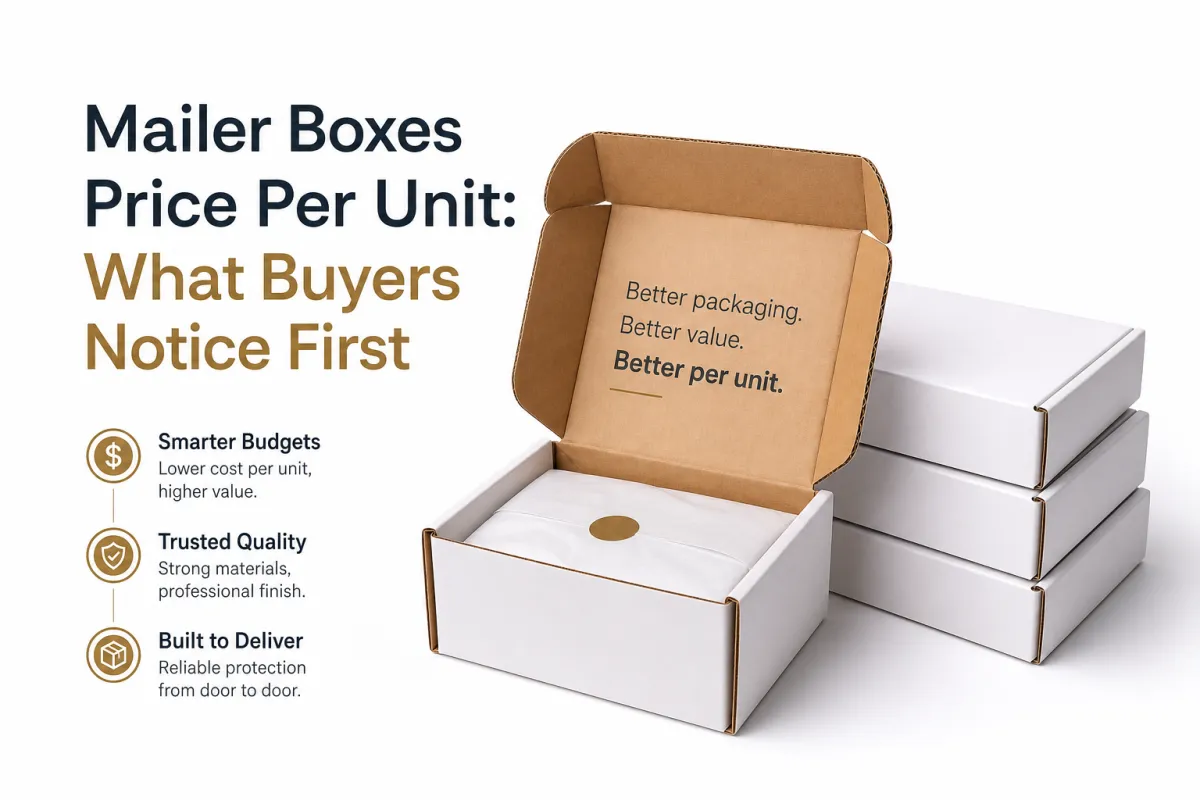
The first thing most buyers notice is that mailer boxes price per unit does not behave like a shelf price on a finished consumer good. A quote can move up or down for reasons that are easy to miss if you only look at the finished box photo. Board grade matters. Flute profile matters. The way the box opens matters. Even the difference between a clean kraft exterior and a full-color print with coating can move the number enough to affect a launch budget.
The buying question is not only, "What does the box cost to make?" It is also, "What does it cost to store, assemble, print, ship, and handle across the full order cycle?" A lower-priced box that arrives flat, folds cleanly, protects the product, and stacks efficiently in the warehouse can be the better packaging choice, even if the quoted mailer boxes price per unit is not the absolute lowest on paper. The reverse is true as well: a cheap-looking box that crushes, scuffs, or slows packing staff can turn into an expensive mistake after the first production run.
Mailer boxes usually serve two jobs at once: protection and presentation. That dual role changes the pricing conversation. A plain shipping carton can be judged mostly on strength, but a branded mailer has to do more. It needs to hold its shape, show the logo cleanly, and still make sense from a cost-per-order standpoint. Once those goals are clear, comparing mailer boxes price per unit becomes faster and more honest because the buyer can ask whether the quote is built for rough transit, retail unboxing, or both.
Many teams miss this part: the cheapest box is not always the lowest-cost packaging choice. If a box needs extra void fill because the inside size is too loose, or if the print quality makes it look like a sample rather than a finished brand asset, the cost of the box itself becomes only one piece of the total spend. That matters even more when packaging supports repeat shipments. Good buyers think in terms of total order economics, not just the number attached to mailer boxes price per unit.
The fastest route to a useful quote is to define the use case clearly. Is the box going out by parcel carrier? Is it being packed by hand or on a semi-automated line? Does the customer expect a premium reveal when the lid opens? Is the product fragile, sharp-edged, or heavy for its footprint? Once those answers are on the table, suppliers can shape the spec more accurately, and the mailer boxes price per unit becomes easier to compare across vendors instead of being buried under vague "starting at" language.
"A quote is only useful if it matches the exact board grade, print coverage, and freight terms. Anything less is just a guess with a price tag."
That framework carries the rest of the discussion. Once you understand what moves the number, you can decide where to save money, where to spend for durability, and where a slightly higher mailer boxes price per unit protects margin on the back end.
Mailer Box Specifications That Change Cost and Performance
Mailers look simple at a glance, but the specification details matter more than most buyers expect. The biggest drivers behind mailer boxes price per unit are usually inside dimensions, board thickness, flute profile, closure style, and print coverage. Those details determine how much paperboard is consumed, how much converting is required, and how efficiently the box can be cut from the parent sheet. A small change in dimensions may not look dramatic on a drawing, yet it can raise waste or push the design into a different board layout, which changes unit cost quickly.
For common corrugated mailers, E-flute is often chosen for cleaner print and a slimmer profile, while B-flute gives more wall thickness and a sturdier feel. Single-wall construction is usually enough for lightweight retail goods, apparel, or small accessory kits. Heavier products, brittle items, or mixed-media bundles may need a stronger spec, which raises the mailer boxes price per unit because both board weight and structure increase. A 9 x 6 x 2 mailer made in E-flute and a 12 x 10 x 4 mailer in a heavier board are not priced from the same baseline, even if the outside branding looks similar.
Print choices move the number as well. No print is usually the lowest-cost option. One-color branding is a modest step up. Full-color exterior printing adds more setup and press time, and inside printing adds another layer of production work that can lift the mailer boxes price per unit again. Finish matters too. A natural kraft uncoated surface gives a plain, earthy feel, while a coated or laminated surface can improve color pop and scuff resistance, but it also adds material and finishing cost. If the mailer will travel through distribution centers or be handled repeatedly, that extra protection can be worth it.
Special features are where the conversation becomes practical. Inserts, partitions, tear strips, self-seal closures, and dust flaps all have value, but they are not free. Each one adds paperboard usage, tooling detail, or labor time. A mailer designed for a bottle kit with dividers is never priced the same as a simple tuck-top shipper. That is why buyers should ask whether the feature is protecting the product, improving the unboxing experience, or just adding complexity. If the answer is not clear, the mailer boxes price per unit may be paying for a feature the product does not truly need.
There is also a difference between a stock-style mailer and a fully custom build. Stock-style mailers use common structures and familiar die patterns, which often helps with speed and cost. Fully custom builds can optimize fit and presentation, but they may require unique tooling and more converting time. Neither option is automatically better. The right choice depends on product dimensions, order frequency, and the level of brand presentation required. If the box has to ship reliably and present well on unboxing, the goal is not the lowest possible mailer boxes price per unit; the goal is the best value for the job.
- E-flute: good for print clarity and a lighter, premium feel.
- B-flute: thicker wall, often better for added crush resistance.
- Single-wall: common for apparel, kits, and lower-weight goods.
- Double-wall: used when product weight or stacking strength needs rise.
- Self-locking or tuck-top styles: convenient, but design details can affect labor and tooling.
One more practical point: I have seen teams spec a heavier board just because it sounds safer, then discover that the extra stiffness makes folding slower and shipping costlier. That is why the right board is not always the thickest one. It is the one that matches the box's actual job, which keeps mailer boxes price per unit honest instead of inflated by habit.
Mailer Boxes Price Per Unit, MOQ, and Unit Cost Breakdown
Once the structure is defined, the next question is how the quote is built. A serious mailer boxes price per unit usually reflects several layers: material usage, print setup, cutting and converting, finishing, packaging, and freight. That stack matters because the lowest paperboard cost does not always create the lowest delivered cost. A supplier with a slightly higher board price but efficient production and predictable freight terms may still offer the better total deal.
MOQ, or minimum order quantity, is the point where fixed production costs can be spread across enough boxes to make the run viable. A small order carries more setup burden per unit, so the mailer boxes price per unit tends to be higher. A larger order usually lowers the unit number because the cost of die-cutting, press setup, proofing, and line preparation is distributed across more boxes. That is not a sales trick; it is how corrugated production works. Fixed costs do not disappear just because the order is small.
Volume breaks are where buyers can make real decisions. A run of 500 mailers may carry a higher per-box number than a 1,000-piece order, and 5,000 pieces often produce a noticeably better unit cost again. The exact break points depend on artwork, board spec, and the plant's production method, but the direction stays the same. If demand is steady, the best mailer boxes price per unit often appears once the order size crosses the point where setup is no longer carrying too much weight.
| Quantity Tier | Typical Build | Indicative Mailer Boxes Price Per Unit | Best Fit |
|---|---|---|---|
| 250-500 | Simple E-flute, limited print | $1.50-$4.00 | Test launches, short campaigns, seasonal runs |
| 1,000 | Single-wall mailer, one-color or light full-color | $0.75-$1.85 | Growing e-commerce programs and repeat sellers |
| 5,000 | Custom size with standard print and finish | $0.35-$1.00 | Established SKUs with steady demand |
| 10,000+ | Optimized board layout, repeat production | $0.24-$0.72 | High-volume replenishment and multi-month inventory planning |
Those figures are illustrative, not a universal rate card, but they help buyers understand the direction of the market. A plain kraft mailer with no print will usually sit toward the low end of the range. A full-color branded box with inserts, specialty coating, or inside print will move toward the high end. If a quote lands far outside those bands, it is worth asking whether the board is heavier, the size is less efficient, or extra services are folded into the number. Good quotes make the structure of mailer boxes price per unit easy to read.
Quotes should always be compared on the same basis. That means the same box dimensions, the same board grade, the same print method, the same finish, the same freight term, and the same proofing assumptions. A quote that excludes shipping may look cheaper until it reaches your dock. A quote that includes a sample or dieline review may look higher but be more accurate. The smartest buyer asks for tiered unit cost so the mailer boxes price per unit can be checked at 500, 1,000, 5,000, and 10,000 pieces rather than guessed from a single point.
That comparison also helps with forecasting. If the next reorder might double the quantity, you want to see how the unit number changes before you commit to a structure. In a lot of shipping programs, the difference between one quantity tier and the next can decide whether the packaging budget stays in line or needs to be adjusted. Good pricing conversations are not about chasing the lowest possible mailer boxes price per unit on a single run; they are about finding the order structure that keeps the program healthy over time.
Production Process, Timeline, and Lead Time Expectations
A quote only becomes useful when it fits the production timeline. The typical path starts with the request and review of the spec, then moves to artwork confirmation, proof approval, tooling if needed, production, packing, and shipment. If any step is vague, the schedule weakens and the mailer boxes price per unit can become less relevant than the cost of missing a launch window. Packaging buyers usually discover this the hard way: a fair price is not much help if the finished boxes arrive after the cartons are needed.
Proof approval is one of the biggest timing checkpoints. Dieline placement, barcode position, color matching, and inside print all deserve a careful review before production starts. A clean proof prevents rework, and rework is expensive. If a revision changes the structure or print coverage, the supplier may need to adjust the quote, which can shift the mailer boxes price per unit slightly. That is normal. The better outcome is not speed at any cost; it is clarity before the press starts.
Sampling time and full production time are not the same thing. A sample or structural prototype can often be turned faster than a full commercial order because it does not require the same scale of machine time, boxing, or freight coordination. Once production begins, timing depends on the order size, the print complexity, and whether special finishes are involved. Straightforward runs may move in roughly 10 to 15 business days after proof approval, while more complex builds can take longer. Inside print, specialty coatings, heavy inserts, or unique closures may extend the schedule and nudge the mailer boxes price per unit upward as well.
Freight planning matters as much as manufacturing time. A finished box sitting in a warehouse does not help if the shipment is booked too late or the delivery window is too tight. If the cartons are going to a fulfillment center, make sure the receiving requirements are understood before production completes. Palletization, case pack, and labeling can all affect how smoothly the order is received. In practical terms, the total program includes both box making and box movement, so a realistic mailer boxes price per unit should be considered alongside shipping timing and receiving rules.
For a first order, build extra buffer into the schedule. That is especially true if the artwork is still being refined, if the product dimensions are not fully frozen, or if the launch date is tied to a marketing campaign. A few extra days at the front end can save a lot of stress later. Buyers who leave room for proof review, freight booking, and one round of correction usually get a cleaner result. In packaging, predictability is worth real money, and that value often shows up in the final mailer boxes price per unit only indirectly.
How to Compare Suppliers Without Guesswork
Supplier comparison gets easier when the buyer refuses to compare vague quotes. A low number on paper means very little if the board grade is lighter, the print limits are different, or freight is excluded. To compare mailer boxes price per unit fairly, ask for the same inside dimensions, the same flute, the same print method, and the same delivery terms. That is the only way to see whether one supplier is truly more efficient or simply pricing a different build.
Samples help. Structural samples show how the box folds, locks, and carries weight. Printed samples show ink density, registration, and surface feel. If the mailer has to survive parcel transit, the team can also use shipping test methods as a sanity check. The procedures referenced by ISTA are widely used for shipment performance discussions, and that matters because a box that looks good on a desk still has to survive the actual shipping cycle. For paper sourcing concerns, FSC certification is a useful marker when a buyer needs responsibly sourced fiber in the specification.
Communication quality matters more than some buyers admit. A good supplier asks about product weight, dimensions, packing method, storage conditions, and order frequency. Those questions are not busywork. They tell the supplier how much protection the mailer really needs and whether the box should be optimized for speed, shelf appeal, or transit durability. When the questions are thoughtful, the resulting mailer boxes price per unit usually reflects a better fit for the job.
"Ask for the same board, same print, same freight term, and same proofing assumptions. If those change, the price comparison is fiction."
There are warning signs too. If a quote does not list dimensions, board type, print method, finish, lead time, and approval steps, the buyer should ask for clarification. If one supplier includes freight and another does not, the lower quote is not automatically the better deal. If sample approval is missing from the process, there is a higher risk of error later. Good purchasing practice is not complicated, but it is disciplined. Clear specs lead to a credible mailer boxes price per unit, and credible pricing leads to fewer surprises.
It also helps to compare mailers alongside other packaging formats. Some brands can move light goods into Custom Poly Mailers and save on weight, while others need the better crush resistance and presentation of corrugated. The same program may also call for a broader mix of structures from Custom Packaging Products if the line includes heavier kits, inserts, or retail-ready packaging. The point is not to force every product into the same box style. The point is to choose the format that keeps the mailer boxes price per unit aligned with product risk and brand goals.
The best supplier is not always the cheapest. It is the one that helps you land on the right spec quickly, explains the tradeoffs plainly, and gives you a price structure that scales with your demand. That saves time on reorder cycles, and it keeps the final mailer boxes price per unit from drifting once the packaging program is in motion.
Why Custom Logo Things Fits Shipping Programs
Custom Logo Things fits shipping programs because the focus is not just on making a box that looks decent in a mockup. The real goal is packaging That Ships Well, stacks well, and presents the brand with enough polish to support repeat ordering. That matters because the best mailer boxes price per unit is the one that holds up across the full cycle, from approval to fulfillment to reorder.
Buyers need clarity on dimensions, graphics, and quantity, and that is where a direct quoting process pays off. If the supplier can work from finished product size, estimated weight, and the level of print coverage the brand actually needs, the quote becomes useful much faster. There is less back-and-forth, fewer assumptions, and less risk of discovering that the box spec does not match the product after the order is placed. That is the difference between a smooth packaging purchase and a costly revision. It also keeps mailer boxes price per unit grounded in actual use.
The practical benefit of working with a packaging partner that understands corrugated construction is that the recommendation can be matched to the use case. A lightweight apparel item may only need a simple branded mailer. A bundled kit may need inserts and a tighter internal fit. A heavier item may need a stronger wall or more careful board selection. The right recommendation reduces waste, improves pack-out, and keeps the mailer boxes price per unit from drifting upward because of unnecessary structure.
For brands that ship multiple packaging formats, consistency matters too. A mailer box, a poly mailer, and a retail carton should all feel like part of the same system, even if the materials are different. That is why a packaging partner should help buyers choose across the line instead of forcing a single solution onto every product. If you are building a broader packaging program, it can help to review the available Custom Packaging Products and decide where mailers fit best, where cushioning is required, and where lighter shipping formats make more sense. The right mix keeps the mailer boxes price per unit connected to the larger fulfillment plan.
There is also value in a partner who is careful with approval milestones. Good packaging work depends on the details: dieline alignment, print boundaries, fold direction, and finish selection. If those are checked before production, the result is more predictable. That is the kind of discipline buyers should expect. A fair quote is good. A fair quote with clean execution is better. A fair quote with repeatable quality is what makes the mailer boxes price per unit worth trusting on the next order.
"A packaging partner should reduce friction at approval, production, and reorder stages. If the process creates more questions than answers, the price was never the full story."
Next Steps to Lock in Your Mailer Boxes Price Per Unit
The cleanest way to move forward is to gather the essentials before requesting a quote. Start with the finished product dimensions, the approximate product weight, the desired print coverage, the target quantity, and any insert or closure requirements. If the pack-out is still being finalized, say so. That honesty helps the supplier build a realistic recommendation and protects the mailer boxes price per unit from changing late in the process.
Next, decide what matters most. Is the main goal lower unit cost, stronger presentation, or a balance of both? That answer shapes the spec. A plain kraft mailer can be efficient and still look clean. A full-color branded mailer may support a premium unboxing experience, but it will raise the mailer boxes price per unit. Neither choice is wrong. The wrong move is trying to get a premium presentation while paying for a basic shipping carton.
Ask for a line-item quote that separates material, print, setup, and freight. That simple request makes comparison far easier because you can see where the money is going. If a supplier can also show tiered pricing by quantity, even better. You will be able to see where the strongest value starts and whether the current order size is enough to unlock a better mailer boxes price per unit. If the forecast suggests a second order soon after the first, that volume information can change the decision.
Make sure artwork and approval timing are realistic before the order is released. Missing dielines, late color changes, and last-minute layout edits are the most common reasons timelines slip. They also make the pricing conversation more difficult because every change adds risk. The smoothest projects are the ones where the product spec, artwork, and quantity are all settled before production starts. That approach keeps the mailer boxes price per unit tied to the actual job rather than to unresolved decisions.
If you only take one thing from all this, make it simple: lock the dimensions, board grade, print method, freight term, and order quantity before you compare quotes. Once those five pieces are fixed, the mailer boxes price per unit becomes a usable number instead of a moving target, and that makes the whole packaging decision a lot less kinda messy.
In the end, the best purchasing choice is the one that balances cost, Quality, and Timing without overcomplicating the program. If the quote, proof, and lead time all line up, you have the information you need. If the mailer boxes price per unit fits the budget and the box fits the product, move ahead with confidence. That is how packaging buyers keep shipping programs predictable, brand presentation consistent, and repeat orders easier to manage.
What affects mailer boxes price per unit the most?
Box size and board grade usually have the largest impact because they determine how much material is used per box. Print coverage, inserts, and specialty finishes can raise the mailer boxes price per unit by adding setup and production time. Order quantity matters as well because larger runs spread fixed costs across more units.
Does MOQ change mailer boxes price per unit?
Yes. MOQ changes the unit number because setup costs are divided across the total order. A lower quantity usually means a higher mailer boxes price per unit, even when the structure is simple. If demand is uncertain, ask for tiered pricing so you can see the break point where the cost improves.
Are printed mailer boxes more expensive per unit than plain boxes?
Usually, yes. Printing adds setup, ink, and additional production steps, so the mailer boxes price per unit is typically higher than a plain box. A simple one-color logo is often more affordable than full-coverage outside print or inside printing. The cleanest comparison is to quote both versions at the same size and quantity.
How do I get an accurate quote for mailer boxes price per unit?
Share finished dimensions, product weight, quantity, print details, and whether you need inserts or special closures. Ask for freight and any setup charges to be included so the numbers are comparable. If possible, send artwork or a clear mockup because layout changes can affect proofing and the final mailer boxes price per unit.
What is a realistic turnaround for custom mailer boxes?
Turnaround depends on proof approval, tooling needs, print complexity, and the current production queue. Simple orders usually move faster than fully custom builds with inside print or structural extras. Always confirm lead time before launch planning so shipping and inventory are not left to chance, and make sure the schedule supports the quoted mailer boxes price per unit as well as the delivery date.

