Buyer Fit Snapshot
| Best fit | Custom Molded Pulp Inserts Branding projects where brand print, material claims, artwork control, MOQ, and repeat-order consistency need to be specified before quoting. |
|---|---|
| Quote inputs | Share finished size, material target, print colors, finish, packing count, annual reorder estimate, ship-to region, and any compliance wording. |
| Proofing check | Approve dieline scale, logo placement, barcode or warning zones, color tolerance, closure strength, and carton packing before bulk production. |
| Main risk | Vague material claims, crowded artwork, missing packing details, or unclear freight terms can make a low unit price expensive after revisions. |
Fast answer: Custom Molded Pulp Inserts Branding: Material, Print, Proofing, and Reorder Risk should be specified like a repeatable production item. The safest quote records material, print method, finish, artwork proof, packing count, and reorder notes in one written spec.
Production checks before approval
Compare the actual filled-product size with the drawing, then confirm tolerance on folds, seals, hang holes, label areas, and retail display edges. Reserve space for logos, QR codes, warning copy, and material claims before decorative graphics fill the panel.
Quote comparison points
Review material grade, print process, finish, sampling route, tooling charges, carton quantity, and freight assumptions side by side. A quote is only useful when the supplier can repeat the same color, closure quality, and packing count on the next order.
Custom Molded Pulp Inserts Branding: Smart Packaging That Earns Its Keep
Custom Molded Pulp inserts branding is one of those packaging decisions that looks modest from the outside and quietly solves several problems at once. A plain kraft carton can still feel deliberate when the insert fits the product properly. A glossy box can feel oddly unfinished if the item rattles around inside like it was packed in a hurry. People notice that feeling right away, even if they never say it out loud.
From a packaging buyer's point of view, custom molded pulp inserts branding is not about pretending fiber trays are luxury objects. It is about fit, structure, reveal, and presentation doing real work. When the insert holds the product securely, frames it cleanly, and makes the opening moment feel considered, the packaging starts carrying brand identity instead of acting like a shipping shell.
This approach shows up often in electronics, beauty, candles, home goods, accessories, and subscription kits. Those categories need protection, but they also need packaging that looks thought through the moment the lid opens. If the contents sit aligned, centered, and easy to lift, the brand feels organized. If the product arrives loose, the whole package story starts to fall apart. That part is simple, and it is the part people often learn late.
I have seen plenty of packs where the outer carton looked polished, but the insert was doing all the heavy lifting in the unboxing. That is usually the piece that tells the truth. You can kind of fake a lot with print and color, but you cannot fake fit for long.
"The insert is not the leftover piece. It is often the first thing the customer actually notices."
Custom molded pulp inserts branding: what it is and why it works
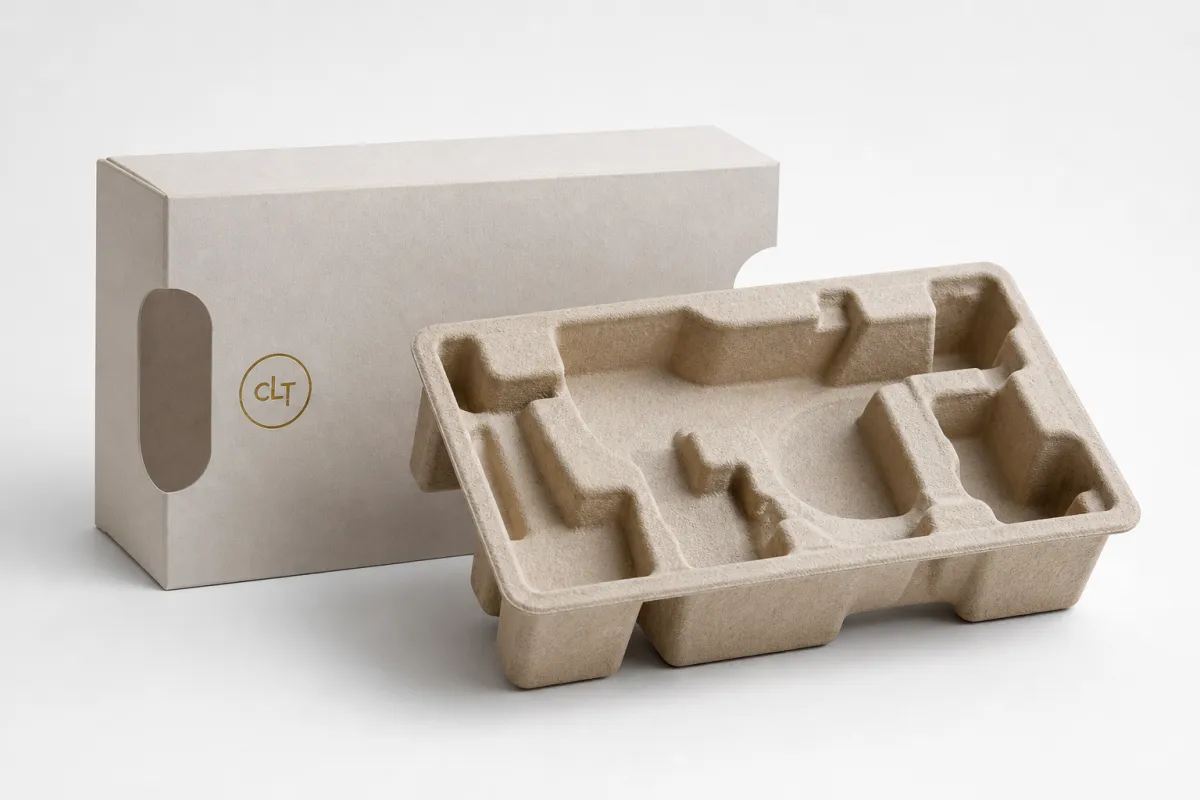
Custom molded pulp inserts branding begins with a straightforward idea: a fiber-based tray, cradle, or shell is shaped around the product so it protects the item and presents it well. In plain English, the insert is what keeps the product from bouncing around inside the box while also making the opening moment feel cleaner than a mix of tissue paper, tape, and good intentions.
The hard truth is that a branded package does not need expensive exterior graphics to feel premium. It needs control. Fit matters more than many teams expect. A tight cavity around a bottle, device, or accessory creates instant order. Edge profiles matter too. Soft radiused edges tend to read as more intentional than harsh, broken forms. Surface texture matters as well. A fine, even pulp finish communicates something different from a lumpy one, and that is where custom molded pulp inserts branding earns its place.
Branding lives in the structure, not only in the logo. The reveal sequence matters: what the customer sees first, what they touch second, and whether the product sits proud of the insert or sinks into it. That is why custom molded pulp inserts branding can do more for perceived value than another layer of ink on the carton. It organizes attention and gives the unboxing experience a clear rhythm.
In use, this format works especially well when the goal is packaging that feels useful rather than decorative. Electronics use it for cable routing and component separation. Beauty brands use it for vial alignment and mirror-safe presentation. Candle brands use it to reduce chipping and wax scuffing. Accessories and home goods benefit because the insert can give each piece its own space. None of that is flashy. All of it matters.
There is also a practical difference between a tray that only holds a product and a tray that supports the brand story. The first one disappears. The second one helps the customer understand what kind of company made the product before they even read the insert card. That is a pretty useful job for a material that started life as fiber and water.
If you already use Custom Packaging Products or are comparing Case Studies to see how other brands handle presentation, study the insert before you fixate on the box print. A lot of packaging design misses the obvious. The outer carton gets the attention, and the inside is where the customer actually judges the brand.
For custom molded pulp inserts branding, the real payoff is simple: the package feels designed, not assembled. That signal often matters more than "expensive" in day-to-day buying decisions.
How custom molded pulp inserts branding works in the real world
Custom molded pulp inserts branding works through a handful of design levers. Cavity shape controls how the product sits. Wall thickness changes strength and weight. Edge profile changes how the insert feels when lifted. Surface texture influences the visual read. Tint can help the pulp feel warmer, cleaner, or more premium depending on the brand direction. Embossing is possible in some setups, though molded pulp usually performs best when the form itself carries the identity instead of depending on printed decoration.
There is also a real difference between passive protection and active branding. Passive protection keeps a product from moving too much. Active branding guides the eye and creates a deliberate reveal. The insert can hide cords, frame a bottle, separate a main item from accessories, or lift the product high enough to make the first view feel composed. That is why custom molded pulp inserts branding is more than a material choice. It is a presentation system.
Manufacturing method matters as well. Recycled fiber is common, and the process usually falls into wet press or thermoformed styles depending on detail level, surface finish, and volume requirements. Wet press can deliver tighter surfaces and cleaner edges. Other methods may suit faster turnaround or thicker structures. The right answer depends on the product, the tooling budget, and how particular you need the look to be. If the spec stays vague, the result usually follows suit.
Where printing is limited, the insert has to do the talking. That is not a weakness. It is a design constraint that can be used well. Form, rhythm, and product placement create visual order without needing a lot of ink. In retail packaging, that can help because fewer printed elements often means fewer chances for the packaging to look busy. If your custom molded pulp inserts branding depends on a giant logo to carry the experience, the structure is probably underdeveloped.
That is also why custom molded pulp inserts branding often pairs well with custom printed boxes. The outside box sets tone. The insert confirms it. Together they make the package feel coherent, which is harder to pull off than people often admit.
For sustainability claims, keep the language grounded. Many buyers ask about recycled content, renewability, and end-of-life options. If you want to point to material standards and fiber sourcing, the FSC site is a strong place to start. For shipping performance, the ISTA test methods give a practical benchmark. Those outside references help keep a packaging discussion honest.
In my experience, the best insert designs are usually not the prettiest sketches in the first round. They are the ones that survive drop tests, packout trials, and a little warehouse abuse without making everybody curse under their breath. That is where the actual expertise lives.
Custom molded pulp inserts branding succeeds when the insert solves three jobs at once: hold the product, calm the visual layout, and make packout easier. If it only does one, the design is probably underbuilt.
Process, timeline, and lead time for custom molded pulp inserts branding
Good custom molded pulp inserts branding starts with measurement, not with mood boards. Measure the product carefully. Note fragile zones. Record tolerances, coating thickness, and any accessories that must fit in the same cavity. A glass bottle with a shoulder radius and a plastic device with a charging port are not the same problem, even if both "fit in a tray" on a whiteboard. Packaging design gets real quickly once the guessing stops.
The usual flow is clear enough: product measurements, concept sketch, sample tooling or sample build, sample approval, final tooling, production, and shipping. Simple projects can move quickly once dimensions are locked. More complex projects add time, especially if the insert needs multiple cavities, specific release angles, or a very clean presentation face. For custom molded pulp inserts branding, every revision round adds friction. That is not a design flaw. It is production planning and material behavior doing what they do.
Typical lead times vary. A simple insert with a clean geometry might move from approved spec to production in roughly 2 to 4 weeks once tooling is set. More custom parts can stretch to 5 to 8 weeks or more, especially when a new mold is needed and sampling takes more than one round. Add freight and factory queue time, and it becomes easy to see why rushed packaging often turns into expensive packaging. Late changes rarely save money.
- Lock the product dimensions early.
- Agree on protection goals before you ask for samples.
- Review one direction quickly instead of dragging out three weak ones.
- Test fit and assembly with the real team that will pack orders.
- Approve the final version only after the insert passes a basic drop, shake, and compression check.
The biggest schedule killers are vague specs, endless revisions, holiday queues, and cosmetic changes after sampling has already started. If the insert already protects the product and the only requested change is "make it feel more premium," that is not useful direction unless you can define what premium means in cavity geometry, finish, or reveal. Custom molded pulp inserts branding rewards clarity and punishes hand-waving.
If you want to move faster, make a one-page brief before quoting. List dimensions, product weight, fragile points, target quantity, and the lane the product will ship through. A 12 oz candle going direct-to-consumer has different needs than a device going into retail packaging on a pallet. The better the brief, the less time custom molded pulp inserts branding wastes in sample churn.
One more practical point: if your launch date is fixed, build buffer. A week of buffer on paper often becomes a day of buffer in real life. Packaging rarely follows the calendar you wanted, and it is usually the last thing teams want to hear right before a launch. Still true.
Cost, pricing, MOQ, and quote factors for custom molded pulp inserts branding
Pricing for custom molded pulp inserts branding usually comes down to tooling, sample charges, unit price, freight, and any finishing or special handling required by the product. The quote may also include setup costs tied to the machine, trim method, and packaging format. If the project needs fine detail or a tighter cosmetic finish, the cost per unit tends to rise. If the insert is simple and the order is large, the math improves quickly.
The biggest pricing drivers are quantity, part size, wall thickness, cavity complexity, surface finish, and tolerance requirements. A basic one-cavity insert with generous fit ranges costs less than a multi-part layout with nested supports, cable channels, and a very specific reveal. That is how custom molded pulp inserts branding works. More shaping means more time, more tooling, and more process control.
MOQ is not one universal number. Different suppliers handle it differently depending on process and mold complexity. Smaller runs can be possible, but the unit cost is usually higher because setup and tooling are spread over fewer pieces. As volume rises, the cost per unit usually drops noticeably. That is why asking for quotes at several volume breaks is smarter than staring at one line item and pretending it tells the whole story.
| Run Size | Typical Unit Range | What It Means |
|---|---|---|
| 1,000-3,000 units | $0.45-$0.95 | Higher setup burden; useful for testing or short launches |
| 5,000-10,000 units | $0.18-$0.40 | Common sweet spot for many custom molded pulp inserts branding projects |
| 20,000+ units | $0.10-$0.28 | Better absorption of tooling and setup costs; stronger pricing power |
Those numbers are directional, not a promise. A tall tray for a glass item and a shallow cradle for an accessory are not priced the same, even if both look "small" on a spec sheet. Freight can swing the final cost more than buyers expect, especially if the insert is bulky and the pallet cube gets awkward. In custom molded pulp inserts branding, the hidden savings often show up in fewer returns, less breakage, cleaner assembly, and less void fill. That matters a lot.
If you want a fuller view of packaging economics, compare the insert quote with the labor cost of packout and the damage rate in transit. A slightly more expensive insert that reduces breakage by even a small percentage can pay for itself faster than a cheap option that looks fine and fails in shipping. That is the kind of math that keeps packaging managers attentive.
For brands selling through Custom Labels & Tags or bundled kits, custom molded pulp inserts branding can also reduce the need for extra paperboard partitions and loose fill. Less clutter. Better fit. Fewer headaches. Nobody complains that the product arrived too neatly organized.
Step-by-step guide to building custom molded pulp inserts branding
Start with the product, not the trend. Measure the item carefully and identify the parts that need support, clearance, or visibility. A bottle neck may need a snug ring. A device screen may need a recessed face. A candle may need a wider cradle to protect the rim. Custom molded pulp inserts branding works best when the product itself decides the geometry.
Write a short brief that covers protection, presentation, assembly, shipping, and sustainability claims. Keep it practical. If the packout team can only accept an insert that drops in one way, say that. If the product must be visible the moment the box opens, say that too. Custom molded pulp inserts branding is easier when the supplier knows whether the priority is anti-rattle performance, shelf appeal, or a strong unboxing experience. Usually it is all three, just not always in equal measure.
Choose the structure that fits the job. A cradle works well for long, narrow products. A tray works when multiple parts need organization. A nested shell can create a more dramatic reveal. A multi-part layout can separate accessories, manuals, and the main item. There is no universal best answer. There is only the answer that protects the product and keeps assembly reasonable. The team in the warehouse will notice quickly if the design ignores that.
Prototype early and test the ugly stuff: shake resistance, drop performance, compression, fit tolerance, and packout speed. Shipping tests should reflect real handling, not a tabletop fantasy. That is where ISTA testing methods become useful, because the point is to simulate what actually happens when cartons move through a network. If your branded packaging looks beautiful but fails a basic abuse scenario, the design has a hole in it. Not figuratively. Literally.
Pay attention to the assembly line, not just the render. If the insert makes the job harder, slower, or more error-prone, the packaging is fighting the business. A design that saves 8 seconds per unit across 10,000 units matters. That is more than 22 labor hours. Suddenly the "small" packaging choice is not small at all. This is one reason custom molded pulp inserts branding should be judged on packout efficiency as well as appearance.
If you want an easy internal reference point, compare the insert work to the structure of your broader product packaging. Brands that already invest in custom printed boxes or a coordinated kit system usually get faster results because they know how to brief artwork, Fit, and Finish. The insert just needs to match that standard instead of pulling the whole presentation backward.
A good rule: approve the insert with the real customer in mind. If it protects well but hides too much of the product, the reveal is weak. If it looks great but slows packing, the operation will hate it. Custom molded pulp inserts branding should solve both problems. Otherwise, you are paying for a nicer way to create a new one.
One practical test I like is simple: hand the prototype to someone who has never seen the design brief and ask them to pack three units in a row. If they hesitate, improvise, or start forcing the parts, that is your warning sign. The render may still look fine. The process probably will not.
Common mistakes that weaken custom molded pulp inserts branding
The first mistake is treating the insert like a safety tray and then expecting it to do branding work on its own. Protection alone is not enough. A safe tray can still feel forgettable the second the box opens. Custom molded pulp inserts branding needs intentional shape, product framing, and a reveal that feels designed.
The second mistake is ignoring tolerances. If the cavity is too tight, the product scratches, binds, or looks forced into place. Too loose, and the item moves around and makes the package feel cheap. That is not subtle. It is the difference between a clean premium presentation and a tray that makes everyone uneasy. Tolerance control is one of the least glamorous parts of custom molded pulp inserts branding, and one of the most important.
The third mistake is chasing a premium look without checking assembly speed. Beautiful packaging that adds 15 seconds per unit is not automatically premium. It may simply be expensive labor with better lighting. If the insert requires a strange loading angle, extra hand motion, or multiple alignment steps, the warehouse will pay for it whether or not the marketing team notices.
- Do not assume recycled content fixes weak structure.
- Do not skip shipping tests because the prototype "looks good."
- Do not finalize graphics before the fit is locked.
- Do not ignore how the product sits when the lid opens.
- Do not let sustainability language outrun actual performance.
Another common miss is treating sustainability like a shield against quality issues. If the insert crushes, sheds, or feels flimsy, customers notice that faster than any recycled-content claim. Good custom molded pulp inserts branding supports both the environmental story and the user experience. If either one is weak, the argument gets weaker.
One more: teams sometimes test in a perfect mockup and never validate the final run with warehouse feedback. That is how a design that worked in the sample room becomes a nuisance at scale. The people packing orders know where the pain lives. Ask them early. It saves time and it saves money.
For visual consistency across the rest of the package, some brands use custom labels, printed cards, or small collateral pieces that match the insert layout. That can support brand identity, but the insert still has to do the core job. A tidy label cannot rescue a bad cavity.
There is also a quieter mistake that shows up on reorders: nobody documents the approved orientation. A tray that was meant to sit one way can get flipped or rotated if the spec is vague, and then the reveal changes a little every time. That kind of drift is small at first and annoying later. Better to write it down once.
Expert tips and next steps for custom molded pulp inserts branding
Before you ask for quotes, build a one-page packaging brief. Include product dimensions, weight, fragile points, target quantity, target shipping lane, and launch date. Add any brand goals that matter, such as a premium reveal, a lighter recycled-material story, or a retail-ready presentation. That brief makes custom molded pulp inserts branding easier to price and faster to approve.
Ask for at least two sample directions. One can prioritize fit and protection. The other can push presentation and product reveal a little harder. Comparing both gives you a real read on the tradeoff. That is better than staring at one option in isolation and pretending it will magically solve every need. It will not. Packaging rarely behaves that nicely.
Run a packout test with the team that actually handles the product. The best insert is the one they can load correctly every time without needing a second glance. If the packout sequence is awkward, fix it before launch. If the insert is strong in theory but irritating in the warehouse, custom molded pulp inserts branding will fail where it matters most.
Compare quote line items side by side and ask what drives the unit price. Is it tooling? Wall thickness? Mold complexity? Freight? Surface finish? Once you know the biggest cost driver, you usually know where the fastest savings live. That is the practical buyer move. Not glamorous. Very effective.
If you need to coordinate the insert with other retail packaging pieces, line up the whole stack early: carton, insert, tags, labels, printed collateral, and any secondary protection. A coherent system makes the unboxing experience feel deliberate instead of assembled by committee. For brands that want the full package to feel aligned, Custom Packaging Products is a useful place to map the rest of the system without separating structure from presentation.
For teams that want a tighter visual system, custom molded pulp inserts branding can work alongside custom printed boxes and product inserts with matching copy blocks. That combination keeps the outside and inside of the box speaking the same language. It is a small thing until you compare it against a package that feels random.
Document the approved fit, finish, and placement rules now. If the insert needs to be flush, centered, or oriented a specific way, write that down. Future reorder batches should not drift because somebody forgot the original intent. Consistency is part of package branding. It is also part of trust.
My practical takeaway is straightforward: start with the product, not the artwork; prove the fit with samples; test the packout with real hands; and only then polish the presentation. That order keeps custom molded pulp inserts branding grounded in how the package actually performs, which is where the brand promise either holds up or falls apart.
Ultimately, custom molded pulp inserts branding is smart packaging because it solves practical problems while making the product feel cared for. It does not fake luxury. It earns clarity. When the structure is right, the result is a better unboxing experience, better protection, and a brand story that holds together long after the box is opened.
That is the real payoff of custom molded pulp inserts branding: fewer surprises, better presentation, and a package that feels built, not improvised.
How does custom molded pulp inserts branding differ from plain molded pulp packaging?
Plain molded pulp protects the product. Custom molded pulp inserts branding does that and also shapes the reveal, directs attention, and makes the package feel intentional. The difference usually comes from fit, cavity layout, finish, and how the insert presents the product when the box opens. If the insert supports unboxing, assembly, and product visibility, it is doing branding work even without heavy graphics.
What affects the price of custom molded pulp inserts branding the most?
The biggest drivers are tooling, order quantity, size, cavity complexity, and finish level. Freight and packaging assembly time can matter as much as the unit price, especially on bulky inserts. Ask for quotes at several volume breaks so you can see where the real savings start, instead of guessing from a single number.
How long does custom molded pulp inserts branding usually take?
Simple projects move faster, but custom tooling, sampling, and approval rounds can add several weeks. Lead time depends on how fast product specs are finalized and how many revisions the sample needs. Build extra time for shipping, factory queues, and any last-minute design changes, because those are the usual schedule thieves.
Can custom molded pulp inserts branding protect fragile products well?
Yes, if the insert is designed around real product dimensions and tested for drop, vibration, and compression. Use ribs, cradles, or nested supports where the product needs extra control instead of relying on filler. Do not skip shipping tests; the warehouse does not care how pretty the mockup looked.
What MOQ should I expect for custom molded pulp inserts branding?
MOQ varies by process, mold complexity, and supplier setup, so there is no single universal number. Smaller runs may be possible, but the unit cost usually improves as quantity rises and setup costs get spread out. The practical move is to compare low, mid, and high quantity quotes before you choose a final run size.

