Buyer Fit Snapshot
| Best fit | MOQ Packaging Comparison projects where brand print, material claims, artwork control, MOQ, and repeat-order consistency need to be specified before quoting. |
|---|---|
| Quote inputs | Share finished size, material target, print colors, finish, packing count, annual reorder estimate, ship-to region, and any compliance wording. |
| Proofing check | Approve dieline scale, logo placement, barcode or warning zones, color tolerance, closure strength, and carton packing before bulk production. |
| Main risk | Vague material claims, crowded artwork, missing packing details, or unclear freight terms can make a low unit price expensive after revisions. |
Fast answer: MOQ Packaging Comparison: Costs, Specs, and Lead Times should be specified like a repeatable production item. The safest quote records material, print method, finish, artwork proof, packing count, and reorder notes in one written spec.
Production checks before approval
Compare the actual filled-product size with the drawing, then confirm tolerance on folds, seals, hang holes, label areas, and retail display edges. Reserve space for logos, QR codes, warning copy, and material claims before decorative graphics fill the panel.
Quote comparison points
Review material grade, print process, finish, sampling route, tooling charges, carton quantity, and freight assumptions side by side. A quote is only useful when the supplier can repeat the same color, closure quality, and packing count on the next order.
A quote can look tidy on screen and still get expensive once freight, setup, and storage enter the picture. Packaging quotes behave a lot like airline fares: the number you see first is rarely the number you pay once the extras show up. That is why a moq packaging comparison should start with total landed cost, not the first unit price a vendor puts in front of you. The lowest number at the top often becomes the priciest line at the bottom.
From a packaging buyer's perspective, the real question is not, "Who has the lowest MOQ?" It is, "Who gives me the best balance of unit cost, flexibility, print quality, and lead time for this launch?" A careful moq packaging comparison helps you avoid dead inventory, rushed reorders, and the kind of awkward surprises that show up after the first run ships. That matters whether you are buying Custom Printed Boxes, labels, inserts, or full retail packaging.
I have watched brands lose more money on the second order than they saved on the first. One launch I reviewed had a low minimum, but the board was lighter than the sample suggested and the reprint was triggered by a color mismatch that nobody caught early. The buyer thought they had found a bargain. They had, but only for the supplier.
Consider a simple example. A brand orders 500 mailer boxes for a pilot drop, then discovers it needs 5,000 a month later. If the first quote looked cheap only because the supplier kept the minimum low but loaded the order with setup fees, the "savings" disappear the moment the second order lands. A buyer who ran the moq packaging comparison properly might have chosen a slightly higher first run with a lower per-unit cost and less rework. That is not theory. It is how cash gets trapped in cartons stacked in a warehouse.
A low MOQ is not a bargain if it forces the wrong board, the wrong finish, and a reprint six weeks later.
The right lens is plain: compare unit price, total landed cost, flexibility, and risk. A proper moq packaging comparison is not about buying the smallest order possible. It is about buying the right amount at the right spec, with enough room to adjust if demand shifts. That sounds obvious, but plenty of budgets still get built on the cheapest number alone.
MOQ Packaging Comparison: Why the Cheapest Quote Usually Wins
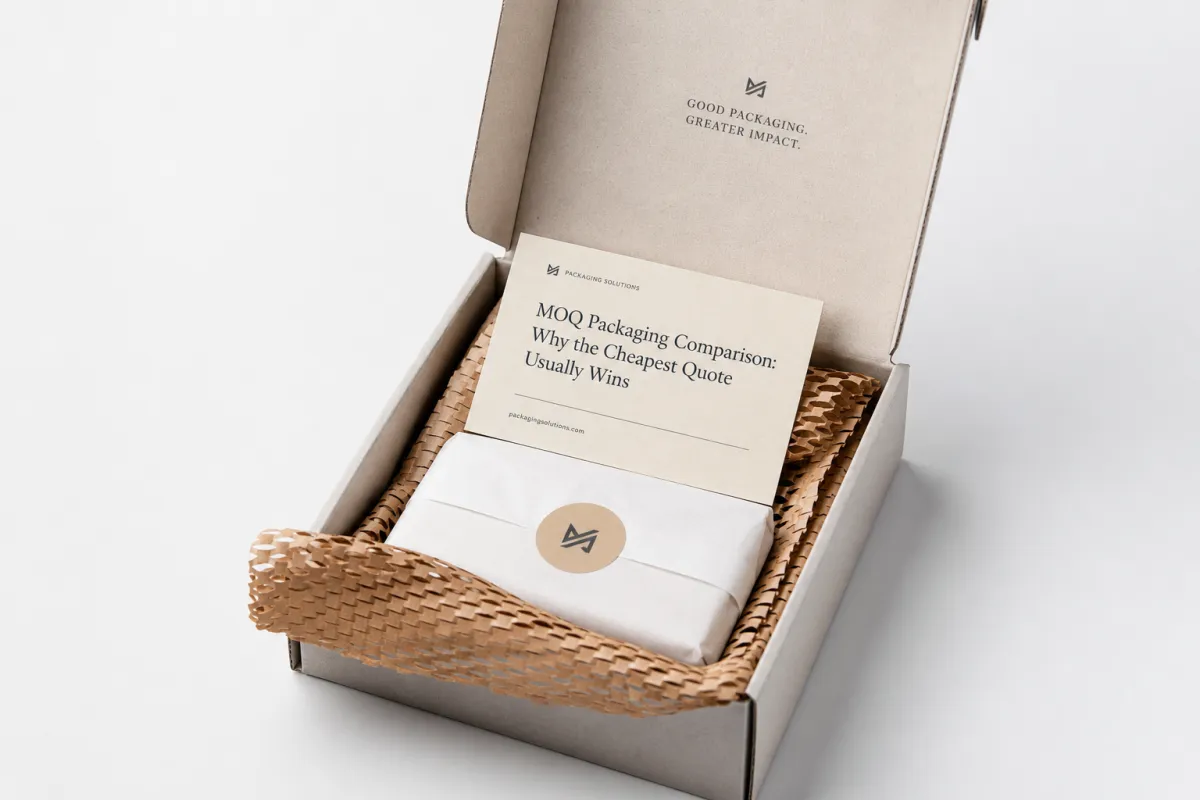
The cheapest quote usually wins the email thread. That does not mean it wins the project. In a real moq packaging comparison, the low number often hides one of three things: a stripped-down spec, a larger setup charge, or freight that is quietly doing the real damage. Buyers see the box price. The invoice sees everything else.
Here is the trap. A supplier quotes 500 folding cartons at a very low unit cost, but the tooling charge is high, the artwork changes cost extra, and freight is billed separately. Another supplier quotes a slightly higher unit price but includes lower prepress fees and a cleaner production path. On a small order, the second option can be cheaper overall. On a larger reorder, the first option may catch up. That is why the same moq packaging comparison should always be run at more than one quantity break.
The smartest buyers compare three things together: cash out now, cost per unit at scale, and inventory risk. If you are selling a seasonal product, the risk is obvious. A stack of printed cartons that misses the selling window is just expensive paper. If you are launching a subscription box or an evergreen SKU, the risk shifts toward paying too much per unit on a tiny run. Either way, the wrong MOQ can eat margin before the first sale even clears.
There is also a behavior problem. Many vendors advertise a low MOQ because it sounds friendly. Fine. But if that low minimum comes with expensive print coverage, limited sizing, and weak material choices, the buyer ends up paying for flexibility in every other line item. A strong moq packaging comparison does not chase the smallest threshold. It asks what that threshold really buys.
Think of it this way: a 500-piece run is useful for testing demand, samples, or a short campaign. A 5,000-piece run usually makes more sense if the product is stable, the artwork is locked, and storage is not a nightmare. The quote should reflect the business plan, not just a supplier's comfort level. That is the whole point of a moq packaging comparison.
There is no magic to it. You are matching volume to risk, then checking whether the pricing curve makes sense. If the quote only looks good because the vendor is hiding a cost in freight or plate charges, the comparison is already off. And yeah, that happens more often than suppliers admit.
Product Details: Compare Packaging Types Before You Compare MOQs
Before you compare minimums, compare the packaging type itself. Different formats behave differently, and the MOQ changes for a reason. A mailer box is not the same animal as a rigid box, and a folding carton does not carry the same setup burden as a retail bag. If the structural format is wrong, the moq packaging comparison turns into noise.
For example, branded packaging for apparel usually needs a polished unboxing moment, but it does not always need heavy-duty protection. Cosmetics often need sharp shelf appeal and tight color control. Electronics may need inserts, a close fit, and better transit resistance. Food packaging adds another layer because substrate choice and compliance requirements begin to matter. The product category should drive the packaging, not the other way around.
Most buyers compare these formats first:
- Mailer boxes for e-commerce and subscription shipments.
- Folding cartons for shelf display, lightweight retail packs, and secondary packaging.
- Rigid boxes for premium presentation and higher perceived value.
- Labels for jars, bottles, pouches, and cost-sensitive launches.
- Inserts for product protection, positioning, and presentation.
- Retail bags for stores, events, and simple branded carryout.
| Packaging type | Typical MOQ range | Common unit cost | Typical lead time | Best fit |
|---|---|---|---|---|
| Mailer boxes | 500-2,000 | $0.65-$1.80 | 10-15 business days | E-commerce, subscription, direct-to-consumer |
| Folding cartons | 1,000-5,000 | $0.18-$0.55 | 12-20 business days | Retail packaging, cosmetics, food, supplements |
| Rigid boxes | 300-1,000 | $2.50-$8.00 | 15-30 business days | Luxury, gifting, premium branding |
| Labels | 500-5,000 | $0.02-$0.12 | 5-10 business days | Fast-moving product packaging, SKU updates |
| Inserts | 500-2,000 | $0.10-$0.60 | 7-15 business days | Protection, fit, presentation |
| Retail bags | 500-2,000 | $0.25-$1.20 | 10-18 business days | Store use, events, simple branded carryout |
The table is a starting point, not a promise. Material, print coverage, and finishing move those numbers around. The pattern still holds: the more complex the structure, the higher the MOQ tends to climb. Rigid boxes usually need more handwork. Folding cartons are more efficient at scale. Labels often offer the most flexibility. That is why a serious moq packaging comparison starts with format, not quotes.
Think about the job the packaging has to do. Does it need to sell on shelf, survive shipping, or do both? If the answer is both, the moq packaging comparison should include structure, board strength, and print quality instead of treating packaging like a decorative afterthought. Good package branding does not rescue weak structure, and strong structure does not cover for poor visual execution.
A custom cosmetic carton and a corrugated mailer might share the same artwork, but they do not share the same economics. One is built for display and fine print reproduction. The other is built for transit. Mixing those up is a good way to compare the wrong numbers and then wonder why the margin is off by a mile.
Specifications in an MOQ Packaging Comparison: Material, Size, and Finish
Specs decide whether a quote is actually comparable. A buyer can ask for "the same box" from three suppliers and still get three different answers because one quote used 18pt SBS, one used E-flute corrugated, and one quietly swapped in a lighter board. That is not apples to apples. It is a moq packaging comparison built on a shaky stack of assumptions.
Start with material. Corrugated board is the workhorse for shipping strength and mailer boxes. Paperboard is common for folding cartons and Product Packaging That needs strong print reproduction. Rigid board gives a thicker, premium feel and usually pushes both cost and MOQ higher because the assembly is more manual. Kraft paper and specialty stocks are useful when the brand wants a natural, tactile look, but they can change print behavior and finishing options. In practice, the substrate is one of the first things that pushes a moq packaging comparison up or down.
Box size matters more than people like to admit. Oversized packaging wastes board, adds shipping cost, and can force a supplier into a less efficient sheet layout. Too many buyers guess dimensions from the sample box on the desk. That habit has a price tag. Measure the product, then allow for the insert, void fill, and shipping tolerance. Even a few millimeters can change how many boxes fit on a press sheet or in a shipping carton.
Finish choices do the same thing. CMYK printing is the usual starting point for custom printed boxes. Pantone matching helps when brand color consistency matters across packaging design, retail packaging, and other printed assets. Lamination adds protection and a different tactile feel. Spot UV, embossing, debossing, and foil stamping all lift shelf presence, but they also raise setup complexity. Some finishes need extra passes, special plates, or additional labor. A proper moq packaging comparison should ask which upgrades improve conversion and which ones simply inflate the order.
Here is a simple rule I use: if a finish does not improve brand perception, product protection, or shelf conversion, it is probably not worth the added minimum. Nice-looking packaging is fine. Wasteful packaging is not. Buyers often confuse the two.
There is also a quality standard issue. If the packaging is shipping product, ask whether the supplier can align with relevant transit or compression tests. For shipping performance, ISTA test methods are a credible reference point. For recycled or responsibly sourced fiber, check whether the material is FSC certified through FSC. Those standards do not make a quote cheaper, but they do make the buying decision less fuzzy. A serious moq packaging comparison should include compliance and performance, not only aesthetics.
Exact dimensions, print coverage, and finish level also affect sampling. A sample for a plain kraft mailer is not the same as a sample for a foil-stamped rigid box. If a vendor can only quote loosely, the buyer cannot compare with confidence. That is why a good moq packaging comparison starts with a full spec sheet and ends with a sample or proof, not wishful thinking.
One more wrinkle: color. If the brand has a signature shade, ask how the supplier controls it across reorders. I have seen brands approve a first run, then get a second run six months later with a noticeable shift because the tolerances were never defined. That kind of drift is small in a spreadsheet and very obvious on a shelf.
What Changes the Price in an MOQ Packaging Comparison?
Now for the part everyone actually wants to know: the money. In any moq packaging comparison, price is shaped by a short list of predictable inputs. Setup and prepress, tooling, material choice, print complexity, finishing, labor, and shipping all move the number. The trick is knowing which items are fixed costs and which ones scale with volume.
Setup and prepress are usually the first hit. A dieline has to be created or checked. Artwork needs to be prepared. Proofs need review. If the supplier is making plates or special dies, there is more upfront cost. On a low MOQ, those fixed charges spread across fewer units, so the unit price climbs. On a larger run, the same setup cost gets diluted. That is the basic math behind every honest moq packaging comparison.
Material choice is the next lever. A thicker board, premium coated stock, or heavier corrugated flute increases material cost. Rigid packaging takes more board and more hand assembly. Specialty stocks can also carry their own minimums because the supplier has to buy and store them. The cheaper-looking option is not always cheaper once waste and yield are counted.
Print complexity matters too. One-color print on kraft is usually easier than full-coverage CMYK with white ink, multiple spot colors, or heavy dark backgrounds. More coverage can mean more ink, more passes, and a greater chance of color variation. If the brand design is busy, expect the quote to reflect that. This is where packaging design should work with the budget, not against it.
Finishing is where the quote can run off the rails. Lamination is common and usually manageable. Embossing, foil, and spot UV add a premium look, but each one can create a higher setup burden and a tighter production window. Some suppliers also set higher MOQs because the finishing line is only economical above a certain quantity. If you need the packaging to look premium, fine. Just know the moq packaging comparison may shift from "cheap per box" to "smart spend for brand impact."
Shipping and storage are the quiet killers. Freight can be a meaningful share of the landed cost, especially on bulky boxes. A buyer who orders more than needed "to save on unit price" can end up paying for pallets, warehouse space, and slower cash turnover. A small per-unit savings means little if the boxes sit in storage for six months. I have seen finance teams smile at a lower per-unit cost while the operations team quietly had to rent another pallet bay. That is not a win.
Here is the comparison framework I recommend. Ask for quotes at two or three quantity breaks, such as 500, 1,000, and 5,000 units. Then compare:
- Unit price at each break.
- Setup or tooling charges.
- Freight and delivery terms.
- Lead time by quantity.
- Reorder flexibility.
That simple method usually exposes the real savings point. Sometimes the best value is the smallest run because the product is still unproven. Sometimes the smart move is to jump to a higher MOQ because the per-unit drop is large enough to justify the inventory. A disciplined moq packaging comparison shows you where that crossover sits. Without it, you are guessing with prettier spreadsheets.
Hidden costs deserve a separate warning. Sampling, artwork revisions, plates, rush fees, and extra storage can all show up late. Some suppliers bundle them. Some do not. If you are comparing vendors and one quote looks suspiciously low, ask what is excluded. A proper moq packaging comparison should make every line item visible before you approve production.
The cleanest quotes are usually the ones that spell out exactly what the buyer is paying for and what the supplier is assuming. If the spec is fuzzy, the price is fuzzy too. That kind of fuzziness is expensive, and it tends to show up right when the launch calendar is getting tight.
Process & Timeline: How MOQ Packaging Orders Actually Move
A lot of buyers think the hard part is choosing the box. In reality, the hard part is moving the order through production without avoidable delays. A realistic moq packaging comparison should include process time, not just quote time. A fast quote is useless if the supplier then sits on artwork for a week because the brief was incomplete.
The normal flow looks like this: brief, quote, dieline review, artwork prep, proof approval, production, inspection, and delivery. Each step has a place where things can stall. If the brief is vague, the first quote will be too. If the dieline is wrong, the artwork gets pushed back. If color notes are missing, the proof round drags on. Simple? Yes. Rarely handled well? Also yes.
For simple stock-style packaging with limited print, the lead time may sit around 7 to 12 business days after approval. For fully custom packaging with multiple colors, specialty finishes, or rigid construction, 15 to 30 business days is more realistic. Add freight and customs if the order is moving internationally. A buyer who expects premium branded packaging in a few days is usually asking for disappointment with a tracking number.
Delay points are predictable. Slow artwork feedback is the obvious one. Last-minute dimensional changes are another. Color corrections can add a full proof cycle, especially if the brand wants a specific Pantone match. If the product team keeps changing the copy after proof approval, production gets messy fast. There is no trick to this. The more complete the specs, the cleaner the timeline.
That is why good buyers come prepared. Exact dimensions. Clear quantity. Print method. Material preference. Finish list. Shipping address. Reorder expectations. When those details are ready, suppliers can quote faster and with fewer revision rounds. A practical moq packaging comparison rewards that discipline with better accuracy and fewer surprises.
If the packaging has to protect a product in transit, ask for packaging performance guidance too. Suppliers who know their materials can usually point to compression strength, board grade, or test references. For products that need transport validation, ISTA remains one of the cleaner industry references. For shelf-facing retail packaging, the visual proof matters more than the transit test, but the buyer still needs both sides of the equation covered.
Lead time also changes with order size. A larger run can sometimes produce a better unit cost but a longer schedule, especially if the factory has to reserve a finishing line or source special stock. That is another reason the moq packaging comparison should include quantity breakouts. If a 5,000-piece run adds two weeks and your launch date cannot move, the cheaper quote is not actually cheaper.
Rule of thumb: buyers who give complete specs up front get faster quotes and fewer revision rounds. That does not make the project glamorous. It just makes it finish on time. Packaging buyers do not get extra credit for drama, and nobody is gonna rescue an incomplete brief with a miracle schedule.
Why Choose Us for MOQ Packaging Comparison
Custom Logo Things exists for buyers who want straight answers, not packaging poetry. If you need a moq packaging comparison that separates real savings from fake savings, the value is in clear pricing, practical MOQ guidance, and honest tradeoffs. A lower minimum makes sense in some projects. In others, it is just a small number attached to a large headache.
We focus on the details that actually affect your order: custom sizing, print support, finishing options, and quality control before shipment. That matters because a buyer comparing vendors needs apples-to-apples numbers. If one quote is based on one board grade and another quote uses a lighter substrate, the comparison is broken from the start. Good vendors help correct that. Bad ones leave the confusion in place and hope nobody notices.
Need to browse product formats first? Start with our Custom Packaging Products page to see the kinds of packaging structures that are commonly quoted. If you want a quick answer to a standard question, our FAQ is there for that. Simple enough. No scavenger hunt required.
We also pay attention to proofing and sampling because that is where expensive mistakes are prevented. A printed proof can reveal a color shift. A flat sample can catch a bad tuck flap or an insert that is too tight. That is not glamorous work, but it saves money. A thoughtful moq packaging comparison should make room for proof checks before the full run.
Another practical advantage is speed of communication. Packaging buyers hate vague responses because vague responses waste launch time. A useful reply should tell you what quantity makes sense, what changes the MOQ, and where the unit cost really drops. That is the kind of information a buyer can use immediately in a moq packaging comparison.
Honestly, most packaging problems come from pretending all boxes are interchangeable. They are not. Product packaging for a cosmetic line is not the same as a mailer for apparel, and a premium rigid set is not the same as a simple folding carton. If your order needs a more specific recommendation, the right move is to narrow the spec first, then run the moq packaging comparison second.
We do not claim every quote will be the cheapest on the page. That would be lazy and, frankly, hard to trust. The better promise is that the quote reflects the real build, the real freight, and the real production path. That is a better deal than a low number with a trapdoor under it.
Next Steps: Use This MOQ Packaging Comparison to Request Better Quotes
If you want better quotes, start with better inputs. Define the product. Measure the exact dimensions. Pick the packaging format that matches the job. Decide which finishes are must-have and which ones are optional. That alone makes a moq packaging comparison more useful because suppliers can stop guessing and start pricing the same thing.
Then request quotes at multiple quantities. A single number hides too much. A quote at 500 units tells you the entry cost. A quote at 1,000 units shows the next break. A quote at 5,000 units often reveals where the real unit cost starts to behave like a business decision instead of a sample order. If you are serious about buying smart, that comparison matters more than any sales pitch.
Ask for samples or proof images before you commit to a larger run, especially if color accuracy, board strength, or fit is important. A flat image on a screen is not the same as a printed box in your hand. A proper moq packaging comparison should include a physical check whenever the job carries risk.
Then do one more thing: ask for the quote in the same format from every supplier. Same size. Same material. Same finish. Same shipping term. Same expected quantity. If one vendor is pricing a different build, the comparison is broken before it starts. A clean comparison sheet is boring, but boring saves money.
Finally, compare suppliers on total value, not just the lowest MOQ. Total value includes quality, flexibility, lead time, and how much extra inventory you are forced to carry. That is the part people ignore until the warehouse is full and the cash is missing. A practical moq packaging comparison keeps the focus on what you can actually use, not what looked cheapest in a spreadsheet.
If there is one takeaway, it is this: send the same spec sheet to every vendor, compare landed cost at two or three volume breaks, and choose the option that fits your sell-through plan rather than your pride. That is how a real moq packaging comparison protects margin, avoids overbuying, and gets the packaging right the first time.
What should I compare first in an MOQ packaging comparison?
Start with total landed cost, not just unit price. Then compare material, print method, and finishing because those change the MOQ and pricing fast. After that, check lead time and reorder flexibility so you do not get stuck with packaging that is cheap only on paper.
How does packaging material affect MOQ packaging comparison pricing?
Heavier or more complex materials usually need higher minimums and higher setup costs. Corrugated and paperboard options often give more flexibility than rigid or specialty builds. The best choice depends on whether the box ships, displays, or does both.
Can I get a low MOQ without sacrificing print quality?
Yes, but the tradeoff is usually fewer finish options or a higher per-unit price. Digital printing can help at lower quantities, while offset printing often makes more sense at scale. Ask for a sample or proof so you can judge print quality before ordering.
What hidden costs show up in a packaging MOQ comparison?
Common extras include sampling, tooling, plates, freight, and storage. Some suppliers also add charges for rush production or artwork revisions. A proper comparison should include every line item, not just the box price.
How do I know if a supplier's MOQ is actually competitive?
Compare multiple quantity breaks and look for where the unit cost drops meaningfully. Check whether the supplier is quoting the same material, dimensions, print coverage, and finish level. A competitive MOQ is one that fits your launch volume without forcing excess inventory.


