Buyer Fit Snapshot
| Best fit | Moq Packaging Manufacturer projects where brand print, material claims, artwork control, MOQ, and repeat-order consistency need to be specified before quoting. |
|---|---|
| Quote inputs | Share finished size, material target, print colors, finish, packing count, annual reorder estimate, ship-to region, and any compliance wording. |
| Proofing check | Approve dieline scale, logo placement, barcode or warning zones, color tolerance, closure strength, and carton packing before bulk production. |
| Main risk | Vague material claims, crowded artwork, missing packing details, or unclear freight terms can make a low unit price expensive after revisions. |
Fast answer: Moq Packaging Manufacturer: Pricing, Specs, and Process should be specified like a repeatable production item. The safest quote records material, print method, finish, artwork proof, packing count, and reorder notes in one written spec.
Production checks before approval
Compare the actual filled-product size with the drawing, then confirm tolerance on folds, seals, hang holes, label areas, and retail display edges. Reserve space for logos, QR codes, warning copy, and material claims before decorative graphics fill the panel.
Quote comparison points
Review material grade, print process, finish, sampling route, tooling charges, carton quantity, and freight assumptions side by side. A quote is only useful when the supplier can repeat the same color, closure quality, and packing count on the next order.
Moq Packaging Manufacturer: Pricing, Specs, and Process
Launching with limited cash is a lot easier when your packaging supplier understands reality. A moq packaging manufacturer can keep a test run from turning into a warehouse problem. That is the whole point. You need packaging that looks good, runs cleanly, and fits a minimum order that does not chew up the budget before the product ever lands on a shelf. Cheap unit pricing does not mean much if the minimum order is absurd or the extras hide in the fine print.
MOQ is not a random number pulled out of a hat. It comes from sheet size, press setup, material yield, die creation, finishing steps, and the labor needed to pack the job out. A moq packaging manufacturer should explain those drivers in plain English. If the quote looks low but the minimum is huge, the math is telling you something. Usually, it is telling you the buyer will pay later in storage, waste, or cash flow stress.
I have seen brands get excited about a per-unit price that looked almost too good to be true. It usually was. The minimum order was the actual story, tucked a few lines lower where nobody wanted to read. That is where a moq packaging manufacturer earns its keep: by making the full picture obvious before money gets locked up in cartons, mailers, or rigid boxes that are gonna sit around for months.
Why a moq packaging manufacturer matters for launches
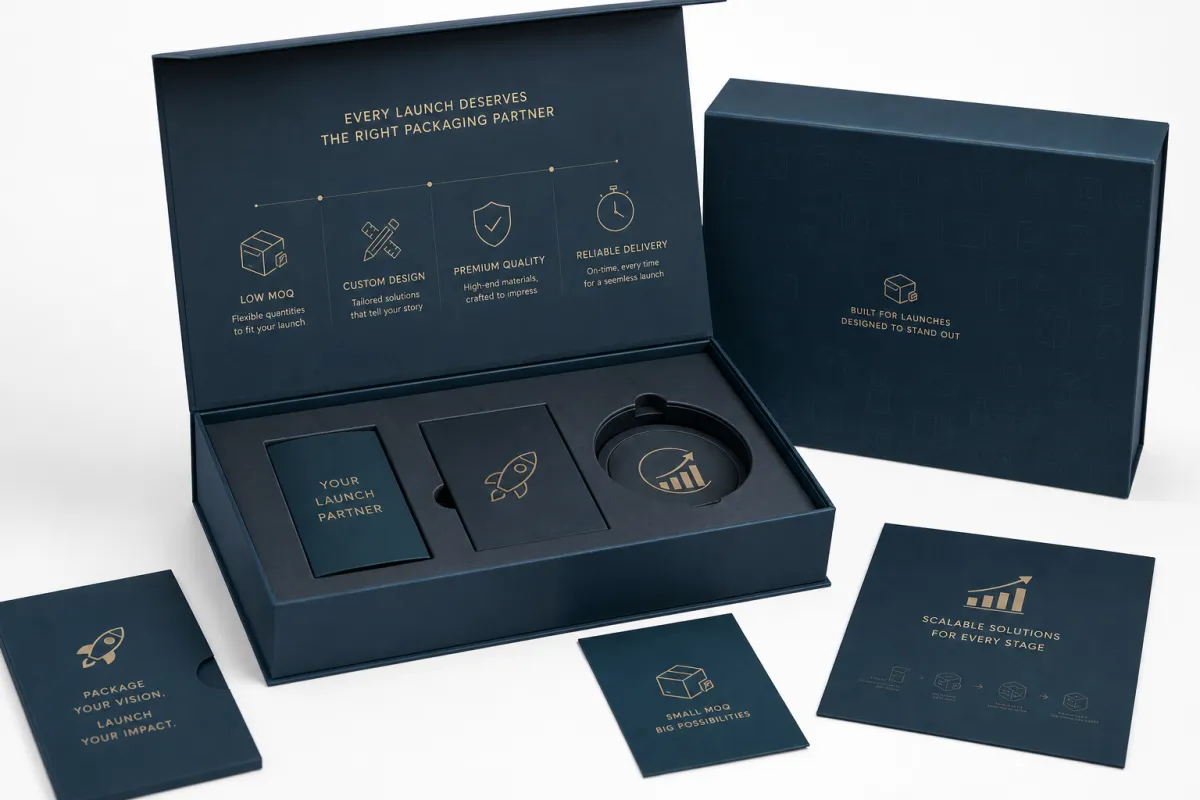
First product run. Tight calendar. Buyers waiting. The packaging is often the thing that slows everything down. A moq packaging manufacturer gives a brand a way from mockup to production without forcing a giant inventory commitment on day one. That matters because packaging is not just decoration. It is part of the product experience and part of the supply chain.
Some launches need speed more than they need a perfect spec. Others need a premium look because the package is doing a lot of the selling. The right supplier should tell you which camp you are in, even if that answer is a little inconvenient. A moq packaging manufacturer with actual experience will not pretend every project deserves the same structure, the same finish, or the same minimum. That would be lazy.
I see this mistake a lot: people chase the lowest unit price and ignore the minimum. Then the quote comes back with 20,000 pieces for a business that only needs 3,000 to test demand. That is not a bargain. That is a very expensive form of optimism. A moq packaging manufacturer helps the buyer spot that gap before money gets locked into boxes nobody needs yet.
MOQ lives inside production reality. A folding carton that nests well on a press sheet can hold a reasonable minimum. A custom die, unusual board, metallic ink, multiple spot finishes, or hand insertion changes the picture fast. Waste goes up. Labor goes up. The minimum follows. A moq packaging manufacturer is not inventing that number. It is translating factory math into something usable.
Launch planning gets easier when packaging is matched to the channel. Retail packaging has to survive harsh lighting and close inspection. E-commerce packaging has to survive drops, pressure, and the glorious chaos of delivery trucks. A moq packaging manufacturer should help buyers make those tradeoffs early, before the run is locked and the budget is already bleeding.
A low unit price only helps if the minimum fits the launch plan, the warehouse, and the cash flow.
The first question should never be “What is the cheapest box?” It should be “What does the package need to do?” Hold the product. Protect it in transit. Sit on a shelf. Carry legal copy. All of the above. A moq packaging manufacturer can recommend the right build when the brief is specific instead of vague.
Some projects belong in Custom Packaging Products. Others need a short run with standard construction and fewer finishes. A good moq packaging manufacturer should be able to tell you why one build starts lower than another and what change would push the minimum up or down. That kind of clarity saves time and prevents pointless back-and-forth.
And yes, a supplier should be willing to say, “This version is not worth the spend yet.” That honesty matters. It is a lot better than selling you a fancy carton just because the rendering looks nice on a screen.
Custom packaging formats and materials to order
Smaller runs usually start with familiar formats: folding cartons, mailer boxes, rigid boxes, sleeves, inserts, labels, and product shippers. A moq packaging manufacturer will usually guide the quote toward the format that fits the product’s weight, display needs, and shipping pattern. The cheapest structure is not always the right one. The wrong structure always costs more later.
Folding cartons show up everywhere for cosmetics, supplements, and other lightweight retail items because they print well and run efficiently on sheets. Mailer boxes work for subscription kits and direct-to-consumer orders where the package has to arrive intact and still look decent when opened. Rigid boxes carry a premium feel, but the material stack and handwork usually push MOQ upward. A moq packaging manufacturer may suggest corrugated or paperboard alternatives if the brand goal can still be met without extra assembly.
Material choice changes both appearance and minimums. SBS paperboard gives a clean print surface and sharp type reproduction, which makes it a common pick for branded packaging and retail packaging. CCNB is a practical option when cost matters more than a luxurious finish. Kraft board gives a natural look and works well for a more restrained package branding style. Corrugated board is the workhorse for shipping strength. Chipboard shows up in rigid constructions and inserts. A moq packaging manufacturer can often keep MOQ lower by staying inside standard board grades instead of chasing specialty substrates.
One rule keeps showing up: the more standard the material and the more common the size, the easier the job is to quote and run. A compact carton in a familiar board stock usually moves faster than a custom structure with a foil-lined insert, a window patch, and a soft-touch exterior. That is not marketing fluff. It is what happens when a job has fewer setup variables. A moq packaging manufacturer is always balancing sheet efficiency, die usage, and finishing sequence.
The product category matters too. Cosmetics often need tight print registration, smooth coatings, and a clean shelf face because flaws jump out on premium packaging design. Food and wellness packaging may need barrier considerations, regulatory review, or special inks depending on direct contact and claim language. E-commerce packaging tends to care more about burst strength, stacking resistance, and protection than display gloss. A moq packaging manufacturer should ask which of those matters most before recommending board, finish, or closure style.
| Format | Common Material | Typical MOQ Range | Typical Unit Price at 5,000 | Best Use |
|---|---|---|---|---|
| Folding carton | SBS or CCNB | 2,000-5,000 | $0.18-$0.45 | Retail product packaging, cosmetics, wellness |
| Mailer box | E-flute corrugated | 1,000-3,000 | $0.55-$1.25 | Subscription kits, direct-to-consumer orders |
| Rigid box | Chipboard with wrap | 1,000-2,000 | $1.20-$3.50 | Premium presentation, gift sets, luxury launches |
| Sleeve or label | Paper stock or film | 1,000-10,000 | $0.03-$0.20 | Branding, secondary packaging, SKU identification |
A moq packaging manufacturer will usually ask whether the packaging touches the product directly or acts as secondary packaging. That answer can change the spec sheet enough to move the minimum. If the package only wraps the outer shell, the build can stay simpler. If it has to support the product, carry legal copy, and protect the item in transit, the minimum often rises because the risk rises with it.
When buyers send a brief, the best ones include more than the visual direction. Product size, fill weight, and the way the package will be stacked or shipped all matter. That helps a moq packaging manufacturer decide whether a snug retail carton, a protective shipper, or a two-piece structure makes sense. It also cuts down on redesign after sampling has already started. Which is good. Nobody likes paying to learn what the dimensions should have been from the start.
If you are comparing several launch ideas, keep the quote request tidy and group related SKUs together. A moq packaging manufacturer can sometimes batch similar builds more efficiently when the same substrate, finish, or die family appears across multiple products. That is one of the cleaner ways to keep unit cost in check without turning the package into something bland and forgettable.
Print, size, and structural specifications that affect MOQ
A useful quote needs enough detail to reflect actual production. A moq packaging manufacturer will want the finished dimensions, board thickness, print sides, coating, spot UV, foil, embossing, inserts, and any die-cut features. Without that information, the quote is just a rough guess wearing a blazer. With it, the number means something.
Size changes matter more than most new buyers expect. A carton that nests efficiently on a press sheet can run smoothly at one dimension, then fall apart from a production standpoint after a tiny width or depth change. Material yield shifts. Waste shifts. The number of cartons per sheet shifts. A moq packaging manufacturer watches that closely because one small dimension can ripple into MOQ and unit cost.
Artwork readiness matters just as much. A clean dieline, correct bleed, proper color mode, and approved copy cut down prepress delays. If the file uses the wrong panel order, if the barcode sits too close to a fold, or if the logo crosses a glue flap, the job slows down and the risk goes up. A moq packaging manufacturer usually prefers a tidy file package over a pretty one. Printability pays the bills.
Color and finishing deserve their own discussion. Four-color process on coated board behaves differently than one-color kraft printing. Matte film reads differently than gloss under store lights. Spot UV, foil stamping, embossing, and debossing all add steps that can improve presentation, but each one also adds setup and inspection time. A moq packaging manufacturer has to account for that labor when setting MOQ because the job still has to clear the press, the die station, and the finishing table.
Tolerances matter too. Folding cartons do not hold the same dimensional certainty as machined parts, and that is normal. Score depth, fold memory, and color density all vary a bit in print production. The smart buyer asks where tight tolerances actually matter: the opening tab, the insert fit, the closure, or the viewing panel. That is exactly the kind of question a moq packaging manufacturer should welcome. It keeps expectations grounded and avoids fights later.
For shipping performance, many brands reference industry testing methods through ISTA. That is especially useful for mailer boxes and product shippers, where drop performance and vibration resistance can affect returns and customer complaints. Not every packaging run needs laboratory testing, but the standard gives teams a shared language for risk. That alone saves time.
Material certification can matter as well. If your brand uses fiber sourcing claims, ask about FSC chain-of-custody documentation and match the claim to the scope of the program. A moq packaging manufacturer that understands the paperwork can keep a compliance problem from showing up later. You can review the framework at FSC, especially if retail partners ask for sourcing proof during onboarding.
The practical rule is simple: decide early whether you need premium finishes or standard production finishes. Every added step changes the build. A moq packaging manufacturer can still support a premium look at a modest run size, but the run has to justify the setup time. If it does not, a cleaner structure with fewer finish effects usually gives a better result.
Moq packaging manufacturer pricing and MOQ drivers
Packaging pricing gets a lot easier once the pieces are visible. A moq packaging manufacturer usually has to account for prepress, tooling or die creation, print setup, material usage, finishing, packing, and freight. Each line has a job to do. Some costs are fixed. Some move with quantity. Some shift when you add more colors or more handwork.
Prepress covers file review, dieline checks, and proof preparation. Tooling covers the die, plates, or cutting forms required to shape the packaging. Print setup includes press make-ready, ink adjustment, and sheet calibration. Material usage is the raw board, paper, corrugated, or chipboard that becomes the package. Finishing includes lamination, varnish, foil, embossing, die cutting, gluing, and assembly. A moq packaging manufacturer has to spread those costs across the run, which is why low quantities usually carry a higher unit price.
The tradeoff is simple. A smaller run protects cash, but the unit price climbs because fixed setup work gets divided by fewer pieces. A larger run lowers the unit cost, but the buyer carries more inventory and more storage risk. There is no magic trick here. A moq packaging manufacturer can help find the middle ground by showing what changes if you move from 2,500 to 5,000 pieces, or from a custom size to a standard one. That comparison is usually more useful than the first quote alone.
Buyers can pressure-test a quote without wasting time. Ask what is included, what is excluded, and what changes if you switch to a standard board grade, a single finish, or a simpler construction. Ask whether the price assumes full-color print on both sides or only one side. Ask whether die charges are one-time or recurring. A moq packaging manufacturer that answers clearly is worth more than one that hides the real cost behind a shiny unit price.
There are practical ways to manage cost without wrecking the finished result. One is to simplify the structure so the product fits a standard dieline with minor adjustments. Another is to use a common board grade instead of a specialty substrate. A third is to combine SKUs that share the same outer box, insert family, or print layout. Those choices reduce repetition in setup, which a moq packaging manufacturer can turn into a lower MOQ or a better unit cost.
Think beyond the quoted box price. Cash tied up in inventory is real. Warehousing costs money every month. Damage from overstacking or moisture exposure creates waste. If the forecast changes, extra boxes become dead stock. A moq packaging manufacturer should help compare those hidden costs against the benefit of a lower printed unit price. For many launches, the smartest buy is not the cheapest quote. It is the one that matches how the business actually moves.
Sometimes a first run only needs a small amount of branded packaging to validate a new product line or a seasonal variant. Sometimes the goal is a steady supply of custom printed boxes across repeat orders. The quote should match the plan. If reorders are likely every quarter, a lower MOQ and a repeatable structure may matter more than shaving a few cents off the first run. A moq packaging manufacturer should be comfortable talking through that tradeoff.
If you want a broader view of how our team handles packaging programs, About Custom Logo Things gives more context on the way we approach specification, quoting, and repeat orders. The right supplier should not just send a price. A moq packaging manufacturer should also explain how the price was built, why the minimum sits where it does, and what levers actually move it.
One caution that saves a lot of grief: do not compare quotes built on different assumptions. A quote for coated SBS with soft-touch lamination is not the same as a quote for uncoated CCNB with no finish. The unit cost will look different for a reason. A moq packaging manufacturer can usually tell you which variable is driving the gap, but only if the buyer asks for a true side-by-side comparison.
For product packaging programs that need a specific feel, the better question is which finish gets you the presentation you need at the lowest stable MOQ. Sometimes that means matte aqueous coating instead of film lamination. Sometimes it means one-color print on kraft with a stronger logo treatment. Sometimes it means leaving out the insert on the first run and adding it in the second. A moq packaging manufacturer should be able to talk through those choices without trying to sell unnecessary complexity.
Production process and timeline from quote to delivery
The workflow is predictable enough to trust, even if the details change by job. A moq packaging manufacturer moves through inquiry, specification review, quote, dieline confirmation, artwork preparation, proof approval, sampling, production, quality check, packing, and shipping. Each stage matters. Most delays happen at the handoff between stages. Clean orders move faster because they arrive with the spec sheet nearly complete.
Proofing often takes longer than printing. If artwork needs a revision, or if the structure changes after the first proof, the schedule can stretch fast. A moq packaging manufacturer can usually move a clean job quicker than a messy one, even when the print run itself is small. Approval speed matters more than many buyers expect because every round of changes restarts part of the internal review chain.
There is a real difference between quick-turn standard work and a custom job that needs sampling before full production. Standard-material folding cartons with simple print can move on a shorter path. Specialty finishes, rigid structures, or insert-heavy kits usually need a sample stage first. A moq packaging manufacturer may quote both, but the timeline will not be the same. It should never be sold that way.
Typical timeline variables include material availability, print method, quantity, finishing complexity, and destination freight. If the substrate is in stock and the artwork is approved quickly, the job can move smoothly. If the board has to be sourced specially, if the finish needs multiple passes, or if the shipment is crossing borders, the clock stretches. A moq packaging manufacturer should be able to separate production time from transit time so the buyer can see where the real deadline risk sits.
Here is the rule I use when a launch date matters: build backward from the ship date and leave room for proof corrections. The best packaging runs happen when the artwork is complete before the quote is approved and the spec sheet is already signed off. A moq packaging manufacturer can work much more efficiently when it is not waiting on missing dimensions, undecided finishes, or late copy edits.
Quality checks belong in the conversation from the start. Good runs are inspected for print alignment, color consistency, fold accuracy, glue integrity, and pack-out count. For shipping-sensitive programs, some buyers also ask for transit testing or carton performance checks. Standards such as ASTM D4169 and ISTA procedures are useful reference points for teams that want a tighter conversation around distribution risk. A moq packaging manufacturer that understands those checks is better equipped to support e-commerce and retail launches alike.
Shipping and packing need attention too. If the cartons are delivered flat, stacked, or master-packed, that changes freight efficiency and warehouse handling. A moq packaging manufacturer should explain carton count per bundle, bundle weight, pallet pattern, and estimated cubic volume. Those details matter when the launch budget includes freight and receiving labor, not just the box price.
When a buyer asks for speed, the right answer is not a simple yes or no. It is usually, “What part of the schedule can we control, and what part depends on approval?” That kind of answer separates a useful moq packaging manufacturer from a vendor who only quotes a number. If you are comparing suppliers, the one that gives a real schedule is usually the one that will deliver a cleaner outcome too.
Why choose our moq packaging manufacturer approach
Our approach starts with something rare in packaging: straightforward answers. A moq packaging manufacturer should not bury buyers in jargon or send a price without explaining what drives it. The better path is clear minimums, honest lead times, and a quote that shows whether the cost is being driven by board, print coverage, finishing, or assembly. That kind of transparency gives buyers room to make a real decision.
Structural engineering matters a lot in small-run packaging. There is less room for waste, so the build has to earn its keep. If a carton can be simplified without hurting the product experience, that usually improves the quote and lowers schedule risk. If the design needs to stay complex because the brand presentation depends on it, the spec should be built around that reality instead of pretending otherwise. A moq packaging manufacturer should be able to support both cases without overpromising.
Prepress support matters even more for smaller launches. A clean dieline review, basic artwork checks, and sample review reduce the chance of expensive rework. That is especially useful for brands testing a line in phases or refreshing packaging on a tight calendar. A moq packaging manufacturer that pays attention to file quality and proof accuracy protects more than print quality. It protects the launch schedule and the budget.
Good manufacturing support is not only about making boxes. It is about matching packaging design to order plan, retail channel, and cash flow. A moq packaging manufacturer should help the buyer decide whether a first run belongs in a 1,000-piece test, a 3,000-piece launch, or a larger prebuild for a confirmed campaign. That advice is valuable for branded packaging programs that need to scale without redesigning the package every time volume changes.
That continuity matters for repeat orders. If the first run performs well, the second should not require a fresh round of guesswork. The structure should be stable enough to reorder, and the quote should be legible enough to compare against the previous run. A moq packaging manufacturer that plans for repeatability makes life easier for operations, sales, and finance at the same time.
Not every project needs premium treatment from start to finish. Some brands want a simple retail carton with crisp print and a clean feel. Others want a higher-end kit that supports product packaging and a more elevated shelf presence. The supplier’s job is to show where the practical line sits and what each design choice does to MOQ and unit cost. Buyers remember honest guidance. They also remember being sold nonsense.
If you are still shaping the direction, our FAQ is a good place to start for common questions on materials, minimums, and proofing. A moq packaging manufacturer should answer the same core questions every time: what is the format, what is the quantity, what is the finish, what is the deadline, and what is the budget? Once those are clear, the quote becomes much easier to trust.
From a procurement perspective, the best supplier relationship is the one where pricing, production, and expectations line up. A moq packaging manufacturer that can explain the reasoning behind the minimum is usually the one that can deliver a more consistent repeat run later. That consistency matters as much as the first run because packaging lives inside a broader supply chain, not in isolation.
Next steps for a fast, accurate packaging quote
If you want pricing that is actually useful, send the spec sheet first. A moq packaging manufacturer can move much faster when it has the finished dimensions, quantity, material preference, finish requirements, artwork status, insert needs, and target ship date. Even a rough brief is better than a vague request, and a complete brief is better still.
Ask for alternate options in the same quote. A standard-size version, a simplified finish version, or a different board grade can show how much the presentation is costing. That side-by-side view helps buyers balance branded packaging against unit cost instead of making the decision on instinct alone. A moq packaging manufacturer that offers those comparisons is usually helping you buy, not just sell.
Proofing should be part of the order plan. Ask whether you need a sample, a digital proof, or a press proof before production. The right proofing step can prevent expensive rework, especially if the artwork is not fully locked or if the structure is new. A moq packaging manufacturer should be able to match the proofing method to the risk level of the job.
Set the launch deadline before you approve the order, then work backward. That keeps the schedule tied to actual business pressure instead of a best-case estimate. When a brand knows its retail date, campaign drop, or freight window, a moq packaging manufacturer can build the timeline around those real constraints instead of making guesses.
If you are ordering for a phased launch, think ahead about reorder size. A first production run that is too small may carry a higher unit cost, but a first run that is too large can leave you with slow-moving stock. The best answer usually sits between those two extremes. That balance is exactly why a moq packaging manufacturer should be part of launch planning early, not after the artwork is already final.
Before you send the request, make sure the product dimensions are current and the copy is clean. If the item changed after prototype approval, the packaging should be measured again. If the label text, claims, or barcode are still moving, say so in the brief. A moq packaging manufacturer can handle a lot of variables, but only if they are visible from the start.
For most buyers, the final decision comes down to clarity. What is the minimum? What is the unit cost at the chosen quantity? What is the lead time from proof approval? What is the tradeoff if the structure gets simpler? A moq packaging manufacturer should answer those questions without making the buyer chase four different emails.
Send the spec sheet first, then compare pricing, MOQ, and timing before you approve the order. That is the cleanest way to work with a moq packaging manufacturer and the surest way to keep your launch plan grounded in reality rather than hope.
What is the typical MOQ from a moq packaging manufacturer?
MOQ varies by packaging type, board grade, and print complexity. Folding cartons and mailers often start lower than rigid boxes or specialty inserts because the setup is simpler and the sheet yield is better. Standard sizes and common materials usually allow smaller minimums, while custom structures with extra finishing steps push the number up. Ask the supplier what drives the MOQ so you can compare it against your launch quantity instead of guessing from the first quote. In practice, the number is rarely mysterious once the spec is on the table.
Can a moq packaging manufacturer lower minimums for multiple SKUs?
Sometimes, yes. If the SKUs share the same board, print method, finish, or dieline family, production can often be grouped more efficiently. A common structure or master carton may reduce setup repetition and make smaller combined runs more practical. The best way to approach it is to send every SKU together and request a bundled quote with the shared details clearly marked. That is a lot better than sending them one by one and hoping someone notices the overlap.
What files should I send to a moq packaging manufacturer for an accurate quote?
Send finished dimensions, quantity, packaging style, material preference, finish requirements, and your target delivery date. If you already have them, include the dieline and final artwork so the quote reflects real production complexity instead of a rough estimate. If artwork is not ready, send a simple spec sheet and ask which decisions will change the MOQ or the unit cost. The cleaner the brief, the fewer surprises later.
How long does a custom order take with a moq packaging manufacturer?
The timeline depends on proofing, sampling, production, finishing, and freight, so approval speed is a major factor. Simple standard-material orders move faster than packaging with specialty coatings, complex die-cuts, or multiple print passes. Ask for a schedule that separates proof time from production time so you can see where the real deadline risk sits. If someone gives you a vague “two to three weeks” without details, that is not a schedule. That is a shrug.
Which materials work best for smaller packaging runs?
SBS, CCNB, kraft, and corrugated are common choices because they are widely used and easier to source in standard production formats. If you want to keep MOQ and cost under control, avoid unnecessary specialty substrates unless they are essential to the product or the brand experience. The simplest path is often the strongest: one material, one finish, and one clear size usually produce the cleanest quote from a moq packaging manufacturer.
For brands that want a practical, budget-aware launch, the right moq packaging manufacturer does more than quote boxes. It explains the spec, the minimum, the timeline, and the tradeoffs in plain language, then helps the project move from sample to production without wasting cash or space. That is the standard worth asking for, and it is the standard that keeps packaging useful instead of expensive. If you are ready to compare options, start with the spec sheet, then let a moq packaging manufacturer show you the most efficient path to branded Packaging That Fits the product, the shelf, and the order plan.


