Buyer Fit Snapshot
| Best fit | Offset Printed Retail Packaging Order projects where brand print, material claims, artwork control, MOQ, and repeat-order consistency need to be specified before quoting. |
|---|---|
| Quote inputs | Share finished size, material target, print colors, finish, packing count, annual reorder estimate, ship-to region, and any compliance wording. |
| Proofing check | Approve dieline scale, logo placement, barcode or warning zones, color tolerance, closure strength, and carton packing before bulk production. |
| Main risk | Vague material claims, crowded artwork, missing packing details, or unclear freight terms can make a low unit price expensive after revisions. |
Fast answer: Offset Printed Retail Packaging Order: Pricing, Specs should be specified like a repeatable production item. The safest quote records material, print method, finish, artwork proof, packing count, and reorder notes in one written spec.
Production checks before approval
Compare the actual filled-product size with the drawing, then confirm tolerance on folds, seals, hang holes, label areas, and retail display edges. Reserve space for logos, QR codes, warning copy, and material claims before decorative graphics fill the panel.
Quote comparison points
Review material grade, print process, finish, sampling route, tooling charges, carton quantity, and freight assumptions side by side. A quote is only useful when the supplier can repeat the same color, closure quality, and packing count on the next order.
An Offset Printed Retail packaging order is not something to improvise. Shelf decisions happen fast. Sometimes brutally fast. The box gets a few seconds to prove it belongs there, and the product may never get a second chance if the packaging looks cheap, noisy, or confused. When you need sharp type, stable color, and a finish that looks deliberate instead of patched together, offset printing is usually the right call once the quantity is big enough to absorb setup costs.
The useful part is simple. A well-planned offset Printed Retail Packaging order can lift retail conversion, sharpen product photography, and make unboxing feel considered instead of accidental. Buyers comparing Custom Packaging Products or checking our Manufacturing Capabilities usually want the same answer: does the print method fit the product, the run size, and the sales target? If yes, you are buying packaging. If no, you are paying for a prettier mistake.
I have seen brands spend weeks arguing over foil and soft-touch while the dieline was still wrong. That never ends well. Get the structure right first, then worry about the shiny stuff.
A box that prints beautifully but misses the product, the shelf height, or the budget is still the wrong box.
Why an offset printed retail packaging order pays off fast
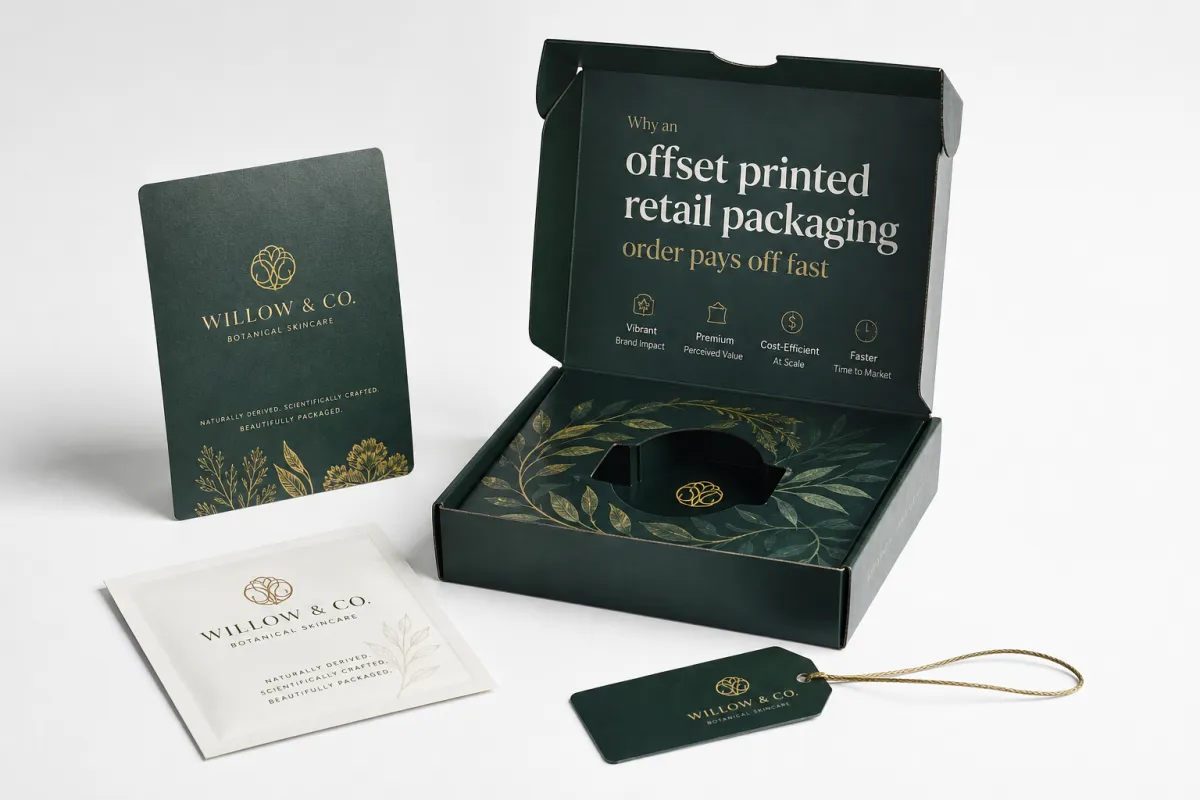
Retail packaging gets judged in a glance and forgotten just as quickly. Harsh? Sure. True? Also yes. A shopper looks at the front panel, the color, the hierarchy, and the perceived quality before the product gets picked up. A strong offset Printed Retail Packaging order gives you control over that first hit with crisp type, tight line work, and repeatable color across the run. That matters whether the pack sits on a boutique shelf, shows up in a subscription box photo, or lands in a product listing gallery.
Offset starts to make more sense as volume rises. Setup costs do not disappear; they just stop hurting as much once they are spread across a larger run. Plates, die cutting, proofing, and press setup all sit at the front of the project, but the unit price usually improves as quantity climbs. For launches, relaunches, and seasonal lines, an offset printed retail packaging order often beats digital pricing once you need the box to look polished without draining margin on every unit.
Consistency is another reason buyers keep coming back to offset. Brand colors need to stay recognizable across multiple SKUs, and offset is usually easier to control than a grab bag of short-run methods. That matters in branded packaging programs where the carton, sleeve, insert, and outer shipper need to feel related without being identical clones. A thoughtful offset printed retail packaging order keeps that visual family in line.
The best time to order is after the real decisions are already made. Product dimensions. Launch timing. Finish choice. Not the finish that looked clever in a mood board at 11 p.m. The one that supports margin and production. A well-built offset printed retail packaging order should follow the sales plan, not a design mood swing.
For many brands, the math is easy enough. If the packaging will be seen on shelf, handled in store, and photographed online, the right print method can pay back faster than people expect. That is why an offset printed retail packaging order often turns packaging from a line item into part of the product story.
And yes, sometimes the simple answer is still the right one. If your run is large, the artwork is stable, and the retail shelf is doing most of the selling, offset usually wins. No drama required.
Offset printed retail packaging order options and product types
The common formats are easy to name, but they do different jobs once production starts. An offset printed retail packaging order can cover folding cartons, rigid boxes, sleeves, inserts, and multi-piece retail kits. The right structure depends on product weight, shelf placement, perceived value, and how much assembly you want to deal with later.
Folding cartons are the workhorse. They ship flat, store well, and can be die cut into a long list of common structures. Tuck end cartons, reverse tuck end cartons, auto-lock bottoms, and hanger cartons all fall into this bucket. For lighter products like cosmetics, supplements, accessories, or small food items, a folding carton is often the cleanest answer. A well-planned offset printed retail packaging order in this format gives you strong print quality without turning the package into a luxury object that swallows margin.
Rigid boxes do a different job. They announce premium value before the product is even opened. Gift sets, specialty electronics, high-end beauty, and display packs that need a heavier hand-feel all fit here. They cost more, and they should. The mistake is using rigid packaging because it feels fancy. That is not strategy. That is budget cosplay. A disciplined offset printed retail packaging order uses rigid construction where the sales story actually supports it.
Sleeves are practical when the base pack already exists. They work well for soap bars, small accessory kits, tea sets, bakery sleeves, and promotional items. A sleeve lets you add branding, seasonal graphics, or regulatory details without rebuilding the whole structure. For a lot of brands, a sleeve-based offset printed retail packaging order is the fastest way to refresh existing product packaging without starting from zero.
Inserts matter more than people want to admit. A good outer box loses value fast if the product rattles, shifts, or arrives crooked. Paperboard inserts, corrugated supports, molded pulp trays, and stacked partitions each solve different problems. In a multi-piece offset printed retail packaging order, the insert is often the part that saves the unboxing experience from turning into a loose pile of parts.
Multi-piece retail kits combine several components into one package family. You see them in bundles, starter sets, subscription kits, and promotional collections. The build can include a carton, sleeve, divider, and printed insert card. It is more complex, yes. It is also a better Fit for Brands that need the packaging to signal value fast. Structure, print, and finish all have to pull in the same direction. If they do not, the box looks busy instead of premium.
| Format | Best For | Typical Strength | Common Finish Choices |
|---|---|---|---|
| Folding cartons | Cosmetics, supplements, accessories, small retail items | Fast assembly, lower freight, strong print surface | Matte lamination, gloss varnish, spot UV |
| Rigid boxes | Gift sets, premium electronics, high-end beauty | Higher perceived value, sturdy feel | Soft-touch, foil stamping, embossing |
| Sleeves | Existing product packs, seasonal updates, bundles | Lower redesign cost, quick brand refresh | Matte, gloss, window cutouts |
| Inserts and trays | Products that need protection or clean presentation | Fit control, better shipping stability | Uncoated board, printed board, molded fiber |
Finish choices change perception fast. Matte lamination reads calmer and more modern. Gloss pushes color harder and can feel louder under retail lighting. Soft-touch adds a muted premium feel, though it should not be used just because the sample card felt expensive. Foil, embossing, spot UV, and window cutouts can all improve an offset printed retail packaging order, but only when they support the design instead of crowding it.
For brands building a cleaner package branding system, the best option is usually the one that keeps the same look across SKUs while allowing small differences for size or flavor. That is where a steady offset printed retail packaging order helps. It keeps the family resemblance intact. The line feels planned, not patched together at the last minute.
A quick rule I use: if a finish does not help the shopper read the product faster or feel better about buying it, it is probably decoration for decoration's sake. Cute in a mockup. Less cute after the invoice lands.
Offset printed retail packaging order specifications that matter
Good quotes start with good specs. Vague requests make vague pricing, and vague pricing usually turns into headaches later. For an offset printed retail packaging order, the key details are dimensions, board or paper stock, quantity, print sides, insert needs, and any finish requirements. Leave one out and the quote is only half useful.
Dimensions should be given as finished internal or external size, whichever your supplier asks for. Do not estimate. A 2 mm error can create a fit issue, especially on rigid boxes or tight inserts. If the product already exists, measure it with the closure in place, then allow for board thickness and protective space. A precise offset printed retail packaging order starts with actual measurements, not wishful thinking.
Board and paper stock shape both cost and feel. Common choices include 250gsm to 400gsm paperboard for folding cartons, SBS or C1S/C2S boards for cleaner print surfaces, and heavier wrap materials for rigid boxes. If you want a premium feel, soft-touch over the right board can work well. If you want lower cost and decent protection, a simpler coated board may be enough. The smartest offset printed retail packaging order balances feel with freight weight, shelf needs, and internal budget.
Color control is where a lot of buyers get sloppy. CMYK is fine for most artwork. Pantone is the better choice when brand color matching matters or when a specific red, blue, or black needs to stay consistent across a line. Black text should be built cleanly, with proper vector type and enough contrast to stay sharp on press. A solid offset printed retail packaging order does not rely on low-resolution screenshots and optimism.
Bleeds and safe areas sound dull until the job hits the press. Bleed usually needs to extend 3 mm to 5 mm beyond the cut line, depending on the plant’s setup. Safe areas need enough buffer so logos, barcodes, and legal copy do not get trimmed too close. The dieline should show folds, glue tabs, and hidden panels clearly. If the fold direction is wrong, the whole box can read backward or put branding on the wrong face. That is not a small mistake. That is a scrap pile mistake.
Coating and finish selection should be locked before proof approval, not after production starts. Changing from matte to gloss, or adding spot UV after the fact, changes the workflow and usually the cost. The same goes for window cutouts and specialty foils. Decide early and keep it fixed. A disciplined offset printed retail packaging order leaves less room for last-minute chaos.
If the packaging needs to survive transit testing, ask about the test method instead of assuming the box is “strong enough.” ISTA publishes recognized transit test standards used across the shipping industry; if the project is going into e-commerce or mixed retail channels, that reference is worth a look: ISTA test standards. For fiber sourcing and chain-of-custody concerns, FSC also matters for many retail buyers: FSC certification standards. A responsible offset printed retail packaging order should fit the product and the route to market, not just the rendering on a screen.
Most mistakes are painfully ordinary. Low-resolution art. Missing fonts. Conflicting dimensions. No barcode check. No one reading the proof carefully. It is still surprising how often an offset printed retail packaging order gets held up by something that could have been caught in ten minutes on day one.
- Send vector artwork whenever possible.
- Outline or embed fonts before upload.
- Provide exact dimensions and product weight.
- Confirm Pantone references if color matching matters.
- Assign one person to approve the final proof.
One more practical note: if your product has a tight insert or a closure that looks fussy in mockup, ask for a sample. A real sample tells the truth. The render mostly tells comforting lies.
Offset printed retail packaging order pricing, MOQ, and cost drivers
Pricing should not be mysterious, yet plenty of suppliers manage to make it feel that way. For an offset printed retail packaging order, the cost usually breaks into setup, tooling, material, finishing, and unit price. Setup covers plates, die cutting, and press preparation. Tooling may include a custom dieline or structural tooling. Material is the board itself. Finishing covers coatings, foil, embossing, or special treatments. Unit cost is what drops as volume climbs.
MOQ is the part that makes buyers either patient or irritated. Offset printing usually makes the most sense once the quantity is high enough to spread setup costs across the run. For simple folding cartons, that sweet spot can start around 1,000 to 3,000 units, depending on size and spec. For rigid boxes or complex kits, the practical MOQ may be higher, often 500 to 2,000 units per style depending on structure and finish. A small offset printed retail packaging order is possible, but the spreadsheet may start making faces.
Here is the part people skip: a cheap unit price does not always mean a cheap project. Freight, sampling, proof corrections, and the cost of a second approval round can wipe out a quote that looked great on paper. Compare total landed cost, not just price per box. That is the number that matters when the goods land at your door. A smart offset printed retail packaging order looks affordable on paper and still makes sense after shipping.
Typical price ranges vary with print coverage and finish, but these ballpark figures are useful for planning:
| Packaging Type | Typical MOQ | Indicative Unit Price at 5,000 pcs | Cost Drivers |
|---|---|---|---|
| Basic folding carton | 1,000 to 3,000 | $0.18 to $0.35 | Board weight, print coverage, simple die cut |
| Premium folding carton | 2,000 to 5,000 | $0.28 to $0.60 | Soft-touch, foil, spot UV, heavier board |
| Rigid box | 500 to 2,000 | $1.20 to $4.50 | Construction time, wrap material, insert complexity |
| Printed sleeve | 1,000 to 5,000 | $0.10 to $0.25 | Size, coating, window cutout, coverage |
Those numbers are real enough to plan against, but they are not a quote. A larger box with full coverage and multiple finishing steps can jump above those ranges quickly. A smaller pack with limited print coverage can land below them. The point is to understand the variables before asking for a price on an offset printed retail packaging order.
Cost drivers usually show up in a predictable order:
- Box size. Larger boxes use more material and more freight space.
- Board weight. Heavier stock improves feel and rigidity, but adds cost.
- Print coverage. Full-bleed artwork usually costs more than sparse layouts.
- Special finishes. Foil, embossing, and spot UV are not free decoration.
- Structural complexity. Inserts, windows, and multi-piece builds add labor.
If you are building a recurring program, ask about volume tiers or repeat-run pricing. That is where Wholesale Programs can matter for buyers who plan to reorder. A repeat offset printed retail packaging order gets easier to manage once the structure, files, and approvals are standardized. That is where the quiet savings live. Less guesswork. Fewer revisions. Better production rhythm.
Do not buy packaging by unit price alone. Buy by outcome. If the box supports the product, protects the shipment, and looks right on shelf, the spend is doing its job. A well-priced offset printed retail packaging order is not the cheapest one. It is the one that survives the route from factory to customer.
And if you are comparing two quotes that look close, ask what they excluded. That question saves money more often than any spreadsheet formula I know.
Offset printed retail packaging order process and timeline
The process is straightforward if everyone stays organized. An offset printed retail packaging order usually moves through inquiry, quote, dieline review, artwork upload, proof approval, production, quality check, and shipping. Every step is normal. The delays come from indecision, missing files, or changing the plan after the job has already started.
Inquiry and quote should begin with the actual product details: dimensions, quantity, finish preference, and destination. If you have multiple sizes or versions, list them clearly. If the packaging needs inserts, say so upfront. The more complete the brief, the faster the quote. A strong offset printed retail packaging order does not make the supplier guess the basics.
Dieline review is where fit gets decided. Check front panel placement, glue flap position, barcode location, and any copy that needs to stay clear of folds. If there is a retail hang tab or display window, confirm the structural impact before artwork is finalized. This is also the right time to verify fold direction. It sounds minor. It is not. A wrong fold can ruin the pack orientation and waste the run of an offset printed retail packaging order.
Artwork upload and proof approval should go through one contact person, not a committee of six sending half-conflicting opinions. That is how jobs drift. Send one clean file set, one instruction list, and one approval response. If the design team wants a change, lock it before the proof is signed off. Every late revision adds time. Sometimes a little. Sometimes enough to make everyone grumpy.
Production timing depends on complexity. Simple folding cartons often move in about 10 to 15 business days after proof approval. Premium cartons with extra finishing may need 15 to 20 business days. Rigid boxes, inserts, and multi-piece builds often sit closer to 20 to 30 business days, especially if custom tooling or specialty work is involved. Add shipping time on top of that. A rushed offset printed retail packaging order can be done, but the timeline has to be realistic from the start.
Quality control should include print inspection, die-line accuracy, fold consistency, and finish check. For retail packaging, a minor defect can read like a major quality issue once the box is on shelf. That is why sample review matters. A buyer who asks for a sample before the full run usually catches the expensive mistakes before they multiply.
There are a few ways to move faster without cutting corners:
- Approve one internal decision-maker for artwork and proofing.
- Send final dimensions before asking for design changes.
- Lock the finish early in the process.
- Use production-ready files instead of draft artwork.
- Confirm the shipping address and delivery method before the run starts.
That sounds basic because it is. Packaging projects rarely fall apart because of one huge failure. They slow down because of a pile of small, preventable issues. A disciplined offset printed retail packaging order keeps those issues under control, which saves time and keeps tempers from spiking.
If you already know the product packaging direction, the next move is simple: send the spec sheet, get a sample or proof, and approve the run only after the structure and print are right. That keeps the calendar intact and the packaging looking like it belongs in the market, not stuck in revision limbo.
The other thing worth saying: once the proof is approved, stop tweaking unless the change is truly necessary. Chasing one more tiny improvement is how a two-day fix turns into a two-week headache.
Why choose us for your offset printed retail packaging order
Buyers do not need theater. They need clean print, fair pricing, useful guidance, and fewer surprises. That is the real value behind a well-managed offset printed retail packaging order. We focus on dependable output, clear proofing, and structure recommendations that make sense for the product instead of forcing a one-size-fits-all box.
Good packaging support should help you answer the questions that actually matter: What board should we use? Does this need a sleeve or a rigid build? Is Pantone necessary, or is CMYK enough? Do we need matte, gloss, or soft-touch? A useful offset printed retail packaging order starts with those decisions, not with vague promises and a nice smile.
We also keep the process practical. If you have product dimensions, target quantity, artwork files, finish preferences, and shipping destination, you are already most of the way there. That is the fastest path to an accurate quote. From there, a proof, a sample if needed, and a clean approval cycle can move the project forward without endless back-and-forth. If you need broader support, our FAQ page covers common questions about file setup, sampling, and production timing.
For many buyers, the real win is avoiding rework. A well-planned offset printed retail packaging order should not force you to fix artwork after the plate is made or discover too late that the insert does not hold the product securely. That kind of mistake costs time and money. It also makes everyone involved less cheerful, which is a polite way of saying it creates a mess.
Here is the cleanest next step:
- Send the product dimensions and quantity.
- Share artwork files and any Pantone references.
- List the finish you want and the shipping destination.
- Ask for a proof or sample if the presentation has to be exact.
- Confirm the final structure before full production starts.
If you are still weighing options, that is normal. The best brands do not rush package branding. They check the fit, the finish, and the margin math before they commit. That is how a offset printed retail packaging order becomes a sound buying decision instead of a gamble. Once the proof looks right, move forward. The box has to work in the real market, not just in the design file.
Choose the structure that sells the product, keep the specs tight, and make sure the numbers hold up. That is the whole point of an offset printed retail packaging order. Not glamour. Not noise. Just packaging that earns its place on shelf and in the cart.
The actionable takeaway is simple: lock the dimensions, the board, and the finish before you request final approval. Do that, and the rest of the run gets a lot less dramatic.
What is the usual MOQ for an offset printed retail packaging order?
MOQ depends on the structure and finishing, but offset printing usually makes more sense once the quantity is high enough to spread setup costs across the run. Simple folding cartons often work at lower MOQs than rigid boxes or heavily finished retail packs. In practice, a smaller offset printed retail packaging order is possible, but the unit cost may climb fast if the run is too short.
How long does an offset printed retail packaging order take after artwork approval?
Simple cartons can move in about 10 to 15 business days after proof approval, while rigid boxes and special finishes often take longer. Most delays happen after approval when artwork changes, finish changes, or shipping details are still undecided. A clean offset printed retail packaging order moves faster when one person owns the approval.
What files should I send for an offset printed retail packaging order?
Send vector artwork when possible, with fonts outlined or embedded and images at print-ready resolution. Include dimensions, dieline notes, Pantone references if needed, and one contact person who can approve the proof. That is the fastest way to keep an offset printed retail packaging order from getting stuck in file cleanup.
Which finishes work best for offset printed retail packaging?
Matte and soft-touch finishes usually feel more premium, while gloss can make color pop and hold up well on busy retail shelves. Foil, embossing, and spot UV work best when you want one or two design elements to stand out without overcomplicating the box. A good offset printed retail packaging order uses finish as support, not decoration for its own sake.
Can I approve a sample before placing an offset printed retail packaging order?
Yes, and you probably should if the packaging needs exact color, tight fit, or a premium retail presentation. A sample helps catch sizing errors, print issues, and finish problems before the full run starts. That is one of the cheapest ways to protect an offset printed retail packaging order from expensive surprises.


