Buyer Fit Snapshot
| Best fit | Printed Retail Packaging Sleeves projects where brand print, material claims, artwork control, MOQ, and repeat-order consistency need to be specified before quoting. |
|---|---|
| Quote inputs | Share finished size, material target, print colors, finish, packing count, annual reorder estimate, ship-to region, and any compliance wording. |
| Proofing check | Approve dieline scale, logo placement, barcode or warning zones, color tolerance, closure strength, and carton packing before bulk production. |
| Main risk | Vague material claims, crowded artwork, missing packing details, or unclear freight terms can make a low unit price expensive after revisions. |
Fast answer: Printed Retail Packaging Sleeves: Material, Print, Proofing, and Reorder Risk should be specified like a repeatable production item. The safest quote records material, print method, finish, artwork proof, packing count, and reorder notes in one written spec.
Production checks before approval
Compare the actual filled-product size with the drawing, then confirm tolerance on folds, seals, hang holes, label areas, and retail display edges. Reserve space for logos, QR codes, warning copy, and material claims before decorative graphics fill the panel.
Quote comparison points
Review material grade, print process, finish, sampling route, tooling charges, carton quantity, and freight assumptions side by side. A quote is only useful when the supplier can repeat the same color, closure quality, and packing count on the next order.
Printed Retail Packaging Sleeves: Costs, Process, Tips
Printed Retail Packaging sleeves can turn a plain carton into something that actually belongs on a shelf. That is the whole job. The base pack protects the product. The sleeve does the selling.
For packaging teams, printed Retail Packaging Sleeves are one of the fastest ways to upgrade presentation without rebuilding the whole pack system. They add brand color, product information, seasonal artwork, and a cleaner retail look while leaving the underlying structure alone. Less disruption. Less retooling. More shelf impact.
I like sleeves because they solve a very specific problem well. You already have a working box, tray, clamshell, or tuck carton. You do not need a new structural design. You need a stronger face. That is where sleeves earn their keep.
This guide covers how Printed Retail Packaging sleeves work, what drives pricing, which materials make sense, and where spec mistakes usually show up. If you are comparing them with custom printed boxes or other product packaging formats, the details matter more than the mockup on your screen.
Printed Retail Packaging Sleeves: What They Are and Why They Stand Out
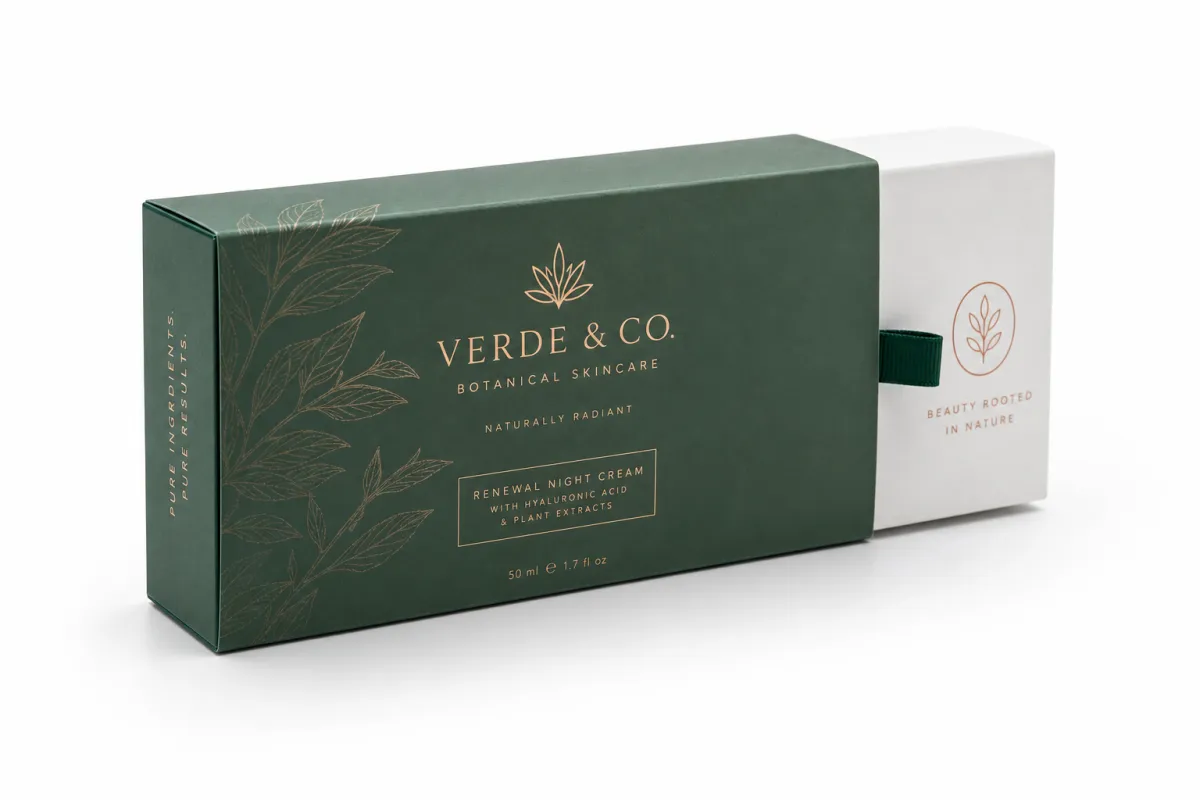
Printed retail packaging sleeves are exactly what they sound like: a printed wrap that slips over a base package. The base might be a carton, tray, clamshell, tuck box, or gift set insert. The sleeve adds branding and information without replacing the structure underneath. That makes it a practical middle ground between plain packaging and a fully custom carton system.
The part people underestimate is how much a sleeve changes shelf behavior. A kraft box can look anonymous even when the product is good. Add a sleeve with clear typography, a clean hierarchy, and a finish that fits the brand, and the same item suddenly reads like a deliberate offer. No magic. Just packaging design doing its job.
Printed retail packaging sleeves are useful because they are light to ship, easier to version, and faster to update than a full box redesign. If you run multiple SKUs, seasonal promos, or gift sets that change every quarter, the sleeve gives you a flexible layer for package branding without forcing a new structure every time. That flexibility saves time, and it saves patience, which is not always easy to buy back.
They also cut waste compared with scrapping an entire carton design for every small change. That is why many teams use sleeves for limited runs, retail bundles, event editions, and product packaging that needs stronger shelf presence without a full structural overhaul. If the inside pack already protects the item, the sleeve can focus on the part that sells.
That said, printed retail packaging sleeves are not a cure for a weak package. If the product needs to carry weight, resist crushing, or survive rough handling on its own, the sleeve is only a layer. I have seen brands get very clever with graphics and very sloppy with structure. The customer still gets the box that falls apart. Not ideal.
If you are mapping out a line refresh, compare sleeve options with other Custom Packaging Products before locking in a format. A sleeve may be the cheapest route to stronger shelf impact, but only if the base structure and pack-out method already make sense.
One practical rule helps more than people expect: printed retail packaging sleeves work best when the message stays simple. A clear hero panel, one or two supporting claims, and a readable barcode area usually beat a crowded wrap packed with ten selling points. The sleeve is not a billboard. It is a decision tool.
And yes, sometimes the best sleeve is the one that looks almost boring from ten feet away, then feels sharp up close. That balance is kinda hard to fake.
How Printed Retail Packaging Sleeves Work in Real Packaging Lines
The structure is simple on paper. Printed retail packaging sleeves start as flat printed sheets with score lines, fold lines, and a seam or lockup method. Once converted, the sleeve wraps over the base pack and holds its shape by friction, glue, a tuck tab, or a sleeve-and-tray fit. The exact construction depends on how rigid the brand wants it and how the item moves through the line.
Most sleeves begin as printed board or paper stock, then move through die-cutting, creasing, trimming, and folding. If the design needs a glued seam, that gets added during conversion. Finished sleeves are usually shipped flat, which saves freight space and makes storage easier. That is one reason printed retail packaging sleeves show up so often in programs where warehouse space is tight and fully assembled cartons would be annoying.
Application can happen by hand, with semi-automatic equipment, or on a fully integrated line. Small brands often slide sleeves over products manually during pack-out. Larger operations may use in-line systems with registration marks and guides so the sleeve lands in the same place every time. Either way, the sleeve only works if the dimensions are right. A sleeve that is a few millimeters off can look crooked, sit too high on the carton, or jam the packing flow.
Design placement matters just as much as size. The front panel needs to land where the customer sees it first. Cutouts, windows, and barcode zones need to line up with the base package, not drift after assembly. If a product has a tray, bottle, candle jar, or insert, the sleeve should be built around the real finished package, not a loose concept rendering that has never touched a pallet.
Compatibility issues usually show up with rigid boxes, folding cartons, tubs, and two-piece gift packs. A sleeve that looks clean on a carton may feel awkward on a curved tub unless the dieline adjusts for the shape. That is why measurement discipline matters before print approval. The sleeve is a fit-driven product, not just a graphics exercise wearing a nice shirt.
Logistics teams like printed retail packaging sleeves because they add late-stage branding without changing the primary pack. If a product is already boxed and approved, the sleeve can create a retail-ready look while the structural pack stays stable for shipping and storage. That matters for multi-SKU programs, where the graphics change more often than the box itself.
For distribution planning, testing standards such as ISTA test procedures and shipping simulations like ASTM D4169 are useful if the sleeve will travel through long fulfillment routes. The sleeve itself is not the shock absorber, but it should survive handling without scuffing, slipping, or tearing at the seam.
Printed Retail Packaging Sleeves Cost and Pricing Factors
Pricing for printed retail packaging sleeves is not one number. It moves with quantity, stock choice, print coverage, finishing, die complexity, and whether the design includes windows, embossing, or unusual folds. Small orders carry the highest per-unit cost because setup gets spread over fewer pieces. Packaging math is not romantic, but it is still math.
For planning, small runs often land around $0.42-$0.88 per unit for 1,000 to 2,500 sleeves, depending on size and finish. Mid-volume runs around 5,000 units may fall closer to $0.18-$0.34 per unit. At 10,000 units and above, you may see $0.10-$0.24 per unit, again depending on complexity. Those are working ranges, not promises, but they are much more useful than vague "affordable" talk.
Material choice has a major effect. Uncoated paperboard usually costs less than specialty stock, while coated and premium stocks can increase both print quality and price. If the sleeve goes on a broad retail run where the goal is clean branding and reasonable durability, standard paperboard is often the best economic choice. If the sleeve needs a premium feel for gifting or upscale retail packaging, higher-end stock can earn its keep.
Finishing is where budgets start drifting. Matte varnish, gloss varnish, foil, spot UV, soft-touch lamination, and embossing all add cost. The trick is to tie the finish to the sales job. A soft-touch sleeve can be worth it for a premium cosmetics kit. It is usually overkill for a low-margin commodity item. I have watched brands spend extra just to say they had a "luxury finish," then act surprised when the margin disappeared. That is not strategy. That is expensive decoration.
| Order Size | Typical Unit Price | Setup Impact | Best Fit | Main Tradeoff |
|---|---|---|---|---|
| 1,000-2,500 | $0.42-$0.88 | High | Launches, tests, short promos | Higher per-unit cost |
| 5,000 | $0.18-$0.34 | Moderate | Core retail lines, seasonal programs | Still sensitive to finish upgrades |
| 10,000+ | $0.10-$0.24 | Lower per unit | Established SKUs, national distribution | More inventory to manage |
Another cost driver is conversion work. If a sleeve needs a complex dieline, tight registration, multiple cutouts, or glue-on structures, the conversion stage will cost more than a simple wrap. Setup costs such as plates, dies, prepress checks, proofs, and press calibration can matter more than the raw board cost on small orders.
Ask for quotes that separate print, finishing, conversion, and freight. If a vendor rolls everything together, you lose the ability to compare true unit economics. A clear quote also helps you decide whether printed retail packaging sleeves should stay simple or justify a higher-end finish. The answer usually depends on the product margin, not the mood board.
One useful buying habit: compare printed retail packaging sleeves against the cost of a full box redesign. Sometimes a sleeve gives you 80 percent of the shelf impact for 30 percent of the work. Other times the base pack is so weak that a sleeve is just covering a bigger packaging problem. That distinction saves real money and a few headaches.
For small brands especially, the decision is rarely about cheapest versus nicest. It is about what gets the product into stores without tying up cash in the wrong place. A sleeve can be the smarter spend if the base pack is already doing its structural job.
Choosing Materials, Finishes, and Specs for Printed Retail Packaging Sleeves
Material choice should follow the use case, not the render. Printed retail packaging sleeves for lightweight promotional packs can use thinner board, while sleeves for gift sets or products that get handled often should use a sturdier stock. If the sleeve has to stay crisp in transit and still look clean on shelf, durability matters more than a pretty mockup.
Coated stock is useful when the design depends on sharp type, strong color blocks, or photographic imagery. It gives printed retail packaging sleeves a tighter visual finish and can help branding feel more polished under retail lighting. Uncoated stock works better when the brand wants a natural, tactile, or more understated look. It also tends to be friendlier for writing, stamping, or handwritten batch details.
Finishes change the reading experience. Matte reduces glare and makes text easier to scan. Gloss can make colors punch harder, especially on bright retail shelves. Soft-touch feels premium, but it can show scuffs if the sleeves rub against each other in transit. Foil and spot UV can create strong visual accents, but only if the artwork gives those effects enough room to breathe. A crowded sleeve with shiny accents usually looks busy, not premium.
Size tolerances are where many printed retail packaging sleeves fail quietly. The sleeve needs enough room to slide on smoothly, but not so much slack that it shifts or bows. Even a 1-2 mm variance can matter on smaller formats. For wider cartons or trays, the exact tolerance depends on board thickness, seam style, and whether the line applies sleeves by hand or machine. Measure the finished product, not the theoretical package.
Sustainability should be handled with specifics. Recycled content, FSC-certified paperboard, right-sizing, and avoiding unnecessary heavy materials can reduce waste without turning the package into a sermon. If your supplier can source FSC material, that is a useful signal for responsible paper sourcing, and the FSC standard is one of the cleaner ways to talk about chain-of-custody paper options. Pair that with lighter board only when the pack can still hold up in real distribution.
From a packaging buyer's point of view, the best specs are the ones that match the environment. If the sleeve is going into a cool, dry boutique, you can choose differently than if it is moving through warehouse picks, store backrooms, and customer handling. Product packaging is not judged on the render. It is judged by what survives the route.
One more detail helps more than people admit: keep the barcode, legal copy, and any required product information in a predictable zone. Printed retail packaging sleeves often become the front-facing brand layer, but they still need to function as retail packaging. If a retailer cannot scan, stock, or identify the item without rotating it three times, the design is working against the sale.
That last point sounds mundane because it is. But boring details are usually what decide whether a pack gets accepted or kicked back.
Printed Retail Packaging Sleeves Process and Timeline
The production process starts with a real brief, not a polished deck. For printed retail packaging sleeves, the supplier needs exact dimensions, quantity, artwork files, pack-out method, and any regulatory copy before they can build a proper dieline. If the product is boxed already, send a sample or detailed measurements. If the sleeve has to work with a machine, say that up front. Hidden requirements create expensive surprises.
- Confirm the base package dimensions and seam style.
- Build or review the dieline.
- Prepare artwork with bleed, safe zones, and barcode placement.
- Check proof files for color, copy, and layout.
- Approve a physical sample or short run.
- Move into print, conversion, finishing, and delivery.
Most delays happen because someone waits too long to finalize measurements or changes artwork after proofing. That sounds obvious, but it happens constantly. Late copy edits, logo swaps, and regulatory revisions can push printed retail packaging sleeves back by days or even weeks. Color approval is another slowdown point, especially if the client wants tight brand matching across multiple SKUs.
Timeline depends on complexity. Simple runs with standard board and basic print usually move faster, often in the 10-15 business day range after proof approval. Add special finishes, complex dies, or large quantities, and the schedule can stretch to 15-25 business days or more. Freight, receiving, and any hand assembly time should be added on top. If the launch date is fixed, build a buffer. Packaging schedules punish optimism without mercy.
Approval stages exist for a reason. First you check the layout. Then you check the sample. Then you sign off on production. Skip those steps and a sleeve goes to print with the wrong barcode, the wrong copy, or a cutout that misses the product by a few millimeters. The cost of one physical proof is tiny compared with reprinting a pallet of sleeves.
Logistics planning matters too. Printed retail packaging sleeves ship flat, which is efficient, but they still need storage space, receiving checks, and possibly pack-out labor. If the sleeves arrive at the warehouse two days before launch and the team needs 12 hours to sleeve the product, that is not a plan. That is a stress test with a deadline.
If the project is tied to a broader packaging refresh, line up the sleeve alongside your other packaging options early. That makes it easier to compare lead times, coordinate artwork across formats, and keep the branding consistent instead of patching it together later.
For teams that want a cleaner internal review, I usually suggest a simple approval checklist: dimensions confirmed, dieline approved, artwork locked, finish selected, proof signed, shipping window confirmed. That is not glamorous, but it prevents the kind of errors that make printed retail packaging sleeves look cheap when the real problem was process discipline.
If you are managing multiple vendors, keep one person in charge of final sign-off. Too many cooks is not a metaphor here. It is how a barcode moves three millimeters and ruins a production run.
Common Mistakes With Printed Retail Packaging Sleeves
The biggest mistake is sizing from assumptions instead of verified samples. A carton that looks "about 8 inches" is not a measurement. Printed retail packaging sleeves need exact finished dimensions, including board thickness, insert height, and any tuck or lock features. If the sleeve is even slightly off, it can sit crooked, wrinkle at the seam, or fail to grip the pack properly.
Another classic error is trying to cram too much onto the panels. Brands want the hero image, the story, the claims, the QR code, the barcode, the ingredients, the warnings, the seasonal message, and the social handle all in one small space. The result is visual noise. Printed retail packaging sleeves work best when the hierarchy stays clean: one main selling message, one support message, and the required retail information in a place that does not fight the design.
Finish choice can also backfire. High-gloss surfaces may look great in a proof but become harder to read under strong store lighting. Delicate coatings can scuff when sleeves rub together in transit. Soft-touch can look rich and feel expensive, but it is not the right choice for every distribution path. If the sleeves will be packed, shipped, and handled repeatedly, durability should outrank novelty.
Cost mistakes usually show up when a team approves premium effects before checking the margin. Foil and spot UV are useful when they support the product position. They are not automatic upgrades. On lower-margin items, printed retail packaging sleeves should earn their cost by improving sell-through, not by looking fancy in a presentation deck.
- Skipping physical samples before production.
- Changing artwork after approval.
- Ignoring how the sleeve is applied on the line.
- Underestimating freight and receiving time.
- Choosing finishes that fight the lighting in store.
There is also a process mistake that gets overlooked: not thinking about assembly speed. A sleeve that looks perfect on screen can be miserable to apply by hand if the seam is awkward or the fit is too tight. On the other side, a sleeve that is too loose may run faster but look sloppy. Printed retail packaging sleeves should balance speed, appearance, and fit. Pick two and ignore the third, and the package usually tells on you.
"The cheapest sleeve is the one you do not have to reprint."
That sounds blunt because it is true. Rework, scrap, rush freight, and launch delays wipe out any savings from squeezing the spec too hard. Good printed retail packaging sleeves are not just printed graphics. They are a controlled part of the retail packaging system.
I have seen teams spend a few cents less per unit and then lose weeks fixing the fallout. That is not savings. That is just a delayed bill.
Expert Tips and Next Steps for Printed Retail Packaging Sleeves
Start with one product or one SKU family before rolling sleeves across the whole line. That lets you test fit, shelf presence, and cost without turning the project into a full-scale packaging redesign. If the sleeve is doing its job, you will see it quickly in store presentation and pack-out efficiency. If it is not, the damage stays contained.
Ask for a sample or short run if the sleeves will be applied by hand or on semi-automatic equipment. That sounds basic, but it saves a lot of guesswork. Printed retail packaging sleeves live or die on real-world handling. A smooth proof does not tell you whether the sleeve will snag, shift, or slow down the line.
Match the finish to the sales environment. High-glare shelves call for different treatment than gift sets sitting behind glass or products moving through rough shipping conditions. A matte sleeve may read better in bright retail lighting. A gloss sleeve may sell a brighter, more energetic product. Soft-touch can suit premium branded packaging, but it is not the answer for every SKU.
Use a simple decision checklist before you quote the job:
- Exact product or carton dimensions.
- Target quantity and reorder expectation.
- Budget per unit.
- Visual goal: premium, promotional, seasonal, or functional.
- How the sleeve will be applied.
- Whether the design needs windows, cutouts, foil, or specialty coating.
If you are building out a broader program, compare the sleeve against other Custom Packaging Products so the design language stays consistent across inserts, cartons, and retail-facing components. That is where package branding starts to feel deliberate instead of patched together.
One more practical tip: keep a physical proof on hand, not just a PDF. Printed retail packaging sleeves can look fine on screen and still fail in hand because of seam placement, board stiffness, or finish feel. A sample lets you spot the little problems before they become expensive ones. And packaging always has little problems. That is apparently part of the deal.
If you want the project to move smoothly, gather the dimensions, define the budget, request a dieline, compare lead times, and review the proof with the pack-out team before production starts. Those five steps are boring. They also save money.
And if someone tries to skip the proof stage because "the artwork looks fine," push back. That shortcut is usually the one that gets expensive.
FAQ
What products work best with printed retail packaging sleeves?
They work well on boxed goods, cosmetics, candles, food gift sets, subscription kits, and seasonal retail products. Printed retail packaging sleeves are strongest when the base package already does the protecting and the sleeve mainly handles branding and shelf impact. They are less useful when the sleeve has to carry structural weight or protect fragile items on its own.
How much do printed retail packaging sleeves usually cost?
Cost depends on quantity, material, print coverage, finish, and die complexity. Small runs usually carry higher per-unit pricing because setup costs are spread over fewer pieces. Special finishes like foil, spot UV, or soft-touch increase the price and should be used only when they support the product margin.
How long does it take to produce printed retail packaging sleeves?
Timeline depends on artwork readiness, proof approval, quantity, and finishing requirements. Simple designs with standard materials move faster than sleeves with custom cuts, special coatings, or tight color matching. Freight and receiving time should be included in the schedule so the sleeves arrive before pack-out starts.
What information do I need before ordering printed retail packaging sleeves?
Provide exact product or carton dimensions, target quantity, artwork files, and any regulatory copy that must appear on pack. Share how the sleeve will be applied, by hand or on a machine, because that affects tolerances and seam design. Ask for a dieline and physical proof before approving production.
Do printed retail packaging sleeves replace a full custom box?
No, not usually. They are best when you already have a functional base package and want better branding or seasonal variation. Printed retail packaging sleeves can reduce packaging cost and waste compared with redesigning the whole box. If the package needs major structural protection, a sleeve alone will not solve that problem.
Printed retail packaging sleeves are a strong choice when you want better retail presence without paying for a full structural rebuild. Get the dimensions right, keep the design disciplined, and compare the quote against your actual margin before adding fancy finishes. If you do that, printed retail packaging sleeves can do a lot of work for a relatively simple piece of packaging.
The cleanest takeaway: start with the real pack, not the rendering. Measure it, test it, and print the sleeve to fit the line it actually has to live on. That is how printed retail packaging sleeves stop being a nice idea and start being useful.


