Buyer Fit Snapshot
| Best fit | Offset Printed Tissue Paper projects where brand print, material claims, artwork control, MOQ, and repeat-order consistency need to be specified before quoting. |
|---|---|
| Quote inputs | Share finished size, material target, print colors, finish, packing count, annual reorder estimate, ship-to region, and any compliance wording. |
| Proofing check | Approve dieline scale, logo placement, barcode or warning zones, color tolerance, closure strength, and carton packing before bulk production. |
| Main risk | Vague material claims, crowded artwork, missing packing details, or unclear freight terms can make a low unit price expensive after revisions. |
Fast answer: Offset Printed Tissue Paper: Branding, Cost, and Process should be specified like a repeatable production item. The safest quote records material, print method, finish, artwork proof, packing count, and reorder notes in one written spec.
Production checks before approval
Compare the actual filled-product size with the drawing, then confirm tolerance on folds, seals, hang holes, label areas, and retail display edges. Reserve space for logos, QR codes, warning copy, and material claims before decorative graphics fill the panel.
Quote comparison points
Review material grade, print process, finish, sampling route, tooling charges, carton quantity, and freight assumptions side by side. A quote is only useful when the supplier can repeat the same color, closure quality, and packing count on the next order.
Offset Printed Tissue Paper: Why Brands Notice It First
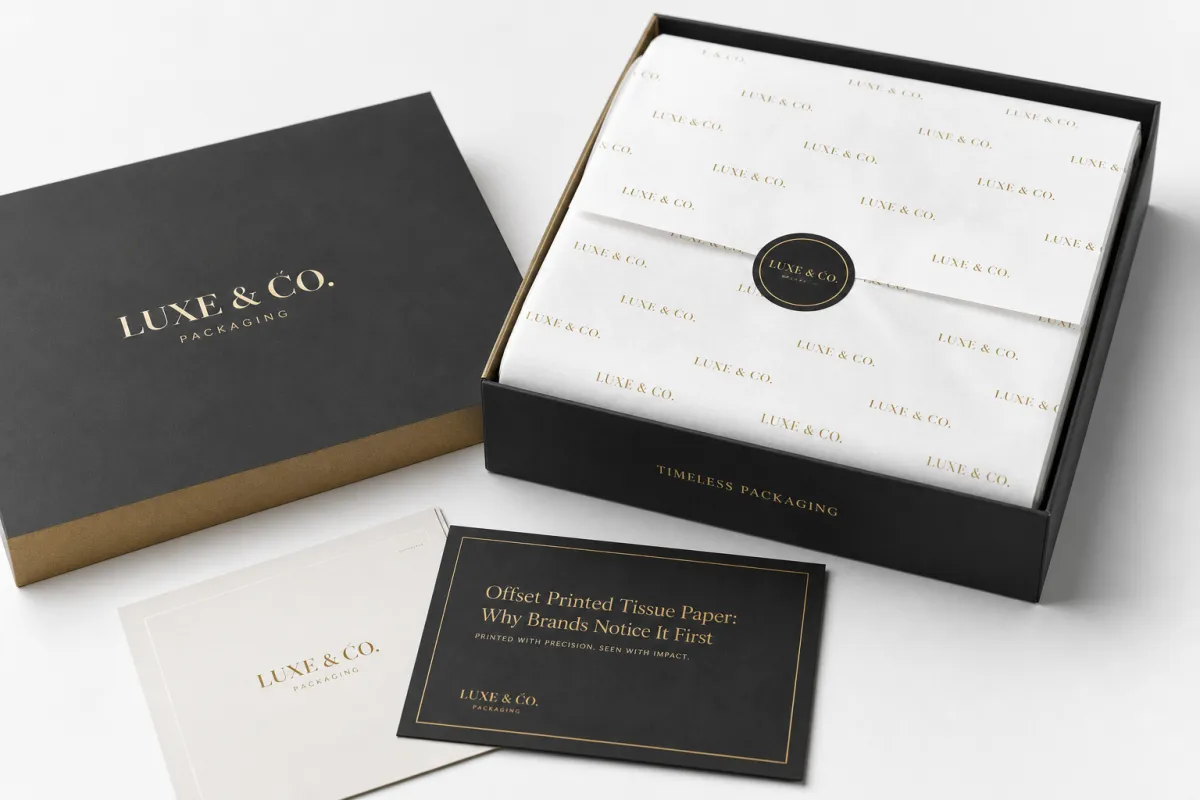
Offset Printed Tissue Paper is one of those packaging details that looks small on paper and feels much bigger in hand. It is often the first branded surface a customer touches after opening a box, and that first contact sets a tone before the product is even visible. A tidy sheet, a repeat logo, and a clean fold can suggest care, order, and a bit of quiet confidence. I have watched plenty of brands spend heavily on the outer carton and then realize the inside still feels unfinished. A branded tissue layer closes that gap fast.
Packaging rarely gets judged in separate pieces. Customers experience the box, tissue, insert card, label, and product as one story, and offset printed tissue paper sits right in the middle of that story. Even a thin sheet can make a package feel more deliberate when the print is sharp and the repeat is well spaced. That matters in e-commerce, gifting, cosmetics, apparel, and boutique retail, where presentation is part of the product promise.
There is also a practical side. Offset printed tissue paper adds visible branding without adding much weight or shipping cost, which is a nice balance for teams trying to keep fulfillment efficient. A stack of branded sheets can turn routine packing into a repeatable presentation system. It is not flashy, but it works, and honestly that is kind of the point.
Many brands underestimate tissue because it looks secondary on a spec sheet. They put their attention into rigid boxes, labels, and mailers, then leave the interior wrap plain. The package still ships, but the impression feels a little unfinished. Offset printed tissue paper solves that by carrying branding, softening the reveal, and reinforcing the idea that the company cares about details customers will actually notice.
Consistency is another reason brands keep coming back to offset printed tissue paper. When the repeat, spacing, and ink color are set correctly, every shipment delivers the same cue. That repetition builds recognition over time. A customer may not remember a Pantone callout, but they will remember that the brand kept showing up with the same clean presentation.
The basic idea is simple: offset printed tissue paper turns a low-cost consumable into part of the brand system. The sections that follow cover how it is made, what quality factors matter most, how timing usually works, and how to budget without stepping into avoidable production mistakes.
How Offset Printed Tissue Paper Is Made
Offset printing is a familiar process in commercial print. Ink transfers from a plate to a blanket cylinder, then onto the sheet. That indirect transfer is part of why offset printed tissue paper works well for repeat logos, controlled color, and larger production runs. The process is established and repeatable, which is reassuring when a buyer needs thousands of sheets to look alike.
On tissue, though, the material behaves differently than coated stock or card. Tissue has a lighter hand, lower opacity, and a more absorbent surface. Those traits create the airy, refined look many brands want, but they also mean the artwork needs to be designed for the substrate rather than copied from a rigid box panel. Offset printed tissue paper usually looks best when the layout is clean, the line weights are practical, and the color coverage is not too heavy.
The production path usually follows the same order: artwork review, plate making, press setup, printing, drying, trimming, packing, and shipping. A careful supplier should confirm the repeat size, sheet dimensions, color targets, and the intended fold method before the run starts. If you are working with a vendor that also supports broader packaging production, such as Manufacturing Capabilities, ask how plate prep and final packing are handled because those steps can affect consistency more than most teams expect.
Offset printed tissue paper can be produced as a one-color repeat, a two-color brand pattern, or a fuller sheet layout with more visual coverage. Smaller design elements increase the need for good registration. A fine line that looks crisp on a screen may break apart once it hits soft, absorbent tissue. A print file that works well usually keeps to practical limits: moderate line weight, enough negative space, and a repeat that still feels intentional after folding.
Drying is one of those unglamorous details that matters a lot. Tissue is light, so it reacts quickly to ink load, humidity, stack height, and handling. Too much ink can lead to scuffing or curl. Too little can make the print look washed out. The press operator has to balance those variables so the final offset printed tissue paper stays readable without turning brittle or rough.
Material choice matters too. Tissue is commonly specified by basis weight, and branded wrap often falls somewhere around 17 gsm to 22 gsm, though the right number depends on opacity, fold behavior, and the look the brand wants. A lighter sheet feels airy and premium. A slightly heavier one can hold up better in shipping. Offset printed tissue paper works in both ranges, but the print behavior changes with the stock.
Not every supplier handles tissue as if it were a standard paper job. Because the surface absorbs ink quickly, the print process may need tighter checks on ink density and plate prep. In my experience, the best results usually come after a proof or sample run, even for straightforward designs. That extra step saves a lot of headache later, especially when a brand color has to land within a narrow tolerance and nobody wants to discover a shift after the shipment is already on a truck.
Key Quality Factors for Offset Printed Tissue Paper
Offset printed tissue paper does not all look the same, even when the artwork is identical. The outcome usually comes down to a handful of controllable variables: paper weight, opacity, brightness, color management, repeat design, and sustainability documentation. Those are the levers that determine whether the sheet feels crisp, soft, muted, or just plain off.
Paper weight is one of the first decisions to get right. A lower-gsm tissue gives a delicate hand feel and can work beautifully for luxury apparel or jewelry, but it also wrinkles more easily and may reveal too much of what is inside the package. A slightly heavier sheet is often a better fit for cosmetics, candles, and gift sets where presentation and protection have to work together. Offset printed tissue paper depends on finding that balance.
Opacity matters more than many teams expect. If the paper is too transparent, the printed pattern can look fine while the product underneath shows through in a distracting way. If it is too opaque, the sheet may lose some of its airy character. Most brands want a middle ground: enough opacity for a clear printed logo, enough lightness for a refined wrap. Offset printed tissue paper usually works best when the spec lands right there.
Brightness and shade change how the ink reads. A warm white tissue softens a logo, while a bright white sheet creates more contrast. Natural or recycled-looking tissue can make black or deep ink feel quieter, which suits some artisan brands but can weaken a sharper luxury identity. In offset printed tissue paper, the base sheet is part of the design, not just the carrier.
Color control is where the technical side starts to show. Tissue is absorbent, so the same ink formula can look different from one paper grade to another. Brand colors that feel close on coated stock may shift on tissue. That is not necessarily a defect; it is a substrate issue. Cleaner artwork and a simpler ink build usually make offset printed tissue paper more predictable.
Design scale is another quality factor. Large logos and broad repeats are easier to read from a distance and work especially well inside larger boxes. Smaller repeated marks can feel subtle, but they can disappear after folding. Some teams assume more detail equals more sophistication. In practice, offset printed tissue paper often looks more premium when the layout is restrained, rhythmic, and clear instead of crowded and busy.
Sustainability belongs in the quality conversation too. Buyers increasingly ask about recycled content, FSC-certified sourcing, and inks that align with their environmental claims. If your brand makes those claims publicly, the tissue supply chain should support them with documentation. The Forest Stewardship Council is a useful reference point for sourcing standards, while the EPA can help when evaluating broader packaging and materials guidance. Offset printed tissue paper should support the story the brand is telling, not complicate it.
Real use matters too. If tissue will be folded tightly around apparel, the print cannot depend on a flat-sheet composition that only looks good in a mockup. If it will sit under inserts in a subscription box, the repeat may need more white space. Offset printed tissue paper should be designed around the actual package motion, not just the image on a screen.
Offset Printed Tissue Paper Process and Lead Time
Lead time is one of the most misunderstood parts of ordering offset printed tissue paper. Many people assume the press run is the slow part, but delays usually show up earlier: artwork revisions, color approval, proofing, and production scheduling. The sequence is predictable, though, and once it is understood, planning gets a lot easier.
- Brief the supplier with sheet size, quantity, brand colors, and delivery destination.
- Send artwork in the correct file format and confirm repeat dimensions.
- Review the prepress proof and check spacing, line weight, and color expectations.
- Approve the quote, setup, and timeline.
- Prepare plates and press settings for offset printed tissue paper production.
- Run the press, then allow ink to dry and stabilize.
- Trim, count, pack, and label the order for shipment.
The flow sounds simple, but each step can stretch when the project is rushed or the file is not ready. Artwork corrections are especially common. A logo that looks fine on a digital proof may need stronger contrast or larger spacing once it is applied to tissue. That is why experienced buyers ask for a sample or a physical proof before placing a full run of offset printed tissue paper. It is far cheaper to catch a repeat issue early than to find it after the shipment arrives.
Turnaround varies with complexity. A repeat order with an unchanged design can move quickly, often in the 10-15 business day range after approval if the production calendar is open. First-time offset printed tissue paper jobs can take longer, especially if the supplier needs to make plates, send proofs, revise artwork, or coordinate export shipping. Add seasonal demand, and even a simple project can move from comfortable to tight in a matter of days.
Special requirements also affect scheduling. Larger sheet sizes, multiple versions, metallic inks, or custom packing instructions all add time. If the tissue has to land for a product launch, retail holiday, or influencer mailer, work backward from the event date instead of the order date. That sounds obvious, but teams still get caught by it. Offset printed tissue paper is part of a broader packaging schedule, not a standalone purchase.
"The cleanest tissue order is the one that arrives before the launch team starts asking where the boxes are."
The line may sound blunt, yet it reflects operational reality. Offset printed tissue paper is inexpensive only if the order is planned properly. Once a rush fee, air freight charge, or extra proof round gets added, the cost picture changes fast. For that reason, smart buyers treat lead time as a budget issue as much as a production issue.
If you are working across multiple packaging components, ask your supplier to quote the tissue alongside the box or insert schedule so the dates line up. A brand can miss a retail window because the tissue is late by three days. That is not dramatic; it is normal supply-chain math. Offset printed tissue paper should be scheduled with the same seriousness as any other branded material.
Offset Printed Tissue Paper Cost, MOQ, and Quote Factors
Price is where offset printed tissue paper stops being an idea and becomes a buying decision. The main drivers are quantity, sheet size, number of print colors, coverage level, paper grade, and packing requirements. If you know those variables before asking for a quote, you usually get a faster and more accurate response.
MOQ, or minimum order quantity, matters because setup cost has to be spread across the run. That includes plate work, press setup, color balancing, and labor. A smaller order can still make sense, but the per-sheet price is usually higher. Offset printed tissue paper is a classic scale product: the more sheets you print, the better the unit economics tend to be, though storage and cash flow still need attention.
In practical terms, many branded tissue projects sit in a range where smaller orders may land at roughly $0.10-$0.20 per sheet and larger runs may drop closer to $0.04-$0.09 per sheet, depending on size and print complexity. Those are not universal numbers, and they shift with paper grade, ink count, and freight, but they show how setup cost can distort smaller orders. A two-color offset printed tissue paper design usually sits above a one-color repeat, and a heavy-coverage layout may cost more than a light repeat even at the same quantity.
A useful way to think about pricing is to compare order styles instead of chasing the lowest quote alone. Here is a simple reference point:
| Order style | Best fit | Typical quantity | Relative cost pressure | Notes |
|---|---|---|---|---|
| Plain tissue | Lowest-cost internal wrap | Any volume | Low | No branding, but limited presentation value |
| One-color offset printed tissue paper | Retail wrap, apparel, gifts | 3,000-10,000 sheets | Moderate | Usually the best balance of price and brand impact |
| Two-color offset printed tissue paper | Cosmetics, premium gifting, launches | 5,000-20,000 sheets | Higher | More setup and color control, stronger visual presence |
| Full-coverage branded tissue | Large campaign packaging | 10,000+ sheets | Highest | Great shelf impact, but waste and ink use rise quickly |
When you request a quote, include the details that influence pricing the most: sheet dimensions, quantity, number of colors, desired paper weight, destination, and target ship date. If the tissue needs to match a specific brand color, say so. If it must be packed in reams or cartons, say that too. Offset printed tissue paper quotes become much more useful when the supplier does not have to guess at handling requirements.
Shipping can change the real cost more than the print itself. Tissue is light, but volume adds up quickly. A small order may be cheap to print and expensive to ship if it is packed inefficiently. International orders add duties, brokerage fees, and transit time. Warehouse delivery can add receiving requirements. The invoice for offset printed tissue paper should be read as a landed-cost problem, not just a print quote.
Storage is another cost issue that many teams overlook. If the brand buys a large offset printed tissue paper run to lower the unit price, it also needs dry storage space and a clear consumption plan. Tissue can crease or absorb moisture if it sits badly packed. A lower unit cost is not always the better business decision.
For brands that use tissue as a recurring presentation layer, the real question is not "What is the lowest price?" It is "What is the most stable cost for the quality level we need?" That is a smarter way to buy offset printed tissue paper, especially if the tissue supports a premium brand position.
Common Offset Printed Tissue Paper Mistakes
The biggest mistakes with offset printed tissue paper are usually not dramatic. They are small, avoidable decisions that stack up. Thin lines, tiny text, crowded artwork, and bad assumptions about color all create problems that show up only after the sheets are printed.
Overcomplicated artwork is the first trap. Tissue is not the place for tiny legal copy, micro-patterns, or intricate line art that depends on perfect registration. A logo with breathing room almost always prints better than a dense design that tries to fill every inch. Offset printed tissue paper performs best when the artwork respects the material.
Screen-only approval is the second trap. A design can look balanced on a monitor and still disappoint on paper. That is especially true with off-white tissue, recycled stock, or darker ink colors. If the brand color matters, ask for a physical proof. Offset printed tissue paper is too material-sensitive to approve by screen alone.
Ignoring fold behavior is another common problem. A flat mockup may look attractive, but tissue is folded, crumpled, tucked, and torn in real use. If the repeat lands badly at the fold, the pattern can look awkward inside the box. Good offset printed tissue paper design accounts for the motion of the sheet, not just the artwork area.
Late ordering causes more pain than most teams admit. Some buyers assume reorders will move at the same pace as first runs, only to learn that seasonality, paper supply, or press schedules have changed. If the tissue is part of a product drop, give it its own deadline. Offset printed tissue paper does not care how polished the launch deck looks.
Budget blind spots can turn a tidy project into a messy one. Freight, setup charges, proof fees, rush production, and extra packing can all add up. Test runs also matter. If the team wants to see the design in an actual fold-and-wrap workflow, that should be budgeted up front. Offset printed tissue paper is inexpensive per unit, but the total project cost still depends on the details.
Here is the part many buyers get wrong: they treat tissue as secondary because it is thin. In practice, the opposite is often true. A thin product is easier to ignore during procurement, which is exactly how mistakes slip through. If your brand uses offset printed tissue paper to support unboxing, retail presentation, or seasonal gifting, the brief deserves the same care as any other printed component.
There is also a compliance angle. If the tissue is part of a sustainability claim, make sure the paper grade and documentation match the claim. If the product is for transit-sensitive items, consider whether the wrap should be tested under ISTA-style shipping conditions. For broader packaging testing standards, ISTA is a helpful reference. The point is simple: offset printed tissue paper is not just decoration. It is part of the packaging system.
Next Steps and Expert Tips for Offset Printed Tissue Paper
If you are planning offset printed tissue paper for the first time, start with one clear use case. Is it for retail wrap, gift presentation, e-commerce unboxing, or event packaging? Each use case changes the sheet size, repeat pattern, and print density. A sheet that works beautifully in an apparel box may not be the best answer for a cosmetic set or a mailer kit.
My strongest recommendation is direct: request a printed sample and test it in the real workflow. Fold it the way fulfillment staff will fold it. Place it around the product. See how it looks inside the box and how it behaves after shipping. Offset printed tissue paper can look ideal flat and still underperform in a package. That test tells you more than any mockup on a computer screen.
Keep the artwork consistent with the rest of the brand system. A repeat logo pattern, a restrained icon, or a clean wordmark usually ages better than a busy graphic built to do too much. The tissue should support the packaging story rather than compete with the product label, carton, or insert card. Offset printed tissue paper works best when it is recognizable in a second, not a minute.
Before asking for pricing, prepare a checklist. Include sheet size, target quantity, number of colors, paper weight, desired packing format, destination, and the date the sheets must be in hand. That one page can cut weeks out of supplier conversations. It also makes offset printed tissue paper quotes easier to compare because each supplier is answering the same question.
If your packaging program is broader than tissue alone, align the order with your other print work. That might include cartons, labels, or retail inserts. A brand that coordinates the whole system creates a cleaner customer experience, and you can see how that fits alongside other production services by reviewing Manufacturing Capabilities at Custom Logo Things. The more the pieces are planned together, the less likely one component will lag behind the others.
Here is the practical takeaway: offset printed tissue paper is small, but it is not minor. It can lift a box from ordinary to considered, yet only if the print method, paper grade, timing, and budget are handled with care. Keep the design simple, check the proof physically, plan the lead time backward from the launch, and treat offset printed tissue paper as a repeatable branding asset rather than a throwaway insert. Handled well, it becomes one of the most efficient ways to sharpen the package experience.
FAQ
What is offset printed tissue paper used for?
Offset printed tissue paper is used to add branded presentation inside boxes, gift bags, subscription kits, and retail packages. It also helps protect delicate items from scuffs while creating a more polished unboxing moment. Brands use offset printed tissue paper when they want tissue That Feels Premium without adding much weight or shipping cost.
How does offset printing affect tissue paper quality?
Offset printing can produce sharp repeat patterns and consistent color across large quantities. The tradeoff is that tissue absorbs ink differently than heavier paper, so artwork must be designed for the material. Simple logos and controlled coverage usually deliver the cleanest offset printed tissue paper results.
What affects the cost of offset printed tissue paper the most?
Quantity, sheet size, number of colors, and tissue grade usually have the biggest impact on pricing. Setup costs and plate charges matter more on small orders because they are spread over fewer sheets. Freight, rush production, and special packing can also raise the final invoice for offset printed tissue paper.
How long does offset printed tissue paper production usually take?
Lead time depends on artwork approval, proofing, press scheduling, and shipping distance. Simple repeat orders can move faster than first-time custom projects that need sampling or revisions. Seasonal demand can extend turnaround, so planning ahead is important for offset printed tissue paper orders.
What should I ask for in an offset printed tissue paper quote?
Ask for a breakdown of unit cost, setup charges, MOQ, shipping, and any proofing fees. Provide dimensions, quantity, brand colors, tissue weight, and delivery destination so the quote is accurate. If timing matters, request the estimated production window and transit time in writing for your offset printed tissue paper project.