Buyer Fit Snapshot
| Best fit | Opaque Plastic Envelopes Bulk projects where brand print, material claims, artwork control, MOQ, and repeat-order consistency need to be specified before quoting. |
|---|---|
| Quote inputs | Share finished size, material target, print colors, finish, packing count, annual reorder estimate, ship-to region, and any compliance wording. |
| Proofing check | Approve dieline scale, logo placement, barcode or warning zones, color tolerance, closure strength, and carton packing before bulk production. |
| Main risk | Vague material claims, crowded artwork, missing packing details, or unclear freight terms can make a low unit price expensive after revisions. |
Fast answer: Opaque Plastic Envelopes Bulk: Pricing, Specs, Lead Times should be specified like a repeatable production item. The safest quote records material, print method, finish, artwork proof, packing count, and reorder notes in one written spec.
Production checks before approval
Compare the actual filled-product size with the drawing, then confirm tolerance on folds, seals, hang holes, label areas, and retail display edges. Reserve space for logos, QR codes, warning copy, and material claims before decorative graphics fill the panel.
Quote comparison points
Review material grade, print process, finish, sampling route, tooling charges, carton quantity, and freight assumptions side by side. A quote is only useful when the supplier can repeat the same color, closure quality, and packing count on the next order.
Opaque Plastic Envelopes Bulk: Pricing, Specs, Lead Times is a sourcing decision, not a branding exercise. One split seam, one weak adhesive strip, one bag that lets the contents show through, and that cheap unit price starts looking pretty silly. Then you are paying for replacements, extra freight, labor, and the customer complaint that follows. That is why opaque Plastic Envelopes Bulk orders make sense for repeat shipments: better privacy, steadier packout, fewer surprises, and a lot less drama from film that looked fine in a sample and then folded like trash in real use.
Bulk buying only works when the shipment profile stays predictable. Same item. Same fold. Same label placement. Same destination mix. If that sounds like your operation, opaque plastic envelopes bulk can cut packing time and reduce damage-related rework. If it does not sound familiar, slow down and test first. A low quote is not a win by itself. Landed cost is the number that decides whether you saved money or just postponed the bill.
Opaque Plastic Envelopes Bulk: why buyers switch
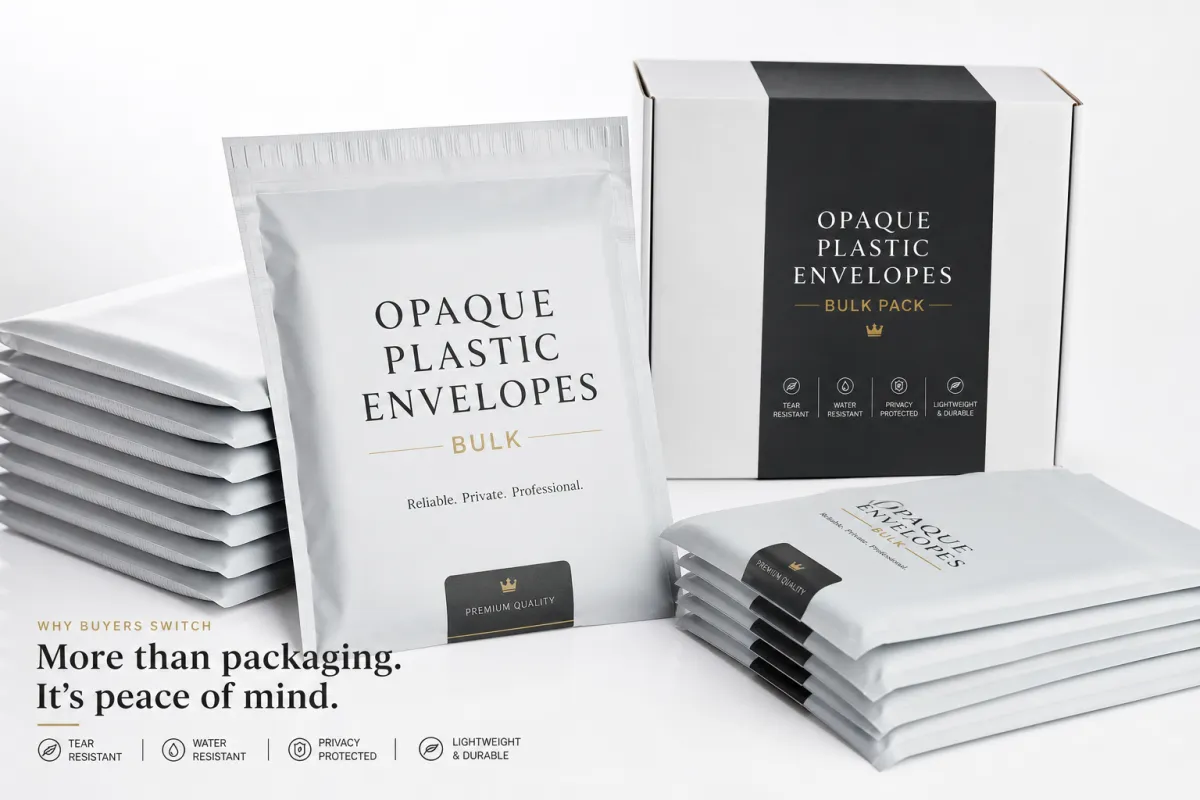
Most buyers do not switch to opaque plastic envelopes bulk because they fell in love with the material. They switch because something already went sideways. Maybe the outline of the product showed through. Maybe the corner blew out in transit. Maybe the adhesive gave up after a parcel sat in a cold truck overnight. One ugly shipment can trigger a refund, a reshipment, and a customer who now thinks your packing team is asleep at the wheel. The mailer may be the cheapest line on the invoice. It is rarely the cheapest part of the order once failure shows up.
Opaque plastic envelopes bulk solves three headaches at once. Privacy comes first. You do not want silhouettes, colorways, or logos visible through the outer bag if the contents should stay discreet. Consistency comes next. Bulk orders give you the same film, the same size, and the same seal behavior across repeated runs. Speed matters too. Once the packout is repeatable, the team stops wrestling the packaging and starts moving product. That matters more than shaving a penny or two off the unit price when you are shipping hundreds or thousands of units a week.
The tradeoff is simple. The cheapest opaque film is only cheap until it stretches too much, wrinkles like a cheap raincoat, or splits at the fold. Buyers love to obsess over unit cost and ignore failure rate. Bad math. A slightly better spec often pays for itself through fewer damaged returns, fewer repacks, and less waste at the dock. Opaque plastic envelopes bulk is one of those categories where the lowest headline price can become the worst landed cost.
There is also a real brand effect. A clean, fully opaque mailer looks deliberate. It tells the customer the shipment was packed with care. No fancy finish required. No theatrical printing either. A bag that fits, seals, and stays intact does the job. Apparel, kits, accessories, and small retail goods all benefit from that kind of boring competence. Opaque plastic envelopes bulk can support a tidy unboxing without slowing the packing line down.
The cheapest opaque plastic envelopes bulk quote is usually the one that leaves out freight, setup, or replacement cost. That is not savings. That is a delayed invoice.
If you want a broader reference point for packaging terminology and material categories, the education resources at packaging.org are useful. For transit testing concepts, ISTA is worth knowing before you approve anything that will spend time in parcel networks. That does not mean every order needs a full lab program. It means you should know what the packaging is supposed to survive before you bet a shipment on it.
Product details that matter before you order
Opaque plastic envelopes bulk usually starts with one of two film families: LDPE or a co-extruded film structure. LDPE shows up a lot because it is flexible, easy to seal, and forgiving in day-to-day use. Co-extruded film gives you more control over strength, puncture resistance, and surface appearance. The right call depends on the contents. Soft apparel can usually live in a simpler build. A kit with harder edges, zippers, or bulky corners deserves more film body.
The body of the mailer does the privacy work. Pigment load matters more than people think. A bag can look fully opaque on a clean sample table and still show product outlines under strong light. I would never approve opaque plastic envelopes bulk based on appearance alone. Hold the sample under a bright warehouse LED, tilt it, and check whether the silhouette leaks through. That test beats the pretty one every time.
Format matters too. Flat mailers are the default for folded clothing, printed inserts, and lighter goods. Tamper-evident seals give you a clear close-open signal, which buyers like for retail goods or direct-to-consumer shipments. Gusseted versions add depth for bulkier apparel or bundled kits. If the product has a stiff edge, choose a design that gives it room. Forcing a thick item into a flat bag is how seams fail.
Custom options change the buying decision more than most people expect. Adhesive strip strength is not a tiny detail if the bag will see heat, cold, or repeated handling. Printed logos matter if the mailer is part of the unboxing experience. Warning text helps with handling or return instructions. Barcode zones, batch marks, and blank panels all affect the final layout. A real spec sheet should say exactly where the print goes and where it should stay off.
Before you commit to opaque plastic envelopes bulk, check four things on a sample:
- Opacity under backlight - hold it under bright lighting and confirm the contents stay hidden.
- Seal integrity - press the adhesive down, wait, and see whether it lifts after handling.
- Corner tear resistance - flex the corners and edges where parcels usually fail first.
- Actual fit - pack the real item, not an idealized flat sample, and confirm the flap closes cleanly.
Think function first and decoration second. Opaque plastic envelopes bulk should protect the product, keep the contents hidden, and speed up packing. Any print or finish choice has to earn its spot after that. The right spec is the one that fits the real item and the real workflow, not the one that photographs well in a catalog.
Specifications: thickness, size, seal, and finish
Thickness is where buyers either protect the shipment or create a future headache. For opaque plastic envelopes bulk, I usually group film thickness like this: 2.5-3 mil for light apparel and soft goods, 3.5-4 mil for standard clothing and everyday shipping, and 4.5-5 mil for heavier, sharper, or higher-value contents. Those numbers are a practical starting point, not a sacred law. If the product has hardware, sharp corners, or dense folds, move up. If the item is flat and soft, do not overbuild the bag just to feel safe.
Size should be based on the packed item, not the empty product dimensions alone. Buyers measure the garment or kit flat, then forget that the mailer needs room for folds, a label, and the seal flap. That creates a bag that is too tight. Too-tight bags are annoying at best and failure-prone at worst. For opaque plastic envelopes bulk, build the size around the packed profile. Measure the longest folded edge, add space for the label area, and leave enough flap to close without forcing the film.
The seal matters just as much as thickness. Pressure-sensitive adhesive is standard, but not all adhesives behave the same. Some look fine in a warm packing room and then get lazy in cold conditions. If your shipments sit in trucks or warehouses before delivery, ask for cold-weather performance. If the shipment should show tamper evidence, specify that clearly. There is no prize for assuming the bag will behave itself later.
Buyers should ask for performance data, not vague reassurances. Useful specs include opacity level, puncture resistance, seam strength, tensile data under methods such as ASTM D882 or similar internal testing, and print adhesion if the mailer is branded. That does not mean every supplier has a giant binder full of lab reports. It does mean they should be able to talk about the performance target in actual numbers instead of hand-waving and calling it quality.
Finish affects both appearance and handling. Matte finishes hide scuffs better and usually give a softer retail look. Gloss can make logos and print pop more sharply, but it also shows handling marks faster. For opaque plastic envelopes bulk, the finish is not about vanity. It is about how the bag will look after packing, sorting, stacking, and delivery. A finish that hides abuse is often more useful than one that only looks good before the shipment moves.
| Spec band | Typical use | Approx. unit cost at 5,000 pcs | Notes |
|---|---|---|---|
| 2.5-3 mil stock opaque flat mailer | Light apparel, soft goods, low-risk contents | $0.10-$0.18 | Lowest cost, but least forgiving on sharp folds and rough handling |
| 3.5-4 mil custom printed mailer | Standard clothing, repeat DTC shipping | $0.16-$0.30 | Best balance for many opaque plastic envelopes bulk orders |
| 4.5-5 mil heavy-duty opaque mailer | Outerwear, kits, higher-value shipments | $0.24-$0.42 | Higher material cost, but fewer splits and better puncture resistance |
| Gusseted or tamper-evident upgrade | Bulkier items, security-sensitive packing | $0.28-$0.55 | More material and more process control, but safer for demanding packs |
If you are comparing opaque plastic envelopes bulk with other packaging systems, remember one thing: the bag is only one piece of the total cost. Carton count, inner packouts, labor speed, label placement, and rejection rate all shape the final number. That is why a slightly higher-priced film often beats a cheaper one. It cuts the hidden costs that show up after the order is already moving.
Opaque Plastic Envelopes Bulk pricing and MOQ explained
Pricing for opaque plastic envelopes bulk comes down to five drivers: size, thickness, print coverage, number of colors, and volume. Adhesive upgrades, matte treatments, gussets, and Custom Packaging Inserts can also move the number. If a quote looks suspiciously low, check what is missing. I have seen low quotes leave out freight, proofing, tooling, carton changes, or a rework allowance. The number only looks good until the rest of the bill walks in.
A practical MOQ framework keeps the buying process sane. Stock-style opaque mailers can sometimes be ordered in smaller quantities because the tooling and print setup are already established. Custom printed opaque plastic envelopes bulk usually starts in the low thousands, and the unit price improves as the run gets larger. That is normal. Setup cost has to be spread somewhere. If a supplier promises a tiny MOQ and a heavy custom print job at a bargain price, I would ask where the margin is hiding.
Comparing quotes is where buyers get sloppy. Do not compare one supplier's 3.5 mil 10 x 13 bag to another supplier's 4 mil 10 x 14 bag and call that pricing research. Match the same size, same thickness, same print method, same carton count, same adhesive, and same delivery terms. Only then does the number mean anything. Opaque plastic envelopes bulk is a quote category where one small mismatch can make the comparison useless.
Tiered pricing is non-negotiable if you want to buy intelligently. Ask for break points at 3,000, 5,000, 10,000, and 20,000 pieces, or whatever volumes fit your business. A larger order often drops the unit price enough to cover the added inventory carrying cost. Sometimes it does not. The point is to see the math before you commit. Buyers who never ask for tiered pricing usually end up guessing, and guessing is not a sourcing strategy.
Here is the buying truth most people overlook: opaque plastic envelopes bulk is not just a packaging purchase, it is a logistics decision. If the bag improves pack speed by a few seconds per unit and cuts damage claims even a little, that can beat a cheaper quote by a wide margin. If the order is imported, landed cost should include freight method, customs timing, and any buffer stock you need to avoid a stockout. A cheap unit price with bad freight timing is still a problem.
For buyers who want to sanity-check the commercial side, these are useful quote questions:
- What is the exact unit price at each volume tier?
- What does the price include: freight, proof, setup, cartons, and overrun allowance?
- What is the expected overrun or underrun range?
- How long does the quoted price stay valid?
- What changes if I move from stock to custom printed opaque plastic envelopes bulk?
That last question matters because print changes the whole equation. More colors mean more setup. Larger coverage means more ink and more production control. If the logo is simple, keep it simple. A strong one-color mark often does the job better than a noisy full-coverage design that adds cost without improving the customer experience.
Process and timeline from quote to delivery
The cleanest opaque plastic envelopes bulk order follows a basic path: request quote, confirm specs, review artwork, approve sample or proof, run production, inspect, then ship. That sounds simple because it is simple. The problem is skipping one step and pretending the result will still be accurate. It will not. A missing dimension or a vague print position can turn into a delay that costs more than the packaging itself.
Quote turnaround is often quick, usually within one to two business days if the specs are clear. Sampling or proofing can take several business days, especially if the print needs adjustment or the color needs to match a reference. Production commonly lands in the 2-4 week range after approval, depending on order size and customization. If the order is imported, add shipping time on top of that. Ocean freight is cheaper, but it is not fast. Air freight is fast, but it will make the freight line look offended.
Missing artwork slows orders down. Vague dimensions slow them down too. Color changes after proof approval. Choosing a finish after the sample was already made. Changing the seal style at the last minute. Opaque plastic envelopes bulk rewards discipline. Lock the spec early and the order moves. Keep changing the spec and the schedule stretches, then the price usually follows it upward.
Approval details belong in plain language. I want exact finished dimensions, film thickness, seal type, print placement, pack quantity per carton, carton count per pallet or shipment, and the shipping destination. If the order is part of a program with repeat buys, keep the final approved spec in one place so the next run does not drift. Reorders should match the first order. That sounds obvious, but it is kinda amazing how often that gets skipped.
Transit method matters more than buyers like to admit. Domestic shipping is faster and easier to track. Ocean freight lowers per-unit shipping cost but adds lead time and planning. Air freight should be reserved for urgent replenishment or a launch that cannot wait. If the order is moving through parcel networks, ask whether the packaging profile has been validated against transit conditions similar to ISTA 3A or another relevant test method. Not every order needs a lab report. Every order does need a realistic sense of how rough the trip will be.
In practice, opaque plastic envelopes bulk works best when the buyer treats the process like a controlled production run, not a hopeful purchase. Clear communication on the front end saves time on the back end. That is not a slogan. It is how supply chains avoid expensive little mistakes.
Why choose us for opaque plastic envelopes bulk
At Custom Logo Things, the value is not mystery. It is consistency. Buyers want opaque plastic envelopes bulk that stay opaque, keep their size, and close the same way on every run. They want the film spec to match the sample. They want the adhesive to behave the same from one lot to the next. They want a reorder to look like the last one, not a distant cousin of it. That is a very reasonable ask, and honestly, it is where a lot of suppliers stumble.
We focus on the practical side of the order: accurate sizing, straightforward proofing, and clear communication when a spec needs adjustment. If you need branded mailers, we can help you keep the artwork simple enough to print cleanly and strong enough to repeat. If you need a no-drama reorder path, our Wholesale Programs page is the place to start. For buyers who ship on a schedule, that kind of repeatable process is more useful than a flashy sales pitch.
Good sourcing is about fewer surprises. That means telling you what the film can do, what it cannot do, and what the production timing actually looks like. It means giving you sample checks that matter instead of just sending a pretty picture. It also means being realistic about MOQ, because opaque plastic envelopes bulk gets more efficient with volume, and pretending otherwise helps nobody.
If your program also includes cartons, inserts, or outer shipping materials, keep the whole packout in view. A strong bag with weak secondary packaging is still a weak shipment. If you want paper components with responsible sourcing, ask about FSC-certified options where they fit the job. If you want to understand how a package should behave in transit rather than just how it looks on a desk, test planning should be part of the conversation from day one.
Buyers do not need hype. They need mailers that arrive on time, look right, and do not fail in transit. That is the standard for opaque plastic envelopes bulk, and it is the standard we build around. If the spec is clear, the order usually is too. If the spec is vague, the problems usually are too.
For repeat buyers, our Wholesale Programs option can simplify the next run by keeping the approved size, thickness, and artwork notes together. That matters more than it sounds. A clean record of the last spec saves time, avoids mistakes, and keeps opaque plastic envelopes bulk aligned with the real shipping job instead of whatever somebody vaguely remembered from the first order.
Next steps to lock in the right order
If you are ready to source opaque plastic envelopes bulk, send the numbers that actually matter: target size, product type, estimated monthly volume, print needs, and destination ZIP or port. If the item has a hard edge, say so. If the shipment has to stay private under bright light, say that too. The more concrete the request, the cleaner the quote. Otherwise you are going to spend time comparing prices for two things that are not really the same thing.
Ask for two or three options instead of one. A 3.5 mil version, a 4 mil version, and a heavier backup spec will usually show you the real tradeoff between cost and protection. That comparison is useful because the lowest price does not always produce the lowest landed cost. Sometimes the middle spec is the right answer. Sometimes it is not. Either way, you cannot know without seeing the options side by side.
Before you commit, request a sample pack or proof. That is especially smart when opacity, seal strength, or print placement matters. A good sample check can save a bad production run. It also gives you a real sense of how the bag feels in the packout line, which is where opaque plastic envelopes bulk either works or annoys everybody. No amount of sales language changes that.
Use this decision rule: choose the spec that protects the product at the lowest landed cost, not the lowest headline price. That usually means balancing thickness, size, adhesive, and freight together. It does not mean buying the most expensive option. It means buying the one that keeps failure rates low and packing labor predictable. That is the part that actually matters once the order starts moving.
If you want the cleanest path, start with a spec sheet and a quote comparison. Keep the details tight. Match thickness, print coverage, MOQ, and delivery terms. Then compare the real options, not the fantasy version of each one. That is how opaque plastic envelopes bulk gets bought properly. If you send the right details now, the next step is getting the right version into production.
What thickness is best for opaque plastic envelopes bulk orders?
Use 2.5-3 mil for light apparel or flat soft goods. Move to 3.5-4 mil for standard clothing and everyday shipping. Choose 4.5-5 mil if the contents are heavier, sharper, or higher value. Those ranges are practical starting points, not law carved into stone. The packed product decides the final spec.
What MOQ should I expect for opaque plastic envelopes bulk?
Stock-style orders are often lower because the tooling is already set. Custom printed runs usually start in the low thousands. Larger orders reduce unit cost, so ask for tiered pricing before you decide. That is the part that keeps opaque plastic envelopes bulk from becoming an expensive guess.
Are opaque plastic envelopes bulk suitable for apparel shipping?
Yes, they work well for folded shirts, basics, and lightweight soft goods. Use a stronger film if the item has buttons, zippers, or rough edges. For premium apparel, pair the mailer with clean folding and consistent label placement. Bad folding makes good packaging look worse than it should.
How long do opaque plastic envelopes bulk orders take?
Sampling or proofing usually takes several business days. Production often lands in the 2-4 week range after approval. Transit time depends on shipping method, destination, and whether the order is domestic or imported. If the schedule is tight, build in slack. Packaging delays have a way of becoming product delays.
How do I compare opaque plastic envelopes bulk quotes correctly?
Match the same size, thickness, print setup, and MOQ across every quote. Include freight, plates, tooling, and any sample or rework costs in the comparison. Check lead time and overruns or underruns, because the cheapest quote can still be the worst deal. In practice, a clean quote comparison is where the real savings show up.
If you are comparing opaque plastic envelopes bulk now, send a spec sheet, ask for tiered pricing, and request a sample before you commit. That is the cleanest way to avoid weak film, mismatched sizing, and freight surprises. Opaque plastic envelopes bulk should protect the shipment, speed the packout, and stay private under real handling conditions. Anything less is just a cheap bag with a fancy quote.


