The ceramic pom pom Beanies Material Sample guide exists for one reason: the spec sheet lies by omission. Not intentionally. It just cannot show you a yarn that feels scratchy after ten seconds, a pom that leans like it owes somebody money, or a cuff that stretches once and never comes back. That is why physical sampling matters so much for retail, team programs, and seasonal promo runs. The sample is where weak decisions get expensive, fast.
Most buyers still look at color first. That is backward. Color matters, sure. But structure, hand feel, recovery, and finish are what decide whether a beanie looks premium or merely presentable. If the body is fine but the pom is flimsy, the whole piece reads cheaper than the quote suggested. Pretty is easy. Consistent is the part that takes work.
Ceramic Pom Pom Beanies Material Sample Guide: What Buyers Miss First
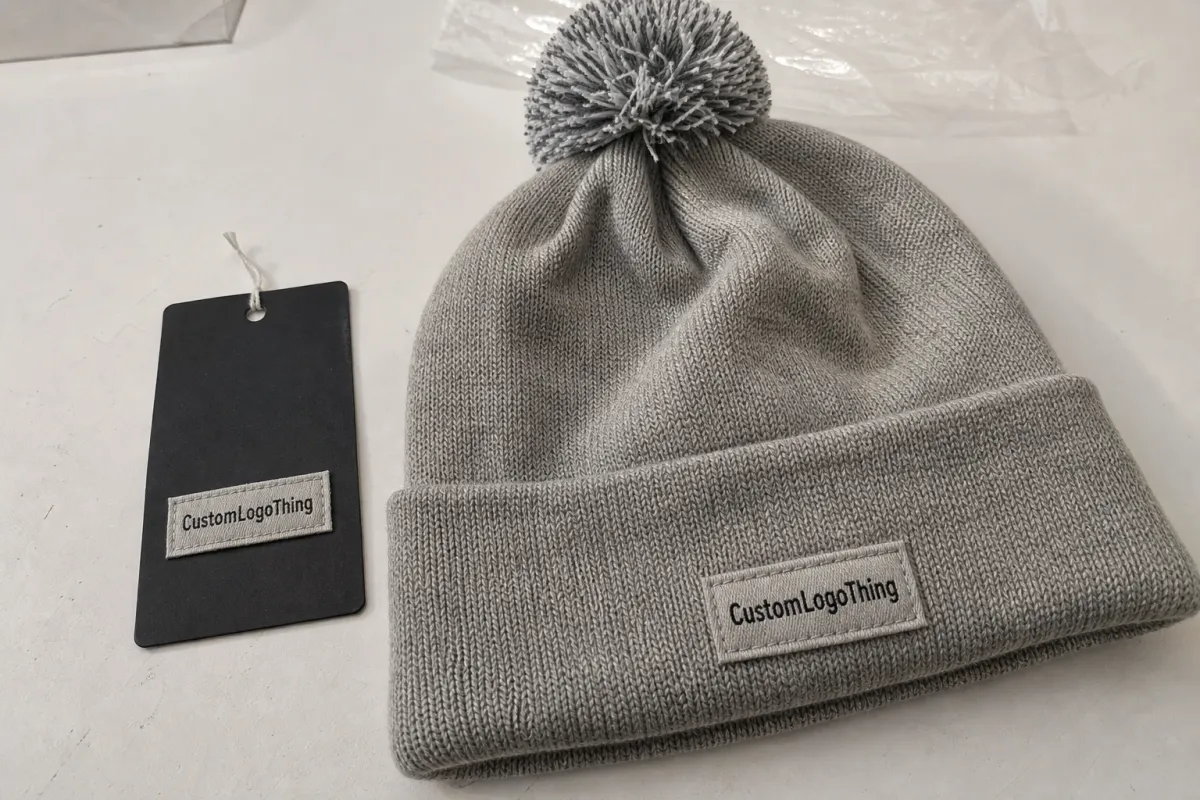
“Sample” is not one thing. It usually means five different things, and mixing them up causes bad approvals. A knit swatch shows yarn texture and stitch density. A mini beanie checks proportion. A full prototype reveals fit and drape. A pom sample tells you whether the fiber is soft, dense, and well balanced. Branding samples, like labels and patches, show whether decoration supports the product or fights it.
The best sampling process starts before artwork is locked. Too many teams wait until the logo is approved, then discover the knit structure cannot hold the placement they wanted. A loose gauge can distort embroidery. A stretchy cuff can warp woven labels. The trim is not an afterthought. On a lot of beanies, it is the thing customers notice first in hand.
That is especially true for pom pom construction. A pom that sits too high makes the beanie look stiff. One that droops too low throws off the silhouette. If the attachment is weak, the product feels unfinished, even when the knit itself is clean. The body and trim have to work together. Otherwise the sample is basically a polite warning.
Buyers should also decide what the product needs to do in the market. A retail beanie needs visual bulk, clean finishing, and a knit that looks intentional under store lighting. A team order may care more about comfort and washability. A promo run often needs simple construction and predictable unit cost. Seasonal drops are judged quickly, so the sample has to survive the ugly truth of first impression.
“The sample is not proof that production will be fine. It is proof that production still has a chance.”
Packaging belongs in the review, too. A good hat wrapped badly still looks cheap. Many buyers compare the beanie with the shipper and inner wrap at the same time: corrugated cardboard for structure, kraft paper for a cleaner presentation, or biodegradable packaging if the brief asks for lower-impact materials. Packaging cannot rescue a weak product, but it can keep a strong one from arriving flattened and forgettable.
How Swatches Reveal Knit, Shape, and Trim Behavior
One swatch can tell you more than three mockups if you know what to look for. Yarn twist changes surface feel. Stitch density changes opacity and warmth. Gauge changes the definition of the knit. Crown height changes the silhouette. Cuff elasticity changes whether the beanie sits neatly or collapses after a few wears. These details seem small until they hit production at scale.
The pom deserves its own inspection. Sewn attachment is usually the safest option for holding power, but the stitching must be tight and even. Tied attachment can work well when the look should feel lighter, though symmetry matters. Glued poms are fast and usually cheaper, but they are the first to fail when the product is flexed repeatedly. Snapped construction is convenient for certain retail or gift formats, yet the connection point has to survive transit, unpacking, and customer handling. Cheap and durable rarely show up together by accident.
Color behavior is another place where samples earn their keep. A yarn can read one way in daylight, another under warehouse LEDs, and another again on a phone screen. Buyers often approve from a PDF and then wonder why the knit surface looks flatter in person. That is not a rendering issue. It is a material one. Texture absorbs light differently depending on yarn type, twist, and density.
Fit checks should happen on a headform and, if possible, on someone from the target audience. You want to see ear coverage, crown bulk, stretch recovery, and how the beanie moves once worn. A good sample feels like apparel. A bad one feels like a shaped object. That distinction matters more than some teams want to admit.
For buyers comparing custom logo beanies, shape is never separate from material. A thick knit may look richer, but it can also feel heavy or warm in a way that limits wear. A lighter knit may be more comfortable, but it can lose presence on a shelf. Sampling is where that trade-off gets real instead of theoretical.
Useful checks at this stage include seam inspection, yarn evenness, edge roll, and inside comfort. Run a finger along the cuff seam. If it scratches, customers will notice. Pull the cuff twice. If recovery is weak, the shape will drift in storage. Hold the piece under bright light. If the knit has thin spots, they usually show before production does. Small failures travel well into larger orders.
Material Factors That Change Feel, Wear, and Shelf Appeal
The fiber blend sets the tone for the entire product. Acrylic is still the most common choice because it is affordable, easy to color match, and predictable in bulk production. Wool feels more natural and usually warmer, but itch sensitivity is a real constraint. Polyester is often blended in to improve durability or manage price. Recycled content is more common now, especially when brands want a sustainability story without moving to a fully natural fiber.
If a buyer asks for recycled yarn, define the claim precisely. Post-consumer waste is not the same as pre-consumer scrap. The difference matters for documentation, labeling, and buyer trust. The same goes for packaging. If the shipment includes FSC certified tags or inserts, that should be specified in writing. FSC certified paperboard and FSC certified kraft paper sleeves can support the same message without pushing cost too far.
Gauge and weight matter as much as fiber. A heavier knit often looks richer and warmer, but it also raises material spend and can make the beanie too hot for some markets. A tighter gauge gives cleaner definition and better logo visibility, though it can reduce stretch if the pattern is overbuilt. In practical terms, buyers often see a material-cost swing of about $0.15 to $0.40 per unit when moving from a simple knit to a denser, more refined build at scale. That range moves with yarn source, color count, finishing, and order size.
The pom is not decoration first. It is a construction choice. Faux fur poms look premium in photos and on a shelf, but lower-grade fiber sheds, mats, or flattens quickly. Yarn poms are more consistent and easier to control in production. Microfiber poms sit in the middle: softer than standard yarn, less dramatic than faux fur, and often easier to keep uniform across a bulk order. If the beanie is being bought for visual impact, the pom quality is doing more work than the sales deck admits.
Decoration compatibility is another place where the sample saves money. Embroidery can pucker on loose knits. Woven labels can distort on stretch-heavy cuffs. Patches need enough surface stability to sit flat. Care tags need secure attachment without creating an abrasive interior. A clean sample usually means the production line has a chance. A messy one usually means the buyer will be chasing avoidable defects later.
Packaging should be judged against the product, not in isolation. If the beanie is folded into a carton, the carton has to protect shape rather than crush it. Many brands use corrugated cardboard inserts for structure, then add a simple outer wrap in kraft or recycled paper. If the brief asks for lower waste, recycled materials and biodegradable packaging can work, but only if the product still lands in saleable condition. Sustainable is not useful if it arrives mangled.
- Acrylic blends: usually the most cost-efficient, with broad color options and dependable bulk consistency.
- Wool blends: warmer and more premium-feeling, but more sensitive to itch and shrink concerns.
- Recycled blends: useful for sustainability messaging, especially when buyers ask for post-consumer waste content.
- Specialty poms: faux fur and microfiber raise shelf appeal, but they need tighter quality control.
Cost, Pricing, and MOQ Signals to Compare Before You Approve
Sample pricing should be broken out clearly. There is the sample fee, freight, setup for the knit or pom construction, and then the bulk unit cost. On a small run, a sample might land in the $20 to $60 range before shipping. Specialty yarns, custom dyeing, or extra revisions can push that higher. The real number is less important than knowing what is included. A cheap sample that excludes shipping and changes is not cheap. It is just incomplete.
MOQ is driven by more than one variable. Color count, custom dyeing, special labels, oversized poms, and unusual yarn sourcing all push the minimum up. If a factory has to reserve a specific yarn lot or match a tight shade, the order floor usually rises. Buyers should ask whether the sample fee is credited back against production. That single detail can make two quotes look similar while the actual spend is very different.
| Sample type | What it shows | Typical cost | Typical lead time | Best for |
|---|---|---|---|---|
| Knit swatch | Yarn feel, stitch density, color behavior | $10-$25 | 3-7 business days | Early material screening |
| Mini beanie | Shape, trim balance, basic fit | $20-$45 | 5-10 business days | Concept validation |
| Full prototype | Final silhouette, comfort, branding placement | $30-$80 | 7-15 business days | Pre-production approval |
| Branding-only sample | Label, patch, tag, and packaging finish | $15-$35 | 3-8 business days | Artwork and presentation checks |
Those figures are directional, not universal. A busy factory, winter demand, or a complicated trim can move them fast. If the beanie launch has a fixed ship date, compare the full path from sample approval to carton-packed delivery, not just the unit quote. Buyers who need transit validation can look into ISTA testing standards through ISTA. For paper components, FSC is the cleaner reference point.
Process and Lead Time: From Request to Sign-Off
A clean sampling process starts with a brief that gives the factory something useful to work from. Send reference images, target price, preferred fiber blend, pom style, label placement, and packaging requirements. If the product needs to ship in corrugated cardboard cartons with kraft dividers, say that immediately. If the beanie must be presented on a backing card, that should be part of the first brief, not a surprise after the sample arrives.
The usual flow is simple: confirm the spec, receive the first sample, review it, send feedback, then lock the final version. Delays usually happen when the buyer has not defined what “good” means. Ask how many revision rounds are included. Ask whether color matching, pom replacement, or label changes trigger a new sample cycle. Ask who signs off on the final photo record before production starts. These are boring questions. They also save money.
Lead time depends on yarn sourcing, pom production, color matching, freight, and factory workload. A simple sample can move in about a week if materials are already in stock. More complex builds usually need 10 to 15 business days, and a precise shade match can stretch longer. If the launch date is fixed, work backward from the approval deadline, not from the production start. That sounds obvious. A lot of teams still miss it.
Packaging can create its own schedule drag. If the buyer wants FSC certified inserts, recycled hang tags, or biodegradable packaging, those components may need separate proofing. Treat packaging as part of the sample, not an accessory to it. The hat and the presentation need to arrive in the same version of reality.
For multi-color programs, keep a reference swatch archive. It sounds administrative because it is. It also prevents slight shade drift from creeping into reorder lots six months later. That is the sort of problem nobody notices until the second order lands and suddenly “same color” is doing a lot of work.
Step-by-Step Sampling Checklist for a Cleaner Decision
The ceramic Pom Pom Beanies Material Sample guide works best when the review is structured. Otherwise everyone remembers a different version of the sample, and the meeting turns into opinions with good posture. A basic scoring system makes comparisons faster and keeps the decision tied to evidence.
- Define the job - State the end use, audience, target price point, and weather conditions. A beanie for an outdoor promo event should not be judged against the same comfort standard as a premium retail item.
- Measure the hand feel - Check softness, seam comfort, stretch recovery, and whether the crown keeps its shape after being pulled. If the knit scratches during a short wear test, that is a real problem, not a preference.
- Compare against a reference - Put the sample next to a known good beanie. Score structure, warmth, cuff balance, and visual proportion. Side-by-side review catches issues that disappear when a sample is looked at alone.
- Test branding and packaging together - Review labels, patches, hang tags, polybags, and inserts as one system. Strong product design falls apart quickly if the packaging looks generic or conflicts with the logo treatment.
- Document everything - Photograph the front, side, inside seam, pom attachment, and packaging. Write pass-fail notes while the sample is still in hand. Memory gets fuzzy after the third revision, and usually sooner.
A simple 1-to-5 score for warmth, structure, softness, decoration quality, and brand fit is usually enough. It keeps the conversation grounded and gives sales, merchandising, and operations a shared reference. If the team cannot agree after scoring, the issue is probably not the sample. It is the brief.
If possible, test a sample after a light wash or at least after repeated wear. Some knits hold shape beautifully on day one and then pill, loosen, or shift after use. That is not guaranteed, but it happens often enough to justify checking. Skipping the test is a gamble dressed up as efficiency.
Common Sampling Mistakes, Expert Checks, and Next Steps
The biggest mistake is approving from photos alone. Texture, weight, and pom stiffness change once the sample is in hand. Another common miss is ignoring the inside construction. Buyers focus on the exterior, then later discover scratchy seams, loose threads, or tags that irritate the wearer. Tiny problems like that create outsized complaints. Customers are very efficient at noticing what procurement missed.
Do not skip comparison sampling when the product will ship in more than one color or use more than one branding method. Two close variants can behave very differently. One may feel warmer but look heavier. Another may look cleaner but lose shape faster. The “better” version is the one that matches the brand and the channel, not the one that simply photographs better.
If the product ships with branded presentation, treat the box or mailer as part of approval. A simple corrugated cardboard shipper may protect shape better than a thin envelope. A kraft paper wrap can work well for low-key gifting. Some programs want post-consumer waste content in packaging, and that claim should be backed by supplier paperwork. Sensible request. Just do not let the packaging be greener than the product’s durability.
One more thing: keep the approved sample. Label it, store it, and make it easy to find. Then archive one clean photo set with notes on yarn, gauge, pom size, label type, and packaging. That reference matters when reordering, especially if production happens months later and the original approver is no longer in the room.
The practical sequence is straightforward:
- Lock the approved sample and store it as the physical reference.
- Confirm the quote, including freight, sample credits, and packaging extras.
- Sign off the production spec so color, trim, and labels do not drift later.
- Keep one signed sample for reorder matching and one reference photo set for internal use.
If the ceramic pom pom Beanies Material Sample guide tells you the knit, pom, and packaging are aligned, move into production approval. That is the point of sampling: reduce the ugly surprises before they become purchase orders. Good products are not improvised. They are filtered.
What should I look for in a pom pom beanie material sample?
Check hand feel, stretch, seam quality, and whether the knit snaps back after being pulled. Inspect the pom attachment, label placement, and overall shape from multiple angles. Confirm the sample matches the intended price point, not just the intended color.
How many samples do I need before placing a bulk beanie order?
One physical first sample is usually enough to catch major construction issues. Request a second sample if you are changing yarn, pom style, or branding method. Use side-by-side comparisons when the product will be sold in more than one colorway.
What affects sample cost and unit price the most?
Custom yarn, dense knit patterns, and special pom construction usually raise both sample and production pricing. Rush requests, shipping method, and extra revision rounds can add hidden costs. MOQ is often tied to color count and setup complexity, not just total quantity.
How long does the beanie sampling process usually take?
Simple samples can move quickly if yarn is in stock and the pattern is already approved. Lead time gets longer when the factory has to source specialty materials or match a precise color. Revision rounds and international freight are the two most common schedule delays.
Can I change the pom size or label after the first sample?
Yes, but any change can affect balance, cost, and lead time, so it should be documented clearly. Ask for updated photos or a revised physical sample if the change affects appearance or fit. Lock the final spec before production so the approved version is easy to reorder later.

