A retail Woven Label Beanies material sample guide matters because a label that looks sharp on screen can turn muddy, stiff, or oversized once it is sewn onto a knit cuff. Beanies are unforgiving that way. The label sits on curved, stretchy fabric, gets handled in packing, and is judged under store lighting that flatters almost nothing. A physical sample tells you what a mockup cannot.
Most approval problems start with a simple assumption: the art is fine, so the trim will be fine too. That is rarely true. A woven label is not just a tiny logo. It is a small piece of product hardware with its own weight, drape, edge behavior, and readability limits. If the label is even slightly too dense or too stiff, the beanie starts to feel off. Buyers notice. So do customers.
Why Sample Swatches Matter More Than a Mockup
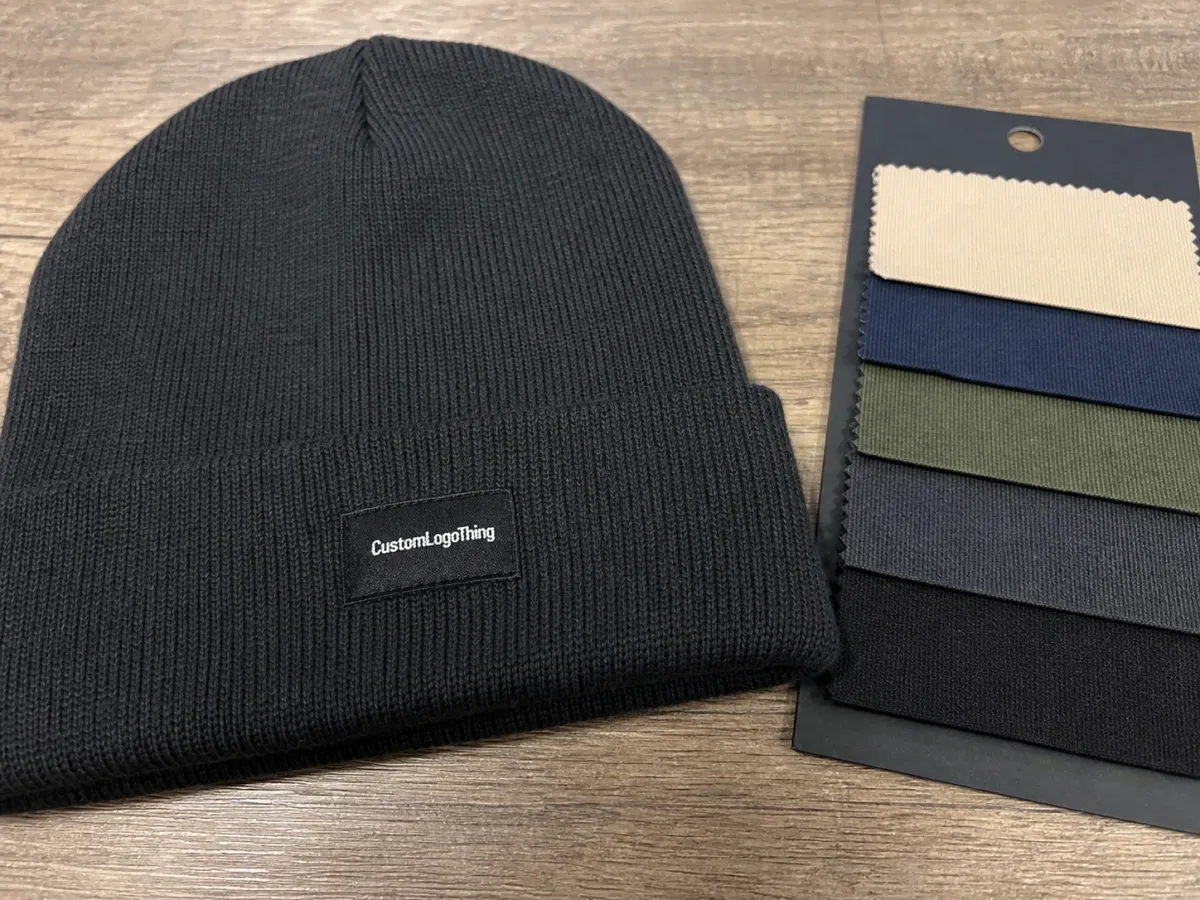
A mockup only checks layout. A sample checks the product in motion. That difference matters more on beanies than on many other garments because the cuff stretches, the knit texture breaks up fine detail, and the label often sits close to the face where people can feel rough edges instantly.
Even a small label can change the handfeel of the whole beanie. Add a fold, and the bulk increases. Add a backing, and the stiffness changes again. Put the same label on a ribbed cuff instead of a smoother knit, and the visual balance shifts. What looked centered in a PDF may appear slightly high, slightly narrow, or just too busy once sewn.
That is why this sample stage should focus on use conditions, not decoration. A beanie in retail use gets folded in shipping, touched by shoppers, hung on pegs, and photographed for ecommerce. The label needs to survive all of that without looking like an afterthought.
If you are comparing woven labels with printed trims, size tags, or hang tags, our Custom Labels & Tags page is a practical way to separate what belongs on the garment from what belongs in the packout.
On a beanie, a woven label is not judged as a flat graphic. It is judged as a small piece of construction: how it bends, how it reads, and whether it still looks clean after a few days of handling.
That is the real value of swatches. They remove guesswork before you commit to production.
What a Woven Label Sample Actually Proves
A physical sample proves a lot more than color. It shows the weave structure, the edge finish, the fold behavior, the stitch allowance, and the way the yarn behaves when the label is bent. For beanie buyers, that matters because the label is usually small and close to the consumer. Tiny flaws show up fast.
Here is what a good sample should answer:
- Does the weave hold small text without filling in?
- Do borders stay crisp after folding or cutting?
- Is the label soft enough for skin contact near the forehead or ear?
- Does the label distort when sewn onto stretch knit?
- Does the finish fit the product tier, or does it look cheaper than the rest of the garment?
That last point gets ignored more often than it should. If the beanie uses recycled packaging, kraft inserts, or FSC-certified corrugated cartons, the label should not feel like it came from a different brand family. It does not need to match the packaging material. It does need to sit comfortably beside it. A clean woven label can support a sustainable presentation. A flimsy one can undercut it immediately.
The sample also reveals how much detail the artwork can actually carry. A beanie label face is often only 20 to 40 mm wide. That is not much room for a logo, fine lines, and small type. If the design includes hairline rules or tiny lettering, the sample may show that the artwork needs simplification. That is not a failure. It is production reality.
Strong samples are often plain in the best way. They read clearly, feel controlled, and do not force detail where the format cannot support it.
How the Sample Process and Lead Time Usually Work
The sample process is straightforward once the buyer sends clean inputs. If the supplier has to guess the fold type, the beanie fabric, the size, or the thread colors, the project slows down. Every guess becomes a revision later. That is where time disappears.
Most sampling runs through the same sequence: artwork intake, digital proof, loom setup, sample weaving, finishing, inspection, and shipment. The proof stage checks spacing and proportion. The physical sample checks whether the label actually works on fabric. Those are related, but they are not the same thing.
Typical timelines depend on detail level. A simple woven sample may take about 7 to 12 business days after proof approval. A denser multi-color sample can run 12 to 18 business days, sometimes longer if the artwork needs cleanup. If a revision is needed, add a few more days for each round.
- Send vector artwork rather than a flattened screenshot.
- Confirm size, usually somewhere in the 20 to 40 mm range for beanie use.
- Specify color targets with Pantone references if color match matters.
- State the fold, backing, and stitch allowance so the sample reflects the final label.
- Review the physical swatch on actual fabric before production release.
That last step matters more than buyers usually expect. A digital proof protects artwork. A physical sample protects the product. One is flat. The other has friction, stretch, and tension.
It also helps to send a photo of the actual beanie body if it is already in development. A ribbed cuff, a thick knit, and a smoother jersey-style fabric will not behave the same way. A label that looks right on one may sit badly on another. Suppliers make better decisions when they know what they are joining to.
Good sampling is less about speed and more about removing uncertainty early. Exact inputs save more time than rushed approvals ever do.
Choosing Yarn, Weave, and Finish for Beanie Retail Use
Yarn choice affects feel and durability, but weave and finish decide whether the label is actually usable. Polyester is still the most common option for Retail Woven Labels because it keeps color consistency, holds detail well, and stays cost-effective. Cotton blends can give a softer, more matte look, which some heritage brands prefer. They usually give up some sharpness in tiny type. That tradeoff is real.
Damask is often the best fit when the design needs fine detail and a smoother face. Taffeta can work for simpler artwork and tighter budgets, but it is less forgiving with small lettering. Satin gives a smoother, slightly glossier finish that can look premium, although the sheen can shift how colors appear under bright retail lighting. A dark navy thread can look flatter or colder than expected. The sample is where that shows up.
Finish choice matters just as much. Folded edges can feel softer and cleaner against the skin, especially on a cuff that sits near the forehead. Heat-cut edges can work well if the cut is clean. If the cut is rough, the label looks unfinished. Backing also changes the outcome. Sew-only labels keep the handfeel lighter. Some backed labels add structure, which can help on performance headwear but feel too rigid on a soft winter beanie.
For most buyers, the best rule is simple: boutique beanies usually need a softer hand and tighter finishing; outdoor or performance styles can tolerate a firmer label if the brand story supports it; promotional beanies should prioritize legibility and cost control over decorative detail. Fancy is not the goal. Fit is.
There is also a sustainability angle, and it should stay honest. If the packaging uses recycled content, post-consumer waste mailers, or FSC-certified board, the woven label does not need to mirror those materials. It does need to feel like it belongs in the same product system. A label that looks sloppy can weaken the whole presentation, even if the carton and inserts are well specified.
Retail Woven Label Beanies Material Sample Guide: Cost, MOQ, and Quote Factors
Pricing usually depends on size, thread count, weave complexity, finish type, and sample quantity. That sounds tidy until you compare quotes and discover that one vendor includes setup, another charges separately for revisions, and a third folds shipping into the total. The only way to compare fairly is to break those items out.
For a small woven label prototype, sample charges often land in a modest range. The range rises fast with fine detail or special finishing. A low production unit price does not guarantee a cheap sample. The loom still needs setup. Colors still need calibration. Finishing still takes labor. Even one physical sample carries real production work.
| Sample type | Typical sample charge | Best use | What it proves |
|---|---|---|---|
| Simple damask, 1-2 colors | $25-$45 | Clean logos and basic retail runs | Readability, edge sharpness, simple handfeel |
| Standard 3-4 color woven sample | $35-$70 | Most retail beanies | Color balance, folding behavior, cuff appearance |
| Fine-detail satin or dense weave | $50-$90 | Small text or premium presentation | Micro-detail clarity, sheen, stiffness |
| Special backing or unusual fold | $60-$120 | Limited editions or comfort-focused trims | Attachment method, seam bulk, wear comfort |
MOQ works differently for samples than it does for production. Some suppliers will produce a one-off prototype because they want the order. The actual production minimum may still be 500, 1,000, or more pieces because that is where loom setup makes sense. That split is normal. It keeps the sample stage separate from full manufacturing risk.
When requesting a quote, ask for three numbers in writing: sample cost, re-sample cost, and production pricing at a stated quantity. Also ask what is included. Shipping, artwork changes, and special finishing are often handled differently from vendor to vendor. A quote that bundles everything into one line is harder to compare and easier to misread.
If a supplier cannot explain the gap between sample pricing and production pricing, that is a warning sign. Not always a dealbreaker. Just a sign to ask more questions before anything is approved.
Common Sampling Mistakes That Lead to Rework
The most common mistake is treating the render as the final truth. It is not. Thread behaves differently from pixels. Scale changes when a label is folded. Texture changes contrast. A clean logo on screen can become crowded or muddy once the weave starts doing its job.
Another common miss is reviewing the sample loose on a desk instead of on the actual beanie fabric. A ribbed cuff can stretch the label wider than expected. A thick seam can lift one edge and make the label look crooked. If the review never happens on the real product, the buyer is not seeing the real condition.
Too many thread colors cause trouble too. Buyers often keep adding detail because the label feels small and they want it to “look premium.” That usually works against them. Small labels do better with cleaner structure. A simpler weave often looks more expensive after it is sewn on.
- Check color in two lights - retail LED and natural daylight can change how black, navy, and charcoal read.
- Check comfort on skin - the label should not feel scratchy at the cuff edge.
- Check stitch placement - a label that sits 2 to 3 mm off center is noticeable on a small beanie.
- Check photo appearance - some labels look fine in hand but flatten badly in product photography.
The biggest practical lesson is that the sample should answer the annoying questions before production starts. Is the label too stiff? Does the border disappear? Does the brand name stay legible when the knit stretches? If the answer is no to any of those, the design needs another pass.
That is where rework usually starts, and rework is expensive for trim. The label itself may be cheap. The lost time is not.
What to Do Before You Request the First Sample
The best sample request is specific. Send vector artwork. Define the exact label size. State the fold style, backing, and attachment method. Add the beanie fabric type if you know it. A smooth acrylic knit behaves differently from a heavier wool blend or a tightly ribbed performance cap. That context helps the sample reflect the real product instead of an idealized version of it.
It usually makes sense to request two or three variations rather than one. A baseline version gives you a reference point. A higher-contrast version shows where the art gets too dense. A finish variation helps judge comfort and presentation. That is usually enough to expose the tradeoffs without flooding the review process with noise.
A simple internal checklist helps keep the decision grounded:
- Legibility - can the logo and text be read at arm's length?
- Handfeel - does the label sit softly on the cuff?
- Attachment - does it stay flat after sewing?
- Retail appearance - does it look right in a box, on a hook, and in photos?
- Decision timing - is there a fixed approval date so the order does not stall?
If you need to compare woven labels with other trim and tag formats, the Custom Labels & Tags catalog is useful for sorting what belongs on the product and what belongs in the packout. For shipping and carton handling, it also helps to think in transit terms: the label should survive normal movement inside corrugated cardboard, not just the handoff from supplier to buyer. General test frameworks are outlined by ISTA.
The point is simple. A sample is not a box to check. It is the last cheap chance to catch a problem before production locks it in. If the beanie fabric is defined, the artwork is clean, the sample variations are limited, and the review happens on the real product, the approval process gets much easier.
FAQ
What should I include in a retail beanie woven label sample request?
Send vector artwork, exact label dimensions, preferred colors, and the beanie fabric type so the sample reflects real production conditions. Also specify fold style, backing, and attachment method, because those details change how the label sits on a cuff or seam. If possible, ask for the sample on the actual knit structure instead of a loose proof.
How long does a woven label beanie sample process usually take?
Digital proofing is usually quick, but physical sampling takes longer because loom setup and finishing still have to happen. Simple samples often take about 7 to 12 business days after proof approval, while more complex multi-color designs can take longer. Shipping time should be added if the sample is needed for a buyer meeting or line review.
What affects the cost of woven label samples for beanies?
Cost is driven by label size, thread count, weave detail, backing, and whether multiple versions are needed. Rush work, revisions, and special finishes can raise the sample price even when the final production unit cost stays reasonable. A clear quote should separate sample setup, re-sample fees, shipping, and production pricing.
Should I test the sample on the actual beanie fabric?
Yes. Knit stretch, seam bulk, and cuff structure can change the way the label looks and feels. Testing on the real fabric helps confirm placement, legibility, and comfort before production starts. It also reduces the risk of rework if the sample feels too stiff or looks too large once attached.
How many sample versions should I request before production?
Two to three versions is usually enough to compare a baseline option, a higher-contrast option, and a finish variation. Too many versions slow approval, while too few can hide the tradeoffs between cost, durability, and presentation. Pick the versions that answer your biggest risk questions instead of asking for every possible variation.