If you are sourcing event merchandise with a premium feel, a wedding Pom Pom Beanies Material Sample guide is not about choosing a cute color and moving on. It is about avoiding the gap between a polished mockup and a real product that feels flimsy, scratchy, or oddly proportioned once it is in hand. Two beanies can look almost identical online and still behave very differently because the fiber blend, knit density, pom construction, and finishing all affect the final result.
That matters more in wedding orders than in a typical promo item. Guests hold the beanie, wear it for photos, pack it into a bag, and notice whether the crown sits cleanly or the pom flattens after ten minutes. A sample is not decoration. It is the first real test of whether the idea survives production.
For buyers, the sample should answer practical questions: What does the fabric feel like? Does the hat recover after stretching? Is the trim secure? Can the decoration be repeated at scale without shifting the price or the delivery schedule? If the sample cannot answer those questions, it is not ready for approval.
What a Wedding Pom Pom Beanies Material Sample Guide Covers
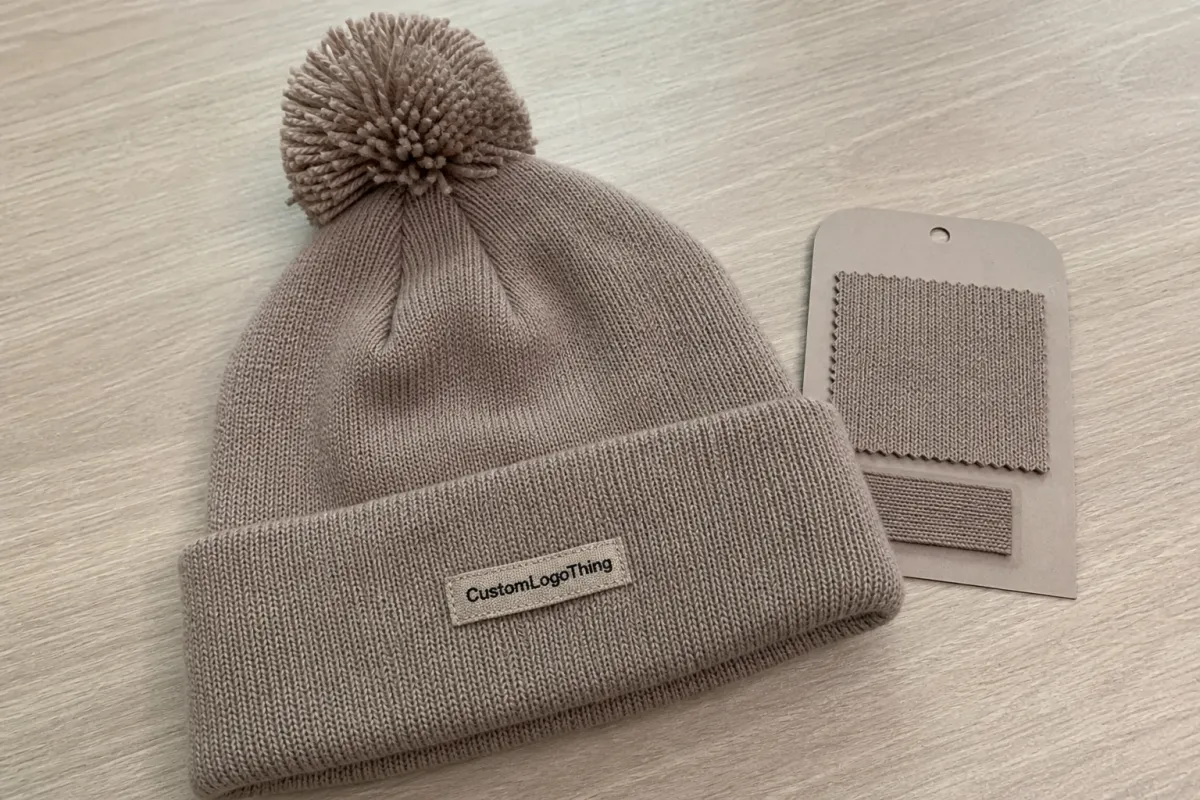
A useful sample guide starts with the job of the sample itself. It is not a color chip with a pom attached. It is the buyer-side checkpoint for hand feel, structure, decoration placement, and repeatability before a bulk order is locked in. If the beanie is meant for bridal party gifts, winter ceremony favors, or resale, the sample has to work in the real setting, not just under studio lighting.
Small material changes can shift the whole look. A 100% acrylic beanie can feel light and smooth, while a wool-acrylic blend usually reads warmer and more substantial. Knit gauge changes how dense the fabric looks and how well it holds shape. Pom attachment affects whether the top looks crisp after handling. Lining can change comfort enough to matter, even if the outside appearance barely changes.
A solid wedding Pom Pom Beanies material sample guide should cover at least five points: fiber options, knit gauge, pom size and attachment method, stretch recovery, and logo or label placement. Leave one of those out and the approval becomes a guess. That is usually how rework starts.
"A sample that looks right from three feet away is not enough. Buyers need to know how it behaves after it is worn, stretched, set down, and worn again."
Wedding buyers also judge these pieces in a harsher environment than most categories. White, ivory, blush, and metallic decor expose tone shifts fast. A cream yarn with a yellow cast can look refined in one venue and off in another. The same is true for pom texture: plush in a product photo, flat and tired under event lighting. Review the sample where it will actually be seen.
Packaging belongs in the review too. If the final order will ship in a printed box, tissue wrap, or a premium mailer, the sample should be examined with that packaging in mind. A tidy sample package suggests control. A careless one raises questions about the rest of production. Fair or not, buyers read it that way.
How the Sampling Process Works Before Bulk Production
The sampling flow usually starts with a short brief: intended use, target color, decoration method, size range, packaging needs, and budget or lead-time constraints. From there, the factory sources yarn, confirms the knit spec, builds the pom, finishes the sample, and ships it for review. If the materials are already available, that can move quickly. If the order needs color matching, a specific lining, or a custom label format, the pace slows down immediately.
There is also a difference between a development sample and a pre-production sample. A development sample tests the concept. A pre-production sample should mirror the final order as closely as possible. Approving the first one too fast is risky. It can look right and still be impossible to repeat at the target cost or lead time.
Once the sample arrives, inspect it like a production auditor. Start with symmetry. Check stitch consistency, cuff depth, edge finishing, and label placement. Pull the pom gently and watch the crown. Does the attachment hold cleanly or shift the knit? Stretch the beanie and release it. Does it spring back, or stay loose? That one test often tells you more than a glossy photo set.
Wear testing matters because a wedding favor gets handled more than a shelf item. Guests try it on, fold it, tuck it into a coat pocket, and wear it through a long event. A sample that passes a tabletop review but fails after a few minutes on a head is not ready for bulk approval.
If shipping durability is a concern, look at standard transit-test frameworks such as ISTA. The beanie itself is soft goods, but the sample still has to survive packing, compression, and shipment without arriving flattened or misshapen.
At the end of the review, the decision should be clear: approve as-is, request revisions, or ask for a second sample. Do not leave it in the vague middle. If the fiber blend needs to change, say so. If the pom is too small, write that down. Loose feedback tends to produce the same problem twice.
Material, Pom, and Fit Factors Buyers Should Compare
Material choice drives more than cost. It shapes how the beanie reads in photos, how it feels against skin, and how well it survives repeated handling. For most buyers, the options are straightforward, but the tradeoffs are easy to underestimate.
Fiber choices
Acrylic is usually the budget-friendly route and gives the widest color range. It is often the safest starting point if the order needs a clean visual match and a controlled unit cost. Wool blends add warmth, softness, and a more natural texture, though they can raise the price and may need comfort testing for itchiness. Recycled materials can support a sustainability message, but the buyer should confirm texture, color stability, and available minimums before assuming every shade is possible.
The fiber spec also affects production behavior. Some yarns knit smoothly but show more variation across dye lots. Others hold color well but can feel stiffer in cold weather. If the event is outdoors, that matters. If the item will be resold, consistency matters even more.
Pom construction
Pom choice changes the personality of the piece. A faux fur pom looks fuller and reads more premium in close-up photos, but it can shed, flatten, or vary slightly from sample to sample. A yarn pom is usually easier to control for consistency and color matching, though it may feel less elevated depending on the design. Diameter matters too. A 10 cm pom and a 13 cm pom do not create the same silhouette, and the larger one can overwhelm a smaller crown.
Attachment deserves close attention. A weak sew point becomes a problem as soon as the beanie is handled. A strong attachment should feel secure without creating a visible lump at the crown. If the pom is detachable, test the fastener twice. Wedding orders often include gifting or resale, so any loose hardware looks sloppy fast.
Fit and comfort
Fit is not just about size. It comes down to crown height, cuff depth, and stretch recovery. A beanie that sits too tall can look awkward in photos. One that is too shallow may ride up during wear. The best sample should sit cleanly, hold its shape, and still feel comfortable after 20 to 30 minutes. That is usually the point where irritation starts to show.
There are also details that do not show well in a product image: pilling risk, static, wash behavior, and how the fabric feels against bare skin. If the event takes place outdoors in cold weather, static and itchiness can become real issues. If guests may reuse the beanie later, colorfastness and care instructions matter more than buyers expect on the first pass.
A practical comparison often looks like this:
- Acrylic for tighter budgets, broad color matching, and predictable bulk repeatability.
- Wool blend for a softer hand and a more textured, premium look.
- Recycled blend for sustainability positioning, provided the visual target still holds.
- Yarn pom for tighter consistency and easier color control.
- Faux fur pom for a fuller, more giftable finish if the construction supports it.
Cost, MOQ, and Unit Pricing Signals to Check First
The quoted sample price only makes sense if you know what is inside it. Sample cost usually depends on yarn choice, pom type, custom labeling, embroidery or patch work, and whether a one-off setup is needed. For a simple knit beanie sample, a buyer might see something around $45-$90. Add a more complex pom, a custom woven label, or a revision round, and the price can move to $80-$150 or more before freight.
Lower minimum order quantities are attractive, but they do not automatically lower the total cost. A small test run can carry more labor per unit, more packaging overhead, and more setup time. If the buyer wants a special color match or a hand-inserted label, that cost gets spread across fewer pieces. The unit number rises quickly.
I like to compare the sample against the likely bulk cost, not against a fantasy retail margin. If the approved spec will push the landed unit cost too high, the sample has already done useful work by exposing that early. Buyers who skip this step often discover the problem only after approval, when flexibility is much lower.
| Sample Option | Typical Sample Cost | What Drives the Price | Best Use |
|---|---|---|---|
| Acrylic knit with yarn pom | $45-$75 | Basic knit, standard finishing, limited trim work | Budget-led wedding favors or early concept checks |
| Acrylic or wool blend with faux fur pom | $70-$130 | Pom density, finishing quality, closer visual premium | Bridal party gifts or photo-focused event items |
| Recycled blend with custom label | $80-$150 | Material sourcing, label setup, approval revisions | Sustainability-led launches or retail resale |
Ask what the quote does not include. Freight, revision costs, special packaging, and sample photography can sit outside the headline number. Packaging details matter too, because sample shipments are often sent in corrugated cardboard mailers or wrapped in kraft paper to protect the knit from snags. If the brand wants greener presentation, ask about FSC certified paper components, recycled materials, post-consumer waste content, and whether the outer pack can use biodegradable packaging without weakening transit protection.
For the paper portion of the pack, the environmental claim should be specific. If the insert, sleeve, or hangtag uses certified paper, ask for proof instead of assuming the label means what you think it means. The FSC site is a useful reference point for chain-of-custody claims and paper sourcing language.
Process and Timeline: From Brief to Approved Sample
A clear timeline keeps the project from drifting. I usually think of it in seven steps: spec intake, yarn sourcing, knitting, pom construction, finishing, review, and final sign-off. If the factory already has the material in house, a simple sample can move through in roughly 5-10 business days. If the order needs a special fiber blend or exact shade matching, the calendar stretches.
Where delays creep in
The most common delay is not knitting. It is waiting for the right yarn. Color corrections also consume time because one slightly off cream or grey can trigger a reset. Missing artwork files cause another round of delay. Then there is shipping. A sample can be finished quickly and still arrive late if it crosses borders or sits in customs.
Revision cycles are manageable if the feedback is precise. Small changes, such as tightening cuff depth or shifting label placement, may only add a few days. Bigger changes, like switching from a yarn pom to a faux fur pom or moving from acrylic to a wool blend, can add a full cycle because the factory has to rebuild the sample from a different starting point. That is why the first brief matters so much.
A good milestone checklist should tell the buyer when the sample is in development, when it is ready for evaluation, and when approval locks the order. It sounds basic, but production teams lose time here all the time. One person thinks the sample is approved. Another thinks comments are still open. A clear paper trail avoids that mess.
The real goal is controlled speed, not speed for its own sake. If the sample takes 8 days and saves you from a 5,000-unit mistake, that is efficient. Slow and accurate beats fast and expensive.
Common Sampling Mistakes That Create Bad Approvals
The biggest mistake is approving a sample under poor lighting. Wedding whites, creams, taupes, and soft neutrals can look fine in a dim office and wrong under daylight or venue lighting. If color is a priority, check the sample in more than one environment.
Second, buyers often focus on color and ignore touch points. Does it itch? Does the pom stay full after being handled? Does the knit recover after stretching? These are not minor details. They are the things guests notice when the item is worn for more than a minute.
Wear testing is another easy skip. A beanie that sits perfectly on a table may shift over styled hair, bunch at the crown, or slide during movement. If this is a bridal party item or a gift people will photograph, the sample should be tried on in a real setting. Hold it up to a camera. Check the silhouette. Then check it again after 10 minutes.
Documentation errors create their own kind of pain. If the comments are vague, the next sample often fixes the wrong issue. "Make it better" is not a production note. "Reduce pom diameter by 1 cm and increase cuff depth by 0.5 cm" is useful. Precision saves time, and it saves the factory from guessing.
"The fastest way to burn budget is to approve a sample you do not fully understand."
Packaging is another common blind spot. A sample should not be treated like an isolated object if the final order will be boxed with tissue, kraft paper, or a printed insert. Review it in the same presentation system you plan to ship. Otherwise, the beanie may be approved in a context it will never actually live in.
Next Steps: Build a Clear Approval Checklist
The easiest way to reduce risk is to create a one-page spec sheet before you request the sample. List the fiber content, knit gauge, pom style, label method, color target, fit notes, and packaging requirement. If you need a particular feel, write that down too. "Soft but not floppy" may sound vague, but it is still better than silence.
Ask for side-by-side photos, measurement confirmation, and a short factory note explaining any approved substitutions or material limits. If the factory had to replace one yarn with another, you want to know that before bulk production starts. A clean approval sheet gives both sides a shared reference point.
Then compare the sample against the real use case. Ceremony photos need a slightly different feel than guest favors. Bridal party gifts may justify a higher-end pom or softer blend. Retail resale may demand tighter consistency, cleaner labeling, and packaging that stands up on a shelf. The spec should follow the use case, not the other way around.
Close the loop in writing. Once the final revision is approved, archive the wedding pom pom Beanies Material Sample guide with the notes, measurements, and photo set. That file becomes the baseline for reorders, which is where real efficiency starts. A buyer who keeps clean records usually spends less time re-explaining the same spec later.
That is the practical value of a wedding Pom Pom Beanies Material Sample guide: it turns a pretty sample into a controlled buying decision. In this category, control is what keeps the final order looking polished, feeling right, and arriving without surprises.
What should a wedding pom pom beanies sample include?
Request the exact fiber blend, pom type, lining choice, and logo or label placement you want in bulk. Ask for measurement confirmation on crown height, cuff depth, and stretch recovery, not just a photo. Make sure the sample reflects the final decoration method, because embroidery, patches, and woven labels can change the look.
How long does a beanie material sampling process usually take?
Simple samples can move quickly if yarn is in stock and no custom trim is needed. Timelines usually expand when the buyer requests color matching, multiple revisions, or special pom construction. Shipping time matters, so a fast factory build can still become a slow approval if the sample must cross borders.
What affects sample pricing for custom pom pom beanies?
Fiber choice, custom finishing, and trim complexity usually drive the biggest price changes. A lower MOQ often raises unit cost because setup and labor are spread across fewer pieces. Freight, revision rounds, and special packaging can add cost even when the beanie itself looks simple.
How do I compare two beanie samples fairly?
Place them under the same light source and compare color, hand feel, pom density, and stretch side by side. Use the same checklist for both samples so one does not get judged more loosely than the other. Check how each sample looks after handling, since pom fullness and fabric recovery can change quickly.
What is the biggest risk if I skip the sample review step?
The bulk order can arrive with the wrong fit, weaker construction, or a pom that looks less premium than expected. Small differences are expensive at scale, especially when the issue affects every unit in a wedding or gift order. A skipped review often creates delays later because corrections happen after production has already started.


