Buyer Fit Snapshot
| Best fit | order custom ar unboxing cards convert for packaging buyers comparing material specs, print proof, MOQ, unit cost, freight, and repeat-order risk where brand print, material, artwork control, and repeat-order consistency matter. |
|---|---|
| Quote inputs | Share finished size, material target, print colors, finish, packing count, annual reorder estimate, and delivery region. |
| Proofing check | Approve dieline scale, logo placement, barcode or warning zones, color tolerance, and any recyclable or compostable wording before bulk production. |
| Main risk | Vague material claims, crowded artwork, or missing packing details can create delays even when the unit price looks attractive. |
Fast answer: Order Custom Ar Unboxing Cards Convert: Dieline, Finish, Proof, and Buyer Review should be specified like a repeatable production item. The safest quote includes material, print method, finish, artwork proof, carton packing, and reorder notes in one written spec.
What to confirm before approving the packaging proof
Check the product dimensions against the actual filled item, not only the sales mockup. Ask for tolerance on folds, seals, hang holes, label areas, and retail display edges. If the package carries a logo, QR code, warning copy, or legal claim, reserve that space before decorative graphics fill the panel.
How to compare quotes without losing quality
Compare board or film grade, print process, finish, sampling route, tooling charges, carton quantity, and freight assumptions side by side. A lower quote is only useful if the supplier can repeat the same color, closure quality, and packing count on the next order.
Order Custom AR Unboxing Cards That Actually Convert
If you want a printed insert that gets scanned instead of tossed, order custom ar unboxing cards with one clear job: push the buyer to watch, click, register, redeem, or come back. That is the difference between packaging that looks nice and packaging that earns its keep. A flat card is cheap to print. A card that drives a measurable action is the part people remember.
Most product packaging gets judged in seconds. The box opens, the filler comes out, and the insert gets one quick glance before it is either useful or gone. If you order custom ar unboxing cards without a real action behind them, you are paying for paper with a logo on it. If you order custom ar unboxing cards with the right content, that same card can carry a demo video, a setup guide, a promo code, a warranty path, or a lead form that keeps working after the box is gone.
I have seen launch kits where the insert was clearly treated like filler. Nice stock, pretty print, zero purpose. The funny part is that nobody notices the paper unless it tells them something worth doing. That is the whole job here. Make the card do one useful thing, then make that action obvious enough that people do not have to think twice.
Why Order Custom AR Unboxing Cards for Product Launches
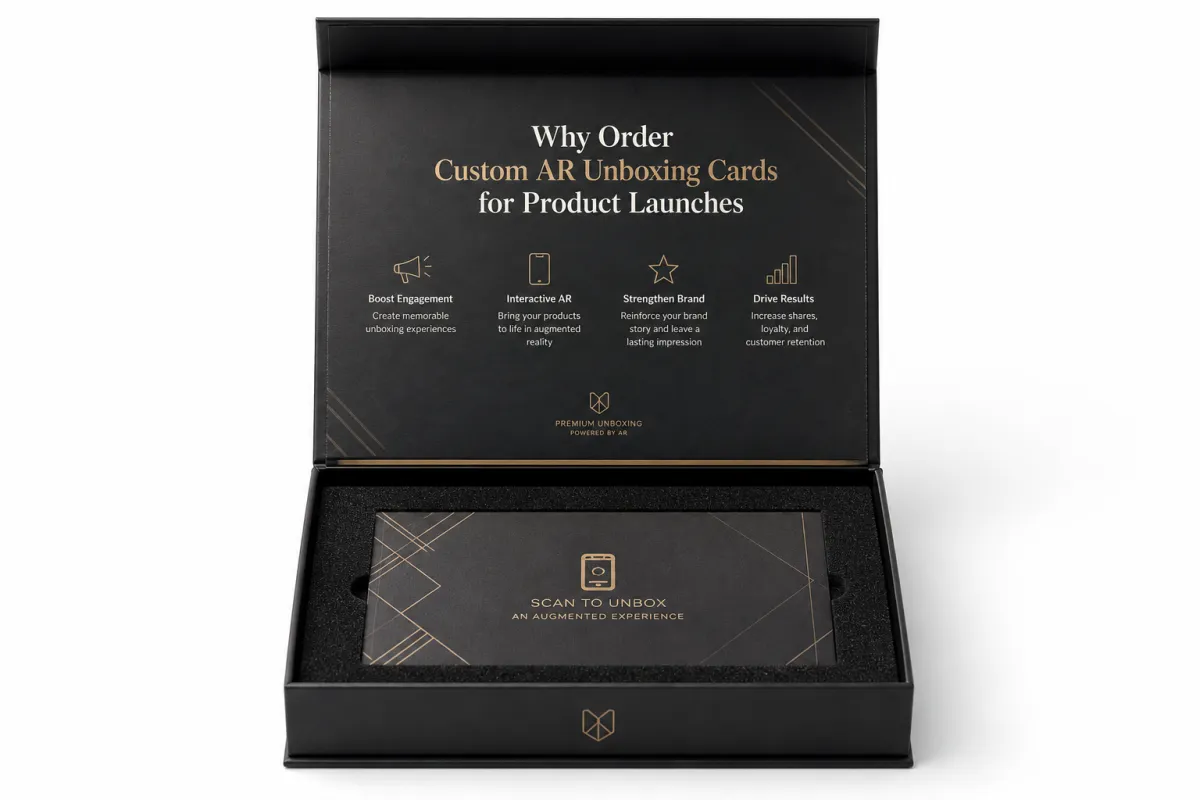
Most inserts get trashed fast. That is the whole problem. It is also why brands order custom ar unboxing cards with a purpose instead of treating them like filler. In launch kits, influencer mailers, retail samples, and post-purchase shipments, the card is one of the few pieces of packaging that still has a chance to work after the outer box is opened and the hype settles down. It has to earn attention fast. No fluff. No decorative nonsense pretending to be strategy.
For a product launch, one printed card can do more than a stack of inserts ever will. It can point to a product demo, a founder message, a how-to video, a landing page, a referral offer, or a support page. That matters because buyers do not all want the same next step. Some want setup help. Some want proof the product works. Some want a discount on the second order. If you order custom ar unboxing cards correctly, the card becomes a routing tool that sends each person to the next best step without making them hunt for it.
It also gives you data. Not vague brand-awareness fluff. Real numbers. QR scans. Click-throughs. Repeat visits. Promo redemptions. Even a simple card can show whether the unboxing moment leads anywhere useful. From a packaging buyer's point of view, that matters because product packaging should do more than look polished in a photo. It should support package branding and give the marketing team a reason to keep using it.
There is one thing a lot of teams miss: the unboxing card is usually the first place where the customer feels the brand after the purchase decision is done. That makes it a trust moment, not just a marketing asset. If the card looks slick but sends people to a broken page, you burn trust for almost no gain. Annoying, yes. Preventable, also yes.
In practice, the best uses stay pretty consistent:
- Influencer mailers - send the creator to a short demo page, not a generic homepage.
- Retail packaging - direct buyers to setup instructions or a review request.
- Subscription boxes - point to a monthly offer, loyalty page, or collection hub.
- Warranty registration - collect ownership data before support becomes a problem.
- Sample kits - give prospects a quick path to order, book, or request a quote.
That is why brands order custom ar unboxing cards for launches instead of treating them like throwaway inserts. The card can carry content that changes with the campaign while the printed shell stays consistent. It is one of the easier ways to make custom printed boxes and the material inside them feel coordinated, not slapped together.
Most packaging gets one shot. If the card does not tell the buyer what to do next, it becomes another piece of paper.
If you are building a launch around product packaging, do not stop at the outer box. Order custom ar unboxing cards that connect the physical moment to the digital one. That is the part buyers actually notice after the first ten seconds are over.
Order Custom AR Unboxing Cards: What You Actually Get
When people order custom ar unboxing cards, they are usually buying two things at once: a printed piece and a digital action. The physical card is the hook. The AR or scan destination is the payoff. A good spec sheet keeps both parts clear. No guessing. No vague "interactive insert" language that sounds clever and helps nobody.
The physical piece is usually a flat postcard-style insert, but there are other formats. Standard sizes like 3.5 x 5.5 inches, 4 x 6 inches, and 5 x 7 inches are common because they fit easily into mailers, folded cartons, and retail packaging. Folded cards work if you need more copy, while die-cut shapes can help when the brand wants the insert to feel more premium or match a campaign theme. If you order custom ar unboxing cards for a tight box, smaller formats save space. If you need room for instructions, a promo code, and a QR code, go larger.
Activation can happen in a few ways. QR code is the lowest-friction option because it works on most phones and does not ask the customer to download an app. Image-trigger AR is useful if you want the card itself to act as the trigger. NFC is cleaner in some premium programs, though it adds cost and depends on user behavior. A short fallback URL matters either way, because some people will ignore the code or have a bad connection. That is normal. Design for reality, not for an ideal user in a pitch deck.
One practical note: a lot of brands call any scan-linked card "AR," even when the experience is really just a mobile landing page. That is fine as long as the language is honest. If the card opens a video, a discount page, or a form, say that. If it launches a true AR layer, say that too. Customers can smell marketing fog from a mile away.
The content behind the card should be chosen with the same discipline you would use for retail packaging or custom printed boxes. Good options include:
- Product demo - show setup, use, or proof points in under 60 seconds.
- Founder message - useful for launches that need trust fast.
- Setup guide - perfect for electronics, skincare tools, or anything with steps.
- Loyalty offer - push the second purchase while attention is still fresh.
- Support page - cut down avoidable service emails.
- Social follow prompt - works best when the brand already has a strong content loop.
What belongs on the card itself? The logo, the CTA, the code, and enough hierarchy that the buyer knows what happens next. If you order custom ar unboxing cards and hide the action in tiny text, the scan rate drops. If the scan is obvious, the card works harder. Put the logo where it supports package branding, then place the scan cue where the eye lands first. That is not fancy design. That is basic packaging discipline.
Most buyers also forget the handoff between print and digital. The printed piece should match the landing page tone, the offer, and the visual system. If the card says one thing and the page says another, the user feels the mismatch immediately. For anyone who orders custom ar unboxing cards as part of a larger branded packaging system, that consistency matters more than a glossy finish alone.
And yes, you can keep it simple. You do not need a giant experiential campaign to make the card useful. A clear card, a clean QR, a short message, and a fast-loading page usually beat a complicated concept with weak execution. That is kinda the point.
Specifications for Custom AR Unboxing Cards
If you order custom ar unboxing cards without locking the specs early, the quote will bounce around and the proof will take longer than it should. Start with size. The most common range is still postcard territory, and there is a reason people keep coming back to it. It is efficient, readable, and easy to insert into product packaging. Typical options include 3.5 x 5.5 inches for compact kits, 4 x 6 inches for standard mailers, and 5 x 7 inches when the card needs to carry more copy or a larger visual. Folded cards are useful if you want more room for instructions or multiple offers. Die-cut shapes work better for premium campaigns than for budget-driven ones.
Stock choice changes the feel more than most buyers expect. A 14pt cover stock is common for simple runs. A 16pt or 18pt stock feels firmer in hand and holds up better if the card is being inserted into custom printed boxes or passed out in retail packaging. Coatings matter too. Matte keeps the look clean and cuts glare over a QR code. Gloss adds pop to bright art. Soft-touch lamination gives a more premium hand feel, but it also adds cost. If you order custom ar unboxing cards for a launch where people will actually touch the insert, a heavier stock with a matte or soft-touch finish usually feels the most intentional.
For buyers who care about sustainability, ask for FSC-certified paper where available. That does not solve every packaging issue, obviously, but it is a straightforward way to support responsible sourcing. The FSC site explains the certification structure clearly enough for a procurement team or brand manager to use it in a brief without guessing.
File prep is where many projects go sideways. If you order custom ar unboxing cards and send a low-res logo, the proof will look rough. Keep these basics ready:
- CMYK artwork for print, not RGB screen files.
- Bleed of 0.125 inch on all sides.
- Safe area that keeps text and codes away from trim.
- Vector logos whenever possible.
- Images at 300 dpi at final size.
AR setup details need to be clear before the first proof. Who hosts the content? What happens after the scan? Is the user sent to a web page, a video, or a filter? Does the card need a custom redirect? Does the scan open in browser or in an app? These questions sound technical because they are technical. If you order custom ar unboxing cards without answering them first, approval slows down. Testing also matters. Scan behavior should be checked on both iPhone and Android before print approval. If a code works on one phone and fails on another, the nice mockup on your screen does not matter much.
For shipping-sensitive programs, ask how the insert will hold up inside the full package. If the card is part of a mailed kit or a product launch box, the whole shipment should be considered. The ISTA testing standards are useful here because they remind buyers that packaging is not just a picture on a flat screen. It is a system that has to survive handling, transit, and a few less-than-gentle drops.
As a rule, the card should be printed to fit the job, not the ego of the marketing team. If you order custom ar unboxing cards for a small sampler, do not spec a giant premium stock just because it sounds nice. If the insert needs to look elevated for a retail launch, then yes, the better finish is worth it. Practical choices usually beat dramatic ones.
Pricing and MOQ for AR Unboxing Cards
Pricing is where buyers usually get unrealistic fast. They see a simple printed card and assume the whole job should cost almost nothing. Then AR setup, content prep, and fulfillment show up, and suddenly the quote looks real. If you order custom ar unboxing cards, the cost is driven by a handful of variables: quantity, stock, finish, shape, variable data, digital setup, and shipping. Remove one of those variables and the price changes. Add three of them and it changes a lot more.
For simple digital runs, lower MOQs are often possible. A basic 4 x 6 card with a QR code and standard finish may start at 250 to 500 pieces, depending on the printer and the amount of setup work. Offset or specialty work usually makes more sense around 1,000 pieces and up. Custom shapes, heavier lamination, spot UV, or variable data can push the minimum higher. If you order custom ar unboxing cards for a one-time promo and need premium finishing, expect the MOQ to reflect that reality. The press does not care that the campaign is urgent.
Here is a practical view of the cost ladder:
| Option | Typical MOQ | Estimated Unit Price | Best Use | Notes |
|---|---|---|---|---|
| Standard digital insert | 250-1,000 | $0.38-$0.92 | Launch samples, small influencer mailers | Fast setup, simple finish, QR or short URL |
| Offset postcard-style card | 1,000-5,000 | $0.14-$0.29 | Retail packaging, subscription inserts | Best unit cost at mid-volume |
| Premium soft-touch card | 2,500+ | $0.32-$0.78 | Luxury branded packaging, VIP kits | Higher hand feel, better shelf presence |
| Die-cut or specialty format | 2,500+ | $0.45-$1.10 | Campaign launches, retail activation | Tooling and finishing raise the price |
Those are working ranges, not a promise. Exact pricing depends on ink coverage, quantity, finishing, and whether the file is actually ready to print. Sample or one-off proof pricing is almost always higher because setup costs do not get spread across production. That is normal. If you order custom ar unboxing cards and only need a few samples, do not compare the sample rate to a 5,000-piece run. Those are not the same job.
The budget should be split into three pieces so nobody fakes a low headline number:
- Print cost - paper, ink, finishing, cutting, and packing.
- AR or content setup - hosting, links, QR generation, image trigger work, or page build.
- Shipping and assembly - especially if the cards are kitted with custom printed boxes or other inserts.
That split matters because the cheapest print quote can still become the most expensive finished project once setup and shipping are added. Buyers who know they need branded packaging, retail packaging, and Product Packaging That all work together usually save time by asking for landed cost, not just print cost. It is a better conversation from the start.
Here is the part people skip: if the campaign uses different quantities or different versions for different audiences, ask for tiered pricing. Compare 500, 1,000, and 5,000 pieces. Compare matte to soft-touch. Compare a QR-only insert to a card with a more customized AR destination. If you order custom ar unboxing cards without tiered pricing, you are guessing about volume. Guessing is expensive.
If budget is tight, prioritize scan clarity and page speed before expensive finishes. A cleaner experience usually outperforms a fancier card that confuses people. Not glamorous, but it works.
Process and Timeline for Custom AR Card Orders
There is a pretty standard flow to this work, and the smoothest orders are the ones where the client respects the sequence. First comes the brief. Then the quote. Then artwork prep. Then proofing. Then production. Then quality check. Then shipping. If you order custom ar unboxing cards and skip any of those steps in your head, you will still do them later, just with more stress attached.
A realistic timeline depends on how ready the content is. If the logo, copy, and destination link are already approved, proofing often takes about 2 to 4 business days. Standard production commonly lands around 7 to 12 business days after proof approval. More complex work, specialty finishes, or bigger quantities can push that to 15 business days or more. If you order custom ar unboxing cards with variable data, custom shapes, or multiple SKUs, build in extra time. The press schedule does not bend because the launch meeting got moved.
Where do delays usually happen? The same places, over and over again:
- Missing copy - the card cannot be finalized if nobody has approved the CTA.
- Weak image files - low-res logos create proof revisions nobody wants.
- Late landing page work - the AR link is only useful if the destination exists.
- Unclear scan logic - app, browser, QR, or image trigger should be settled early.
- Last-minute legal notes - promo terms and claims need real review.
Rush service is possible in some cases, but it only works when the content is final. That is the catch. You cannot rush a file that does not exist. If you order custom ar unboxing cards for a launch next week and the landing page is still being written, the calendar will not magically cooperate. Speed comes from preparation, not wishful thinking.
Proofing is the stage where the practical details get confirmed. Check the QR size. Check contrast. Check the safe area. Check the address under the code if you are using one. Make sure the CTA matches the actual outcome. If the card promises a setup guide, do not send people to a product homepage. If the card promises a discount, the code has to work on the first attempt. That sounds obvious. It still gets missed.
If the card is part of a bigger mailer or retail kit, use the same mindset you would use for the rest of the package. A product launch kit should feel coordinated, from the outer box to the printed insert. If you are also ordering Custom Packaging Products, keep the card spec aligned with the carton spec. Small mismatches show up fast once the customer opens the box.
For brands that distribute across retailers or channels, ask about shipping configuration early. Some teams need bulk ship. Others need kitting into display packs. Others want a direct-to-customer drop. That choice affects both timeline and cost. If you order custom ar unboxing cards without clarifying shipping, the quote may be accurate and still be wrong for your operation.
One more scheduling tip: do not approve print before the destination page has been tested on a real phone over a real mobile connection. Wi-Fi hides a lot of sins. Customers do not care what the internal review looked like; they care whether the page loads fast enough to matter.
Why Choose Us for Custom AR Unboxing Cards
The advantage is not magic. It is fewer handoffs. If print, AR setup, and assembly are split across three vendors, somebody is going to blame somebody else when the card scans badly or the insert arrives late. When you order custom ar unboxing cards through one coordinated workflow, the spec stays cleaner and the accountability stays in one place. That is worth money. It is also worth sleep.
We also test before production. That should be standard, but a lot of shops still treat testing like a favor. It is not a favor. If the card is supposed to scan, it needs to scan before it reaches a customer, not after someone posts a complaint online. Pre-production testing catches the easy misses: bad contrast, wrong link, awkward landing page layout, or a code that looks fine on a mockup but fails in real lighting. If you order custom ar unboxing cards and the scan is the whole point, testing is not optional.
Another practical difference is how spec recommendations get handled. Not every project needs the fanciest finish. Sometimes the best choice is the cheapest card that still feels premium enough and scans cleanly. A lot of sellers push upgrades because upgrades are easy to sell. We prefer to recommend the lowest-cost spec that still does the job. That is better for brands, especially when they are scaling branded packaging across multiple campaigns.
We also make it easier to plan for different types of buyers. DTC brands need insert cards that convert after the first order. Subscription boxes need insert cards that hold attention without adding much weight. Retail launches need cards that match shelf presentation. Event mailers need a clean action that works on the spot. Wholesale sample kits need something that guides the buyer to the next step without making them hunt for contact info. If you order custom ar unboxing cards for any of those uses, the structure should match the buyer type.
That same logic applies if the project extends beyond inserts. For larger programs, we can help with Wholesale Programs that keep recurring orders organized and easier to budget. If the goal is a broader branded packaging rollout, the card should match the rest of the system rather than feel like an afterthought. The box, the insert, and the offer all need to point in the same direction.
There is also a trust issue that buyers do not talk about enough. If a customer scans the card and gets a broken page, the brand takes the hit. If the page loads slowly, the brand takes the hit. If the QR leads somewhere confusing, the brand takes the hit. That is why we push for simple, tested setups. When you order custom ar unboxing cards, you are asking the customer to take one extra step. That step should feel obvious and low-risk.
One more practical point: if the card is part of a larger launch, make sure the content team and the packaging team are talking. That sounds basic, but it prevents a lot of rework. Package branding only works if the printed insert supports the campaign instead of fighting it. A clean layout, a correct code, and a matching landing page do more for conversion than overcomplicated effects ever will.
Next Steps to Order Custom AR Unboxing Cards
If you want a fast quote, gather the basics before you send anything over. Quantity. Card size. Target audience. Scan destination. Launch date. Finish preference. Any required copy or legal notes. That is the shortest path to an accurate estimate when you order custom ar unboxing cards. If you leave those details out, the quote will be broad. Broad quotes are fine for a rough early look. They are not great for actual planning.
Send the logo, copy, and artwork files together if you have them. A logo alone is not enough for a useful layout, and a layout without the final CTA usually gets revised anyway. If the AR content is not finished yet, define the goal first. Do you want a demo, a lead form, a product registration page, or a discount code? The answer changes the structure of the card. If you order custom ar unboxing cards before you know the destination, you are designing around a guess.
Ask for tiered pricing at a few quantities. That gives you a real view of the unit cost curve instead of a single number that may not fit your rollout. If you need to compare finishes, ask for that too. Matte versus gloss is easy. Soft-touch versus standard cover stock is easier to compare when the numbers are side by side. If sample costs matter, include them in the request. A good buyer does not just ask for the cheapest version. A good buyer asks for the version that will perform best for the budget.
Before production, lock these four things:
- Approve the proof and check the scan behavior on real phones.
- Confirm the shipping address and fulfillment method.
- Make sure the AR link or landing page is live.
- Reserve the production slot so the job does not slip behind another run.
If your project is still in the planning stage, start with the basics on our FAQ page and then move into the quote request. That keeps the back-and-forth down and helps the production team focus on the parts that actually affect cost and turnaround.
Order custom ar unboxing cards with a specific outcome in mind, and the whole job gets easier. You get a printed insert that does more than sit inside the box. You get a measurable touchpoint, a better unboxing moment, and a cleaner bridge between product packaging and the digital action that follows. If you want the card to convert, do not treat it like decoration. Order custom ar unboxing cards that earn their place.
Actionably, the cleanest path is simple: pick one scan destination, one card size, one finish, and one success metric before you approve print. Everything else is decoration. Nice to have, sure. Not the thing that Moves the Needle.
How do I order custom ar unboxing cards if I only have a logo?
Send the logo, brand colors, and the action you want after the scan, such as a video, landing page, or offer code. A simple layout can be built from that starting point, then refined once the destination is confirmed. If you do not have AR content yet, define the goal first so the card points somewhere useful instead of nowhere.
What size works best for custom AR unboxing cards?
Standard postcard sizes work well because they leave room for instructions, a QR code, and branding without driving up print cost. Smaller inserts fit tight packaging and lower-cost programs, but they leave less room for copy and visual hierarchy. Choose the size based on the number of jobs the card has to do: scan, explain, and persuade.
What is the minimum order quantity for AR unboxing cards?
Lower MOQs are usually possible with simpler digital print runs and standard finishes. Custom shapes, specialty coatings, and more complex fulfillment usually push the minimum higher. Ask for tiered pricing so you can compare the unit cost at different quantities instead of guessing.
How long does it take to produce custom AR unboxing cards?
Proofing often takes a few business days if the artwork and AR destination are ready. Standard production commonly runs about one to two weeks after approval, depending on quantity and finish. Rush turnaround is possible sometimes, but only when the files are final and the link is already live.
Do custom AR unboxing cards need a special app to scan?
Usually no. Browser-based QR or AR links are easier because they remove app-download friction. Test the scan on both iPhone and Android before approving print so the experience is not broken at launch. Always include a short fallback URL in case someone ignores the QR code or has a weak connection.


