Custom Five-Panel Caps for Event Crews That Do the Job
Custom Five-Panel Caps for event crews help teams look coordinated and easy to spot in busy spaces. On a check-in line, backstage entrance, loading dock, or expo floor, staff need headwear that makes identification faster without adding friction to the shift. The five-panel build gives the front a wider, cleaner surface than many six-panel caps, so logos read clearly and the cap stays visually simple.
That shape also sits a little lower and usually feels less bulky than a more traditional structured cap. For production teams, venue staff, volunteers, and registration crews, that makes the cap practical as uniform headwear rather than a fashion piece. If the cap is working well, people notice the staff first and the hat second.
A good crew cap has to identify the team, survive a hard shift, and stay comfortable enough that people keep wearing it.
What custom five-panel caps for event crews are and why crews choose them
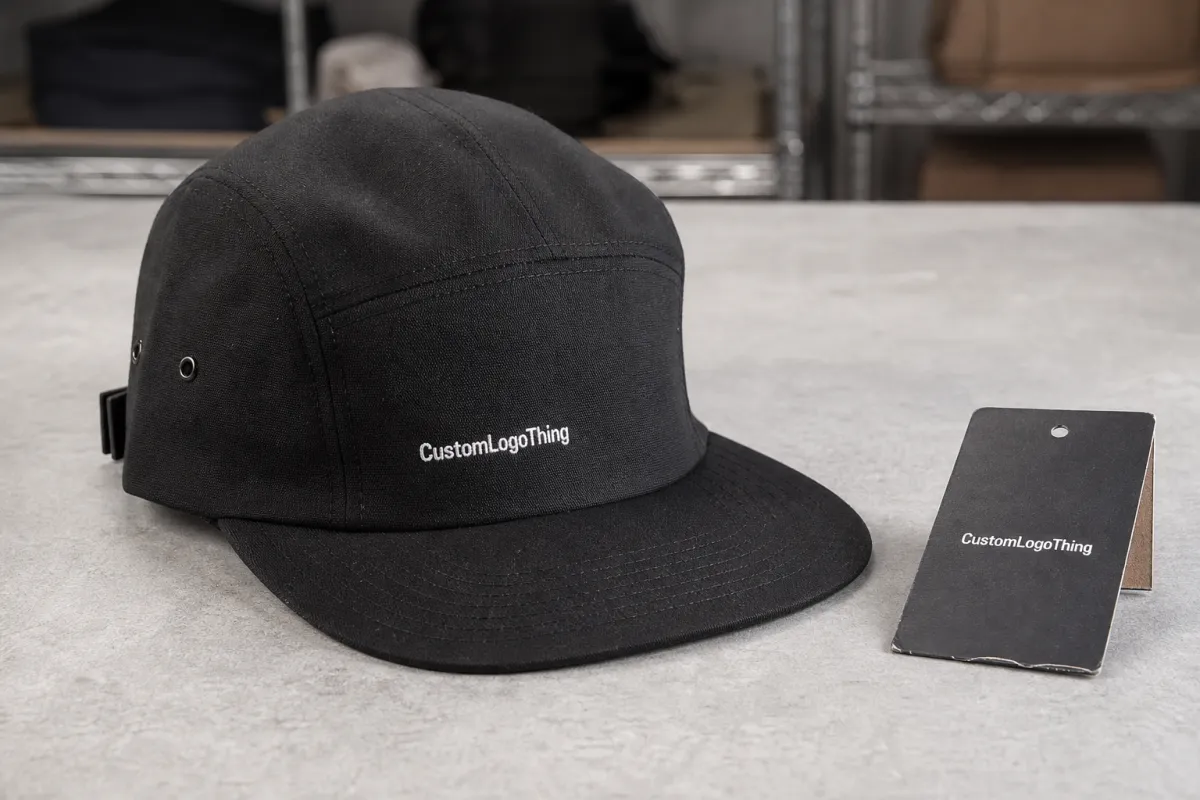
A five-panel cap uses one front panel, two side panels, and two rear panels. The single front panel is the main advantage because it gives the logo room to breathe without a center seam interrupting the design. That makes it easier to place a wordmark, icon, or short line of type in a way that still reads from across the room. The lower, flatter silhouette also feels more modern without looking overly styled.
Crews choose this format for simple reasons. It is easy to recognize on a crowded floor. It works with polos, tees, safety vests, and outerwear. It can look polished for front-of-house staff or more casual for setup crews depending on the fabric and decoration. When one order covers supervisors, runners, techs, and volunteers, that flexibility matters.
The strongest designs stay simple. A bold icon or compact wordmark usually works better than a crowded badge with tiny details. On headwear, clarity beats decoration density. If the eye has to work too hard, the message gets weaker.
How the panel build affects comfort and logo placement
The panel layout determines where the logo can go and how the cap feels in motion. On a five-panel cap, the broad front panel gives more room for embroidery or a patch, and the lack of a front seam keeps the artwork intact. That is useful when the logo was originally designed for shirts or bags and needs to be scaled for headwear without losing legibility.
Comfort comes from the smaller choices too. Crown height changes how much space sits above the head. Brim curve changes the look and how much shade the cap throws. Eyelets matter for hot venues and outdoor work. A slightly stiffer brim keeps the front looking sharp longer, while a softer brim packs flatter and feels less rigid during a long shift.
Structured and unstructured builds each have a place. Structured caps hold shape better and make the front panel look crisp, which helps when the logo has to look consistent across a large crew. Unstructured caps break in faster and feel softer, which some teams prefer for lighter-duty assignments or less formal events. For most event crews, structured styles win when consistency matters most; unstructured styles work better when comfort and a relaxed look matter more.
Materials and decoration choices that hold up on busy jobs
Material choice affects appearance, wear, and how the cap recovers after a long day. Cotton twill is common because it feels familiar and wears in well. A 60/40 cotton-poly blend usually keeps shape a little better and wrinkles less. Washed canvas gives a softer, broken-in look right away. Performance polyester makes sense for outdoor crews because it dries faster and handles sweat more easily during long load-ins or hot tent setups.
Decoration should follow the artwork, not force the artwork to fit the method. Embroidery is still the most common option because it feels durable and reads as professional. It works best for simple logos, block lettering, and marks that do not rely on tiny detail. Woven patches are better when the logo has small type, thin lines, or multiple colors that would blur in thread. Printed patches or transfers can be useful for short runs, bright graphics, or designs that need a flatter finish.
| Decoration method | Best for | Typical price impact | Practical note |
|---|---|---|---|
| Embroidery | Simple logos, durable crew wear | Moderate setup, lower unit add-on | Best when the logo can be simplified without losing identity |
| Woven patch | Fine detail, small type, multi-color art | Higher setup, moderate unit add-on | Preserves detail that thread would blur or crowd |
| Printed patch or transfer | Bright graphics, short-run orders | Varies by method and quantity | Useful when color count matters more than texture |
Placement and contrast matter as much as the method. A white logo on navy or black usually reads well from a distance. A tone-on-tone mark can look sharp up close, but it can disappear across a room. Front graphics also need enough size to survive distance; if the art is too small, the cap looks blank where staff need to be identified.
For buyers managing a broader branded kit, consistency across packaging and apparel helps. If the caps are packed with other event materials, it is worth checking whether any cartons or inserts use FSC-certified paper through FSC. If the order is moving through multiple handoffs before it reaches the venue, the packaging logic behind ISTA transit testing is worth borrowing. Caps get crushed more often than people think.
Process and timeline from proof to delivery
The cleanest orders follow a predictable path: artwork review, digitizing or patch prep, proof approval, production, finishing, and packing. The artwork review stage catches file issues early. If the design is going to be embroidered, digitizing turns the art into stitch data. If the cap uses a patch, the shape, edge finish, and color breaks need to be locked in before production starts. That upfront work prevents guessing later.
Turnaround depends on quantity, complexity, and the factory schedule. Simple embroidered runs often land in the 10 to 15 business day range after proof approval. Orders with patches, special trims, or multiple production steps can stretch to 15 to 20 business days. Rush production may be possible, but only when the artwork is ready and the line has room. A late logo file is the fastest way to lose time without changing anything else.
Proof approval deserves attention. Check spelling, logo size, thread colors, cap color, and placement. Confirm whether the logo sits centered, offset, or slightly above the seam line. If the order includes other branded pieces, review the full set together so the colors do not drift apart. One day of delay on approval can become several days in production.
Cost and pricing factors that shape the quote
The quote usually breaks into a few parts: the base cap, decoration, setup, sampling if needed, packaging, and freight. Buyers often focus on the unit price and miss the rest, then the freight or setup charge changes the total. Headwear pricing is rarely just one number.
Quantity has the biggest effect on unit cost. A 100-piece run spreads setup over fewer caps, so the per-unit price stays higher. A 500- or 1,000-piece run usually brings the cost down because the prep is distributed across more pieces. As a rough planning range, embroidered five-panel caps often land around $3.50 to $7.50 per unit before freight on mid-size orders. Smaller runs usually cost more per piece. Patches, extra thread colors, specialty fabrics, and custom closures can move the price up. Digitizing often adds $25 to $75. Patch tooling can be more, depending on size and complexity.
The most useful quote shows the tradeoff clearly. If a cheaper cap uses thin fabric that loses shape after a few wears, the savings disappear quickly. If a higher-priced cap uses better fabric, cleaner stitching, and a sturdier closure, it may be the cheaper choice by the end of the event season. That is the same math buyers use with packaging: the lowest unit price is not always the lowest total cost.
Fit, sizing, and closure choices for mixed crews
Mixed crews need adjustability. Snapback closures are popular because they size quickly and work well when the same order covers supervisors, volunteers, and technical staff. Strapback and buckle closures feel a little cleaner on the back of the cap and can sit flatter. Hook-and-loop closures are practical and fast, though they read more casual. Fitted caps only make sense when the size split is known ahead of time and the order is being distributed with care.
Fit is not just head circumference. Crown depth changes whether the cap rides high or sits naturally. Sweatband feel matters after a long shift. Brim stiffness changes how the cap looks after repeated wear or a day stuffed into a bag. For outdoor jobs, a cap that pinches or sits too shallow becomes a complaint by midafternoon. A quick sample fit is worth it if the crew has different hair volume, head shapes, or wearing preferences.
The best cap is the one people keep on. If it feels comfortable, adjusts easily, and looks clean with the rest of the uniform, it stays in circulation. If it rides up, slips, or feels awkward, it ends up on a table or in a gear bag. That is wasted branding.
Common ordering mistakes that create rework
Poor artwork is the first problem. A logo that looks sharp on a screen can turn fuzzy once it is converted for embroidery or patch production. Vector files are best: AI, EPS, or a clean PDF with outlined fonts. If the logo includes tiny text, expect it to be simplified. On headwear, lettering below about 4 to 5 mm in visible height starts to get risky.
Color mistakes come next. Navy and royal are not the same thing. Black and charcoal are not interchangeable when the rest of the crew uniform is already set. Vague color language creates back-and-forth and can produce a mismatch that is obvious once the caps are lined up next to shirts or jackets. Quantity changes cause their own problems because they affect material ordering and freight. Underordering is especially common when the event team grows after the first count is approved.
Overcomplicated art causes a different kind of failure. Too many thread colors, tiny details, and layered graphics make the front panel harder to read. The logo may look impressive in isolation, but it loses force on the cap. The same mistake happens in packaging when a design tries to say everything at once. For event crews, clarity usually wins.
Next steps for a smooth crew order
The cleanest order starts with a short, useful brief. Send the quantity, cap color, logo file, decoration method, delivery date, and any fit concerns. If the caps need to match other uniforms or event materials, mention that too. The more complete the brief, the less likely the quote turns into a guessing game.
Here is the checklist I would use for event crew headwear:
- Confirm the crew count and add a small buffer for replacements.
- Choose the cap style, closure, and crown profile.
- Send a vector logo file or the cleanest art available.
- Pick the decoration method that fits the logo and the budget.
- Set the delivery date before the schedule gets locked.
- Ask for pricing at two quantities if the headcount may move.
If the cap order is part of a bigger branded kit, keep the visual system consistent across the rest of the materials. For event crews, custom five-panel caps are useful because they are easy to spot, easy to wear, and straightforward to produce without turning the whole order into a design exercise.
Frequently asked questions
Are five-panel caps better than six-panel caps for event crews?
Five-panel caps usually give a flatter front area, which helps logos read larger and cleaner. Six-panel caps can work well too, but the seam placement changes how the artwork sits. For crews that need quick identification across a room, the five-panel shape is often the easier choice.
What decoration method works best for crew caps?
Embroidery is the most common choice because it is durable and looks polished. Patches are better when the logo has fine detail, small type, or multiple colors. The right method depends on the artwork, the budget, and how bold the cap needs to look from a distance.
How many caps should I order for an event crew?
Order for the full team plus a small buffer for replacements, added staff, and last-minute changes. If the crew count is not final, a few extras are usually safer than trying to match the exact headcount. Ask for pricing at two quantities if you want to see whether the overage changes the unit cost in a useful way.
What is a typical turnaround for custom five-panel caps?
Simple embroidered runs often take about 10 to 15 business days after proof approval. More complex patch orders can take 15 to 20 business days or longer, depending on the production steps. If the caps are tied to a fixed event date, start from the deadline and work backward.
What should I send to get an accurate quote?
Send the logo file, cap color, quantity, target delivery date, and preferred decoration method. Add any notes about closure preference, fit, or whether the caps need to match other uniforms. Clear artwork and a real deadline help the quote reflect actual production instead of a rough guess.
Good custom five-panel caps for event crews are not about flashy branding. They are about clear identification, practical comfort, and a look that holds together under pressure.

