If your club is ready to order custom five panel caps for running club merch, the main job is not just placing a logo on a cap. The cap has to work on training runs, at race start lines, in post-race photos, and after it gets stuffed into a gym bag. That makes the front panel, fabric, fit, and decoration method part of one decision.
Five-panel construction gives a flatter front than many casual six-panel styles, which makes names, club marks, and sponsor logos easier to read. For running clubs, that matters because the item has to look clear in motion and in real use, not only on a proof.
A logo that only works on a mockup is not ready for production. It should read clearly in motion, in photos, and in weather.
Why custom five panel caps work for running club merchandise
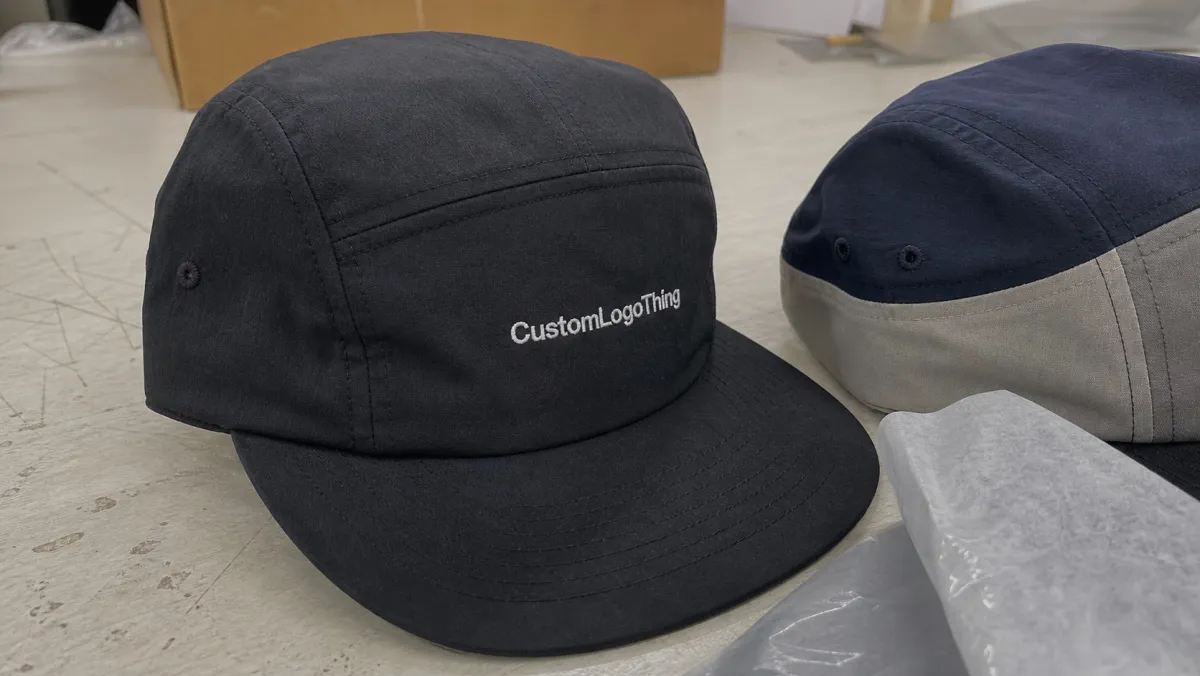
There is a practical reason these caps stay popular: they fit the way runners actually use gear. A race shirt may be tied to one event. A cap can move across seasons and settings, from packet pickup to easy miles to brunch after the finish.
The shape also helps branding. One uninterrupted front panel gives a club name or sponsor mark a cleaner canvas, with less competition from seams. That usually improves legibility for wordmarks, initials, and small event logos.
Five-panel caps sit in a useful middle ground style-wise. They feel more athletic than a fashion cap, but less technical than a visor. That makes them suitable for members, volunteers, and supporters, which is why they often work well as both giveaway items and resale merchandise.
They are also light and easy to pack. If caps are part of a race kit, membership bundle, or broader branded package, that smaller footprint can make shipping and handout setup easier without adding much cost.
The format can reduce SKU sprawl too. Instead of splitting into several styles for athletes, casual supporters, and volunteers, one cap often covers all three groups. Fewer versions usually means cleaner artwork and fewer leftover units after the event.
In recent club merch reviews I have handled, the caps that reordered fastest were not the flashiest ones. They were lightweight, easy to adjust, and simple enough for members to wear outside official club events. That is the clearest sign that a buyer made the right call.
How the production process and turnaround usually work
The production path is usually straightforward: quote, artwork review, digital proof, approval, production, packing, and shipping. For decorated caps, the proof stage is the main gate. If approvals stall, the schedule slips even when the supplier is otherwise moving quickly.
Lead time depends most on stock availability, decoration method, and order size. A blank cap in a standard color moves faster than a custom-dyed body. Embroidery adds digitizing and stitch review. Woven patches may need their own sampling or setup. Screen print or heat transfer can be quick for simple marks, but not every logo is a good fit.
Rush orders cost more because they compress the proof window and the production window at the same time. Shipping speed matters, but transit is only one part of the timeline. A supplier that promises overnight freight but takes several days to approve a proof can still miss race day.
In 2026, standard production for decorated caps often lands in the 10 to 18 business day range after proof approval. Larger runs, mixed colorways, custom labels, or more complex artwork can push beyond that. Add transit and the total often reaches 3 to 5 weeks from first quote to delivery.
If you need to order custom five panel caps for running club merch before a spring race or marathon weekend, start the quote process at least six weeks before handout day. That gives the club enough room for artwork edits, sponsor approval, shipping, and a small receiving buffer.
Packaging should be confirmed before approval if you want folded pack-outs, insert cards, or branded cartons. If paper components matter to your club’s sustainability standards, ask whether the supplier can specify FSC-certified materials from FSC. If the caps are being shipped through a fulfillment workflow, carton strength and handling expectations should also be checked against common transit-testing practices from ISTA.
2026 cost, pricing, MOQ, and unit cost
Pricing is where many clubs get tripped up. The headline unit cost only helps if it reflects the same cap body, decoration method, quantity, and freight terms. For teams trying to order custom five panel caps for running club merch, a small run with embroidery can land in a very different range from a larger order with woven patches or a simpler print.
Unit cost usually falls as quantity rises because setup fees spread across more pieces. Minimum order quantity can determine whether the project works at all. A 24-piece order may be fine for a small club or committee gift, but the per-unit cost will be much higher than a 100-piece or 300-piece order.
| Order size | Typical decoration | 2026 estimated unit range | What usually drives the price |
|---|---|---|---|
| 24-49 pcs | One-color embroidery or small patch | $9.25-$15.50 | Setup fees carry more weight at this volume |
| 50-149 pcs | Embroidery, woven patch, or simple print | $7.25-$11.75 | Often the best balance of MOQ and unit cost for clubs |
| 150-499 pcs | Patch or embroidery with more detail | $5.85-$9.25 | Better spread on setup, freight, and handling |
| 500+ pcs | More custom finishes or mixed pack-outs | $4.60-$8.10 | Lowest per-unit cost, but planning matters more |
These are working ranges, not promises. Fabric grade, logo complexity, stock color, and packaging all move the number. Premium presentation, custom printed boxes, hang tags, or header cards will raise cost. A straightforward stock-color cap with a simple logo keeps the budget more manageable.
Think in cost per use, not only cost per unit. A cap that gets worn twenty times is a stronger purchase than a cheaper one that looks tired after a few washes or loses its shape in a bag.
For clubs planning to resell caps, the safest pricing model is usually landed cost plus a clear margin for payment fees, event staffing, and leftover inventory. Many clubs price a cap in the $20-$32 range in 2026, depending on fabric, decoration, and local audience. If you order custom five panel caps for running club merch as a fundraiser, build the margin before you approve the final quantity.
Fit, fabric, and decoration specs that matter
The spec sheet is where “good enough” turns into “worth buying.” Start with the crown. Five-panel caps usually sit lower and cleaner on the head than bulky casual caps, which gives them a lighter athletic feel. Brim shape changes the look too: a flat brim creates a sharper front for logos, while a slight curve feels more familiar to some runners.
Closure choice matters as well. Snapback, strap, buckle, and elastic cord closures each affect fit, adjustability, and the final look. If your club has a broad member base, adjustability is usually more important than a fashion-driven profile.
Fabric should follow climate and use. Cotton twill in the 220-280 gsm range feels substantial and familiar. Polyester and performance blends are lighter, dry faster, and handle sweat better in warm weather. For summer training or race-day handouts, a lighter blend usually makes more sense. For a casual everyday piece, cotton often feels better in hand.
Decoration method changes both the look and the wear life. Embroidery is durable and familiar, but very detailed art can lose clarity if the stitch count gets too high. Woven patches handle small text better and produce a crisp, flat front panel. Printed graphics work well for limited runs or bold artwork, though the finish may age differently depending on the fabric.
| Decoration method | Look | Durability | Best use case |
|---|---|---|---|
| Embroidery | Classic, textured, premium | Very strong for everyday wear | Simple logos, club initials, sponsor marks |
| Woven patch | Clean, detailed, flat | Strong if stitched well | Fine text, multi-element artwork |
| Printed patch | Bright, flexible, more graphic | Moderate, depends on materials | Bold event art, limited-run merch |
| Direct print | Light, minimal, modern | Varies by fabric and wash use | Simple marks on performance fabrics |
The small details matter more than many buyers expect. Sweatband style affects comfort during long events. Ventilation eyelets can help with breathability. A firmer front panel keeps the logo from collapsing in photos. The best caps are the ones that feel like running gear first and souvenir second.
New options clubs are asking for in 2026
One clear 2026 trend is the move toward performance fabric without making the cap look overly technical. Lightweight recycled polyester, nylon ripstop, quick-dry sweatbands, and laser-cut side ventilation are showing up more often in running club orders. These options can cost more than basic cotton, but they make sense for clubs in humid climates or for events with long volunteer shifts.
Color choices are also shifting. Black and navy still sell, but more clubs are adding high-visibility colors, muted earth tones, and contrast rope details so the cap feels like a limited merch drop rather than a standard giveaway. If you order custom five panel caps for running club merch in more than one color, keep the logo treatment consistent so reorders stay easy.
Personalization is another useful option, especially for anniversary runs, charity teams, and coach gifts. Small side embroidery, inside taping, woven labels, or a custom sweatband message can make the cap feel special without crowding the front panel. These details work best when the main logo stays simple.
Clubs that care about presentation are also pairing caps with practical inserts, race cards, or custom packaging products. For a deeper look at how the cap itself can be used across campaigns, see this guide to custom five panel caps for giveaways. The same planning logic applies: clear artwork, useful packaging, and a delivery date that leaves room for inspection.
Step-by-step ordering plan for club buyers
A clean ordering plan keeps the project from turning into a committee puzzle. Start by defining the audience. Are these caps for members, volunteers, race staff, retail buyers, or sponsors? That answer changes the quantity, the price target, and sometimes the decoration method.
Next, lock the budget and deadline before requesting quotes. Suppliers can price more accurately when they know the ceiling and the date. Then gather the artwork files: vector logo if available, brand colors, sponsor rules, and any approved lockups. A low-resolution JPEG usually means extra back-and-forth.
- Define the use case - member wear, supporter merch, volunteer gear, or event giveaway.
- Set the quantity - use confirmed demand plus a buffer for replacements or late signups.
- Choose the cap spec - fabric, crown height, closure, and whether the front panel should be structured.
- Select decoration - embroidery, woven patch, printed patch, or direct print.
- Assemble the artwork - logo files, color references, and sponsor approvals.
- Approve the proof - confirm placement, size, spelling, color treatment, and stitch or print detail before production starts.
- Confirm pack-out - polybags, inserts, bundle counts, and delivery address.
- Set the sign-off date - one internal deadline so the order does not drift.
That last step saves more time than it seems. Clubs often have two or three people who want to review a proof, which is fine until nobody knows who has final authority. Pick one decision-maker and the order usually moves faster.
If you order custom five panel caps for running club merch as part of a larger launch, align the cap proof with the shirt, bib, sticker, and sponsor artwork before any item goes into production. Small differences in logo color or sponsor placement become more obvious once every item is displayed together.
Common mistakes that raise cost or slow delivery
Most delays are self-inflicted. The first mistake is overcomplicated artwork. Very thin lines, tiny text, and too many colors can force a more expensive decoration method or make the logo unreadable on a small front panel.
The second mistake is vague approval chains. “We need to check with the committee” sounds harmless, but it can add days. The third is choosing the wrong fabric for the weather. A heavier cap may look premium, but if it traps heat during summer training, members stop reaching for it.
Another common miss is forgetting the operational details: exact delivery address, whether the order needs split shipping, and how many spares are needed. If the caps are going to multiple race sites or a volunteer lead’s home, confirm that before production begins. Also ask whether the supplier ships in master cartons or individual units.
Finally, do not judge a supplier only by the base cap price. Compare setup fees, proof rounds, freight, and pack-out costs side by side. A quote that looks cheaper by 40 cents per unit can become the most expensive once shipping and rework are added.
A better quote is not the lowest quote. It is the one that tells you exactly what arrives, when it arrives, and how it is packed.
Next steps: build a shortlist and request quotes
The fastest way to move from idea to order is to write a one-page brief. Include quantity, deadline, target unit cost, cap color preference, decoration method, and the artwork files you already have. If you also note whether the caps are for resale, member distribution, or race-day giveaways, suppliers can point you toward a better spec.
Then request two or three comparable quotes. Ask each vendor to list MOQ, lead time, setup charges, proof rounds, freight, and packaging. Use the same spec with each supplier so the numbers mean something. A quote for a cotton cap with embroidery is not directly comparable to a quote for a performance blend with a woven patch and custom header card, even if the headline price is close.
It also helps to look for suppliers that regularly handle club, event, or athletic work. They are more likely to understand fast approvals, sponsor constraints, photo-friendly decoration, and delivery tied to an event date.
Finally, decide where the cap fits in the merch mix. Is it a core item that should stay available all season, a seasonal drop, or a limited run tied to one race? That decision affects quantity, inventory planning, and packaging style.
If you plan to order custom five panel caps for running club merch every year, keep the final spec, artwork proof, invoice, and reorder notes in one shared folder. That simple habit makes the next order faster and helps the club avoid paying to solve the same questions again.
FAQ
What makes five-panel caps a good fit for running club merchandise?
The front panel gives logos a cleaner canvas than many casual cap styles, so branding reads better in photos and at a glance. The shape feels light and sporty, which suits runners and supporters alike.
How many custom five panel caps should a running club order?
Start with confirmed demand, then add a buffer for late signups, replacements, or a few extra sales. Quantity should be tied to budget and MOQ, not just the lowest headline unit price.
What affects turnaround on custom five panel caps for running clubs?
Decoration method, stock availability, and artwork approval usually matter most. Fast proof approval often shortens the schedule more than changing shipping speed.
Which decoration method lasts longest on running club caps?
Embroidery and woven patches are usually the strongest choices for everyday wear. Pick the method that matches your logo detail, fabric weight, and desired finish.
How should we compare quotes for custom five panel caps merch?
Compare total landed cost, not just the base cap price. Check MOQ, setup fees, proof rounds, freight, and packaging side by side.
What is the best first step if we need to order custom five panel caps for running club merch?
Start with a short brief that lists quantity, deadline, target price, artwork, cap color, and decoration preference. Suppliers can give cleaner quotes when those details are settled early.
If the specs stay tight, approvals stay clear, and packaging stays practical, these caps are usually straightforward to order, wear, and reorder.

