Buyer Fit Snapshot
| Best fit | Order Custom Poly Mailers projects where brand print, material claims, artwork control, MOQ, and repeat-order consistency need to be specified before quoting. |
|---|---|
| Quote inputs | Share finished size, material target, print colors, finish, packing count, annual reorder estimate, ship-to region, and any compliance wording. |
| Proofing check | Approve dieline scale, logo placement, barcode or warning zones, color tolerance, closure strength, and carton packing before bulk production. |
| Main risk | Vague material claims, crowded artwork, missing packing details, or unclear freight terms can make a low unit price expensive after revisions. |
Fast answer: Order Custom Poly Mailers: Specs, Pricing, and Process should be specified like a repeatable production item. The safest quote records material, print method, finish, artwork proof, packing count, and reorder notes in one written spec.
Production checks before approval
Compare the actual filled-product size with the drawing, then confirm tolerance on folds, seals, hang holes, label areas, and retail display edges. Reserve space for logos, QR codes, warning copy, and material claims before decorative graphics fill the panel.
Quote comparison points
Review material grade, print process, finish, sampling route, tooling charges, carton quantity, and freight assumptions side by side. A quote is only useful when the supplier can repeat the same color, closure quality, and packing count on the next order.
If you order Custom Poly Mailers, you are not just buying a bag and calling it a win. You are choosing the first physical brand touchpoint most customers actually handle. For apparel, accessories, and other soft goods, that outer pack often does more visible work than the product carton ever will. Get the size right. Get the film right. Get the print right. When you order custom poly mailers with those basics locked down, waste drops, fulfillment gets cleaner, and your branded packaging looks sharper the second it leaves the building.
Packaging is not background noise anymore. A plain mailer can disappear in transit. A planned one keeps reinforcing package branding every time it hits a sorter, a carrier hub, a porch, or a mailbox. If you order Custom Poly Mailers for lightweight items, the logic is simple: less empty space, fewer fillers, faster pack-out, and less drama than stuffing a rigid carton around something that never needed one.
People comparing product packaging formats usually ask the wrong question first. They ask whether the mailer looks nice. Cute. The real question is whether it fits the item, the shipping method, and the budget. Buyers who order Custom Poly Mailers carefully tend to ask better questions before they sign anything: What size fits the folded garment? How thick should the film be? How many colors do we actually need? What does freight do to the landed cost? Those are the decisions that move the final result.
Why order custom poly mailers for shipping that stands out
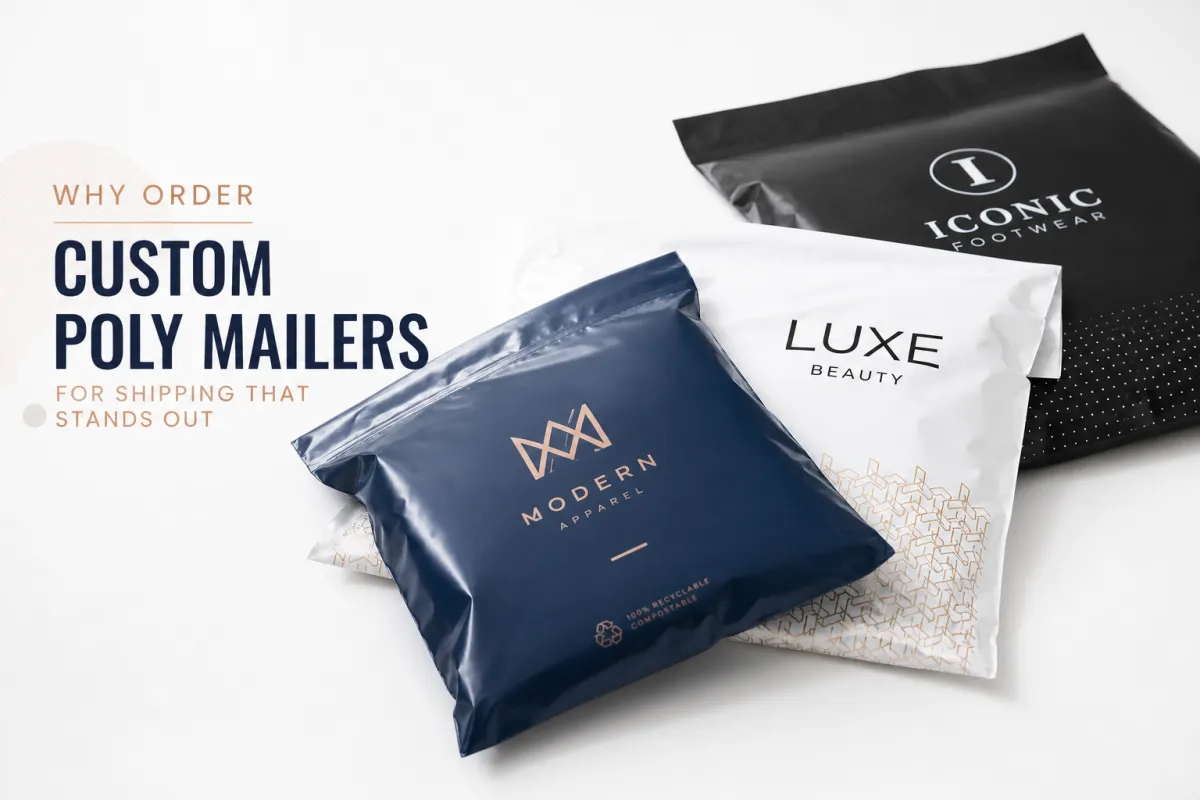
For a lot of apparel and soft-goods brands, the mailer is the first physical touchpoint, not the product itself. People miss that part because the product gets the spotlight. If you order Custom Poly Mailers, the outer pack becomes the opening line of the customer experience before a box, tissue wrap, or insert card ever shows up. From a packaging buyer's point of view, that is useful, not decorative. The pack has to move fast, stay light, and still carry the brand without falling apart like a bad idea.
There is a real operational win here too. Lightweight items usually ship better in a flexible mailer than in a rigid carton. A well-sized mailer cuts dead space, keeps packing stations moving, and can reduce dimensional weight exposure on parcels that do not need crush protection. I have seen teams swap tees and socks from boxes into mailers and immediately clean up the line. Nothing glamorous. Just fewer motions and fewer mistakes. Small blessing. Real savings.
Brand visibility is the other half of the equation. A printed mailer turns every shipment into a moving ad unit, but that phrase undersells the point. The customer may post it, keep it, reuse it, or ignore it. The brand still gets recognition in transit. When orders move through multiple hands, a plain package blends in. A custom one does not. That is why businesses that order custom poly mailers often treat them as part of packaging design, not a side purchase they approve after a sleepy lunch meeting.
It helps to compare the mailer against other formats. Custom printed boxes make sense for fragile, premium, or multi-item orders. For a single garment, a book, a flat insert, or an accessory set, a mailer can be the better fit. It uses less material, needs less storage space, and usually keeps the retail packaging workflow simpler. That is not universal. It is just true often enough to matter.
Practical rule: if the item does not need a rigid shell, test whether you should order custom poly mailers instead of defaulting to cartons. The right format is the one that protects the product, fits the process, and avoids paying for plastic you never needed.
Customer perception matters too. A well-sized printed mailer looks deliberate. A bag that is too large or flimsy looks like somebody gave up halfway through packing. That difference is tiny on paper and obvious in real fulfillment. Brands that order custom poly mailers with a clean print layout usually get a more polished result than brands chasing only the lowest unit price. You can save a little on paper and lose the whole presentation. Not a great trade.
For a current product overview, see the Custom Poly Mailers page and compare it with other Custom Packaging Products if your program includes inserts, labels, or secondary packs.
Custom poly mailer product details to review before you buy
The build is simple. The choices are not. A standard poly mailer is usually made from polyethylene film with a self-seal adhesive strip. Many buyers also want a tamper-evident closure so the package cannot be opened and resealed without showing it. If you order custom poly mailers, that closure detail matters more than people expect because it affects pack speed, perceived security, and how ugly a return looks when it shows up damaged.
Start with the film. Polyethylene mailers are light, flexible, and resistant to moisture. That makes them a strong fit for apparel, accessories, printed materials, and other non-fragile goods. They are not a substitute for rigid protection, but they do a solid job when the product can handle a little flex. Teams that order custom poly mailers for soft goods usually care most about puncture resistance, surface finish, and how neatly the bag folds around the item. If the bag feels cheap in hand, customers notice. Fast.
Then look at customization. You can usually specify size, thickness, print coverage, color, finish, and where the branding sits on the bag. Some programs need a simple one-color logo. Others need full-coverage print with a louder visual field. Either can work. The right choice depends on the role the mailer plays in the broader product packaging system. If the mailer is the only visible brand surface, a cleaner and larger print area usually earns its keep. If it sits inside a layered unboxing sequence, a simpler design can do the job and keep the file cleaner too.
Size deserves more attention than most buyers give it. A mailer that is too small makes the product bow or bunch. A mailer that is too large leaves air, wrinkles, and a sloppy fit in transit. Brands that order custom poly mailers for multiple SKUs should consider a size family instead of one dimension for everything. That keeps warehouse logic easier and prevents one bag from being forced into a job it never wanted.
The easiest way to think about the product is to break the variables apart:
- Film controls durability, stretch, and feel.
- Closure controls speed, security, and reopen resistance.
- Size controls pack fit and postage efficiency.
- Print controls brand visibility and color impact.
- Finish controls gloss, texture, and perceived quality.
If you order custom poly mailers for flat products such as catalogs, folded apparel, or promo kits, you may not need a heavy-gauge film. If the bag has to carry awkward seams, zippers, or sharper edges, move the spec up. The packaging buyer mindset here is boring in the best way: match the mailer to the item, not to the cheapest line on the quote.
For buyers comparing formats across the line, it can help to look at Wholesale Programs alongside direct custom runs. A wholesale stock option may fit a short-term need. A custom run makes more sense once volume stops wobbling around.
Specifications that affect protection, print quality, and shipping costs
Film thickness is one of the first specs to review, and it is usually measured in mils. As thickness goes up, puncture resistance and perceived quality usually improve. So does weight. That tradeoff matters. If you order custom poly mailers in a thin gauge just to shave pennies, the bag may feel cheap and perform badly around seams or product corners. Go too thick, and you spend more than needed while adding material the item never asked for.
For many brands, 2.5 mil to 3 mil is a common working range for everyday apparel shipments. Heavier or higher-risk applications may move toward 3.5 mil or 4 mil. That is not a rule. It is a starting point. A buyer who wants to order custom poly mailers for a folded hoodie, a premium knit, or a product with sharper accessory edges may decide the higher film cost is cheaper than a damaged shipment or a return nobody wants to process.
Dimensions should be chosen around the packed product, not the flat spec alone. A shirt folded with a belly band, insert card, and sticker needs more room than the shirt dimension suggests. A bundle with a hang tag, folded tissue, or thank-you card adds depth too. When teams order custom poly mailers without accounting for the full pack-out, they end up with overfilled seams, stressed adhesive strips, and wrinkled presentation. That problem is optional. Fixable. Usually caused by somebody eyeballing it.
Postage belongs in the spec conversation too. Flexible packaging can still change the shipping class if the final parcel gets too bulky. The goal is not just to reduce material. It is to keep the shipped package inside the most efficient practical size. Buyers sometimes obsess over unit cost and forget the cost living inside fulfillment labor and postage. A bag that fits correctly usually saves more than a cheaper bag that fits badly. That is especially true when you order custom poly mailers in volume and the mistake repeats thousands of times.
Print quality has real business impact. Single-color artwork is simpler and can produce a very clean result, especially when the logo and brand marks are strong. Multi-color art adds more visual range, but it also adds setup complexity and a longer approval path. If you order custom poly mailers with edge bleed or full-wrap coverage, the artwork needs enough margin so critical elements do not clip near the seam or seal area.
Proof approval is where many projects either stay on schedule or slide sideways. Do not treat the proof like a courtesy image. It is the point where size, print placement, color hierarchy, and margins are checked before production starts. A good proof should make it easy to confirm placement and catch issues such as logo scale, barcode readability, or the distance from the edge. If you order custom poly mailers without reviewing the proof carefully, small mistakes can turn into a full reprint. Annoying. Expensive. Preventable.
For transit performance, some buyers compare package testing standards such as those described by ISTA. That is especially useful if the mailer is part of a broader shipping validation program. If your packaging strategy includes recycling guidance for customers, the EPA recycling resources are a practical reference for communicating local disposal realities without promising magic that does not exist.
| Mailer spec | Best use case | Typical thickness | Approx. budget at 5,000 units | Notes |
|---|---|---|---|---|
| Basic printed mailer | Light apparel, accessories, printed inserts | 2.5 mil | $0.18-$0.28 per unit | Good for straightforward branding and low-risk contents |
| Midweight branded mailer | Everyday DTC shipments, folded garments, mixed flat goods | 3 mil | $0.22-$0.34 per unit | Often the best balance of feel, protection, and price |
| Heavy-duty custom mailer | Bulkier textiles, items with edges, higher return exposure | 3.5-4 mil | $0.28-$0.42 per unit | Costs more, but can reduce puncture and handling complaints |
| Full-coverage multi-color mailer | High-visibility launch packs and strong package branding | 3 mil or above | $0.30-$0.50 per unit | Print complexity and setup usually move the price up fastest |
Those numbers are planning ranges, not a promise. Freight, print coverage, color count, order quantity, and finishing details can move the quote either way. Still, the table gives a better decision frame than guessing. If you order custom poly mailers from a quote that ignores setup, freight, or proofing, the real cost comparison is incomplete. That is how bad buying decisions happen: the headline number looks friendly, the landed price does not.
There is one more detail worth tracking: the shape of the artwork. A strong logo lockup can look better than a crowded design trying to do seven things at once. Buyers who treat packaging design like a billboard often forget that the package is moving, folding, and getting handled under bad lighting. If you order custom poly mailers with a clean logo field, a readable URL, and a disciplined color plan, the finished bag usually looks better in real life than a busier concept that only looked good on a screen.
Pricing and MOQ when you order custom poly mailers
Price is never just price. It is a mix of size, thickness, print colors, print sides, artwork complexity, and total quantity. If you order custom poly mailers, the cheapest quote may hide a smaller print area, thinner film, or a freight line you did not notice until the invoice showed up. Compare specs side by side. Not just the number at the bottom of the page.
The biggest cost driver is usually order quantity. Larger runs typically reduce unit cost because setup is spread across more pieces. Smaller runs help with launches, regional tests, and seasonal campaigns, but they can push unit pricing higher. That tradeoff is normal. If you order custom poly mailers for a new brand or a short test window, a smaller MOQ may be worth the premium. If the design is locked and volume is steady, a larger run usually makes more sense.
MOQ exists for a reason. Printing, cutting, film setup, and inspection all carry a base cost. A supplier cannot absorb that forever on a tiny order. The important part is understanding how the MOQ is structured. Sometimes it applies per size. Sometimes per design. Sometimes per colorway. If you order custom poly mailers without clarifying that point, you can get a quote that looks workable but does not actually fit the buying plan.
Here is a practical way to think about the cost stack:
- Setup charges cover plates, tooling, or prepress work.
- Unit pricing reflects the bag itself, the print method, and the run size.
- Proof costs may be included or billed separately.
- Freight changes with weight, carton count, and destination.
- Rush fees appear when the schedule needs to move faster than standard production.
For a buyer comparing options, a quote that includes everything is much more useful than one that hides freight or setup in the weeds. I would rather see a realistic landed cost than a cute teaser number. If you order custom poly mailers for recurring shipments, that landed cost is what affects margin, not the first sticker price.
The examples below are directional, but they help set expectations. A small, simple print run usually sits in the lower range. A full-color, two-sided, larger-gauge order rises. If you order custom poly mailers with stronger film, more print coverage, and a tighter schedule, expect the quote to reflect all three. That is normal. Not a penalty. Just how production works.
It also helps to compare the mailer program against other packaging spend. Brands that already invest in custom printed boxes or premium inserts sometimes overspend on the mailer because they treat it as secondary. From a package branding standpoint, that is a mistake. If the mailer carries the customer from shipping label to doorstep, it is part of the primary experience and deserves an actual budget line.
One buying pattern shows up all the time: a company starts with a low MOQ, validates the size, then moves to a larger run once the pack-out is stable. That can be smart. The catch is consistency. If you order custom poly mailers in one size for a launch and then change dimensions later, you may save a few cents on the quote and create a mess in the warehouse. Sometimes the better move is to pick a size that works across more than one SKU and keep the process sane.
For companies with multiple brands or channel partners, it may also help to review FAQ guidance and ask whether the same mailer spec can support future campaigns. A slightly larger MOQ today can create better continuity tomorrow.
Order custom poly mailers: the process and timeline
The best orders move in a straight line. First, you request a spec recommendation. Then you submit artwork. Then you review a proof. Then you approve production. Then the bags are made, checked, packed, and shipped. Basic stuff. Still, a surprising number of delays happen because one step gets rushed or skipped. If you order custom poly mailers with a clean workflow, the project stays on track without guesswork or panic emails at 7 p.m.
Start with the information the supplier actually needs: finished product dimensions, estimated monthly volume, desired print coverage, target ship date, and any special handling concerns. If you order custom poly mailers for multiple SKUs, send the size spread instead of the single hero item only. That helps the quote reflect the real use case instead of a narrow one that falls apart the second a second product gets added.
Artwork is usually the next bottleneck. Clean vector files are easier to work with than low-resolution images. If the logo includes a lot of fine detail, ask how it will reproduce at the chosen bag size. A design that looks sharp on screen may blur in print if the line weight is too thin. Buyers who order custom poly mailers and send incomplete files often add days to the schedule because the proof cannot be finalized until the artwork is fixed. That delay is not mysterious. It is self-inflicted.
Here is the typical sequence many procurement teams follow:
- Request a quote with size, quantity, and print needs.
- Submit artwork in the required format.
- Review the digital proof or prepress sample.
- Approve color placement, margins, and text.
- Move into production after sign-off.
- Complete quality check and ship.
Timing usually breaks into three parts: proofing, manufacturing, and transit. Proofing can be fast if files are clean. Production often takes around 12-15 business days after proof approval for many standard custom runs, though that can shift with seasonality and complexity. Freight then adds its own window, which may be a few days domestically and longer if the destination is farther away. If you order custom poly mailers and need them for a launch, build in a buffer. Do not plan the release date as if the truck arrives the second production ends.
The most common delay points are easy to spot in hindsight. Missing artwork files. A late size change. Unclear print instructions. A color approval that takes too long to get signed. An unexpected request for a second proof because the original spec changed. If you order custom poly mailers with those risks in mind, you can usually stop them with one early checklist and one person who owns the decision.
Quality control matters too. A good check should confirm print alignment, closure integrity, film consistency, and basic count accuracy. For more sensitive freight programs, some buyers also ask how the bag performs against transit stress expectations similar to ISTA-style package testing. That is not necessary for every mailer order, but it is a smart question when the contents are high value or the route is rough.
Once the bags arrive, inspect a master carton before the full release. Look at the print sharpness, the adhesive, the bag seal, and the actual fit with the product. I recommend a quick pack-out test using the real item, not a placeholder. If you order custom poly mailers based only on a flat drawing and never test the folded product, you are leaving too much to luck.
Most buyers who order custom poly mailers for the first time are relieved by how simple the process can be if the supplier is clear. The key is discipline: accurate specs, complete files, and timely approval. That is how a transactional purchase stays transactional instead of turning into a long cleanup project.
Why choose us when you order custom poly mailers
Packaging buyers do not need hype. They need consistency. That is the standard any vendor should be judged by, especially if you order custom poly mailers for a brand that ships every week. A good partner should reduce uncertainty, not create more of it. The useful questions are simple: Does the print reproduce consistently? Are the specs clear? Does the proof match the final product? Do the timelines hold?
What separates a practical supplier from a mediocre one is often the ability to recommend the right spec instead of forcing the most expensive one. Not every customer needs the thickest film or the loudest print. Sometimes a midweight bag with disciplined branding is the smarter move. If you order custom poly mailers from a team that understands packaging design, they should be able to tell you when a 3 mil bag is enough and when a heavier version will save you trouble later.
That kind of guidance matters because packaging is a system, not a single SKU. The mailer sits beside labels, inserts, tissue, and sometimes retail packaging or product packaging components that travel together. If the outer pack feels mismatched to the rest of the program, the whole presentation suffers. Strong package branding comes from alignment across the pieces, not from one loud print decision trying to do all the work.
Service also matters in a purchase that is usually time-sensitive. Fast quoting helps. Clear proofing helps. Direct communication helps. If you order custom poly mailers and need to hit a launch window, you want a supplier that answers straight, explains the tradeoffs, and does not hide key assumptions inside vague language. That matters even more when freight, MOQ, or print coverage change from one quote to the next.
We also make it easier to compare options across your packaging mix. Some customers pair poly mailers with inserts or branded cartons. Others need a cleaner wholesale path for larger programs. If you are planning broader sourcing, it can help to review Custom Packaging Products and Wholesale Programs together so your order structure matches the way you actually ship.
There is a trust signal that matters more than polished sales language: accuracy after approval. Once you sign off on the proof, the finished bag should match it closely in print placement, size, and overall feel. That is where a dependable provider earns repeat business. If you order custom poly mailers from a partner that respects that standard, you spend less time chasing exceptions and more time shipping product.
To be direct, the right supplier should make the process easier without flattening your choices. You should still be able to specify size, film thickness, number of print colors, and target quantity. You should not have to decode the quote yourself or guess at the implications of each option. That is the practical value of experienced support when you order custom poly mailers.
Next steps to place your order with confidence
If you are ready to order custom poly mailers, start with the basics and the rest gets easier. Measure the packed product, not just the product itself. Gather your logo files. Estimate monthly usage. Decide whether you need one size or several. Then ask for a quote that spells out film thickness, print coverage, MOQ, freight terms, and proofing steps in writing.
It also helps to be honest about the use case. If the bag is for a single tee, the spec should be different than if it is for a heavier bundle or an item with a sharper edge. If you order custom poly mailers for more than one SKU, ask for a size range recommendation instead of forcing one bag to fit every shipment. That small bit of planning usually prevents packing problems later.
Before you approve anything, confirm the details one more time: closure type, dimensions, thickness, print sides, color count, and quantity. Review the proof at actual size if possible. Then check the expected lead time against your launch calendar. When you order custom poly mailers with the spec locked, the timing becomes much easier to manage.
There is no mystery here. The best order is the one that fits the product, supports the brand, and respects the budget. If you order custom poly mailers with those three goals in mind, you are far less likely to overbuy, under-spec, or miss your ship date. Compare the options, approve the proof, and place the order once the packaging actually matches what you need.
How do I order custom poly mailers for my product size?
Measure the product after folding or after packaging inserts are added, not just the flat item size. Choose a mailer with enough room for a clean seal without wasting space. If you order custom poly mailers for more than one SKU, ask for a recommended size range so the bag works across your actual pack-out, not just one sample. A quick pack test with the real item saves a lot of back-and-forth later.
What is the usual MOQ when I order custom poly mailers?
MOQ varies by size, print complexity, and whether the bags are stock or fully custom. Larger runs generally lower the unit price, while smaller runs are better for trials and seasonal campaigns. Confirm whether the MOQ applies per design, per size, or per colorway before you order custom poly mailers. That one detail can change the quote more than people expect.
How long does it take to get custom poly mailers after I place an order?
Timeline depends on proof approval speed, production schedule, and shipping method. Artwork revisions usually add the most delay, so send clean files early. Ask for a timeline that separates proofing, production, and freight if you plan to order custom poly mailers for a launch or promotion. Standard runs often sit around 12-15 business days after approval, but seasonality and complexity can stretch that.
Can I order custom poly mailers with full-color printing?
Yes, many mailers can support multi-color branding, but print complexity affects price and lead time. Artwork should be prepared at the correct size and resolution for the chosen print method. Request a proof to verify color placement before production starts, especially if you order custom poly mailers with edge-to-edge graphics. Full coverage can look great, but only if the layout respects the seams and seal area.
What should I confirm before I finalize my custom poly mailer order?
Confirm size, thickness, closure type, print sides, and total quantity. Review freight charges, proof approvals, and reprint policies before paying. Make sure the spec sheet matches the exact item you plan to ship before you order custom poly mailers, because the smallest mismatch tends to show up in fulfillment. If possible, inspect one master carton and test a real pack-out before the full release.
If you want a packaging format that is light, efficient, and clearly branded, it makes sense to order custom poly mailers with the real shipment in mind rather than the prettiest mockup. Measure the packed item, pick the smallest size that still seals cleanly, and approve the proof only after a real pack-out test. That is the move that keeps the order practical, and it is usually the difference between Packaging That Works and packaging that just looked good on a screen.

