Personalized champagne labels can change the way a bottle reads before anyone even lifts it. The liquid stays the same. The bottle stops looking generic, and that shift is usually what people are paying for.
That matters for weddings, corporate gifts, hotel suites, restaurant service, private-label releases, and any event where presentation has to do some of the selling. A stock bottle can feel perfectly fine in a warehouse or on a back bar. Put a well-made label on it, and the same bottle starts reading like a deliberate part of the occasion.
Why a standard bottle can still look generic
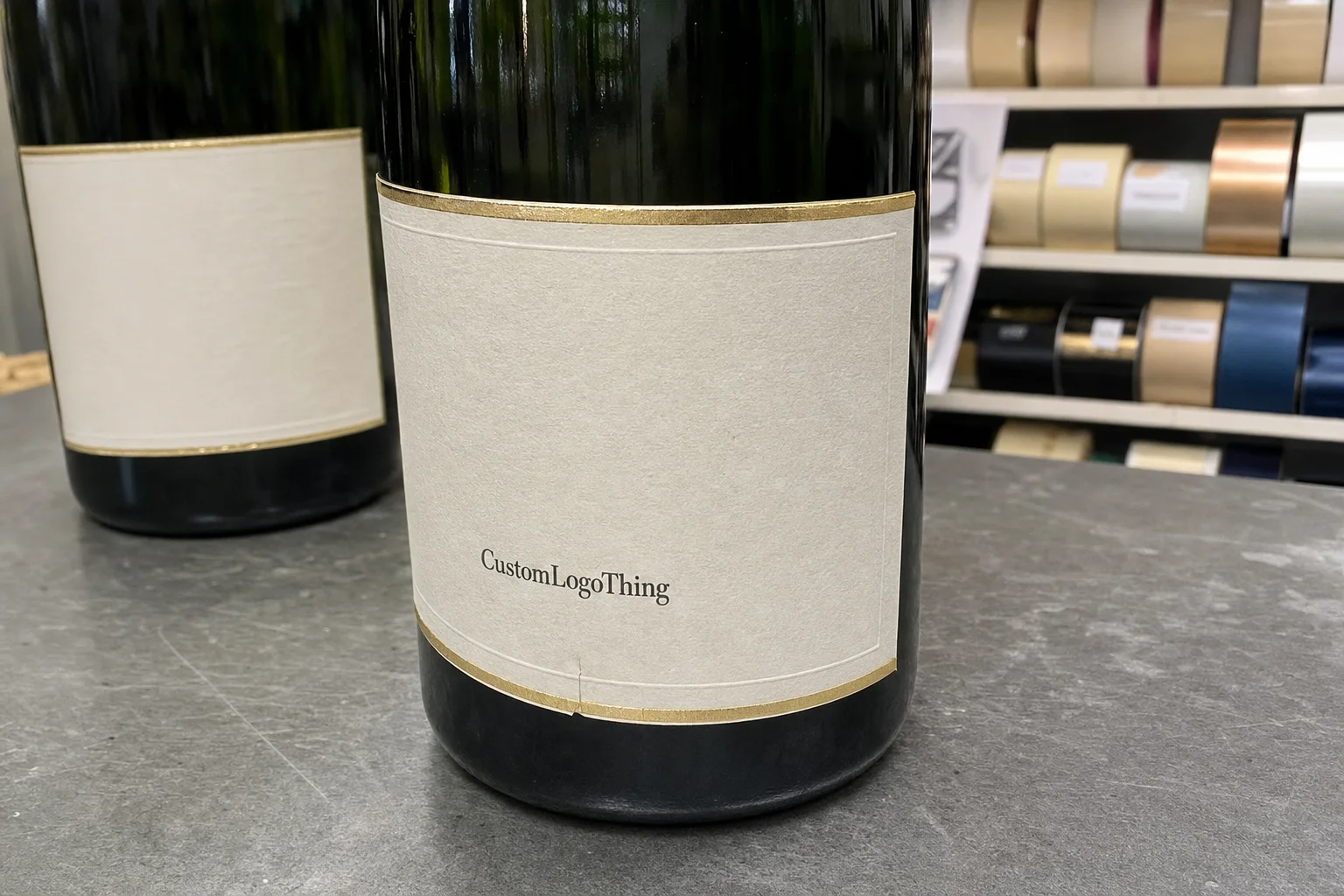
Most champagne bottles arrive with the same basic structure: a front label, a back label, and the legal copy that has to be there. That works for retail. It does not do much for a party favor, a branded pour, or a gift that needs to feel specific to the moment. Personalized champagne labels solve that gap without requiring a custom bottle shape, a molded glass run, or a long lead time.
The bottle surface has a lot to do with how good the final result looks. Clear glass exposes everything behind the label, which means weak art shows up fast. Green glass can swallow darker ink if the contrast is too low. Frosted bottles soften the look and can make a matte design drift toward invisible if the layout is too quiet. Under warm event lighting or bright retail lights, those small differences matter more than they do on a monitor.
There is also a perception issue people underestimate. A bottle with a personalized front panel tends to feel custom even if the base bottle is standard stock. That makes labels useful for wedding favors, holiday bottles, house pours, and branded gifts. They are a practical way to create a premium impression without paying for permanent decoration methods that make more sense only at larger scale.
A label is often the least expensive part of the bottle and the part that changes how people judge the whole thing.
Compared with sleeves, direct print, or engraving, labels are also easier to adjust. Sleeve decoration can be dramatic, but the setup is heavier. Direct print and engraving look permanent and clean, but they are usually better when the same bottle format will be used again and again. For smaller runs, seasonal orders, and event work, custom labels usually win on speed, flexibility, and price control.
If you are comparing formats, start with Custom Labels & Tags and match the decoration method to the bottle shape first. That choice tends to decide the rest of the project.
Production process and turnaround basics
Good label production follows a predictable path: artwork review, proofing, material selection, print, cutting, finishing, packing, and shipment. The order sounds straightforward because it is. The delays usually happen when one step is skipped or someone changes direction after approval.
Artwork is the most common bottleneck. Files with low resolution, missing bleed, tiny text near the edge, or logos that were pulled from a web image can slow the job before production even starts. The same thing happens when a buyer changes the wording after proof approval. That kind of reset is expensive in time, even when the order itself is small. Personalized champagne labels are simple to print, but they are unforgiving about late changes.
Typical timing depends on the order setup. A reorder with final art and a standard stock can move through production in roughly 5 to 7 business days. A first-time run usually lands closer to 7 to 12 business days once proofing is included. Rush service can shorten that window, but the tradeoff is obvious: less room for revision and more pressure on the schedule.
Shipping needs to be treated as its own step. A printer can finish a job on time and still miss the event if transit was not counted separately. That mistake is common because people mentally treat production and delivery as one timeline. They are not. If the bottle is needed on a fixed date, the countdown starts with the delivery deadline, not the press date.
The easiest things to speed up are final copy approval, sizing, and artwork cleanup. The hardest things to rush are specialty materials, Custom Die Cutting, and any finish that needs extra setup. Removing uncertainty saves more time than asking for a faster machine ever will.
Materials, adhesive, and finish choices that actually matter
Material choice affects how the label looks and whether it survives the way the bottle will actually be used. Matte paper is economical and clean-looking for dry display bottles or short-lived table use. Waterproof film is the safer option for cold service, cooler storage, ice buckets, and anything that may pick up condensation. If a bottle is going into chilled service, standard paper without the right construction is a weak choice.
Adhesive matters just as much. A label can print well and still fail if the glue is not built for cold glass or moisture. Condensation creates a thin barrier that weakens the bond, and the corners are usually the first place to lift. For champagne bottles, that means a label should be selected for the service environment, not just for the artwork. Dry application is always easier, but event bottles do not always stay dry.
Finish changes both readability and how expensive the bottle feels in hand. Matte gives a quieter look and usually reads well under mixed lighting. Gloss makes colors brighter and can help a design pop, though it can also create glare if the lighting is harsh. Soft-touch feels more upscale, but it is not ideal when the bottle will be handled repeatedly. Clear labels can look crisp on glass if the artwork is strong enough to stand up against the transparent background. Foil and metallic accents add impact, but too much shine can make the design feel crowded instead of considered.
For practical planning, the table below covers the most common tradeoffs.
| Material / Finish | Best Use | Typical Cost Impact | Watch Outs |
|---|---|---|---|
| Matte paper | Dry service, display bottles, short runs | Lowest | Not ideal for condensation or ice buckets |
| Waterproof film | Chilled bottles, events, cooler service | Moderate | Can feel too slick if the artwork is weak |
| Soft-touch laminate | Premium gifts, luxury branding | Moderate to high | Can show scuffs if handled roughly |
| Metallic or foil accents | Luxury cues, celebratory packaging | Higher | Too much shine can hurt legibility |
Bottle shape deserves as much attention as stock choice. A front panel that sits nicely on one bottle can buckle badly on another if the shoulder, seam, or curve changes. Narrow labels are usually easier to place than wide wraps. On a highly curved bottle, the best design is the one that stays readable even if the edge alignment is not perfect.
For buyers comparing label options across different bottle types, our custom labels and tags page is a practical place to check stock, finish, and adhesive combinations before any art is approved.
For sustainability-minded projects, ask whether FSC-certified stock is available where relevant. The Forest Stewardship Council explains certification standards at fsc.org. For broader packaging context, the Packaging Machinery Manufacturers Institute is a useful industry resource at packaging.org.
Pricing, MOQ, and unit cost drivers
Pricing for personalized champagne labels is shaped by quantity, size, stock, finish, and whether the label needs a custom cut. Color count matters less than it used to in digital print, but full coverage, specialty adhesive, and premium finishing still push the price up. The quote is usually a stack of small decisions, not one big one.
MOQ exists because setup work does not disappear when the order is small. A press still has to be prepared, a file still has to be checked, and material still has to be loaded. That means a 50-label job carries more cost per piece than a 5,000-label job. The curve drops quickly at first, then levels out once the setup cost has been spread across enough units. That is normal and useful to understand before the quote arrives.
For realistic budget planning, small custom runs may land around $0.60 to $1.50 per label depending on size and finish. Mid-size orders often move into the $0.20 to $0.50 range. Larger runs with simpler specs can fall below that. Those numbers are not universal, but they are close enough to keep expectations grounded.
There are also extras that do not show up in a mockup. Proof fees can apply on more complex jobs. Rush charges are common when the timeline gets compressed. Custom cutting, sheeted versus rolled delivery, and special packing for event handling can all affect the quote. None of that is unusual. It is just the cost of moving from a design file to a usable product.
The cleanest rule is simple: if the order needs premium finishing and the timeline is short, expect to pay for setup, speed, and handling, not just ink and paper. A rushed correction is almost always more expensive than a planned order that was set up correctly the first time.
Step-by-step ordering checklist for a clean fit
Start with the bottle. Measure the usable flat area, the available height before the shoulder begins, and any seam, emboss, or molded detail that affects placement. Do not assume the full circumference is usable. It rarely is. A Label That Fits on paper can still fail on glass if the bottle shape was ignored.
After the bottle dimensions are fixed, decide on placement. Front label only, front and back, or a full wrap each changes the layout and the application process. For most champagne bottles, a front-facing label is simpler and more reliable than a wide wrap that fights the curve of the bottle body.
Next, define the use case. Is the bottle for dry display, cold service, a wedding favor, retail promotion, or a corporate gift? That answer should drive the stock, adhesive, and finish choice. Personalized champagne labels are not one-size-fits-all, and the wrong material can make even a good design look careless once it meets condensation.
Before approval, check the proof against the obvious failure points.
- Spelling and punctuation
- Bleed and safe area
- Logo placement
- Foil or metallic alignment
- Barcode or compliance content, if needed
Application logistics matter more than most teams expect. Bottles and labels should be close to the same temperature if possible. If one is warm and the other is cold, condensation will make installation harder. Decide who is applying the labels, where the work will happen, and whether the bottles are being labeled before or after chilling. Those choices affect labor time, reject rate, and how consistent the finished bottles will look.
The short version is not glamorous: confirm measurements, confirm the proof, match the material to the service condition, and lock the delivery date before production starts. That is the part that keeps the order from turning into avoidable rework.
Common mistakes that make labels look cheap
The first mistake is weak artwork. Tiny copy, poor contrast, and crowded layouts all get worse on curved glass. A champagne bottle is not a poster, and the design should not try to behave like one. A strong focal point, enough white space, and readable type do more for perceived quality than packing every inch with decoration.
The second mistake is ignoring condensation. A label can look perfect on a desk and still fail after ten minutes in a cooler. Moisture, dust, and hurried placement lead to bubbles, lifting corners, and crooked panels. The print is only part of the result. The application is the part people actually see.
Size mistakes are common too. Labels that wrap too far around the bottle can buckle near the seam or shoulder. Labels set too high drift into the curve and distort. Labels placed too low can look off balance and under-scaled. Bottle geometry should drive the format, not the other way around.
Another easy way to cheapen the look is to stack too many finishes at once. Foil, gloss, emboss texture, and metallic ink all have a place. Put them together without restraint and the label starts to look busy instead of polished. A quieter design with one strong finish often looks more expensive than a noisy one with every effect turned on.
Skipping the proof is still the fastest route to a costly mistake. One misspelled name, one wrong date, one stretched logo, and the whole run becomes a reprint problem. The proof stage exists for a reason. It is not a formality, and it is not a place to speed past because the mockup looked fine on screen.
If a label needs too many effects to feel premium, the layout is probably doing too much.
For repeat orders, keep the approved spec locked in one place: same bottle, same stock, same finish, same adhesive, same size. Consistency saves time and keeps the visual result from drifting between reorders.
Expert tips for better shelf appeal and faster installs
Use one main point of attention. A name, logo, event title, or short line of copy is usually enough. Champagne labels are small relative to the attention they have to carry, so clarity matters more than volume. If the design can be read from arm’s length without effort, it is probably in the right place.
Keep small formats simple. Artwork that looks elegant on a monitor can collapse into clutter on a narrow label once it is printed at bottle scale. Strong contrast, a clear hierarchy, and a limited number of elements usually look more expensive than a more complex design. That is not a style opinion. It is how visual spacing behaves on curved glass.
For event installs, stage the bottles and labels at roughly the same temperature before application. That reduces condensation surprises and improves consistency from bottle to bottle. It also helps to batch by bottle type so the team is not switching between formats every few minutes. The first case usually takes the longest. The rest go faster when the workflow is stable.
Premium cues do not need to be overdone. Choose one or two and let the rest of the layout support them. Matte stock with foil text can look sharper than glossy stock with foil, clear film, and multiple decorative accents all competing for attention. Restraint tends to age better, too.
A practical preflight list keeps the job moving.
- Confirm bottle measurements
- Confirm label size and placement
- Approve the proof only after checking copy and alignment
- Match stock and adhesive to the service environment
- Verify quantity, delivery date, and application plan
That routine is plain, but it prevents most of the avoidable issues that show up after production has already started. Personalized champagne labels look easy until the bottles arrive and someone notices the panel is too tall by a couple of millimeters. A simple spec sheet catches that before the press does.
For brands that order labels more than once a year, keep the bottle measurements, finish notes, and approved artwork version together. It shortens reorder time and keeps the presentation consistent from run to run.
When the bottle shape, service condition, and artwork all line up, the label does its job quietly. That is usually the sign the project was set up well.
How do personalized champagne labels stay on cold bottles?
Use a stock and adhesive designed for chilled or condensation-prone surfaces. The best results come from applying labels to clean, dry glass whenever possible. Wet bottles, fogged glass, and ice-bucket handling all make adhesion less reliable.
What size should personalized champagne labels be?
Measure the usable flat area on the bottle first instead of assuming the full circumference can be used. Leave enough room so the label does not climb into the shoulder or buckle at the seam. A front-facing label is often more reliable than a full wrap on curved bottles.
How much do personalized champagne labels usually cost?
Pricing depends on quantity, material, finish, size, and whether the label needs custom cutting. Small runs have a higher unit cost because setup is spread across fewer labels. Tiered pricing is the most useful way to compare a short run against a larger order.
What is the typical turnaround for personalized champagne labels?
Turnaround usually includes proofing, production, and shipping as separate steps. Clean reorders can move quickly, while first-time jobs usually take longer because the proof stage adds time. Rush orders are possible, but they leave less room for changes and usually cost more.
Can personalized champagne labels be used for weddings and corporate gifts?
Yes, and the use case should shape the design. Weddings usually lean toward photo appeal and decorative detail, while corporate gifts need cleaner branding and tighter consistency. If the bottles are for resale, compliance or barcode details may also need to be built into the layout.