Ordering decorated caps for a team, school, or rec league sounds simple until the first quote arrives. The sports team Caps Embroidery Cost guide most buyers need is not a price chart alone; it is a way to decode what is actually being charged. A clean logo on a stable front panel can be economical. A small crest with fine lettering, seam crossings, and extra placements can change the number fast.
That gap catches people off guard because embroidery is not flat decoration. A cap crown curves. Front panels behave differently from side panels. Mesh, buckram, and soft cotton twill all stitch differently. Two logos with the same thread colors can still land at very different prices if one takes twice as long to sew or needs more digitizing work. That is the central issue behind cap embroidery pricing.
Once buyers understand the pieces that shape the quote, the process gets less mysterious. They compare suppliers more accurately, ask better questions, and avoid the common mistake of choosing the lowest base number without checking the setup charges hidden underneath it.
Why this pricing guide matters
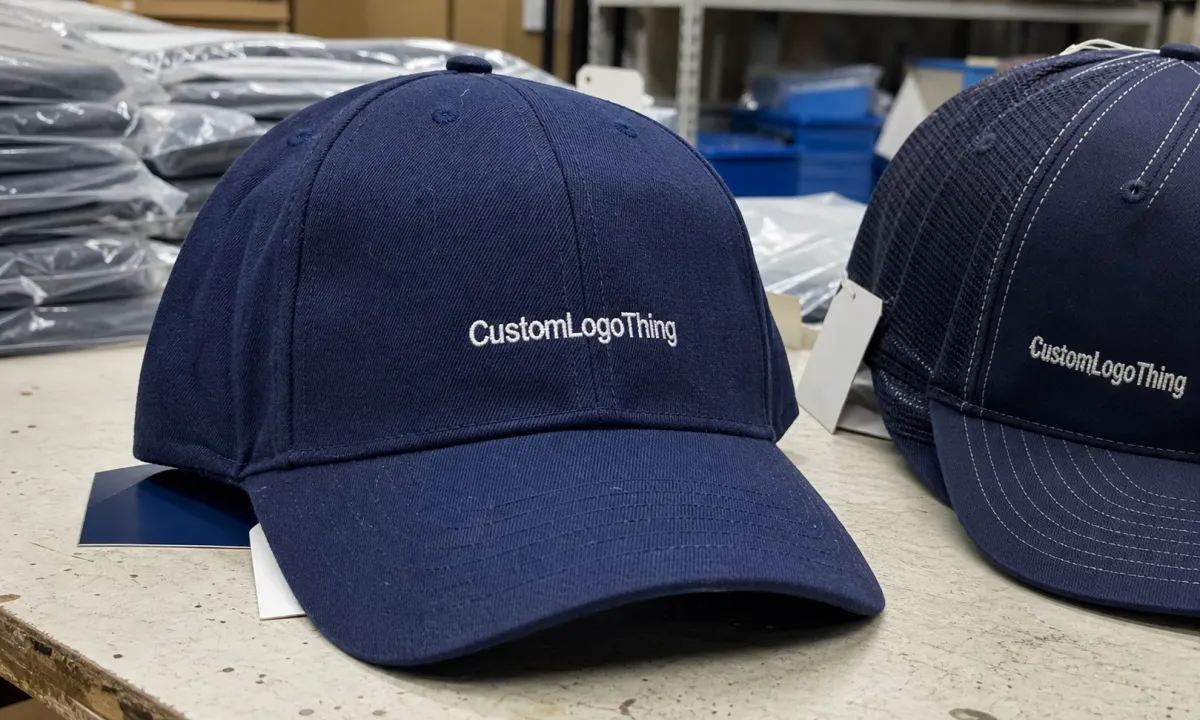
Embroidery cost is driven more by stitch count and machine time than by thread color count. A three-color design with 8,000 stitches can cost more than a five-color design with 4,500 stitches because the machine spends longer tracing fill areas, trimming jumps, and changing direction. Color matters, but it is not the main cost lever.
That is why a simple “How much per hat?” question usually produces a vague answer. A better quote request includes the logo size, location, cap style, and quantity by color. Those details tell a supplier far more than “embroidered team hats.” If the art is complex, the supplier should also explain whether the design needs simplification before production.
A low base price can hide the real cost. Digitizing, second-location fees, rush handling, and freight can erase the savings quickly if they are not listed up front.
There is also a quality issue, not just a budget issue. Dense embroidery on a soft cap can pucker. A logo that crosses a seam can distort. Tiny lettering may disappear once stitched. Buyers who understand those risks can decide whether to simplify the art, upgrade the cap structure, or accept that a premium look will cost more to produce.
For team orders, that practical view matters more than chasing a single number. The best quote is the one that matches the actual build, not the one that looks smallest on paper.
Cap styles and embroidery placements that change the quote
Structured caps usually cost less to embroider cleanly because the front panel holds its shape. The fabric stays firmer under the needle, which reduces the chance of puckering and keeps the logo centered. Unstructured caps feel softer and more relaxed, but they are less forgiving when the design is dense or large.
Truckers add another variable. Mesh back panels are fine for a simple front logo, but they limit what can be stitched near the sides or back. Low-profile caps have a smaller decoration field, while high-profile crowns give more room for stacked text or larger marks. The cap itself can nudge the price up or down before the thread even starts moving.
Placement matters just as much. Front-only embroidery is the baseline and usually the cheapest. Side embroidery adds hooping time. Back embroidery can be awkward because closures, seams, and internal construction interfere with the stitch path. Wraparound decoration looks sharp, but it asks more of the machine and the operator.
Some finishes add visual value without adding much useful information. 3D puff gives a raised sports look, and it works well for bold initials or block lettering, but it also increases stitch volume and often needs foam underlay. Tonal thread can be understated and premium, yet it can disappear at a distance. Strong contrast improves legibility, although it does not always require a higher-cost cap if the design is already simple.
- Structured six-panel caps: the most stable choice for front embroidery.
- Unstructured dad caps: softer appearance, but more care needed for dense logos.
- Trucker caps: useful for casual team merch, with placement limits near mesh.
- Low-profile caps: smaller decoration area, best for compact artwork.
- High-profile caps: extra space for larger emblems or stacked text.
A supplier should be able to explain whether a placement needs a different hoop, altered stitch angles, or a revised file. If the answer is only “yes, we can do that,” the quote is too thin to trust.
Stitch count, digitizing, and file specs buyers should verify
Stitch count is the number of thread movements needed to finish the design. It is one of the strongest predictors of embroidery price. A compact chest-style emblem may run 3,500 to 5,000 stitches. A detailed crest or multi-line logo can reach 8,000 to 12,000 stitches or more, especially if the fill areas are dense.
Digitizing is where the art becomes a machine-readable file. It is not a simple export. A good digitizer chooses stitch direction, density, underlay, pull compensation, and trim points. Those decisions shape how the logo behaves on a curved cap. Weak digitizing can make a clean logo sew badly. Strong digitizing can rescue artwork that would otherwise look too busy or too fragile on cap fabric.
Buyers should send vector art whenever possible. AI, EPS, or PDF files with outlined text and clean edges give the best starting point. Logos with gradients, shadows, and hairline details often need simplification. That is normal. Embroidery is a thread process, not a printing process, and the design has to survive that translation.
A practical file checklist is short:
- Vector art in AI, EPS, or PDF format.
- Text outlined or clearly identified by font name.
- One-color version if the logo must be simplified for embroidery.
- Target size and exact placement on the cap.
- Brand thread references if there are fixed color standards.
Three specifications deserve extra attention: minimum text height, embroidery area, and backing choice. Text smaller than about 0.2 inch tall can become hard to read on a cap. Thin serif fonts usually need to be simplified. Heavy backing supports dense stitching better than a light stabilizer, but it can change the feel inside the cap and affect comfort.
Before approving production, check the proof against the actual cap shape. Is the logo centered where expected? Does it cross a seam? Are the letters large enough to read from a few feet away? Is the thread color acceptable under the lighting where the caps will be worn? Those checks take minutes. They prevent expensive do-overs.
For detailed artwork, a stitch-optimized version is often the smarter choice. The goal is not to reproduce every digital detail. The goal is to create a mark that reads well, wears well, and can be repeated across the full order without surprises.
Embroidery pricing, MOQ, and unit-cost breakpoints
Most quote confusion comes from blending setup costs with production costs. A supplier may charge $35 to $85 for digitizing, then add a one-time setup fee for machine preparation or a special placement. After that, the per-cap price falls into a more usable range. That is why 24 caps can look expensive while 100 caps suddenly look reasonable. The setup work is spread across more pieces.
For common team orders, a simple front-embroidered cap often lands around $6.50 to $11.00 per piece at lower volumes. Larger runs can drop into the $4.00 to $7.50 range, depending on cap style, stitch count, and packaging. Add a second embroidery location, and the price often rises by $1.50 to $4.00 per cap. Complex crests or 3D puff usually move the number higher again. These are market patterns, not hard rules, but they are useful for comparing real quotes.
| Order Size | Typical Quote Pattern | What Usually Changes |
|---|---|---|
| 24-48 caps | Higher setup impact, higher cost per piece | Digitizing and tooling fees weigh heavily |
| 50-99 caps | Moderate unit cost, better bulk pricing | Setup is spread across more units |
| 100-299 caps | Lower cost per piece, stronger price efficiency | Production runs more smoothly |
| 300+ caps | Best unit cost, with freight and packing more visible | Logistics and QC matter more |
MOQ usually means minimum decoration quantity, not the smallest number of cartons. Many suppliers can work around 24 to 48 pieces for embroidered caps, although a complex style may push that higher. Ask whether mixed sizes or mixed cap colors can share the same setup. If they can, the effective MOQ becomes easier to manage.
Line-item pricing is nonnegotiable if you want a fair comparison. Ask for the base cap cost, embroidery cost, digitizing, setup charges, shipping, and rush fees if applicable. A bundled number can be fine for a quick estimate, but it is poor for decision-making.
Packaging and freight should also be visible. Confirm whether the supplier includes polybags, carton labeling, and domestic delivery. If the caps are traveling a long distance or moving through consolidation, ask how cartons are packed to reduce crushing and moisture damage. For buyers who want a packaging benchmark, ISTA test methods are a useful reference point for transit protection, while FSC certification can be a reasonable request when paper-based packaging matters.
That last point is easy to overlook. Buyers often focus on the cap and ignore the box, yet carton quality can determine whether the embroidered fronts arrive crisp or flattened. Packaging discipline is part of production discipline.
Production steps and turnaround from proof to shipment
A clear order flow usually runs in the same sequence: quote request, artwork review, digitizing, proof approval, sample or sewout approval if needed, production, finishing, and shipment. If a supplier skips one of those steps for a detailed logo, the risk moves to the buyer.
Turnaround depends on art complexity and order size. A straightforward cap order may move from proof approval to shipment in about 10 to 15 business days. More detailed logos, multiple placements, or sample revisions can stretch that to 15 to 25 business days. Rush service exists, but it typically adds cost and narrows cap options. Faster is rarely cheaper.
Most delays are predictable. Slow artwork approval stalls the order. Unclear files create extra proof rounds. Sample revisions reset the clock. Freight adds time after production is done. The order moves fastest when the artwork is complete and the buyer knows the exact cap style before the quote is approved.
A simple milestone list helps:
- Quote approved: style, quantity, and pricing are confirmed.
- Artwork proofed: placement, thread colors, and stitch layout are reviewed.
- Sample approved: a sewout or photo proof is signed off if needed.
- Production released: the machine runs the approved spec only.
- Finished goods packed: caps are counted, labeled, and cartonized.
- Shipped: tracking is shared and the invoice is reconciled.
That structure matters because late changes are expensive. If the logo is still being edited, the full production run should not be released. A small delay at the proof stage costs less than redoing a batch of finished caps.
For tournament deadlines or season launches, ask for the timeline in writing. A written schedule is more useful than a verbal estimate, especially if freight or a sample approval is part of the plan.
What a cap supplier should prove before approval
Good suppliers show their work. They provide line-item pricing, stitch proofs, sample photos, and a revision policy that is easy to understand. Weak suppliers send a rounded estimate and hope the buyer does not inspect the details too closely. The difference shows up later in the order.
In-house digitizing is a positive sign because it shortens the revision loop. It also makes changes faster if the logo needs to be simplified or resized. If the same supplier also checks the embroidery during production, the odds of shifted logos, loose threads, or inconsistent placement fall. That matters on team orders, where one bad cap can make the whole batch look uneven.
Ask how reorders are handled. A reliable supplier keeps the approved stitch file, thread codes, and placement notes on record. That helps the second run match the first instead of drifting. If the vendor can reproduce the same cap months later without changing the spec, that is a real operational advantage.
Ask for proof, not promises: approved artwork, stitch count, cap style, thread references, and the revision window. Those five items separate a controlled order from a guess.
Packaging is another practical test. Caps crushed in transit can arrive with distorted fronts even if the embroidery itself was perfect. Good carton packing, sensible stacking, and moisture protection lower that risk. A supplier that thinks carefully about shipping usually thinks carefully about the rest of the job too.
If a supplier can explain the difference between decoration quality control and transportation quality control, that is useful. It means they understand the order as a finished product, not just as stitching on fabric.
Final buying checklist for line-item quotes
Before requesting numbers, gather the logo file, cap style, quantity by color or size, placement, deadline, and shipping zip code. If there is a budget ceiling, include it. That gives the supplier room to suggest a simpler cap build, a smaller stitch area, or a front-only layout that stays inside target cost.
It also helps to request two versions of the quote. One should show the standard build. The second can show a lower-cost alternative, such as fewer decoration locations, a simpler cap style, or a reduced stitch count. Comparing the two makes the actual cost drivers obvious.
Use this list before approval:
- Approve the art proof with exact placement.
- Confirm MOQ and whether mixed colors share setup.
- Check digitizing, setup, and shipping line items.
- Lock the turnaround date in writing.
- Request a pre-production sample if the logo is detailed or the cap style is new.
The most reliable orders usually have three things in common: a clear logo, a stable cap style, and a supplier that explains the numbers instead of burying them. If a quote looks vague, it probably is. If a proof looks rushed, the finished caps may look rushed too.
Used properly, a Sports Team Caps embroidery cost guide is not a sales pitch. It is a filter. It helps buyers tell the difference between a genuinely expensive build and a simple one that is being quoted loosely. That distinction is where better decisions start.
What drives the cost of sports team caps embroidery most?
Stitch count, digitizing complexity, and placement usually drive the biggest swings. Cap structure matters too, because a structured front is easier to embroider cleanly than a soft or highly flexible crown. Setup and digitizing fees can make small runs look expensive, so compare quotes at several quantities.
What MOQ should I expect for embroidered team caps?
Many suppliers set MOQs around 24 to 48 pieces, though the number depends on the cap style and decoration method. Ask whether mixed sizes or mixed colors can use the same setup, since that can lower the effective minimum. Smaller test runs are possible, but the unit price usually rises.
How long does a team cap embroidery order usually take?
Simple orders can move from proof approval to shipment in about 10 to 15 business days. Detailed artwork, multiple embroidery locations, and sample revisions can extend that to 15 to 25 business days or more. A written timeline is better than a verbal estimate when delivery matters.
Can detailed team logos be embroidered cleanly on caps?
Yes, but the artwork may need to be simplified for stitch quality and legibility. Tiny text, gradients, and thin lines often need adjustment. A vector file and a stitch-optimized proof give the best chance of producing a readable result on a curved cap.
What should I send to get the most accurate quote?
Send the logo file, cap style, quantity, placement, thread color needs, and delivery deadline. Include whether you want front-only, side, or multi-location embroidery so the pricing is comparable. If there is a budget target, share it early so the supplier can steer the build toward it.

