Buyer Fit Snapshot
| Best fit | Packaging Quotes for Corrugated Boxes projects where brand print, material claims, artwork control, MOQ, and repeat-order consistency need to be specified before quoting. |
|---|---|
| Quote inputs | Share finished size, material target, print colors, finish, packing count, annual reorder estimate, ship-to region, and any compliance wording. |
| Proofing check | Approve dieline scale, logo placement, barcode or warning zones, color tolerance, closure strength, and carton packing before bulk production. |
| Main risk | Vague material claims, crowded artwork, missing packing details, or unclear freight terms can make a low unit price expensive after revisions. |
Fast answer: Packaging Quotes for Corrugated Boxes: Board, Finish, Dieline, and Unit Cost should be specified like a repeatable production item. The safest quote records material, print method, finish, artwork proof, packing count, and reorder notes in one written spec.
Production checks before approval
Compare the actual filled-product size with the drawing, then confirm tolerance on folds, seals, hang holes, label areas, and retail display edges. Reserve space for logos, QR codes, warning copy, and material claims before decorative graphics fill the panel.
Quote comparison points
Review material grade, print process, finish, sampling route, tooling charges, carton quantity, and freight assumptions side by side. A quote is only useful when the supplier can repeat the same color, closure quality, and packing count on the next order.
Getting packaging quotes for corrugated boxes should be straightforward. Usually, it is not. The number only means something when the carton spec, shipping method, and protection target are clear from the start. A low unit price can look fine on paper and then turn into a headache when boxes crush in transit, the packing line slows down, or the warehouse starts logging damage claims. I have seen all three. It is not pretty.
Read packaging quotes for corrugated boxes as a build spec, not a random number with a logo on it. A useful quote should spell out board grade, flute structure, inside dimensions, print method, freight basis, and any tooling or setup charges. Without those details, you are not comparing suppliers. You are comparing guesses. For shipping and logistics buyers, that difference matters just as much as the final price tag.
Packaging quotes for corrugated boxes: what the numbers really tell you
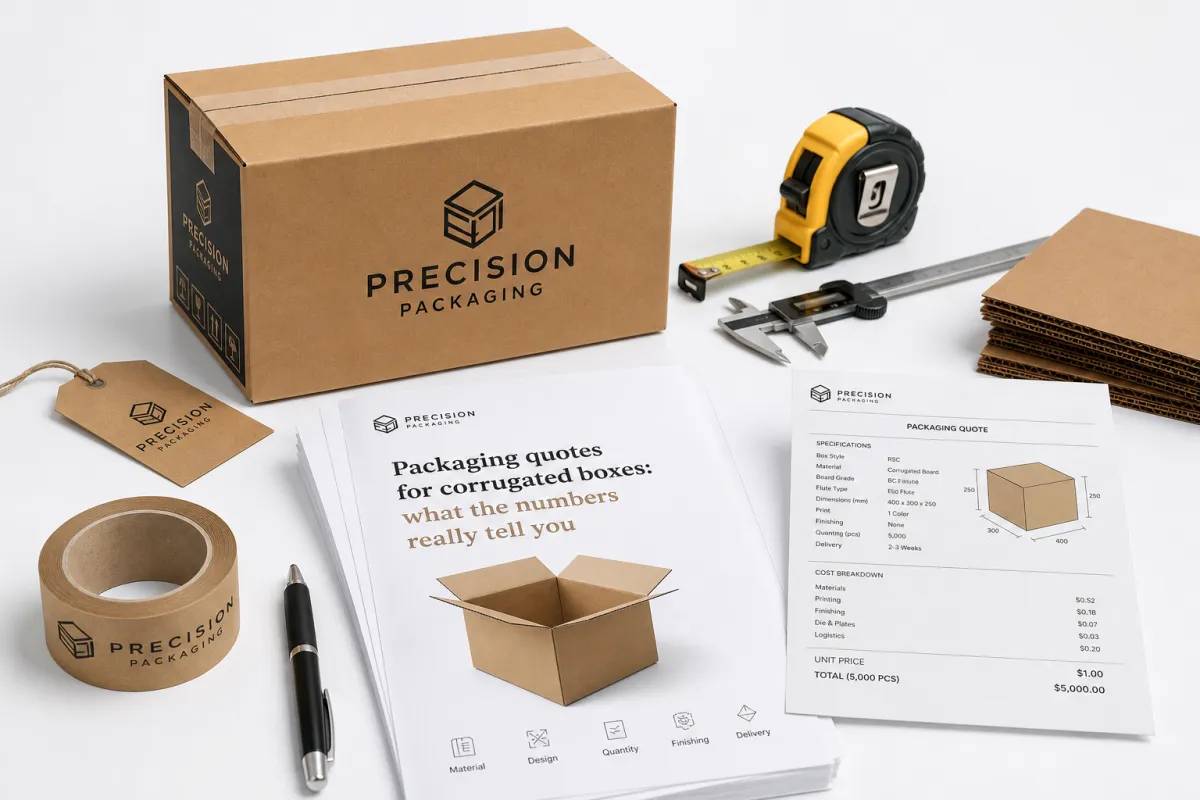
The real job of packaging quotes for corrugated boxes is not to find the cheapest carton. It is to find the cheapest carton that actually works. A box can look like a bargain and still end up expensive if it fails Edge Crush Testing, opens too easily, sheds product dust, or forces the team to use extra tape and void fill just to get it through the trip. That kind of savings is fake. Cute, but fake.
The useful quote explains what you are buying. You want the carton style, internal size, board construction, print coverage, quantity, and shipping assumption in plain view. If a supplier keeps those details fuzzy, the quote may be incomplete instead of competitive. That happens a lot with packaging quotes for corrugated boxes used for branded packaging, product packaging, and retail packaging, where appearance and performance both affect the decision.
Corrugated packaging does more than hold a product. It protects weight and fragile corners. It keeps pallet cube efficient. It helps the packing line move faster because the flap scores, glue points, and fit behave the same way every time. A well-built carton lowers damage rates and makes operators faster because they are not fighting bad geometry. From a packaging buyer’s point of view, that is where the value sits.
A quote that skips the board grade or hides the freight basis is not a clean quote. It is a polite way to stay vague.
My rule is simple: compare packaging quotes for corrugated boxes only after every supplier is quoting the same dimensions, the same flute profile, the same print standard, and the same delivery terms. One quote that assumes plain kraft and another that includes printed artwork, wax coating, or a higher stacking requirement is not a fair fight. The numbers may look close. The boxes are not.
Buyers who send complete specs usually get better answers. When carton size, quantity, and performance target are defined up front, packaging quotes for corrugated boxes are easier to trust, easier to compare, and easier to approve. The supplier can price the right structure instead of padding the quote for unknowns. That saves everybody from playing detective later.
- Ask for the board construction: single-wall, double-wall, or another build.
- Confirm inside dimensions: fit starts there, not with outside measurements.
- Check print assumptions: one-color flexo is not the same as full-coverage custom printed boxes.
- Review freight terms: delivered pricing and ex-works pricing can look very different.
- Match the use case: shipping, storage, shelf display, or retail packaging all call for different decisions.
If the requirement is still taking shape, that is normal. Plenty of buyers start by asking for Custom Shipping Boxes, then tighten the dimensions and print after seeing the first construction recommendation. If the project runs broader than a single shipper, our Custom Packaging Products page is a useful place to see how different carton formats fit different packing and shipping needs.
Corrugated box styles, materials, and product details
The first step toward accurate packaging quotes for corrugated boxes is Choosing the Right style. A regular slotted carton, usually called an RSC, is the workhorse for shipping cartons. It is economical, easy to run on automated or semi-automated lines, and familiar to warehouse teams. A die-cut mailer looks cleaner, closes more precisely, and often gives stronger package branding. It also tends to bring higher tooling and setup costs. Heavy-duty shipping boxes and double-wall constructions show up for weight, stacking, or long-distance transport where abuse is more likely.
Corrugated board is made from linerboard and fluting. The liner is the flat facing paper. The flute is the wavy middle layer that creates stiffness and cushioning. Smaller flutes usually give a smoother print surface. Larger flutes can offer better cushioning or stronger compression characteristics, depending on the build. Single-wall board is common for moderate loads. Double-wall board shows up when the carton needs more stacking strength, more puncture resistance, or better survival on rough shipping lanes.
That construction choice changes packaging quotes for corrugated boxes in a direct way. More fiber means more cost, though not always in a straight line. Sometimes stepping up one board grade costs less than adding another layer of void fill, a liner, and an extra tape pass. That is why packaging design should follow the full shipping path, not just the box sitting on the worktable. A carton that looks cheap but eats labor is not cheap.
Common box formats buyers request
- Regular slotted cartons: efficient for general shipping, palletized freight, and recurring runs.
- Die-cut mailers: cleaner presentation, good for e-commerce and branded packaging.
- Heavy-duty shipping boxes: better for higher weights, rough handling, and longer dwell times.
- Custom inserts and partitions: useful when product packaging needs separation, alignment, or impact control.
- Retail-ready cartons: suitable when the shipping container also supports shelf presentation.
Product weight and fragility change the math more than many buyers expect. A light apparel item can ship in a lower-grade carton without trouble. Glassware, hardware, batteries, or mixed SKUs usually need a tighter fit and a stronger board construction. Storage conditions matter too. Humid warehouses, cold-chain environments, and long dwell times can soften board performance, so the quote should reflect those realities when they apply.
When you ask for packaging quotes for corrugated boxes, share whether the product will ship parcel, LTL, or full truckload. Parcel handling is harder on corners and seams. LTL stacking can punish weak board. Truckload shipping may look gentle, but compression under load is the real problem. Those differences decide whether a standard single-wall box is enough or whether you need a stronger double-wall option or a custom die-cut with reinforced structure.
Some projects also justify inside print, pre-printed panels, tabs, or glued seams. Inside print can add brand messaging or handling instructions. Tabs and special closures can speed up assembly. Glued or stitched seams are worth the extra spend when repetitive packing needs more reliability. None of those features belong on every job. They do improve the system when the shipping profile is demanding.
For buyers working through packaging design choices, the cleanest approach is to define the use case first and the decoration second. A box that protects the product, packs quickly, and stacks cleanly will usually produce better packaging quotes for corrugated boxes than one that tries to look perfect while leaving the board spec undefined.
Specifications that change packaging quotes for corrugated boxes
If you want accurate packaging quotes for corrugated boxes, send a complete spec sheet. The most important details are internal dimensions, product weight, board grade, flute type, print coverage, finish, and quantity. Those items tell the supplier what the box has to do and how much material, labor, and setup time the job will consume.
Inside dimensions deserve extra attention. Outside dimensions can help with pallet planning, but the carton has to fit the product from the inside. A few millimeters can change whether the box needs extra void fill, whether inserts are needed, and how many cartons fit on a pallet layer. When buyers only share outside measurements, packaging quotes for corrugated boxes often come back with hidden assumptions that make the number less useful.
Performance targets matter too. If the carton needs to pass stacking requirements, vibration testing, or distribution testing, say so early. Common references include ASTM methods for compression and distribution performance, and many buyers also use ISTA testing guidance when shipment integrity matters. If the box sits inside a sustainability program, FSC-certified board or recycled content targets may also be part of the spec. Those requirements can affect both availability and price.
Special handling requirements change the quote as well. Moisture resistance, grease resistance, food-safe contact considerations, retail-ready appearance, and darker print coverage all influence board selection and production method. A plain kraft shipper and a high-coverage branded carton are not the same build, even when the footprint matches. That is one reason packaging quotes for corrugated boxes can vary so much across suppliers.
Core details to collect before requesting a quote
- Product dimensions: inside length, width, and depth.
- Product weight: per unit and, if relevant, packed-out weight.
- Shipping method: parcel, LTL, truckload, or international.
- Board grade: single-wall, double-wall, or a target ECT/burst requirement.
- Print needs: no print, one-color flexo, custom printed boxes, or full graphics.
- Quantity: pilot run, repeat order, or annual forecast.
- Special conditions: moisture, stacking, retail display, or performance testing.
Inside the quote, ask whether the supplier is pricing to burst strength, edge crush test, or another performance target. In many shipping applications, edge crush test is the more useful number because it relates closely to stacking strength and pallet performance. For heavier or more fragile shipments, the carton may need more than one metric to be truly appropriate. Experienced packaging suppliers add value here. They translate the product and shipping conditions into a board construction that holds up in the real world.
Reusable packaging design notes help too. If the product is already packed in a tray, bag, or retail carton, say so. If the outer shipper is only a transit carton, say that as well. The more the supplier knows about the product packaging inside the shipper, the tighter the fit will be and the cleaner the packaging quotes for corrugated boxes will read.
When the spec is incomplete, suppliers protect themselves. That usually shows up as a more conservative board grade, a larger carton, or a wider pricing cushion. Clear requirements do the opposite. They narrow the construction and make the quote easier to trust.
Pricing and MOQ: how corrugated box costs are built
There is no mystery in how packaging quotes for corrugated boxes are built. The main cost drivers are board raw material, box size, print complexity, tooling, setup time, and order quantity. Simple design, high volume, and minimal print usually keep the price down. Once the structure becomes custom, die-cut, or heavily printed, the quote reflects more press time, more tooling, and more waste during setup.
Quantity has a strong effect on unit cost because setup and waste get spread across more cartons. A 5,000-piece order and a 25,000-piece order can use the same die, the same artwork, and the same board spec, yet the larger run usually lowers the per-unit number in a meaningful way. That is one reason packaging quotes for corrugated boxes often look expensive at low volume and much better once the order reaches a practical production quantity.
MOQ reality matters. Custom die-cut cartons often carry higher minimums than standard RSC shipping boxes because the tooling, make-ready, and press setup have to be justified. Stock-style cartons can sometimes be produced in smaller lots, but they may not fit the product as efficiently. It is common to see a lower MOQ for a standard shipping box and a higher MOQ for a custom printed carton or a specialty retail-ready structure.
To make the tradeoffs clearer, here is a simple comparison of typical options buyers ask for when they request packaging quotes for corrugated boxes.
| Box option | Typical use | Relative cost | Typical MOQ pressure | Best fit |
|---|---|---|---|---|
| Regular slotted carton | General shipping and warehouse packing | Lower | Lower to moderate | Recurring transit cartons with simple specs |
| Die-cut mailer | E-commerce, subscription, branded packaging | Moderate | Moderate | Cleaner presentation and easier assembly |
| Double-wall shipping box | Heavy or fragile shipments | Higher | Moderate | Stacking strength and puncture resistance |
| Custom printed box | Retail packaging and package branding | Moderate to higher | Moderate to higher | Brand visibility and controlled presentation |
Hidden cost variables deserve attention. Freight can take a large bite out of the landed number, especially on oversized cartons. Warehousing and staggered releases can change the effective price if the supplier has to hold inventory. Compressed lead times can push the quote higher because production needs to be rescheduled. Even revisions matter; if artwork changes after approval, the final charge may include new proofing or plate adjustments. Those are normal commercial realities, but they should be visible.
If two packaging quotes for corrugated boxes differ a lot, do not assume the low number is the better deal. Check whether the cheaper quote uses lighter board, smaller print coverage, a different freight basis, or a narrower quality expectation. Sometimes the higher quote is the better value because it includes the right construction, cleaner assembly, and fewer downstream losses from damaged product or packing inefficiency.
As a rule, I tell buyers to compare the following side by side:
- Internal dimensions and carton style
- Board grade and flute structure
- Print method and coverage
- MOQ and pricing tiers
- Freight assumption and delivery location
- Included setup items like plates, dies, or proofs
From quote to sample to production: process and timeline
The cleanest path from packaging quotes for corrugated boxes to production is simple: share the specs, confirm the use case, review the quote, approve the construction, and then move into sampling. That sequence sounds basic, but it prevents most of the delays I see in corrugated projects. The quote is not just a price. It is the first technical checkpoint.
After approval, the supplier usually creates or confirms the die-line, checks the artwork, and reviews the structure for print and fold accuracy. If the project is straightforward, a prototype or sample can be produced quickly. If the box is custom printed, die-cut, or built around unusual product dimensions, the review stage takes longer because there are more places for a mismatch to appear. That is true for both corrugated shippers and custom printed boxes used in retail packaging.
Timing depends on complexity. Stock-style cartons can often move faster because the construction is already standard. Fully custom builds, especially those with insert work or special coatings, need more planning. In many plants, a simple run may be completed roughly 10 to 15 business days after proof approval, while larger or more detailed projects can take longer depending on board availability and press scheduling. Exact lead times move around, but the pattern stays the same: the cleaner the brief, the faster the approval.
Where delays usually happen
- Missing measurements: inside dimensions or packed-out dimensions were not fully defined.
- Artwork changes: new logos, revised copy, or print adjustments after proofing.
- Unknown performance needs: the box must protect a product, but no one defined the drop or stacking target.
- Freight uncertainty: the ship-to location or delivery method changes after quoting.
- Unclear release plan: the order is large, but the call-off schedule was never set.
At this stage, buyers often realize that packaging quotes for corrugated boxes are only the starting point. The schedule depends on how quickly decisions move. If the team takes three weeks to approve a dieline, the production calendar shifts by three weeks. That is not a supplier problem. It is a project management problem. Clear communication keeps the job moving.
If you are planning a recurring program, ask about staging inventory or release-based production. That can help smooth cash flow and reduce warehouse clutter, especially when the order volume is large. It also keeps package branding consistent because you are working from one approved spec instead of revising the box every time a new order is placed.
One practical note on testing: if the box is going into a channel where damage risk is high, ask whether a sample should be tested before the full run. A prototype might not be a formal lab specimen, but it can still reveal fit issues, flap interference, or too much empty space. Early correction is cheaper than reworking a production lot. Way cheaper.
Why choose us for shipping and logistics packaging
Custom Logo Things works best for buyers who want practical packaging advice, not sales fluff. For packaging quotes for corrugated boxes, that means the focus stays on protection, consistency, and supply reliability first, with branding and presentation added where they actually help the business. The goal is not to make the quote sound exciting. The goal is to make the box perform the way your operation needs it to perform.
In shipping and logistics, the details usually separate a workable carton from a troublesome one. A good quote should reflect how the box packs on the line, how it stacks in storage, how it handles freight vibration, and how it arrives at the customer’s door. Experience with corrugated packaging, packaging design, and product packaging matters here. The right construction cuts damage, reduces handling time, and supports more predictable production planning.
We also know branded packaging has a practical side. Clean graphics, legible copy, and the right print method can strengthen package branding without turning the carton into an expensive marketing piece. A simple one-color mark may be enough for a transit box. A more visible custom printed box may make sense for retail packaging or ecommerce. The point is to align the design with the job the box actually has to do.
For buyers comparing packaging quotes for corrugated boxes, that usually means you need a partner who can explain the tradeoffs clearly. The cheapest box may save a few cents and cost you more in damage. The strongest box may be more than you need. The right answer sits between those two extremes, and it depends on the product, the route, and the packing workflow.
Clear communication matters on repeat orders too. If your shipping volume changes, if your pallet pattern changes, or if the product dimensions shift, the quote should be updated rather than assumed. That discipline keeps the cost model honest. It also makes future packaging quotes for corrugated boxes faster because the supplier can build from a known construction instead of starting over each time.
When the project calls for more than a standard shipper, our team can help you sort through the options. Maybe the better answer is a stronger carton from our Custom Shipping Boxes category. Maybe you need a different board grade, a printed sleeve, or a packaging design adjustment that lowers void space and improves freight efficiency. If you want a direct conversation about your requirements, Contact Us and share the product dimensions, quantity, and shipping conditions you are working with.
The best packaging decision is not the one that sounds cheapest. It is the one that gets the product there with the least waste, the least rework, and the least risk.
Next steps: request packaging quotes for corrugated boxes with confidence
The fastest way to better packaging quotes for corrugated boxes is to send complete information the first time. Start with the internal dimensions, product weight, shipping method, and quantity. Then add the print requirement, any stacking or drop-test needs, and whether the box is for transit, display, or retail packaging. With that information in hand, the quote becomes much more accurate and much easier to compare.
It also helps to define your target budget and your operational constraints. If the box has to run quickly on a packing line, say so. If pallet pattern matters because cube efficiency affects freight cost, say that too. If the box must support FSC sourcing or another sustainability target, mention it at the beginning so the supplier can quote the right board construction. For many buyers, those details make the difference between a rough estimate and a quote that is actually useful.
Do not be shy about asking for a spec review before you place the order. In some cases, a single-wall carton will work perfectly. In others, double-wall is the better choice, even if the unit price is higher, because it cuts damage and lowers the total cost per shipped unit. If you are unsure, ask for the supplier’s recommendation and compare the build against the shipping conditions you expect.
When the numbers come back, compare them on the same basis. The right approach is simple:
- Match dimensions, board grade, and flute type.
- Check whether freight and setup are included.
- Review print coverage and finish details.
- Confirm MOQ, lead time, and sample process.
- Request a prototype if the fit or protection level is not obvious.
That process keeps the conversation grounded in performance, not just price. It also helps you avoid surprises once production starts. Good packaging quotes for corrugated boxes should feel specific, readable, and defensible. If they do, you are much closer to a box that ships well, packs cleanly, and supports the brand without piling on extra cost.
For buyers who want a practical path forward, the move is simple: define the carton, confirm the load, compare like with like, and approve the spec before production starts. That is the cleanest way to get packaging quotes for corrugated boxes that reflect the real job the box has to do, and it is the best way to keep corrugated packaging under control from prototype through production.
FAQ
What information do I need for packaging quotes for corrugated boxes?
Give internal dimensions, product weight, quantity, print requirements, and shipping method. For stronger packaging quotes for corrugated boxes, include stacking, moisture, or drop-test targets, plus whether you need stock-style cartons, custom die-cuts, inserts, or retail-ready packaging.
Why do packaging quotes for corrugated boxes vary so much between suppliers?
Board grade, flute type, tooling, waste allowance, and freight assumptions can move the price fast. Some suppliers include artwork, samples, or setup in the number, while others list those separately, so packaging quotes for corrugated boxes need a close side-by-side review.
How long do corrugated box quotes usually take?
Simple requests can often be quoted quickly once the specs are complete. More complex custom packaging may take longer if the supplier needs to review construction, print, or testing requirements. In most cases, incomplete measurements are the main reason packaging quotes for corrugated boxes slow down.
Can I get lower packaging quotes for corrugated boxes by changing the design?
Yes. In many cases, a smaller size, simpler print, or different board grade can reduce cost. Cutting excess void space can also improve freight efficiency and lower total spend, but the redesign still has to protect the product and fit the packing line. The best packaging quotes for corrugated boxes balance both cost and performance.
Should I choose the lowest quote for corrugated boxes?
Not automatically. The lowest quote may use lighter board or leave out assumptions that show up later. Compare board grade, dimensions, print, MOQ, and freight so the numbers are truly comparable, because a slightly higher quote can be the better choice if it reduces damage, rework, or shipment delays. That is the real test for packaging quotes for corrugated boxes.


