Buyer Fit Snapshot
| Best fit | Pallet Boxes for Bulk Shipping projects where brand print, material claims, artwork control, MOQ, and repeat-order consistency need to be specified before quoting. |
|---|---|
| Quote inputs | Share finished size, material target, print colors, finish, packing count, annual reorder estimate, ship-to region, and any compliance wording. |
| Proofing check | Approve dieline scale, logo placement, barcode or warning zones, color tolerance, closure strength, and carton packing before bulk production. |
| Main risk | Vague material claims, crowded artwork, missing packing details, or unclear freight terms can make a low unit price expensive after revisions. |
Fast answer: Pallet Boxes for Bulk Shipping: Strength, Cost, Fit should be specified like a repeatable production item. The safest quote records material, print method, finish, artwork proof, packing count, and reorder notes in one written spec.
Production checks before approval
Compare the actual filled-product size with the drawing, then confirm tolerance on folds, seals, hang holes, label areas, and retail display edges. Reserve space for logos, QR codes, warning copy, and material claims before decorative graphics fill the panel.
Quote comparison points
Review material grade, print process, finish, sampling route, tooling charges, carton quantity, and freight assumptions side by side. A quote is only useful when the supplier can repeat the same color, closure quality, and packing count on the next order.
Pallet Boxes for Bulk Shipping: Strength, Cost, Fit
Pallet boxes for bulk shipping do not earn attention through appearance; they earn it by preventing the quiet failures that happen between pack-out and receiving, where edge crush, load shift, and repeated handling turn small packaging mistakes into damage claims and extra labor. I have watched a perfectly decent product get chewed up simply because the container was built for the box line, not for the truck lane. That is the kind of mistake that looks minor on paper and ugly on a receiving dock. Buyers trying to protect product and control freight often find that pallet boxes for bulk shipping solve several problems at once: they steady the load, simplify fulfillment, and make shipments easier to count, move, and store. In practice, that puts them somewhere between a corrugated shipping container and a unitized freight system.
That matters for industrial parts, retail replenishment, and dense mixed SKUs alike. A properly built palletized box can replace a stack of smaller cartons, reduce rework at the dock, and cut the urge to pile on stretch wrap just to keep everything in place. The value of pallet boxes for bulk shipping often appears after the shipment leaves the building, when the receiving team opens one clean unit instead of sorting loose product off a damaged pallet. The difference is not cosmetic; it is operational. One shipment arrives as a system, the other arrives as a cleanup project.
Practical rule: if the load is heavy, awkward, or valuable enough that a repack would slow the schedule, pallet boxes for bulk shipping are often the safer packaging choice before the freight math even enters the conversation.
What Makes Pallet Boxes for Bulk Shipping Worth the Cost?
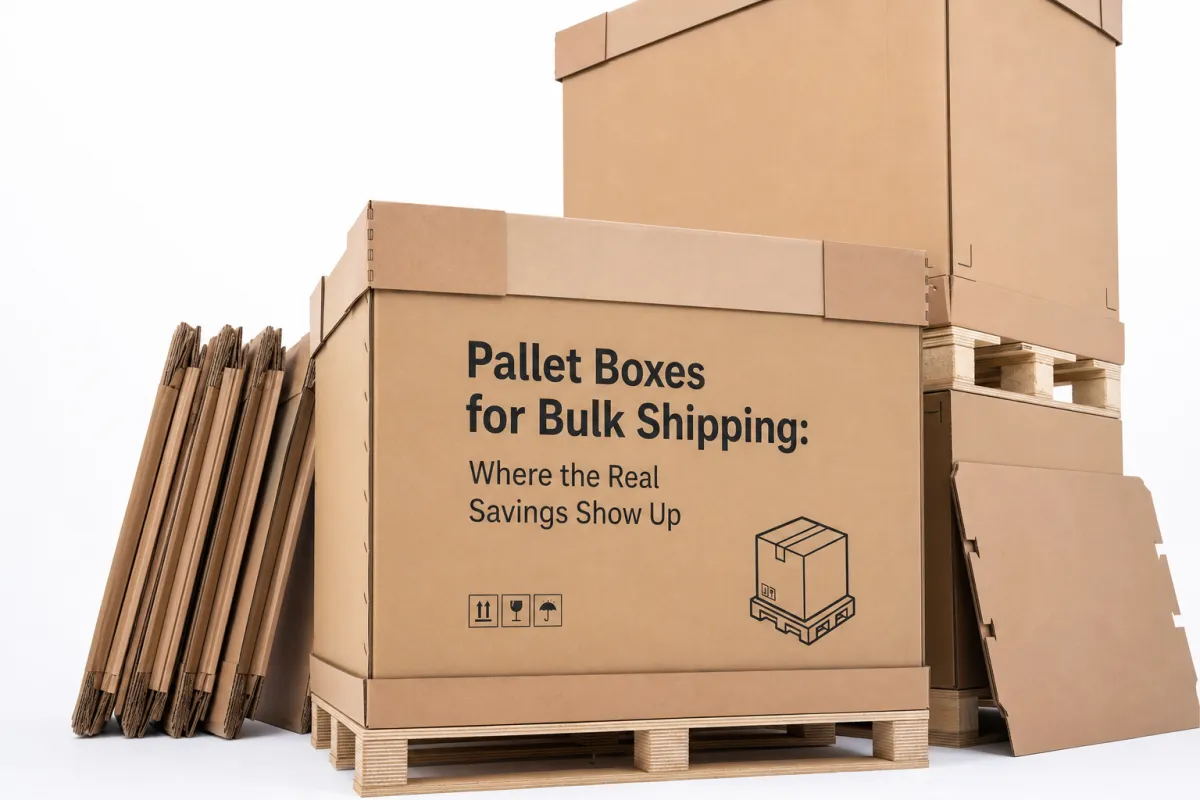
Pallet boxes for bulk shipping are not just stronger paperboard. They change the way a load behaves from the moment it leaves pack-out to the moment it is opened at destination. Many freight losses come from movement rather than impact alone. A box that shifts half an inch on a pallet can start wearing through corners, leaning into neighboring cases, or forcing a carrier to re-stack it. Once that happens, package protection becomes a labor issue as much as a materials issue, and the real cost starts to spread into claims, delays, and time spent fixing what should have stayed fixed.
One stable palletized unit can replace several smaller cartons, and that creates three practical gains. Pack-out labor drops because the team builds one controlled load instead of managing multiple cartons and labels. Warehouse handling improves because the pallet moves as one unit with a forklift or pallet jack. The chance that an order gets opened, counted, and repacked before dispatch also falls, which is a common source of damage in ecommerce shipping and wholesale distribution. For teams moving high-volume orders, that is not a minor convenience. It is the difference between a controlled release and a chain reaction of touchpoints.
Pallet boxes for bulk shipping also use cube more efficiently in many real-world shipments. A loose stack of cartons often leaves voids, odd corners, and unstable top layers that demand extra stretch wrap. A correctly sized pallet box cleans up that geometry. Less void space means less movement, and less movement usually means fewer claims, fewer replacement units, and fewer emergency reships. The savings show up there, even if the box itself costs more than a standard carton. It is a familiar tradeoff in bulk freight packaging: pay a little more for the container, or pay later in labor and loss.
Bulk fasteners, molded components, promotional kits, refill packs, and mixed SKU allocations all travel better when they stay inside one unit that can be counted at receiving without tearing through a mixed pallet. That is where pallet boxes for bulk shipping fit well: control, clarity, and speed. The box becomes part of the process, not just a container. In operations terms, it reduces decision fatigue. In logistics terms, it reduces handling density, which is where so many avoidable problems begin.
Freight cost plays a role too. Dimensional weight, pallet efficiency, and re-handling all influence landed cost. A weak or awkward build can increase overshipped air, add more wrap, and invite more carrier attention. Well-made pallet boxes for bulk shipping can reduce hidden shipping materials spend by lowering the amount of dunnage, tape, and wrap needed to keep the load stable. That does not mean every shipment should use the heaviest structure available. It means the box should match the job instead of merely surviving it. A stronger box that allows a cleaner pallet pattern can often be cheaper than a lighter box that needs constant correction.
There is also a strategic reason buyers keep returning to pallet boxes for bulk shipping: they reduce variability. The fewer variables in a shipping lane, the easier it is to forecast labor, estimate freight, and maintain quality. That predictability is useful whether the order is going to a distribution center, a manufacturing line, or a customer who expects the whole load to arrive ready to use. In a lane that repeats month after month, repeatability is not boring. It is money.
- Less rework: fewer repacks, fewer relabels, fewer handoffs.
- Cleaner receiving: one palletized unit is easier to verify and move.
- Better load stability: fewer edge failures and fewer transit surprises.
- Lower hidden costs: less wrap, less labor, less damage recovery.
If your current process depends on over-taping, over-wrapping, or hoping the freight stays upright, pallet boxes for bulk shipping deserve a hard look. They create a more controlled unit, and control is what keeps product and schedule intact. That is a simple idea, but it is one that usually pays for itself in the unglamorous places: fewer interruptions, fewer exceptions, and fewer calls asking why the shipment arrived looking like a compromise.
What Pallet Boxes for Bulk Shipping Are Designed to Handle
Pallet boxes for bulk shipping are usually built from corrugated board with a pallet-compatible footprint, reinforced sidewalls, and a closure system that keeps the load contained through warehouse moves and linehaul transit. Some designs use a separate lid. Others use telescoping sections, glued corners, or a regular slotted container style with reinforced top flaps. The right build depends on how often the shipment will be touched and how much pressure it will face in transit. In other words, the box has to be designed for the route, not for a catalog photo.
Material choice matters more than many buyers expect. Single-wall board can work for lighter shipments that are less sensitive to crush, especially when the load is uniform and the route is short. Double-wall board shows up more often when the contents are dense, tall, or subject to repeated stacking. In some cases, moisture-resistant treatments, coated liners, or heavy-duty inserts help when the route is long, humidity is high, or the product is abrasive enough to wear through standard corrugate. Pallet boxes for bulk shipping are not one material class; they are a family of transit packaging options, and the differences matter.
I usually look at three content categories first. Mixed SKU shipments need internal organization so parts do not migrate. Industrial components need edge and surface protection, especially if metal parts can cut the board from inside. Bulk consumables need a structure that supports weight without sagging when the pallet sits in a warehouse for several days. Pallet boxes for bulk shipping can serve all three, but the internal design changes each time. That is where inserts, partitions, and dunnage stop being accessories and start becoming functional engineering.
These boxes also need to work with the warehouse instead of against it. Forklift access has to stay clear. Top-load stacking needs to be predictable. A box that is too large or oddly proportioned becomes harder to stage, count, and cross-dock. Good pallet boxes for bulk shipping have enough rigidity to hold shape, but not so much extra material that they waste cube or drive unnecessary freight cost. It is a narrow path, but the right spec keeps the operation moving without asking the team to babysit every pallet.
For teams balancing multiple packaging lines, the format can fit into a broader system that includes Custom Packaging Products, outer cartons, and secondary packs for smaller line items. That matters when one customer gets a pallet shipment and another gets a parcel or carton program. Not every order belongs in the same shipper, and a thoughtful packaging mix often trims total cost better than forcing one box type to do every job. The best packaging program is usually the one with enough flexibility to match order size to ship mode without creating extra complexity at the dock.
When the shipment is part of a larger fulfillment flow, pallet boxes for bulk shipping can also be paired with clear labeling and straightforward pallet patterns so the receiving side knows what is inside before opening. Warehouse managers, distributors, and order fulfillment teams all benefit when stock stays in the right lane without burning time on manual sorting. That small bit of structure can have outsized effects, especially in high-throughput operations where every extra minute compounds.
Formal transit testing often borrows from recognized methods such as the ISTA test standards and compression or distribution checks used across the corrugated industry. Those benchmarks do not replace a real product trial, but they help separate guesswork from a documented spec. That matters because a box that survives one warehouse move may still fail after vibration, humidity, and stacking pressure have taken their turn. The truck does not care that a sample looked fine on the bench.
Specifications That Make or Break Performance
Pallet boxes for bulk shipping succeed or fail on specification detail. The first thing to verify is internal dimension, not just the nominal outside size. A box that fits the pallet footprint but steals too much internal space can crush the product or force a sloppy fill. A box that is too loose invites movement, which often leads to scuffed surfaces, torn corners, or collapsed stacks. The right clearance depends on product shape, insert strategy, and whether the load is unitized or loose-packed. A quarter inch can be a nuisance; an inch can become a failure mode.
Finished outer size matters too because it affects pallet pattern, trailer cube, and storage footprint. If the box is designed around a 48 x 40 pallet, it should actually work with that footprint without overhang or corner compression. The same logic applies to larger or specialty pallets. Pallet boxes for bulk shipping need to fit the handling environment, not just the print spec. If the footprint is wrong, the whole system starts negotiating with itself.
Load rating and board grade should match the actual product weight. A light cosmetic set does not need the same structure as a box of steel hardware. In corrugated packaging, terms like ECT and burst strength still matter, but buyers should ask how the board performs under compression, stacking, and humidity. A 44 ECT single-wall solution may be fine for some moderate loads, while heavy or tall pallet boxes for bulk shipping often need double-wall construction or a reinforced design with better crush resistance. The point is not to buy the strongest board on paper; it is to buy the board that stays honest in the lane.
Closure method is another place where the spec can swing from practical to frustrating. Tape may be enough for some builds. Others need banding, straps, stitched seams, or glued corners. Tuck-in lids can speed pack-out, but they are not always the best choice if the shipment sees rough handling. If the box is going to be opened and closed several times, the closure needs to hold up to that cycle without tearing the top edge apart. That is especially true in palletized freight where the same unit may be touched by more than one team before it reaches destination.
Internal clearance deserves more attention than it usually gets. Too tight, and the contents press against one another or against the sidewall. Too loose, and the load shifts during transit. Inserts, partitions, corner posts, and dunnage can solve that, but only if they are designed around the real product. Pallet boxes for bulk shipping are most effective when the internal fit is deliberate rather than improvised with extra paper and tape. Improvisation may look efficient in the moment; it usually costs more when the pallet arrives with the evidence attached.
Testing should match the route. Compression testing, vibration, and corner impact are all worth considering if the shipment travels long distance or changes hands multiple times. ASTM methods such as D642 for compression or D4169 distribution testing are often used as part of a qualification process. A sample that looks good on a table is not the same as a sample that survives a dock route and a truck run. For additional context on packaging materials and performance, the FSC certification framework is also useful when sustainability and sourcing matter to the buying team. The box spec may start with dimensions, but it ends with performance under real pressure.
| Option | Best For | Typical Structure | Planning Price Range | Notes |
|---|---|---|---|---|
| Single-wall pallet box | Moderate-weight loads with short-to-medium transit | 33-44 ECT board, standard closures | $1.40-$2.80 per unit at mid-volume | Lower material cost, but less forgiving under stack pressure |
| Double-wall pallet box | Dense, tall, or long-haul shipments | Double-wall board, reinforced corners or lids | $2.75-$5.25 per unit at mid-volume | Better crush resistance and usually stronger package protection |
| Printed, reinforced custom build | Brand-sensitive programs or mixed SKU kits | Custom print, inserts, moisture resistance, upgraded closures | $4.25-$8.50 per unit depending on size and finish | Higher setup cost, better presentation, and tighter control |
Those ranges are planning figures, not fixed quotes. Pallet boxes for bulk shipping move up or down based on board grade, size, quantity, print coverage, and how much converting complexity the design demands. A square, standard-footprint box can cost noticeably less than an oversized custom build with heavy internal supports. Buyers should also look at the cost of tape, wrap, labor, and damage recovery, because the cheapest unit price is not always the cheapest shipment. A low sticker price can hide a lot of operational drag.
Do not under-spec because someone wants to save a few cents. If a box fails in receiving or during transit packaging handling, replacement cost can erase the savings very quickly. Strong spec discipline keeps product and schedule in line. It also protects the procurement team from the classic false economy: buying a lighter box that quietly creates a heavier problem.
Pricing, MOQ, and What Changes Unit Cost
Pallet boxes for bulk shipping are priced by more than size alone. Board grade, flute combination, print coverage, die-cut complexity, coatings, and internal supports all affect the final number. A simple unprinted box with standard dimensions is easier to produce and usually carries less setup cost. Add a custom lid, internal partitions, or full-color branding, and the cost rises because the converting process takes longer and the material yield changes. The quote is really a reflection of how many production variables you are asking the factory to control.
MOQ is usually tied to setup economics and board yield. Standardized sizes often allow lower minimums because the tooling and material usage are easier to plan. Highly Custom Pallet Boxes for bulk shipping may need a higher MOQ to make the run efficient. That does not mean small programs are impossible; it means the quote should reflect real production math rather than a generic estimate. For a buyer, the best first question is often not "What is the cheapest box?" but "What quantity gets us the best landed cost without overstocking our warehouse?"
Larger runs typically lower unit cost, but they can increase storage and freight considerations. That is why full landed cost matters. A lower per-unit box price can still lose if it creates more warehouse occupancy, requires special freight, or arrives in a format that is hard to stage. Pallet boxes for bulk shipping should be evaluated as part of the whole shipping materials system, not as a standalone purchase. The math should include the box, the labor, the handling time, and the cost of making the same decision again later.
If you are requesting a quote, the most useful information is straightforward: product dimensions, finished weight, quantity, shipping region, and handling requirements. If the box has to survive long storage, high humidity, or repeated handling, say so up front. If the load includes fragile inserts, mixed SKUs, or line-side replenishment packs, include that too. Pallet boxes for bulk shipping are much easier to price accurately when the supplier knows the actual use case. The more the buyer can describe the route, the less the supplier has to guess.
The difference between a rough estimate and a useful quote can be as small as one missing detail. A half-inch of clearance, a heavier board grade, or a lid style that needs extra die cutting can change the price enough to matter. Honest pricing is built on exact dimensions and clear expectations. That is better for the buyer and better for the production schedule. It also makes the eventual reorder less surprising, which is a small mercy in a category where surprises usually cost money.
Here is a simple way to compare the cost drivers:
- Lower unit cost: standard sizes, unprinted board, simpler closures.
- Mid-range cost: reinforced sides, moderate print, custom sizing.
- Higher unit cost: heavy board, moisture resistance, inserts, or complex lids.
- Hidden cost risk: over-specifying the box or under-specifying the load.
For buyers balancing wholesale programs and repeat replenishment, pallet boxes for bulk shipping can be a smart place to standardize. Once the size and board grade are proven, reorders are easier to forecast, and freight planning gets cleaner. That stability matters when receiving, customer service, and warehouse teams all depend on the same spec staying consistent. The less time they spend reinterpreting the package, the more time they spend moving product.
Pallet Boxes for Bulk Shipping: Process and Timeline
Pallet boxes for bulk shipping usually start with intake rather than artwork. The first step is collecting product measurements, unit weight, pallet footprint, number of units per load, and the conditions the shipment will face in transit and storage. If the product is uneven, fragile, or prone to settling, that needs to be documented early. A box spec is only as good as the information behind it. In packaging work, the first measurement error tends to echo through every later step.
After intake, the next step is usually a structural mockup or sample. Fit, fill, stacking, and closure behavior get checked before full production. A sample does not need to be fancy to be useful. In fact, a plain mockup often tells you more than a decorated prototype because it shows whether the load stays centered, whether the corners hold, and whether the closure can handle the real handling pattern. Pallet boxes for bulk shipping should be tested with a real load whenever possible. If the sample survives only when treated gently, it has not actually passed.
Timeline depends on complexity. Unprinted builds with standard board and straightforward sizing often move faster than printed boxes with heavy reinforcement or special coatings. If tooling, sampling, or artwork approval is involved, time should be added for those steps. A practical schedule usually includes material allocation, converting, quality checks, packing, and outbound freight. Communication matters because a buyer should know when the sample is approved, when production starts, and when the finished stock leaves the plant. The best timelines are boring in the right way: clear, repeatable, and free of surprise handoffs.
The timing window also changes with seasonality and material supply. Corrugated board availability can tighten when demand spikes, and certain coatings or specialized liners may require longer lead times. Pallet boxes for bulk shipping are often ordered on a repeat basis, so one of the best things a buyer can do is lock in a reorder rhythm once the spec is proven. That keeps the program from sliding into rush charges and emergency freight. A stable order pattern is often worth more than a slightly lower quote that cannot hold a schedule.
For a straightforward custom program, a common working range might be 10-15 business days from proof approval to ship date. More complex pallet boxes for bulk shipping can take longer, especially if a new sample is required or if the order includes print, inserts, or nonstandard board. That range is not universal, but it is a realistic starting point for planning. The important part is not the exact number; it is the discipline of getting the number early enough to plan around it.
Good process also means good records. Keep the approved dimensions, board grade, closure method, pallet pattern, and sample photos together in one file. If the box is part of a broader transit packaging system, note the linked cartons and any secondary packaging used in the same order flow. That makes the next reorder faster and reduces the chance of accidental changes. A packaging file that is easy to read is often the cheapest insurance in the operation.
At this stage, many buyers also compare pallet boxes for bulk shipping with other options in the same category, such as Custom Shipping Boxes for carton-level distribution or Wholesale Programs when the spec will be ordered repeatedly across multiple shipping cycles. The best fit depends on the product, the route, and how much handling the shipment will see before it reaches the customer. The real question is not which format is strongest on paper, but which one behaves best in the actual shipping lane.
What a Good Packaging Partner Should Prove
The value in pallet boxes for bulk shipping is not just in the materials. It is in translating product data into a box spec That Actually Works. That means looking at the load, the route, the pallet pattern, the warehouse process, and the cost target together. A good recommendation should explain why a certain board grade, closure method, or insert layout makes sense instead of just throwing more corrugated at the problem. The goal is fit, not brute force.
Clear communication is a major advantage in packaging projects. Buyers need board grade, print lead times, freight expectations, and MOQ information in plain language. Pallet boxes for bulk shipping often support important orders, so the team making the buy should not have to decode vague packaging language to know whether the spec is too light, too heavy, or simply too expensive. Facts help decisions move faster. So does a supplier who can say, plainly, what the tradeoffs are.
Consistency matters too, especially for repeat orders. Once a pallet program is approved, the dimensions need to stay stable, the board performance needs to remain dependable, and the reorder process needs to stay easy. That is true whether the boxes are used for internal distribution, customer replenishment, or mixed freight that feeds retail and ecommerce shipping at the same time. A small change in size can ripple through the whole operation. In a warehouse, small ripples are rarely small for long.
Sampling support is another place where careful packaging guidance pays off. The best result often comes from one or two precise adjustments, not from forcing a first-pass design into production. If the fit is off by a fraction, or if the box needs a stronger closure for the actual route, that is better discovered on a sample than on a truck. Pallet boxes for bulk shipping deserve that level of attention because the cost of failure is usually larger than the cost of testing. A sample is cheap compared with a claim, especially when the claim includes labor and downtime.
There is also a sourcing side to the decision. If the buyer cares about responsible fiber sourcing, ask about certification options and how the materials align with internal policy. If sustainability reporting is part of the procurement process, packaging choices may need to connect with broader environmental goals without compromising package protection. In those situations, pallet boxes for bulk shipping can be specified with the same care as any other material purchase. Sustainability only helps if the box still does its job.
For teams that need a broader packaging mix, access to multiple formats within one program helps, from palletized corrugated to smaller shipping formats such as Custom Poly Mailers. That way, the packaging strategy matches the order type instead of forcing every shipment into the same lane. The most efficient program usually has a family of options, not a single rigid answer.
Honestly, the best packaging partner is the one that helps you avoid overbuilding while still protecting the load. That balance is where cost control and real performance meet. Pallet boxes for bulk shipping should feel engineered, not improvised. When that balance is right, the box disappears into the workflow and the workflow gets better. And if someone tries to sell you a heavier spec for every load, that is usually a sign to ask a few more questions.
Next Steps for Ordering Pallet Boxes for Bulk Shipping
Start with the essentials: product dimensions, finished weight, pallet footprint, units per load, and the conditions the shipment will face in transit and storage. Those five details do most of the heavy lifting when a quote is being built. If the shipment is prone to vibration, moisture, or long dwell time in a warehouse, say that as well. Pallet boxes for bulk shipping perform best when the use case is clear from the start. Ambiguity almost always shows up later as extra cost.
Decide early whether you need print, moisture resistance, dividers, or a custom insert system. Those choices affect both performance and pricing, and it is better to make them during the quote stage than after sampling has already started. If the box is carrying mixed SKUs, the internal layout may matter more than the outer appearance. If the shipment is highly branded, print coverage may be worth the extra spend. If the product is dense, a stronger board grade may be the most economical choice in the long run. Every one of those choices changes how the load behaves, which is why they should be decided together.
Ask for a sample or structural mockup and test it with a real load. Use your normal warehouse handling process, not a special demo process that hides the weak points. Move it with the same pallet jack, stack it the same way, and close it the same way you would in production. Pallet boxes for bulk shipping need to prove themselves in the real environment, not just on a flat table. A mockup that survives ideal conditions tells you very little; a mockup that survives normal abuse tells you a lot.
Once the spec works, lock in the reorder plan, freight method, and inspection checklist. That keeps future runs consistent and makes it easier for purchasing, warehouse, and operations teams to stay aligned. A good pallet program should become easier the second time around, not more confusing. If the program gets simpler with each order, you have probably found the right configuration.
It also helps to document what success looks like. If the load is supposed to arrive with no corner crush, no product migration, and no repack at receiving, write that down. If the tolerance for overpack is tight because dimensional weight matters, include that too. Pallet boxes for bulk shipping are easiest to manage when the performance target is measurable. Clear success criteria make the next reorder less subjective and the supplier conversation far more productive.
Use the first approved run to create the internal standard. Then the next quote can be built faster, lead time can be planned more accurately, and the shipping team can stop reinventing the wheel every time the order repeats. That is where the packaging program becomes genuinely useful. Standardization does not sound dramatic, but in shipping it often saves more money than a clever one-off solution.
Bottom line: pallet boxes for bulk shipping are worth serious consideration whenever the shipment is dense, bulky, multi-item, or too important to leave to loose cartons and excessive wrap. The right spec protects product, improves handling, and keeps the buying decision grounded in actual cost rather than guesswork. If the goal is fewer claims and cleaner receiving, the actionable next move is simple: define the product load, match the board and closure to the route, and test the sample under the same handling conditions the live shipment will face.
Frequently Asked Questions
How do pallet boxes for bulk shipping compare with standard cartons?
Pallet boxes for bulk shipping are built for palletized freight and stronger load stability, while standard cartons usually work better for parcel shipments or smaller hand-carry moves. The pallet format reduces re-handling because one unit stays together from pack-out to receiving, which can lower damage and labor. The right choice depends on product weight, pallet pattern, and how many times the shipment will be moved before delivery. For dense or awkward loads, the pallet format usually wins because it reduces the number of decisions between origin and destination.
What information do you need for a quote on pallet boxes for bulk shipping?
Provide finished product dimensions, weight, quantity, and the number of units per pallet or container. Also share the destination region, print requirements, and whether the shipment needs moisture resistance or internal separation. If you include your target quantity, the quote can balance setup cost, material use, and MOQ more accurately. The better the inputs, the less guesswork is built into the price.
Can pallet boxes for bulk shipping be customized for mixed SKUs?
Yes, they can be configured with dividers, inserts, partitions, or dunnage to keep different items separated. Mixed-SKU builds usually need closer attention to internal fit so smaller products do not shift during transit. A sample is useful here because the best configuration depends on how the items actually sit inside the box. What looks tidy on a drawing can behave very differently once the pallet starts moving.
What affects lead time the most on custom pallet boxes?
Board availability, custom tooling, artwork approval, and sampling speed are usually the biggest schedule factors. Simple unprinted runs are typically faster than printed boxes with heavy reinforcement or special coatings. Freight timing can also affect delivery, so the production schedule should be reviewed together with the shipping plan. If the project needs a new sample, expect that to be the step that slows everything else down.
Are pallet boxes for bulk shipping reusable?
Some are one-way shipping formats, while reinforced versions can be reused if the board stays dry and the handling is controlled. Reuse depends on load weight, stacking pressure, and how many times the box is opened and closed. If reuse matters, specify that upfront so the structure, closures, and board grade are chosen for the expected cycle. A reusable pallet box should be designed for the second trip, not just the first one.
Do pallet boxes for bulk shipping help with dimensional weight?
They can, if the design is matched to the actual product size and the pallet footprint is used efficiently. The goal is to reduce wasted cube without creating a box that is too tight or too light for the load. Good pallet boxes for bulk shipping balance outer dimensions, internal clearance, and handling needs so you are not paying for empty space. That matters because unused volume is often the most expensive thing in the truck.
What standards should I ask about before ordering?
Ask about board grade, stacking strength, and any test method used to verify performance, such as compression or vibration checks. If sustainability matters to your team, ask about fiber sourcing and certification options as well. For many buyers, the most useful signs of a solid program are a clear spec, a sample that passed a real load test, and a supplier who can explain why the chosen structure fits the route. If those three things line up, the rest of the order usually gets easier.
Pallet boxes for bulk shipping work best when the spec is practical, the quote is based on real numbers, and the sample is tested the same way the live order will be handled. That combination gives you the best shot at stable freight, cleaner receiving, and a better outcome for the product, the warehouse, and the budget. It also makes the next order less of a project and more of a repeatable system.


