Buyer Fit Snapshot
| Best fit | Custom Pallet Boxes for Shipping projects where brand print, material claims, artwork control, MOQ, and repeat-order consistency need to be specified before quoting. |
|---|---|
| Quote inputs | Share finished size, material target, print colors, finish, packing count, annual reorder estimate, ship-to region, and any compliance wording. |
| Proofing check | Approve dieline scale, logo placement, barcode or warning zones, color tolerance, closure strength, and carton packing before bulk production. |
| Main risk | Vague material claims, crowded artwork, missing packing details, or unclear freight terms can make a low unit price expensive after revisions. |
Fast answer: Custom Pallet Boxes for Shipping: Board, Finish, Dieline, and Unit Cost should be specified like a repeatable production item. The safest quote records material, print method, finish, artwork proof, packing count, and reorder notes in one written spec.
Production checks before approval
Compare the actual filled-product size with the drawing, then confirm tolerance on folds, seals, hang holes, label areas, and retail display edges. Reserve space for logos, QR codes, warning copy, and material claims before decorative graphics fill the panel.
Quote comparison points
Review material grade, print process, finish, sampling route, tooling charges, carton quantity, and freight assumptions side by side. A quote is only useful when the supplier can repeat the same color, closure quality, and packing count on the next order.
Custom Pallet Boxes for Shipping: A Practical Buying Guide
A lot of freight claims start with a simple mismatch. The pallet, the box, and the load were never designed to work together. That is the real reason Custom Pallet Boxes for shipping matter. Once a shipment gets heavy, tall, fragile, or awkward, the old habit of pairing a stock carton with stretch wrap and optimism falls apart fast.
Custom pallet boxes for shipping solve three problems at once. They protect the product, keep the load in one piece, and make handling easier for warehouse crews, carriers, and fulfillment teams. They also give you a cleaner path for branding when the shipment is customer-facing, and they cut down on repacking at the dock. Nobody enjoys fixing a load that should have been spec'd correctly the first time.
This is the practical version. Not the polished sales deck version. By the end, you should know where custom pallet boxes for shipping beat standard cartons, where crates or basic shipping boxes make more sense, what drives the spec, and which questions matter before you ask for pricing. If you are comparing options for lighter outbound kits, it helps to look at the structure next to Custom Shipping Boxes and, for smaller mixed-product mail orders, Custom Poly Mailers.
What Custom Pallet Boxes for Shipping Actually Solve
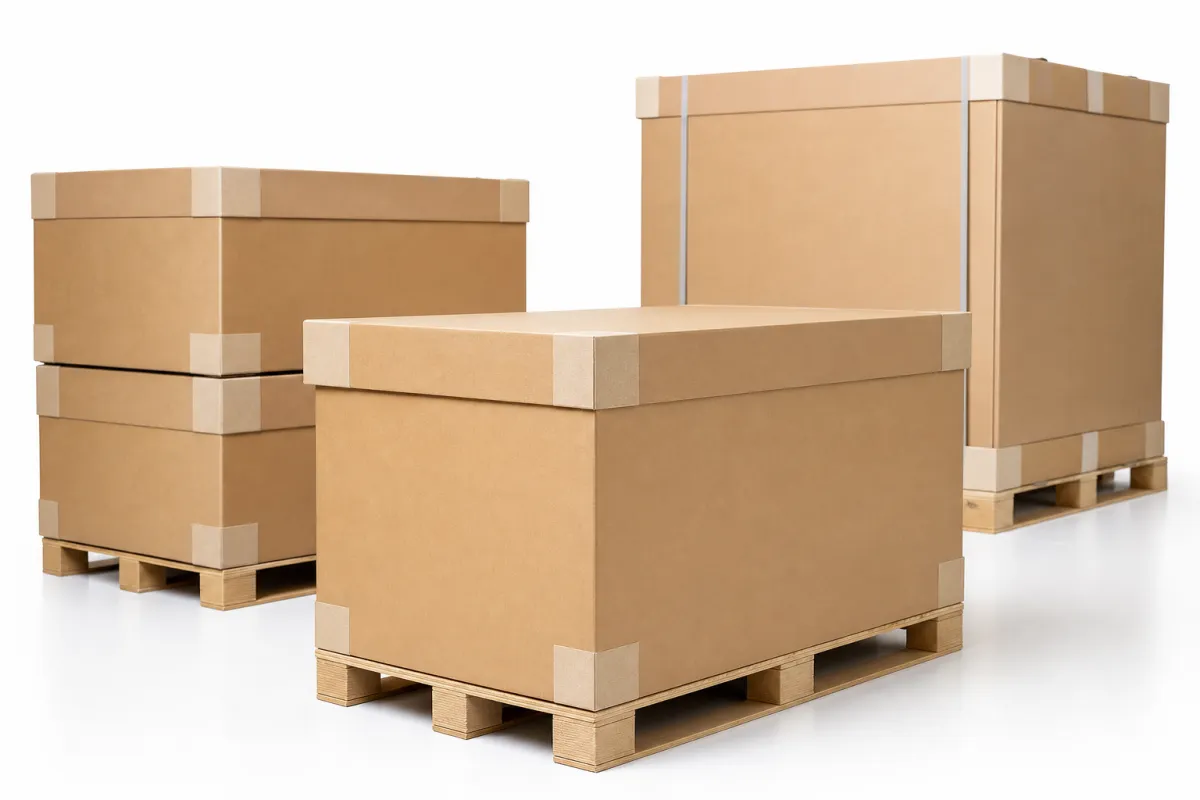
Most damage does not start with a bad product. It starts with a bad interface. The product can be fine. The pallet can be fine. The box can look strong on its own. Once the footprint, weight, and handling method are ignored, the load begins to shift, corners crush, or the base flexes enough to create a problem in transit. Packaging usually fails at the handoff points, not in the brochure.
Custom pallet boxes for shipping are pallet-integrated enclosures built to protect, stabilize, and simplify bulky or high-value freight. Think of them as transport systems, not just containers. They show up on equipment parts, multi-pack retail programs, refillable components, promotional kits, and anything that needs more structure than a normal carton can offer. A well-built pallet box can carry branding too, as long as the graphics do not get in the way of protection.
Standard cartons still have a place. A regular shipping carton works for a compact, uniform load. Stretch wrap helps unitize a pallet, but it does not stop point impacts, edge abrasion, or top load. Crates can handle rough treatment and may be better for ventilation or visibility, yet they are not always ideal for dust control, moisture resistance, or a cleaner presentation. Custom pallet boxes for shipping sit in the middle, giving you more enclosure than a crate and far more control than a loose palletized stack.
They tend to make sense when the shipment has one or more of these traits:
- the load is heavier than a standard carton should carry;
- the product has a high center of gravity or uneven weight distribution;
- the shipment moves through multiple handoffs or LTL freight;
- the destination is export, warehouse transfer, or long-haul distribution;
- the buyer wants lower damage risk without jumping all the way to a full wooden crate.
Too many buyers look at a generic box and see the lower quote. That part is easy. The harder part is the full cost. Cheap packing can turn expensive fast once product loss, freight waste, dock rework, and support time show up. Custom pallet boxes for shipping reduce that kind of noise by giving the load a structure that matches the real trip.
“If the product can move, the box will eventually tell you where the weak point is.”
How Custom Pallet Boxes for Shipping Work
Custom pallet boxes for shipping usually combine five pieces: a pallet base, side panels, a top closure, reinforcement at the corners or edges, and access for a forklift or pallet jack. The materials can be corrugated, wood, hybrid, or a mix of all three. The logic stays the same. The package has to control the load path so weight, vibration, and stack pressure move through the container instead of pushing straight into the product.
The base carries more responsibility than many teams expect. If the bottom deck is too weak, the whole package can sag under point loads during storage or transport. If it is too rigid without the right clearances, pallet jack access turns into a mess. Good custom pallet boxes for shipping are built around the handling environment, not just the product dimensions. That means thinking about forklift tine entry, pallet jack clearance, dock door width, and whether the box will live on racking, the floor, or in truck stacks.
The load should be guided by the structure, not by hope. Carton liners, inserts, blocking, and internal dividers can keep the contents from moving. Edge protectors help walls resist compression. Top pads spread stacking pressure. Export or long-haul programs may need moisture barriers, anti-slip features, and stronger fasteners. If the shipment has to pass packaging validation, ask whether the design can be tested against an ISTA protocol or an ASTM distribution test such as ASTM D4169. ISTA's current standards library at ISTA is a useful reference point.
Protection and unitization are not the same thing. That confusion causes a lot of bad specs. Protection means the product survives impact, compression, vibration, humidity, and handling. Unitization means the load behaves as one stable piece during transit. Custom pallet boxes for shipping need both. A package can look strong and still fail if the contents move inside. The reverse happens too. A tightly packed load can still fail if the outer walls are too thin for the stack pressure above it.
For buyers managing packaging across multiple channels, this is the point where structure matters more than graphics. The same team that worries about retail finish and Custom Printed Boxes for shelf appeal should care just as much about the transport envelope. The goal is not to overbuild every shipment. The goal is to match the box to the route, the load, and the way the warehouse actually handles it.
Key Factors That Decide the Right Spec
Specifying custom pallet boxes for shipping starts with the load, not the artwork, the catalog, or a supplier's favorite construction. Weight is the first filter. Footprint comes right after that. A 60-pound load centered low on a standard 48 x 40 inch pallet is a very different problem from a 240-pound irregular assembly with a tall center of gravity. The more the product can move, roll, tilt, or settle, the more the box has to do.
Five inputs usually drive the structure:
- Weight: gross weight, not just product weight, including inserts and pallet;
- Center of gravity: critical for top-heavy or off-center loads;
- Footprint: standard footprints are easier to store and ship, but not always the best fit;
- Fragility: glass, electronics, machined parts, and finished surfaces need different protection;
- Shift risk: nested, bagged, layered, or loose-packed goods behave very differently in transit.
Environment matters too. Moisture is a big one. Corrugated structures can hold up well, but not if they sit outdoors, load into humid warehouses, or see condensation during temperature swings. Dust and abrasion matter for finished goods. Vibration matters for assemblies with fasteners, coatings, or delicate components. If the route includes ports, cross-docks, or outdoor storage, custom pallet boxes for shipping may need coated board, stronger closures, or a hybrid build with better weather resistance.
Destination changes the spec faster than most people expect. Domestic truckload, air freight, export container, and warehouse transfer all put different pressure on the package. A box designed for internal distribution does not need the same treatment as one that sits in a port yard before loading. If the build uses paperboard or fiber-based components, sourcing may matter too. FSC-certified materials can support a documented sustainability claim, and the FSC system is the cleanest place to verify what that certification actually means.
Practical details belong early in the conversation. Confirm usable dimensions, not just nominal dimensions. Check whether labels need to stay visible from a specific side. Decide whether the box is single-use or reusable. Define stacking limits. If the shipment must pass a distribution test or meet internal supplier standards, say so at the quote stage. Custom pallet boxes for shipping work best when the supplier knows the lane, the handling method, and the reuse goal, not just the item size.
If the load sits inside a broader branded packaging system, make sure the structural spec and the visual spec are not fighting each other. A glossy presentation can help, but it should never force a thinner wall, weaker closure, or awkward assembly step. That tradeoff is where avoidable damage starts.
Custom Pallet Boxes for Shipping: Cost and Pricing Drivers
Pricing for custom pallet boxes for shipping depends on structure, material, size, and volume. That sounds obvious. The spread still catches buyers off guard. A simple palletized corrugated enclosure on a standard footprint might land around $18-$35 per unit at moderate volume, while a reinforced export-style build with heavier board, internal blocking, moisture protection, and print can move into the $45-$120 range or higher. That is a realistic shopping band, not a promise. The final number follows the design choices.
The biggest cost drivers usually look like this:
- Material type: single-wall corrugated, double-wall corrugated, triple-wall, wood, or hybrid;
- Board or lumber grade: stronger stock costs more, but can reduce damage and rework;
- Size: large footprints consume more material and often increase freight cube;
- Load rating: higher compression or stacking requirements need stronger construction;
- Customization level: die cuts, inserts, closures, labels, print, or special fasteners all add cost;
- Order volume: tooling and setup spread out better on larger runs.
Custom features can hide in plain sight on a quote. A basic hand-hole cut is not expensive. A full set of internal dividers, edge blocking, anti-shift inserts, and reusable closures is a different story. Weather protection is another one. So is a design that ships flat and gets assembled later in the warehouse. Even small changes, like moving from plain kraft to custom printed boxes with wider coverage, can affect cost, lead time, and compression performance.
| Option | Typical Use | Common Price Range | Why Buyers Choose It | Watch-Out |
|---|---|---|---|---|
| Standard corrugated pallet box | General freight, stable loads, warehouse moves | $18-$35 each at mid-volume | Lower cost, lighter weight, easier print options | May not handle moisture or heavy stack pressure well |
| Reinforced export pallet box | Long-haul, cross-border, higher-risk handling | $35-$90 each depending on inserts and board grade | Better enclosure and load control | Can add freight cube and assembly time |
| Hybrid wood and corrugated enclosure | Heavy, high-value, or awkward products | $60-$140+ each for smaller runs | Strong base, better abuse resistance, more reuse potential | Higher material and labor cost |
| Reusable pallet pack | Closed-loop programs and returnable logistics | Higher upfront cost, lower per-trip cost over time | Designed for multiple cycles | Needs return planning and repair strategy |
The smarter way to judge custom pallet boxes for shipping is total landed cost. The lowest quote can become the most expensive option if it creates damage claims, extra repacking labor, higher freight cube, or customer chargebacks. I have seen buyers save a few dollars on the box and lose far more on rework, spoilage, and support time. That is why the real comparison includes product loss, handling time, and freight efficiency, not just the carton line item.
Here is the useful test: if a stronger box lets you ship fewer replacement units, stack more safely, or reduce the number of people needed to stage the load, it can pay for itself quickly. Custom pallet boxes for shipping often look more expensive on paper and cheaper in the warehouse. That difference matters.
Step-by-Step Process and Timeline
The cleanest way to buy custom pallet boxes for shipping is to treat the project like a small engineering brief. Start with the load, the route, and the handling method. Gather exact dimensions, product photos, gross weight, stacking arrangement, and any notes about fragility or shift risk. If the product nests inside itself, say that. If it ships assembled, say that too. The difference can change the structure a lot.
- Discovery: share dimensions, weight, photos, shipping lanes, and any special handling concerns.
- Spec review: the supplier should translate the product into board grade, base design, closures, and reinforcements.
- Prototype or sample: a sample often takes 3-7 business days, depending on complexity and tooling.
- Test and revise: fit checks, stack checks, and handling checks should happen before approval.
- Final sign-off: lock the artwork, dimensions, materials, and construction details.
- Production: first runs often take 10-20 business days after approval, with longer timelines for large volume or seasonal demand.
First-time custom pallet boxes for shipping usually move slower than repeat orders. That is normal. The first job has to answer more questions. Will the box ship flat or assembled? Does the pallet base need a custom deck? Is the load drop-tested, stack-tested, or just visually checked? Are there export markings, hazmat labels, or internal lot codes? Once those answers are locked in, repeat ordering gets simpler and the timeline tightens.
Production timing depends on more than press capacity. Material availability, print coverage, die tooling, and corrugator schedules can all move lead time around. If you ask for custom printed boxes with heavy ink coverage, a special finish, or unusually long side panels, expect more review. If the build includes FSC-certified board, moisture resistance, or multiple inserts, the schedule can stretch again. That is not a warning sign. It just means the spec is doing real work.
Good suppliers will ask about order fulfillment behavior too. That matters because a box that looks efficient in a sample room can be annoying in a live warehouse. If the packout team needs fast assembly, the design should cut tape steps and loose parts. If the shipment sits inside ecommerce shipping or mixed-channel distribution, the design may need to support warehouse speed and brand presentation at the same time. That is where custom pallet boxes for shipping become a logistics decision, not just a packaging one.
For recurring programs, keep a version-controlled spec sheet. Include dimensions, material callouts, print requirements, target weight, and photos of the approved sample. Keep the first approved box as the control. It sounds basic, but it prevents a lot of mistakes when the project gets reordered six months later and nobody remembers why the closure changed.
Common Mistakes to Avoid When Specifying the Box
The most common failure is underestimating the load. A team measures the product, adds a little padding, and forgets the pallet, the inserts, the label packs, and the fact that the shipment will be stacked. Then the custom pallet boxes for shipping arrive looking correct but performing poorly. Weight was the real issue, not width. Stack pressure was the real issue, not print coverage. That kind of miss happens because it is easy to think of packaging as a shell instead of a system.
Handling geometry gets ignored a lot too. A box can be structurally sound and still be a pain to move if forklift entry is tight, pallet jack access is blocked, or the unit does not fit warehouse rack clearances. If custom pallet boxes for shipping slow down pickers or force awkward handling, the plant or DC will work around it. That workaround usually creates a new damage path. A package should not need heroics every time someone touches it.
Over-specification is the quieter problem. Some buyers ask for everything: heavier board, stronger closures, full print, coatings, inserts, double reinforcement, and a reusable build, even though the route is short and controlled. The result can cost more than the risk justifies. The better approach is to match the structure to the exposure. Custom pallet boxes for shipping should absorb real risk, not every theoretical risk a spreadsheet can invent.
Under-specification hurts just as much. A thin wall, weak base, or loose internal layout can look fine in an approval photo and fail during the first live shipment. That is why a design review should always ask three questions:
- What actually causes damage on this route?
- How will the load behave if it is bumped, stacked, or left in a warm trailer?
- What happens if the box needs to be reused or returned?
Reuse is the blind spot I see most often in recurring programs. If the shipment comes back, even occasionally, the closure should be serviceable, the board or wood should survive more than one cycle, and the design should support reverse logistics. If not, custom pallet boxes for shipping may still be the right answer, but the box should be built as a one-way system rather than a returnable asset. Mixing those two use cases creates messy planning and ugly surprises later.
One more mistake: treating a sample as proof that the job is done. A sample is only one data point. The real test is the production run, the actual lane, and the warehouse crew that handles it at scale. If you can, run a small pilot before full rollout. That one step can expose weak closures, bad print placement, or a stacking problem nobody caught in prototype.
Expert Tips and Next Steps
If you want better results from custom pallet boxes for shipping, ask suppliers for a spec review before you ask for a price. A good review should cover load weight, footprint, handling method, transit exposure, and any print or branding requirements. That conversation often improves the design. It also makes the quote more honest because the supplier is pricing the right thing instead of guessing at the wrong one.
Where possible, standardize dimensions. It is one of the simplest ways to cut friction in order fulfillment. Standard footprints are easier to store, stack, and reorder. They also help internal teams recognize the right pack quickly. A company that uses three or four sizes across product lines usually does better than a company that invents a new box for every SKU. Custom pallet boxes for shipping still give you flexibility, but a small family of sizes usually beats a one-off every time.
Build a comparison checklist Before You Buy. Include protection level, freight efficiency, assembly time, reusability, and storage footprint. If the box is part of a broader branding system, add print quality and package branding consistency to the list. If the shipment sits near retail packaging or ecommerce shipping, compare how the pallet box fits with the rest of the line. That is where Custom Packaging Products can help as a broader starting point, especially if you are trying to align transport packaging with customer-facing presentation.
My practical rule is simple: gather dimensions, product photos, load limits, stacking notes, and lane details before requesting quotes for custom pallet boxes for shipping. If possible, add a picture of the current packout and a short note about where damage has happened before. Those two things save a surprising amount of time and usually produce a better design on the first round.
For brands balancing transport performance with presentation, custom pallet boxes for shipping should sit inside a clear packaging design strategy, not outside it. The structure protects the goods. The print supports recognition. The logistics detail keeps the whole thing moving. That is the point. Not perfection. Just a package that behaves the way the business needs it to behave.
Custom pallet boxes for shipping are usually worth the extra planning when the product is heavy, fragile, irregular, or high-value, because the cost of a better spec is often smaller than the cost of one bad transit event. If you are choosing your next packout, start with the route, the load, and the handling reality, then ask suppliers to build around those facts. Write that brief down before you price anything, and you will avoid the usual mess of underbuilt cartons, overbuilt quotes, and surprised warehouse crews. That is the cleanest path to custom pallet boxes for shipping that protect the product, simplify freight, and fit the operation instead of fighting it.
How do I know if custom pallet boxes for shipping are better than crates?
Choose custom pallet boxes for shipping when you need enclosed protection, cleaner unitization, or better control over fragile, irregular, or high-value loads. A crate usually makes more sense when ventilation, visibility, or quick inspection matters more than full enclosure. The real comparison should look at handling risk, freight cube, and damage history instead of judging by material alone. If the shipment has already generated claims, that is a strong signal that custom pallet boxes for shipping may be the more disciplined choice.
What information do I need to quote custom pallet boxes for shipping?
Share exact product dimensions, weight, center of gravity if you know it, and how the load is stacked or nested. Add the shipping lane, handling method, destination type, and whether the box needs to be reusable, export-ready, or moisture resistant. Include quantity, target timeline, and any branding or labeling needs so the quote reflects the real build. The more complete the brief, the more accurate the custom pallet boxes for shipping quote will be.
How much do custom pallet boxes for shipping usually cost?
Pricing depends on size, material, structural strength, custom features, and order volume, so two similar-looking boxes can price very differently. A simple corrugated pallet pack may land in one range, while a reinforced hybrid build with inserts and print may sit much higher. The better comparison is total landed cost, including labor, freight efficiency, and the cost of damage or rework avoided. Ask suppliers to separate material, fabrication, and add-on costs so you can see what is driving the number for custom pallet boxes for shipping.
How long does it take to make custom pallet boxes for shipping?
First-time projects usually take longer because they need specification review, design work, and sample approval before production starts. Repeat orders move faster when dimensions and materials are already approved and the supplier has the right tooling or templates. Lead times stretch when materials are tight, quantities are large, or the project needs testing and revisions. For many programs, custom pallet boxes for shipping can move from approved sample to production in roughly 10-20 business days, but complexity changes that quickly.
Can custom pallet boxes for shipping be reused or returned?
Yes, if they are designed with durable materials, serviceable closures, and enough strength for multiple trips. Reuse works best when the box is built for the real return loop, not just the outbound shipment. Plan for repairability, stacking, and reverse-logistics handling before production so the box supports the full lifecycle. If the return path is uncertain, discuss that early because it changes how custom pallet boxes for shipping should be built.

