Personalised Plastic Bags Wholesale: What Buyers Should Check Before Ordering
Buying personalised Plastic Bags Wholesale is a specification exercise, not just a branding exercise. The right bag has to carry the product safely, print cleanly, fit the budget, and arrive on time. A mockup can look fine while the real bag fails at the handle, the seal, or the print durability after a few uses.
The cheapest quote is rarely the best decision. A bag that looks slightly more expensive on paper can cost less overall if it reduces reprints, complaints, and last-minute replacements. Buyers who get good results usually start with the product weight, the carrying distance, and the level of finish they actually need.
If the bags will be used for apparel, cosmetics, brochures, boxed goods, or event giveaways, the construction should match the load and the way the bag will be handled. That is the main filter before artwork, colour, or finish.
Why cheap bags fail fast when branding has to last
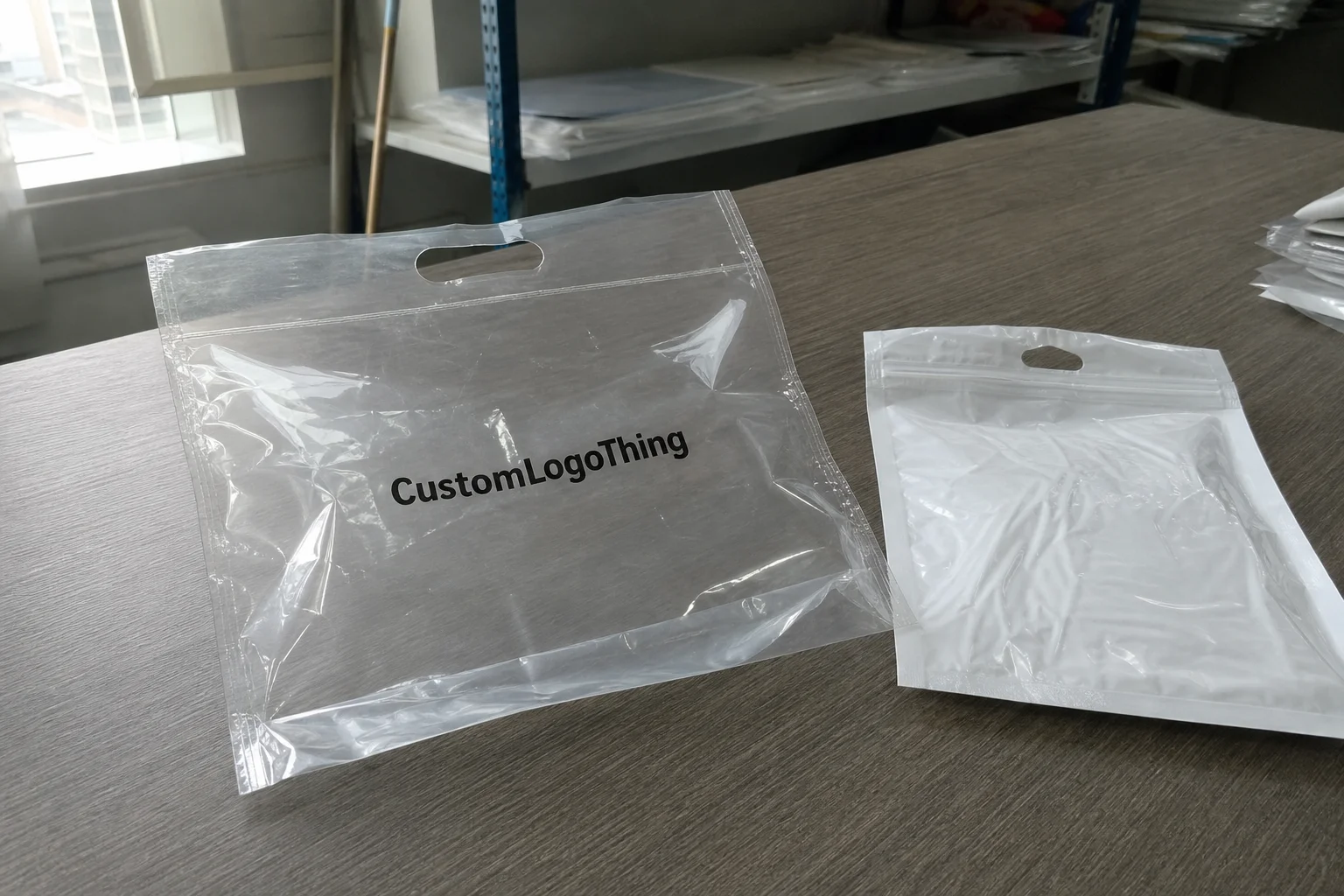
Low-cost bags often save money by reducing film thickness, weakening seals, or using less robust print systems. Those compromises do not always show up in a flat sample. They appear later, once the bag is filled, carried, stacked, or reused. At that point the hidden cost is no longer theoretical: the order has already been delivered, and the problem becomes visible to customers.
Wholesale orders change the maths because setup costs spread across more pieces. If the specification is sound, larger runs can reduce unit price without forcing a fragile bag. The value is in consistency as much as cost. Repeating the same bag across locations or campaigns only works when the size, print, and finish stay stable from order to order.
“The wrong bag is never cheap. It just moves the cost to the second use, the reprint, or the complaint you did not budget for.”
The use case should drive the spec. A folded T-shirt, a glass bottle, and a mixed retail order need different levels of structure. If the bag is reused or folded into inventory, handle comfort and seal strength matter more than a small visual difference. If it travels through distribution, carton packing and pallet stability become part of the product rather than just the logistics.
Bag styles, print methods, and finish options that actually matter
Bag style shapes how the product behaves before the print is even considered. Die-cut handle bags are neat and stack well, which makes them common for retail and events. Patch handle bags feel sturdier and often signal a more substantial product. Gusseted carrier bags add volume and work better when the contents need room. Zip bags suit samples, kits, and small components. Mailing bags are for dispatch and protection, not display.
Print method matters just as much. Flexographic printing is usually the practical choice for larger runs and simple branding because it handles repeat layouts efficiently. Gravure can give very consistent results on larger programmes, but the cylinder cost only makes sense when volume justifies it. Screen printing works well for bold artwork and opaque ink, especially on darker films, but it is less suitable for fine gradients or tiny text.
Finish affects the way the bag reads in hand and in light. Gloss gives stronger colour impact. Matte reduces glare and can feel calmer or more premium. Frosted film sits between the two. Clear film is useful when the product itself should remain visible. Tinted film supports privacy and branding, but it also changes how colours appear under store lighting.
Material choice should be tied to performance. LDPE is softer and more flexible. HDPE is thinner and crisper, often used when a lighter bag is acceptable. Recycled-content films may suit a lower-impact brief, but they still need to pass checks for seal strength, print adhesion, and clarity. A sustainability claim does not make a weak bag acceptable.
For general plastics and disposal guidance, the EPA has useful background at epa.gov. That does not replace a proper spec, but it helps keep the discussion grounded in material handling rather than slogans.
Artwork complexity also changes both cost and risk. One clean logo in one colour is easier to print and easier to repeat consistently. Full-coverage artwork, gradients, small reversed text, or multiple spot colours require more prepress work and more press control. If one side is enough, do not pay for a second side just because the template allows it.
- Retail handout: die-cut or patch handle bag with one- or two-colour branding.
- Product packaging: zip bag, clear bag, or gusseted carrier with thickness matched to load.
- Event distribution: slightly heavier film, simple artwork, and high contrast for visibility at a distance.
Specifications buyers should lock in before requesting samples
If the brief is vague, the sample will be vague too. Before asking for pricing or proofs, define finished size, film thickness, material type, handle style, gusset depth, and print area. Those details control most of the cost and most of the bag’s real-world performance.
Thickness deserves special attention. A bag that looks acceptable in a flat proof may feel flimsy once it is filled. Light apparel can usually work in thinner film, but heavier goods need more structure. If the bag will be carried a meaningful distance or loaded with items that have edges, choose the gauge for use, not appearance.
Artwork files should be ready before the first sample request. Vector files are safer than low-resolution images, and colour references need to be explicit. If brand colour accuracy matters, state whether spot colours are required or whether a close process match is acceptable. Fine strokes, narrow line work, and small reversed text can disappear once they hit press.
Sampling should be treated as a test. Check seal strength, handle comfort, colour consistency, print registration, and whether the bag still feels right when filled with the intended product weight. If the bags will ship inside cartons or travel through distribution channels, carton compression and abrasion also matter. ISTA publishes packaging testing standards at ista.org, which is useful when the bags are part of a longer transit chain.
The common mistakes are straightforward: measuring by eye instead of measuring the packed product, forgetting gusset depth, approving artwork that is too small to read, or changing the design after the proof stage. Packaging projects rarely fail in dramatic ways. They drift because the spec was never pinned down.
It also helps to ask for basic quality control details. Does the supplier inspect seal integrity? Do they verify registration against the approved proof? Is carton count checked before shipment? Those are small questions, but they prevent large problems later.
Cost, pricing, and MOQ for personalised plastic bags wholesale
This is where the spreadsheet becomes the design tool. The main price drivers are order quantity, film thickness, bag dimensions, print colours, and whether custom tooling, plates, or cylinders are needed. A custom size changes the setup. Extra print colours slow the run. Heavier film adds material cost.
MOQ is usually based on setup economics rather than arbitrary policy. A printer has to cover prepress, plate making, machine setup, waste allowance, and the initial run-in before output stabilises. That is why a low-volume order can carry a high unit price even when the material itself is inexpensive.
For Personalised Plastic Bags Wholesale, ask for tiered pricing rather than a single quote. The table below uses a standard custom die-cut handle bag with one-colour flexographic printing as a rough guide. Exact pricing varies by size, thickness, finish, freight, and artwork complexity.
| Order size | Typical unit price | Best fit | Tradeoff |
|---|---|---|---|
| 1,000 to 2,000 pcs | $0.26 to $0.48 | Testing, pop-ups, short campaigns | Higher setup share per bag |
| 3,000 to 5,000 pcs | $0.14 to $0.28 | Retail use, event programs, first repeat order | Good balance of cost and flexibility |
| 10,000+ pcs | $0.08 to $0.18 | Multi-store branding, seasonal stock, recurring orders | Lower unit cost, but larger cash commitment |
The lowest factory quote is not always the lowest landed cost. Freight, carton packing, palletisation, customs handling, and import charges can erase a small saving quickly. If two suppliers are close on unit price, compare total delivered cost rather than the number on the quote. Also confirm whether setup charges, plates, and artwork fees are included.
If the spec is likely to repeat, stability matters more than a one-off bargain. A fixed size and print spec reduce reapproval work, prevent colour drift, and simplify inventory planning. That is why recurring buyers tend to care more about repeatability than about squeezing the first order by a few cents.
Process and timeline: from artwork approval to delivery
A clean process is faster than a rushed one. The usual sequence is enquiry, quotation, artwork check, proof or sample approval, production, quality inspection, packing, and shipping. If one step is unclear, the later steps inherit the problem.
Delays usually come from predictable sources. Artwork is incomplete. Colour references are vague. The buyer changes the spec after the proof has already been issued. Or internal approval stalls because nobody wants to be the final sign-off. The supplier is not always the bottleneck.
For a simple repeat order, turnaround can be faster because tooling, artwork, and size are already locked. For a first-time custom order, extra time is usually needed for plate making, proofing, and quality checks. A straightforward order may take around 12 to 15 business days after proof approval, while more complex print jobs or larger volumes can take longer. Freight is separate.
One question helps avoid confusion: when does the clock actually start? If production begins after payment clears or after final artwork approval, that should be stated clearly. Ambiguity here becomes a delivery dispute later.
Good suppliers also flag limits before production starts. If the artwork contains tiny reversed text, they should say so. If the colour match will be close rather than exact because of the print method, they should say that too. That level of honesty is more useful than a broad promise that everything can be fixed later.
Quality control should not be treated as an afterthought. Ask what is checked before cartons are sealed. A sensible process normally includes print registration, seal integrity, handle strength, and count accuracy. If the order is going to multiple locations, carton labels and pack counts matter almost as much as the bag itself.
Why buyers switch suppliers after one bad packaging run
Supplier changes are rarely dramatic. They usually happen after one bad run creates too much operational noise to ignore. The print is inconsistent. The seals are weak. The delivery misses the selling window. The quote changes once the order is in motion. None of that sounds catastrophic in isolation, but together it can disrupt a campaign or force a retail team to work around a packaging problem that should never have reached production.
Packaging sits in the brand experience, so failure is visible. Shoppers may not know who printed the bag, but they notice when the handle feels weak or the logo looks off. That is especially true in retail chains and event programmes, where consistency across locations matters.
Service detail usually predicts the result better than the sales pitch. Fast sample turnaround helps. Clear prepress feedback helps. Stable QC helps. Straightforward reordering helps. A supplier that can handle those four things without changing the process each time is usually worth keeping.
Communication style is part of product quality. If questions are answered in broad, non-specific language, expect the production outcome to be broad and non-specific too. If a supplier confirms specifications in writing and flags problems before production starts, that is a better signal.
That matters especially for personalised Plastic Bags Wholesale, where small changes in thickness, print coverage, or handle shape can alter the feel of the finished piece. A fractional change in specification can become a noticeable change in use.
Next steps to place a cleaner, faster bulk order
Before requesting quotes, prepare a short specification sheet. Include finished size, material, thickness, quantity, print colours, artwork file type, and delivery postcode. One page is usually enough to reduce avoidable email traffic and make supplier comparisons more honest.
Ask for tiered pricing at two or three quantity bands. A quote for 3,000, 5,000, and 10,000 pieces says far more than a single number. It shows where the break point sits and whether ordering slightly more now will reduce cost enough to justify the stock.
Request a digital proof or reference sample before production, especially on the first order. Check logo placement, handle position, seal line, and the printed size of small text. If the bag is meant to carry a specific product, test it with that product. A bag that works for folded clothing may fail on a boxed item or a bottle because the load behaves differently.
Then confirm the practical details that are easy to overlook: timeline, payment terms, packing method, freight responsibility, and any import issues. The best order is the one that gets approved once, produced once, and delivered without a cleanup list attached. That is the main reason buyers keep returning to personalised plastic bags wholesale instead of chasing one-off runs that look cheaper on paper and cost more in practice.
A cleaner buying process usually comes down to three things: a tighter brief, a more honest price comparison, and a sample that is tested against real use. None of that is complicated. It is just easier to do before the order is in motion.
What is the minimum order for personalised plastic bags wholesale?
MOQ depends on bag size, print method, and whether plates or other tooling are needed. Small runs can be possible, but the unit price is usually higher because setup costs are spread across fewer pieces. Ask for pricing at several quantities so you can see where the better value begins.
Which material is best for custom plastic carrier bags?
The right material depends on the load, appearance, and whether you need a clear, glossy, matte, or recycled-content film. LDPE and HDPE are both common, but they behave differently in hand and under weight. Choose after you confirm the product weight and how the bag will be carried.
How long does production usually take after artwork approval?
Timeline depends on print complexity, order size, and whether tooling is already available. Simple repeat orders can move faster than first-time custom jobs. A practical planning range is around 12 to 15 business days after proof approval, though freight time is separate.
Can I order multiple sizes in the same personalised plastic bags wholesale run?
Yes, but each size may count as a separate specification, which can affect MOQ, tooling, and total price. If you need several sizes, ask for separate unit pricing so the cost difference is visible. In many cases, standardising sizes is the smarter route unless the products genuinely require different dimensions.
What should I check before approving a sample or proof?
Check size, print placement, colour accuracy, seal strength, and whether the handle or closure suits the intended use. Confirm that the artwork remains readable at the printed size and that the bag can carry the actual product weight. If anything is off, fix it before production starts because changes after approval usually cost time and money.


