Personalized Name Labels solve a narrow problem with outsized consequences. They keep clothing from wandering into the wrong drawer, the wrong backpack, or the wrong laundry pile. That matters in schools, daycare centers, sports clubs, shared households, and any place where a stack of nearly identical garments starts looking interchangeable.
The buyer's mistake is usually treating labels as decoration. They are not. A label has to stay readable after washing, sit comfortably against skin, match the fabric it is applied to, and survive the kind of handling real clothes get: being pulled, folded, stretched, stuffed, and washed again. If those variables are ignored, the label becomes a weak point instead of a solution.
That is why the most useful way to evaluate personalized name labels is not by font or color first. Start with construction, attachment method, and wash performance. Style comes after those are sorted. The order matters more than people expect.
Why personalized name labels solve real wardrobe problems
Clothing mix-ups happen quickly. A rack of identical school polos, a bin of daycare jackets, or a locker room full of black athletic tops can turn sorting into guesswork. In those settings, personalized name labels are not a branding accessory. They are a practical identification system that helps clothing make its way back to the right person.
The comparison that makes this clear is simple. A care tag tells you how to wash a garment. A size tag tells you whether it is small or medium. A name label tells you ownership. That distinction sounds minor until a uniform shirt disappears, a hoodie does not come home from practice, or a family starts replacing the same item twice because no one can tell whose is whose.
There is also a financial angle. A label costs a fraction of the garment it protects. That ratio matters most for uniforms, specialty outfits, workwear, and high-use children's clothing, where replacement is annoying at best and expensive at worst. If a garment is likely to be reused, returned, or shared, identification pays for itself faster than most buyers assume.
Caregivers and staff feel the benefit immediately. Daycare workers, camp counselors, school staff, and nurses often handle many similar items in a day. A clear label reduces sorting time and improves the odds that lost items are returned instead of discarded into a general pile. The quieter the label works, the better it performs. Nobody wants to think about it twice.
"A label succeeds when it keeps working after the first wash, the third laundry cycle, and the tenth hurried changeover."
There is a broader systems lesson here too. Clothing is rarely just clothing. It moves through a routine, and that routine includes storage, transport, laundering, and handoff. Buyers who think in systems tend to order smarter because they choose Labels That Fit the full lifecycle of the garment, not just the first day it is worn. For programs that need more than name identification, it can make sense to pair owner labels with other Custom Labels & Tags so garment identity stays consistent across the line.
How personalized name labels are made and attached
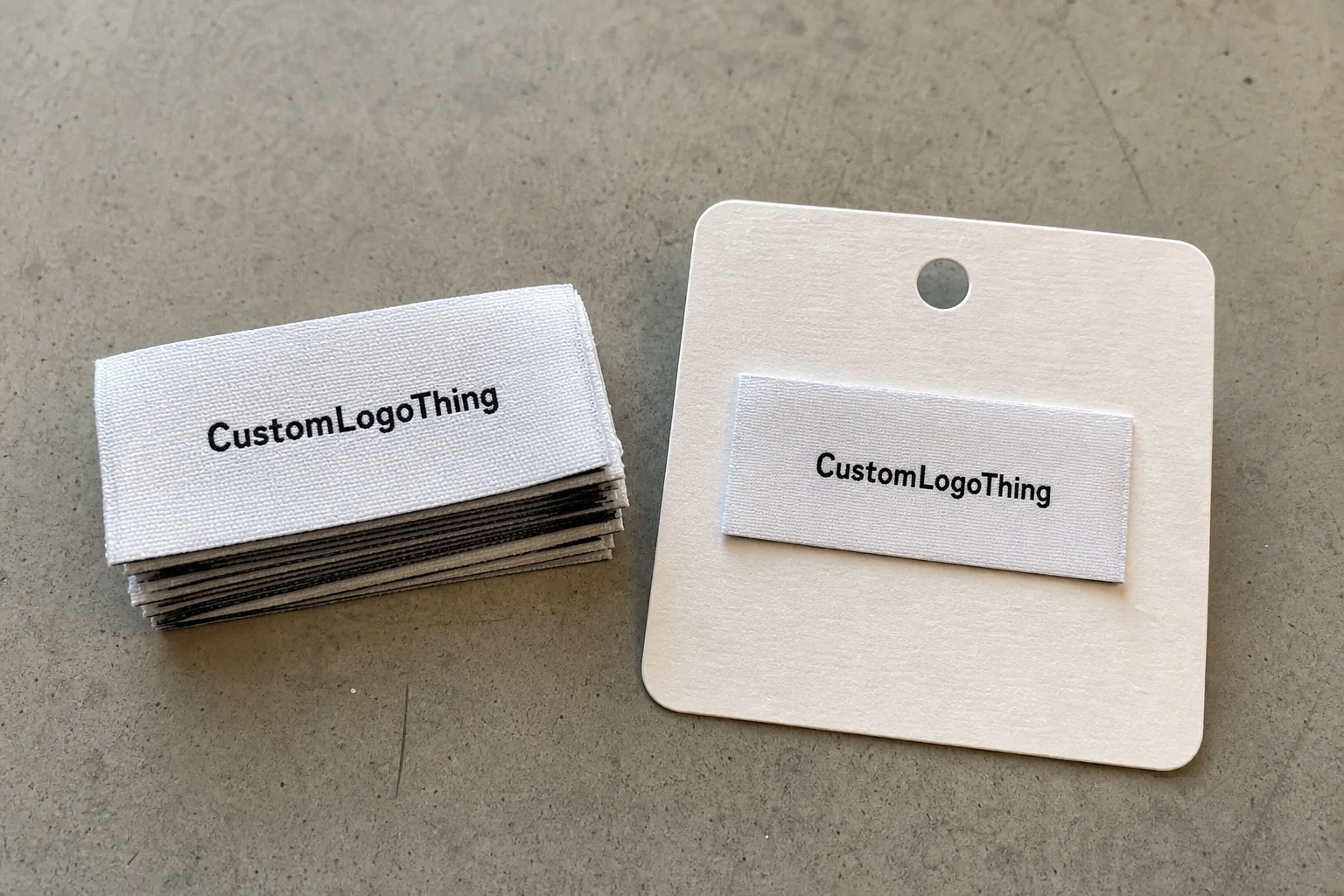
There are several label formats, and each one solves a different problem. Woven labels build the text and artwork into the fabric structure itself, so they tend to look crisp and feel substantial. They suit premium apparel, uniforms, and projects where the label is expected to last as long as the garment.
Printed satin labels are softer and usually a better fit for children's clothing or garments worn close to the skin. The tradeoff is that the print quality depends heavily on the setup. If the artwork is too small, too thin, or too low-contrast, the label can look neat in a proof and blurry in use.
Heat-transfer labels are common for tagless applications. They are applied with heat and pressure, which bonds the design directly to the garment surface. Done properly, they give a low-profile finish with very little irritation. They are not universal, though. Fabric composition, stretch, and surface texture all affect adhesion.
Iron-on labels are close in concept, but often aimed at end users applying them at home. Sew-in labels remain one of the most durable options if the garment can handle stitching. Adhesive labels are usually better for temporary identification, packaging, or short-term use than for repeated laundering. That distinction matters. A label that is perfect for a kit bag may be a bad fit for a school uniform.
The artwork process should be treated like production, not design theory. Text is set first, then font, spacing, line breaks, and any icons or logos. If a name is long, the layout may need to be adjusted so the final cut size still reads cleanly. Proofs should show the actual footprint, not just the wording on a white page. A label can fail on spacing long before it fails on material.
Garment type should influence the build. Cotton, polyester, blends, and stretch knits behave differently. A rigid label may sit fine inside a jacket but feel irritating inside a tee shirt collar. Heavy seams, linings, and edge binding also change how a label sits after application. The same format that works on a work jacket can be wrong for a baby's bodysuit.
A practical comparison helps:
| Label Type | Best Use | Comfort | Durability | Typical Buyer Tradeoff |
|---|---|---|---|---|
| Woven | Premium apparel, uniforms | Moderate | High | Sharp detail and long life, but higher unit cost |
| Printed satin | Children's clothing, soft garments | High | Moderate to high | Comfortable against skin, but print setup must be clean |
| Heat-transfer | Athleisure, tagless applications | High | High | Low-profile finish, but fabric compatibility matters |
| Sew-in | Workwear, uniforms, long-term use | Moderate | Very high | Excellent retention, but it requires stitching |
Material sourcing can be part of the buying decision too, especially for programs that care about packaging and paper inputs. Certifications such as FSC are useful where paper-based components are involved. They do not solve every sourcing question, but they do give buyers a clearer standard for traceability on applicable materials.
Key factors that affect cost, pricing, and MOQ
Pricing is shaped by a small number of variables, and none of them are mysterious. Size, color count, construction method, backing type, finish, and packing format all affect the quote. A simple one-color woven label and a multi-color printed satin label with a soft backing do not belong in the same price conversation.
MOQ, or minimum order quantity, deserves attention early. Small runs usually carry higher unit cost because setup, file prep, proofing, and machine time are spread across fewer pieces. As volume rises, the per-label price usually falls. That is why 500 labels and 5,000 labels do not scale linearly. The setup work does not change much, even if the order size does.
For budgeting, a realistic small-run range is often around $0.18 to $0.35 per label, depending on size and construction. Larger runs can come in lower if the artwork is simple and the production path is efficient. Specialty finishes, more demanding adhesives, or dense woven detail can push the price up. Those numbers are not a quote. They are a practical benchmark so you can read proposals without guessing whether a number is normal or inflated.
Setup-related charges are where buyers get surprised. Ask whether artwork cleanup, digitizing or file prep, proof revisions, sampling, and rush processing are included. A cheap-looking headline price can become expensive once those are added. The cleaner comparison is the one that shows the real landed cost for your actual quantity.
Two orders with the same label size can still price very differently if the details are different. A label with one color on a simple fold is not the same job as a label with multiple folds, a custom edge finish, and a tagless application method. Production complexity is often more expensive than design complexity.
The best way to compare offers is to make the variables visible:
- Confirm the exact size and attachment method.
- Ask what proofing, sampling, and revisions are included.
- Check whether shipping, taxes, and packaging are separate.
- Compare the unit cost at the actual order quantity, not a hypothetical higher volume.
- Ask whether sample charges are credited against production.
Packaging compatibility can matter if the labels are part of a larger apparel program. Folding method, roll direction, and carton packing affect how fast the order can be received, counted, and applied. References from organizations such as The Packaging Machinery Manufacturers Institute are useful when the label has to fit a larger packing or kitting process.
Production process and timeline
Once the proof is approved, the order moves into production. First comes a final check on spelling, color placement, line breaks, fold requirements, and any special finishing notes. Then the label is manufactured, trimmed or finished, and packed in the requested format. Depending on the product, that may be rolls, sheets, strips, or individually cut pieces.
The timeline is usually longer than buyers expect if any part of the artwork is unsettled. The most common causes of delay are misspelled names, low-resolution logos, inconsistent spacing, and late approvals. If the customer is still deciding between two fonts, the order is already at risk. Production cannot stay on schedule if the proof is treated like a draft.
Standard lead times for custom labels often land in the 10 to 15 business day range after proof approval. Simpler jobs may move faster, and more complex builds may take longer. Rush service is sometimes available, but it depends on artwork readiness, current machine load, and the finishing method. A sewn label with multiple colors and a custom fold will almost always take longer than a basic printed strip.
Seasonality matters more than many buyers plan for. Back-to-school demand, camp season, and year-end uniform replenishment can tighten schedules. When volumes rise, the choices that seemed flexible at the start become constrained. Buyers who plan ahead usually get a better price, more finish options, and fewer compromises on lead time.
Good orders arrive with the decisions already made:
- Exact spelling for every name or department
- Confirmed quantity by size or version
- Preferred attachment method
- Placement notes if the label must sit in a specific area
- Any wash, wear, or comfort requirements
Durability testing is worth asking about if the labels will be washed often or handled roughly. For general context on handling and transit conditions, the ISTA resource library is a useful reference point. It helps buyers think more concretely about abrasion, packaging stress, and repeated movement rather than relying on appearance alone.
How to choose the right label style for your garments
The correct label style depends on the garment, not the other way around. Children's wear usually needs softer edges and dependable wash life. Uniforms need clean legibility and a more controlled appearance. Athleisure often works best with tagless or low-profile options because comfort and stretch are part of the product itself, not extras.
Workwear and rental garments require a different standard. If a garment will be washed hard, shared among multiple users, or circulated repeatedly, permanent identification is usually worth the additional effort. For loaner items, resale, or short-term ownership, removable solutions can be smarter because they allow the garment to change hands without leaving a visible mark behind.
Readability depends on contrast and scale. A pale name on a pale background may look elegant in a mockup and disappear in use. A clear font with enough stroke weight usually performs better than a script that curls tightly or thins out at small sizes. If the label needs to be read from a distance, keep the text large enough to survive folding, laundering, and fast visual scanning.
Comfort is the other half of the decision. Stiff edges can rub against the neck or side seam. Thick stitching can irritate sensitive skin. Printed or heat-applied formats often work better in those placements, while woven or sew-in labels can be fine on outer layers, waistbands, or interior seams where touch matters less. A label does not need to be invisible, but it should not become the thing people notice first.
The real tradeoff is usually between appearance, feel, and longevity. The strongest labels are rarely the most ornate. They are the ones that stay readable, stay attached, and stay tolerable after repeated washing. That is a narrow target, and it is why experienced buyers care more about fabric match than graphic polish.
Common mistakes that make custom name labels fail
The first mistake is tiny text. On screen, small lettering can look refined. On a finished label, especially one that is sewn, folded, or washed repeatedly, it can become hard to read. If the name is difficult to read in the proof, it will not improve after production. Small text tends to fail quietly, which is the worst kind of failure.
Low contrast creates the same problem. Dark gray on black, beige on cream, or busy colors on patterned fabric may look tasteful but function poorly. The design may photograph well and still be a bad label. Identification is the job. A label that blends in has missed the point.
Placement is another weak spot. If the buyer does not specify where the label should sit, the production team has to infer a standard position that may not suit the garment. That can mean rework, slower turnaround, or a label that catches in the wrong place. On garments with thick seams, zippers, or lining, placement is not a minor detail. It changes how the label wears.
The wrong attachment method can ruin a good design. Heat-transfer options may not be the best match for textured surfaces or highly stretched fabrics. Adhesives can fail on delicate or uneven materials. Sew-in labels are durable, but they are not always ideal for garments that need a very soft inside surface. The method should follow the fabric, not the mockup.
Proofing errors are the most preventable problem and still one of the most common. Misspellings, inconsistent spacing, and overlooked care instructions usually show up only after the proof is rushed through. That is avoidable. The proof should be reviewed against the real garment use case, not just as a standalone graphic. A name label on a jacket lining is not the same problem as a label on a child's collar.
"A proof is the last chance to catch a problem before it becomes inventory."
There is also a soft failure that does not show up in production specs: overdesign. Too many fonts, too many icons, or too much text can make the label harder to read and less durable-looking. Buyers often add details because the design feels incomplete. In practice, the simplest version usually survives use better than the crowded one.
Expert tips for ordering with confidence
Start with a small test order if you are trying a new material, adhesive, or heat-applied finish. That is the fastest way to confirm feel, wash behavior, and application quality. A sample tells you things a mockup cannot. You can see whether the edges curl, whether the print stays crisp, and whether the label still looks acceptable after handling.
Ask for a sample that reflects real use. A visual swatch is helpful, but it is not enough if the garment will be washed weekly or worn next to skin. You want to understand edge softness, print clarity, attachment strength, and the look after application. Flat on a screen and attached to a real garment are not the same test.
Keep the design restrained if long-term readability matters. Clean type, clear background separation, and enough breathing room around the text usually outperform decorative complexity. If a logo needs to be included, the name should still be the primary message. For garments that move through busy systems, less visual noise usually means fewer mistakes.
Ask for a proof checklist before approval. It should confirm spelling, quantity, size, color, finish, and placement. If the supplier cannot explain those items plainly, the order is not ready. Good communication is part of product quality, not an optional extra. The cleanest production runs usually come from the least ambiguous briefs.
Match the size to the garment range you actually use. A label that works on adult uniforms may be too large for infant clothing. A tiny tag that fits a collar may disappear on outerwear. Buyers who size for the real garment mix tend to get a better result than those who choose only by appearance. Practical fit beats theoretical neatness every time.
Two more checks are worth making before approval. First, ask how the label will be packed so you know whether distribution will be easy or awkward. Second, ask what wash performance is expected in plain language. If the answer is vague, that is a clue. The better the production partner understands the use case, the fewer surprises you get later.
Next steps for placing your order
Before requesting a quote, gather the exact names, quantities, garment types, and preferred attachment method. That short prep step makes the estimate cleaner and reduces back-and-forth during proofing. If the order includes multiple versions, separate them clearly so pricing reflects the real mix instead of an averaged guess.
Decide whether you need a permanent solution, a comfort-first label, or a removable option. Permanent labels fit uniforms and repeat-use garments best. Softer formats work better for children's wear and close-to-skin items. Removable versions are better for loaners, resale, or short-term identification where the garment may later change hands.
Then compare three things side by side: unit cost, lead time, and MOQ. Choosing only the lowest price can create problems later if the label peels, feels wrong, or arrives after the season has passed. A slightly higher quote can be the better buy if it reduces waste, returns, and rework. The cheapest label is not cheap if it has to be replaced.
Once the proof is approved, treat it as final. Check spelling, legibility, quantity, and placement against the garment you will actually use. That is where mistakes are caught, and it is the step that protects the entire order. In label buying, the proof is not paperwork. It is the control point.
At that stage, personalized name labels stop being a research item and become part of the clothing system. They reduce mix-ups, cut replacement cost, and make everyday handling less chaotic. The result is plain, which is usually a sign the product is doing its job.
What are personalized name labels used for on clothing?
They identify garments clearly so clothing does not get mixed up in school, daycare, team, or shared-laundry settings. They also reduce replacement costs because items are easier to return when they are labeled correctly.
Which type of personalized name label lasts longest?
Woven and high-quality heat-transfer labels usually offer strong durability when matched to the right fabric and wash routine. The best choice depends on garment stretch, comfort needs, and how permanently the label needs to stay in place.
How much do personalized name labels usually cost?
Price depends on quantity, label size, construction, color count, and finish, so unit cost can vary widely. Larger orders usually lower the per-label price, while small runs can carry higher setup and production costs.
What is the usual turnaround time for custom name labels?
Standard production often takes longer than stock items because proofs, approval, and custom manufacturing are involved. Rush options may be available, but lead time still depends on artwork readiness and order complexity.
How do I make sure my personalized name labels are readable?
Use strong contrast, a clear font, and a size that fits the garment without crowding the text. Always approve a proof and check spelling, spacing, and placement before production begins.