Buyer Fit Snapshot
| Best fit | Personalized Packaging for Small Business projects where brand print, material claims, artwork control, MOQ, and repeat-order consistency need to be specified before quoting. |
|---|---|
| Quote inputs | Share finished size, material target, print colors, finish, packing count, annual reorder estimate, ship-to region, and any compliance wording. |
| Proofing check | Approve dieline scale, logo placement, barcode or warning zones, color tolerance, closure strength, and carton packing before bulk production. |
| Main risk | Vague material claims, crowded artwork, missing packing details, or unclear freight terms can make a low unit price expensive after revisions. |
Fast answer: Personalized Packaging for Small Business: A Playbook should be specified like a repeatable production item. The safest quote records material, print method, finish, artwork proof, packing count, and reorder notes in one written spec.
Production checks before approval
Compare the actual filled-product size with the drawing, then confirm tolerance on folds, seals, hang holes, label areas, and retail display edges. Reserve space for logos, QR codes, warning copy, and material claims before decorative graphics fill the panel.
Quote comparison points
Review material grade, print process, finish, sampling route, tooling charges, carton quantity, and freight assumptions side by side. A quote is only useful when the supplier can repeat the same color, closure quality, and packing count on the next order.
Personalized Packaging for Small business does more than make a parcel look finished. It changes how the product is remembered. I have watched founders pour money into ads, then wonder why the repeat-purchase rate barely moved, while a modest packaging refresh - a custom sleeve, a better insert, a smarter note - made the brand feel unmistakably intentional. The package is the first physical proof of the promise. If it opens well, travels well, and feels thought through, the customer reads that as care, not decoration. If you are comparing formats, it helps to start with a practical assortment such as Custom Packaging Products that can cover mailers, cartons, sleeves, and inserts without forcing a full redesign.
That matters because the box or mailer is often the only brand touchpoint a customer physically holds. Screens can be scrolled past. A package cannot. For personalized Packaging for Small business, that simple fact changes the economics: a small, disciplined improvement in the unboxing moment can influence trust, referrals, and second-order sales without requiring a bigger ad budget. The trick is not to make everything custom. The trick is to make the right parts custom.
This piece walks through what personalized Packaging for Small business actually includes, how the artwork and structural files move from brief to production, what timelines really look like, where pricing comes from, and which mistakes tend to burn cash. The aim is practical. If a box has to ship, survive transit, and still look credible when it lands on a kitchen table, the design has to earn its keep.
For many small brands, that means choosing one clear visual cue and building around it. A kraft mailer with a sharp logo, a well-written insert, and a clean closure can outperform a louder package that tries to say everything at once. Personalized Packaging for Small business usually works best when the structure matches the product and the message matches the buyer.
Personalized Packaging for Small Business: The Unexpected Growth Signal
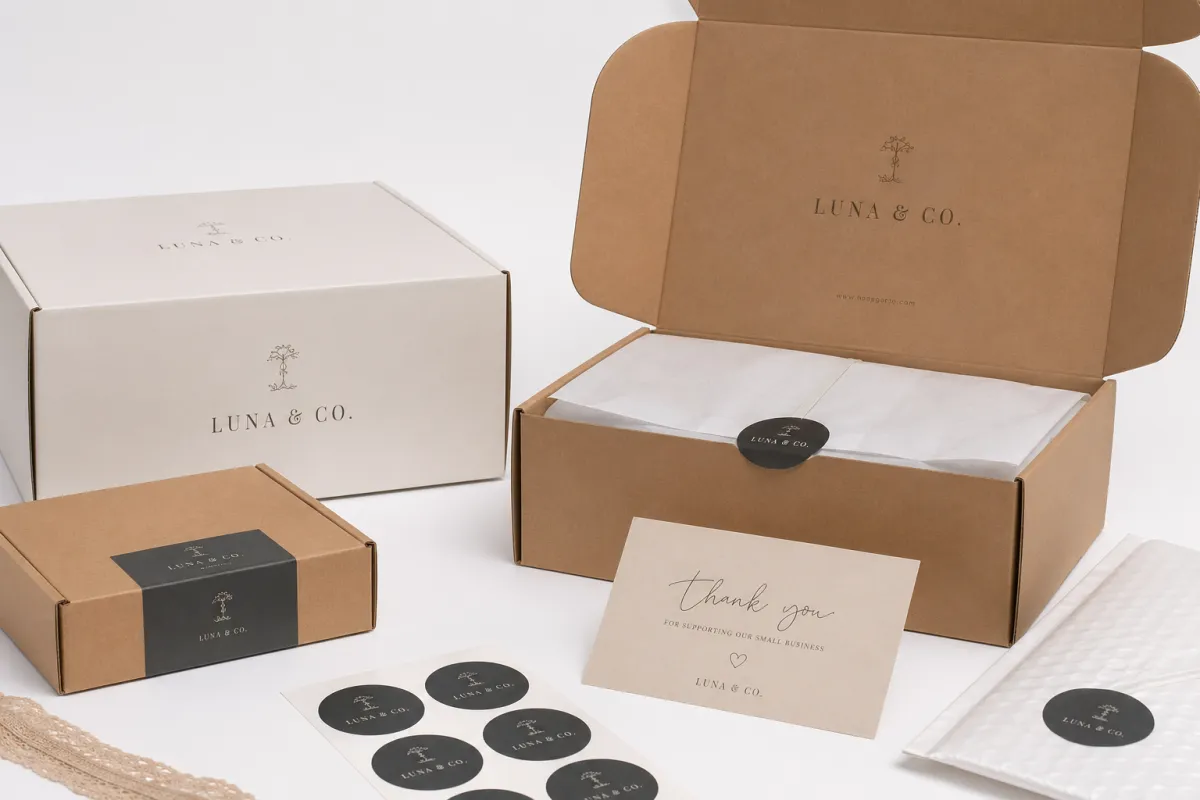
Personalized Packaging for Small business keeps showing up in retention conversations for a reason. It interrupts the usual digital blur. Customers may skim five emails and ignore ten ads, but they notice a package arriving at the door. That moment is physical, brief, and oddly persuasive.
A plain shipper moves an item from point A to point B. A branded box, a custom sleeve, or a tailored insert adds a second layer of meaning. The product still needs to be protected first, of course. But once protection is handled, the package starts doing brand work that a banner ad simply cannot do.
Small runs can still feel premium. Fifty units, one hundred units, even two hundred units can carry a polished look if the details are disciplined. A first-name field, a location-specific message, or a QR code tied to a limited offer can create relevance without turning the operation into a manufacturing headache. That is the whole point: personalization should sharpen the experience, not trip over itself.
Most microbrands do not win by trying to customize every panel. They win by selecting one strong cue and making the rest reliable. A soft-touch insert with one careful message may do more than a box covered in competing graphics. Personalized Packaging for Small business usually rewards restraint. One clear claim. One practical benefit. One dependable structure.
Good packaging lowers doubt before it creates delight. If the package opens cleanly, survives transit, and matches the category the customer expected, it quietly tells them the product inside was handled with the same level of care.
That is why personalized Packaging for Small Business often acts as a trust signal. It suggests the founder is paying attention to fulfillment, product quality, and repeat business, not just launch-day polish. When the structure fits the item, the result can make a first-time buyer feel less like they are taking a gamble.
One quick reality check helps keep expectations sane. Ask whether the same packaging setup would still work if order volume doubled next quarter. If the answer is yes, the architecture is probably healthy. If the answer is no, the problem is often hidden in manual assembly, fragile folds, or a material choice that looked cheap on paper and turned expensive in practice.
What Does Personalized Packaging for Small Business Include?
Personalized Packaging for Small Business is not just a logo on a box. It can include structural design, print format, insert strategy, labels, variable-data printing, QR links, and hybrid systems that combine stock components with one short-run custom element. A good packaging plan treats those pieces as one system, not as separate decorative add-ons.
Three levels usually show up in real projects. The first is brand-level personalization, where the logo, color system, and finish stay consistent across the line. The second is campaign-level personalization, where seasonal artwork, audience segments, or channel-specific messages change from run to run. The third is unit-level personalization, where customer names, loyalty tiers, or event-specific details vary by order. Personalized Packaging for Small business can succeed at any level, but the right entry point depends on labor, budget, and tolerance for mistakes.
Most smaller teams start with the basics: a standard structure, a controlled format size, and one finish that fits the brand story. Matte aqueous coatings, spot gloss, soft-touch lamination, and raw kraft each communicate a different value tier. None of those choices is cosmetic only. They affect scuff resistance, perceived quality, and how the package reads on camera and in hand. Once that base is stable, customer-specific data and campaign inserts can be added with less risk.
There is also a technical side that gets skipped too often. Ask for dielines, print specs, material call-outs, finish descriptions, and the assumptions behind any assembly step. If a supplier only says "custom box" or "branded mailer," the quote is too vague to compare. Personalized packaging for small business deserves clarity on board grade, fold style, adhesive system, print process, and whether the run will be handled digitally, flexographically, or offset.
- Dieline: the cut-and-fold template that keeps artwork aligned after the sheet is printed and converted.
- Print specs: the rules for color mode, bleed, image resolution, and safe area.
- Finish call-outs: coating, varnish, foil, embossing, or lamination details.
- Assembly method: glued, folded, sleeved, kit-packed, or machine-packed.
- Test requirements: drop, vibration, compression, and sealing checks.
For teams comparing suppliers, it helps to review options through fulfillment behavior first and style second. Personalized packaging for small business becomes much easier to execute when the structure mirrors how the pack is actually assembled, shipped, and opened. A good-looking box that fights the warehouse is not a good-looking box for long. For quick benchmarking, many teams compare stock options and short-run formats through Custom Packaging Products before deciding where a fully custom structure is actually justified.
How It Works: From Brand Brief to Production-Ready Files
Personalized packaging for small business moves through a chain that looks simple from the outside and gets expensive when one link is skipped. The safest sequence is straightforward: brand brief, message hierarchy, format decision, printer compatibility, sample approval, and production sign-off. That order is not bureaucracy for its own sake. It is how you avoid paying twice for the same mistake.
The brief should define the pack's first job before any visual direction is discussed. Is the package protecting a fragile product, communicating premium positioning, or creating a memorable opening moment? Those are different problems. A cosmetic vial needs crush protection and secure closure. A candle brand needs shelf appeal and gift-readiness. A wellness sample kit needs clean barcode placement and readable lot tracking. Personalized packaging for small business works best when purpose comes before aesthetics.
Material and structure decide whether the concept survives real use. Thin stock can buckle during packing. Heavy board can improve presentation, but it can also raise freight weight. Barrier choices matter for scent-sensitive or food-adjacent items. Coatings affect both scuff resistance and how the package photographs. And adhesive choice is not a footnote. A package that opens badly at the seam becomes a complaint magnet by week two.
I have seen teams approve gorgeous mockups, then watch them fail at the packing bench because the board was too soft for the actual handling route. That part is kinda humbling. The flat render never showed the score-line stress, the lift from the insert, or the way a tight tuck flap slows a fulfillment team down.
The file stage is where many projects quietly slip. A common US bleed is 0.125 inch, though the printer may specify something different. Artwork usually stays in CMYK unless the production partner says otherwise. Images should generally sit around 300 ppi for dependable print quality. QR codes need strong contrast, quiet space around the code, and placement away from folds. Barcodes need clean scanner access and no glare. Personalized packaging for small business gains credibility only when the files are engineered for print, not just presentation.
A mockup is not production readiness. The supplier still needs final copy, locked artwork, legal text where required, and a plain assembly note that spells out what happens in the warehouse. If variable data is part of the job, define which elements change and which remain fixed before proofs start. That single step can save days. Sometimes a full week.
Ownership matters too. One person should hold artwork consistency. One should manage material and supplier constraints. One should approve final changes. When too many people weigh in on the same proof, personalized packaging for small business gets slower and less coherent, not better.
Quality logic should stay close to real distribution standards. The International Safe Transit Association, or ISTA, publishes test methods used to benchmark shipment performance, and many teams borrow that same mindset for drop, vibration, and compression risk. Not every small run needs a full lab cycle. But a package that has to ship should at least be judged by the stresses it will actually face.
Process and Timeline: A Small-Business-Friendly Production Calendar
Personalized packaging for small business goes smoother when the team tracks real week-level tasks instead of vague lead times. On a clean schedule, week one is for concept and brief, week two for proofing and sample development, week three for corrections and approvals, and week four for printing, inspection, and shipping prep. That is a realistic launch rhythm. It is not a promise that every supplier will move that fast.
Design work can move quickly in a small team. A founder, designer, and fulfillment lead may settle on a direction in one meeting if the decision chain is short. Production, though, follows physical limits. Press queue timing, courier cutoffs, and late file changes can push a delivery by days, and sometimes by more than a week. Personalized packaging for small business can be nimble on ideas and still be bound by machines, labor windows, and transport schedules.
Here is a planning framework that usually holds up:
- Week 1: finalize the brief, choose the format, lock the artwork layout, and align quote assumptions with the supplier.
- Week 2: run the proof cycle, review samples, validate color expectations, and test assembly behavior.
- Week 3: apply corrections, review legal text, and secure production approval.
- Week 4: complete the print run, inspect the batch, and ship finished goods to packing or fulfillment.
That calendar can compress when files are mature, supplier templates already exist, and materials are standard. It stretches when custom coatings, variable data, or multiple insert versions enter the mix. Personalized packaging for small business gains speed when board type, finish, and personalization logic are reduced to a smaller set of controlled variables.
The friction points are pretty predictable. A late QR code change, an extra compliance sentence, or a seasonal message can trigger a fresh proof round. Missing dielines are worse because structural fixes touch more than one department. A tiny shipping-label typo can create its own mess if a launch date, campaign timing, or legal line is involved. Nobody wants to discover that after the boxes have already landed.
A safer approach starts at the end and moves backward. Confirm the content approval target, then lock the dieline, then select materials, then book the proof window. Personalized packaging for small business stays easier to manage when the sequence is protected from the start.
Cost and Pricing Factors for Personalized Packaging for Small Business
Personalized packaging for small business can look expensive if you only stare at unit price. That is a common mistake. Real pricing is a stack of cost buckets: artwork prep and setup, press setup, minimum order quantity effects, material quality, finish complexity, color management, assembly labor, and freight. Leave one out and the quote starts lying by omission.
The table below shows planning ranges, not promises. Board grade, print coverage, finish choice, and quantity will reshape every line item. Still, a pattern shows up again and again: lower quantities push unit cost up, and simpler structures cut setup pain. Personalized packaging for small business should be judged by landed cost, not headline cost alone.
| Option | Typical MOQ | Approx. Unit Cost | Best Use | Main Tradeoff |
|---|---|---|---|---|
| Printed sleeve + stock box | 250-2,000 | $0.40-$1.20 | Light branding with controlled cost | Less structural distinction |
| Custom mailer box | 500-5,000 | $1.25-$3.50 | Ecommerce shipping and unboxing | Higher setup and freight weight |
| Insert card + label system | 100-10,000 | $0.08-$0.35 | Campaigns, loyalty notes, and promos | Depends on manual pack-out discipline |
| Fully custom folding carton | 1,000-10,000 | $0.30-$0.95 | Retail packaging and shelf presentation | Needs tighter dieline and proof control |
Value comes from more than appearance. Better opening flow can reduce return friction from damage, improve referral willingness, and cut repetitive support replies about missing pieces or suspect authenticity. Those savings do not always show up on the print quote, but they change the margin picture in a real way. Personalized packaging for small business proves itself when the post-delivery experience gets cleaner.
Most teams should compare at least two MOQ levels. A 250-unit run may feel expensive, but a failed first run at 1,000 units usually costs more in time, materials, and morale. Reprint fees can swallow sample costs fast, especially when fold errors force mass correction. Bundling inserts, labels, and outer mailers in one quote request often produces a more accurate labor estimate than pricing each piece separately.
Unexpected charges show up often: storage handling, reproofing cycles, late mailers, insert updates, and compliance additions. Vague scope language is usually the trigger. Personalized packaging for small business stays easier to defend financially when the scope is explicit and the variables are limited.
Material policy affects both cost and credibility. FSC-certified board may support responsible sourcing goals, while shipping and recycling choices connect to broader sustainability plans. The Forest Stewardship Council is a practical benchmark when a brand wants sourcing language that can actually be verified instead of generic "eco-friendly" claims.
Step-by-Step Guide to Launching Personalized Packaging for Small Business
Personalized packaging for small business works best when the launch is narrow enough to control and specific enough to measure. A five-step sequence keeps momentum without letting the project sprawl into a dozen disconnected choices.
- Audit the use case. Decide whether protection, presentation, or surprise is the main role. Heavy shipping routes demand structure first. Shelf-facing campaigns prioritize perceived value. Repeat-order goals usually depend most on the unboxing moment and the clarity of the next action.
- Write a constraint sheet. Record dimensions, material type, finish, personalization method, inventory assumptions, and fulfillment-tool compatibility. Personalized packaging for small business stays under control when the brief leaves no room for guesswork.
- Request identical quotes. Send the same spec packet to at least two converters and ask for lead time, proof windows, and quality checks. Side-by-side comparisons fail quickly when one estimate includes premium finishing and the other does not.
- Approve one prototype path. Set acceptance rules for print consistency, opening motion, edge resistance, and panel stability before finalization. A pilot of 20 to 100 units often reveals handling and fit problems that spreadsheets miss.
- Measure the pilot. Track damage rate, reseal success, packing time per order, and opening-response behavior. Personalized packaging for small business should improve measurable outcomes, not just make a stronger argument in a team meeting.
A useful operating rhythm is a live packaging scorecard. Rate each prototype against brand fit, print quality, shipping durability, packing speed, and unit economics with simple pass/fail fields. Ambiguous language slows teams down; scorecards make decisions visible and repeatable.
Starting small is usually smarter. A stock core format plus one personalization layer often beats a fully custom structure on the first launch. For many categories, a standard mailer with a printed insert is enough to test response before adding more complexity. Personalized packaging for small business does not need a dramatic redesign on day one.
Plan the next run before the first batch leaves the warehouse. A successful pilot should already trigger replenishment logic: same supplier continuity, same board and finish availability, and source files that can be archived without rebuilding them from scratch later. Personalized packaging for small business compounds value when the second run is an extension, not a reset.
Common Mistakes That Drain Small-Business Packaging Budgets
Packaging budgets for small brands usually erode through repeated small errors, not one dramatic failure. Personalized packaging for small business gets expensive when teams combine too many SKUs, too many personalization layers, and too little pre-production review.
The first trap is over-customizing before demand is stable. Three box sizes, four insert variants, and rotating seasonal labels can create dead inventory if the market has not settled yet. Cash then sits in cartons instead of marketing and fulfillment capacity, and reorder decisions become harder than they need to be.
The second trap is ignoring production feasibility. A mockup can look flawless and still fail under fold stress, crack at score lines, or slow the packing line. Certain coatings look beautiful in photos but scuff in transit. Some closures are too tight for daily fulfillment pace. Some structures quietly assume manual labor that nobody budgeted for. That is the kind of mistake that feels minor until the warehouse gets busy.
The third trap is fuzzy personalization data logic. Font fallback behavior, long names, apostrophes, and non-Latin characters can all trigger overflow and ugly line breaks. If the template cannot handle a long surname or a special character in the first-name field, the process is not production-ready. Personalized packaging for small business is much safer when data rules are explicit before variable files start moving.
The fourth trap is skipping compliance and channel constraints. Food and supplement categories often require ingredient copy, warning language, lot tracking, and recycling symbols. Retail channels may demand barcode scan-readability under different lighting conditions. Small order volume does not buy a free pass on those rules.
The validation mindset should mimic end-use reality. Test opening, resealing, scuff resistance, and scan performance in the same order the customer or carrier will encounter them. If shipping stress is likely, compare the results against ISTA-style thinking for transit handling. Personalized packaging for small business is only as reliable as the path it survives.
This checklist cuts waste more effectively than wishful thinking:
- Confirm dieline revision and artwork version.
- Verify print contrast, bleed, and safe-zone discipline.
- Check barcode placement and scanning clearance.
- Review compliance text and recycling symbols.
- Approve sample stock, finish quality, and fold behavior.
Once that list is firm, personalized packaging for small business stops feeling improvised and starts operating like a controlled system.
Expert Tips and Actionable Next Steps for Personalized Packaging Success
Personalized packaging for small business works best as an iterative setup, not as a finished monument. The first version only needs to prove the core experience, protect the product, and produce enough data to guide the second version. Overbuilding too early often delays proof and creates more complexity than revenue.
The minimum viable packaging mindset helps. One size, one material, one personalization field usually reveals the key response signal. If conversion improves but damage climbs, structure changes beat new graphics. If damage stays flat but packing time climbs, simplify assembly before changing the design language. Personalized packaging for small business should move toward better margins and smoother operations, stage by stage.
Build a scorecard before each production cycle. Rate brand coherence, print consistency, logistics safety, unboxing sensation, and unit economics. If two of those five checks fail, the format probably does not belong in the next run. Clear yes/no gates help teams make decisions with less debate and more evidence.
A 60-day implementation sprint that works well for many small operations looks like this:
- Week 1: short-list suppliers, finalize the brief, and gather current pack dimensions.
- Week 2: review proofs, request one controlled sample route, and verify material availability.
- Week 3: test pilot batches for damage, opening speed, and packaging labor requirements.
- Week 4: revise design, approve files, and lock reorder timing.
That cadence keeps personalized packaging for small business from drifting into endless redesign cycles. It also gives finance and operations a concrete moment to compare landed cost against customer behavior. If retention rises or complaint rates drop, a higher-quality material or a bolder finish can be justified. If not, the plan can scale down before money disappears into another order.
For teams serving both ecommerce and retail, consistency matters. Keep the outside shell stable for brand recognition, then use the inside space for campaign details or customer-specific personalization. That split reduces structural rework and allows faster promo changes. Personalized packaging for small business can be disciplined and still feel current.
The clearest takeaway is simple: start with one stock structure, one personalization layer, and one pilot batch, then measure damage, packing time, and repeat behavior before adding more complexity. That sequence keeps personalized packaging for small business grounded in evidence instead of guesswork.
How much does personalized packaging for small business usually cost per order?
Cost shifts with size, material, color count, finishing choice, and quantity, so a meaningful comparison should include at least two or three MOQ points such as 250, 500, and 1,000 units. Personalized packaging for small business tends to look pricier at first because setup, freight, and assembly labor rise, then becomes more efficient once those fixed costs are spread across volume. A quote for custom printed boxes or branded mailers is only useful if it also shows labor and freight assumptions.
How long does personalized packaging for small business take from first draft to shipping-ready?
A practical baseline is 3-5 weeks when artwork approvals move quickly and materials are standard. Specialty coatings, variable inserts, or extra sample iterations usually add 1-2 weeks. Personalized packaging for small business stays on schedule when dieline, legal copy, and proof windows are confirmed early.
Can I do personalized packaging for small business with low quantities without paying too much?
Yes. Keep the first run focused, reduce personalization variables, and pick one core structure plus one accent detail. A stock box with a printed insert often beats multiple custom variants in early stages because setup overhead stays controlled. Personalized packaging for small business performs better when the first batch verifies demand before scaling complexity.
What is the biggest risk in personalized packaging for small business quality control?
File inaccuracy usually leads the risk list, especially color shifts, incorrect dieline placement, and text that shrinks into illegibility at production size. Fold behavior and opening consistency are a close second; a package that looks good in mockups can still feel awkward in real use. Personalized packaging for small business should always be validated with sample stock, realistic assembly conditions, and scanner-friendly checks.
Should small teams include variable-data personalization for personalized packaging for small business?
Variable data adds real power in segmented drops, loyalty programs, and event-based editions, but only after a stable baseline format is in place. Keep text fields short, include fallback logic for long names or special characters, and start with a narrow pilot batch. Personalized packaging for small business becomes safer when variable output is treated as a controlled manufacturing step, not a marketing experiment.


