Pet treat Cuffed Knit Beanies unit cost review only makes sense when the buyer looks past the headline number. A cuff changes the structure, decoration changes labor, and packaging can add more cost than expected once labels, inserts, and bagging are included. Two quotes can look similar while assuming very different specs, which is why the real comparison is not supplier style but production scope.
That is the core issue with custom knitwear pricing. A plain stock beanie and a cuffed branded beanie may look close in a product photo, but the order structure is not close at all. One may be a blank cap with a woven label. The other may need embroidery, a private label tag, folding rules, and carton packing that works for retail or fulfillment. Those details affect the final unit cost whether the buyer planned for them or not.
A useful review focuses on what is built into the quote. The buyer needs to know which costs are fixed, which are per piece, and which change when specs change. Without that breakdown, cost comparisons are not reliable.
Why Pet Treat Cuffed Knit Beanies Cost More Than Plain Stock
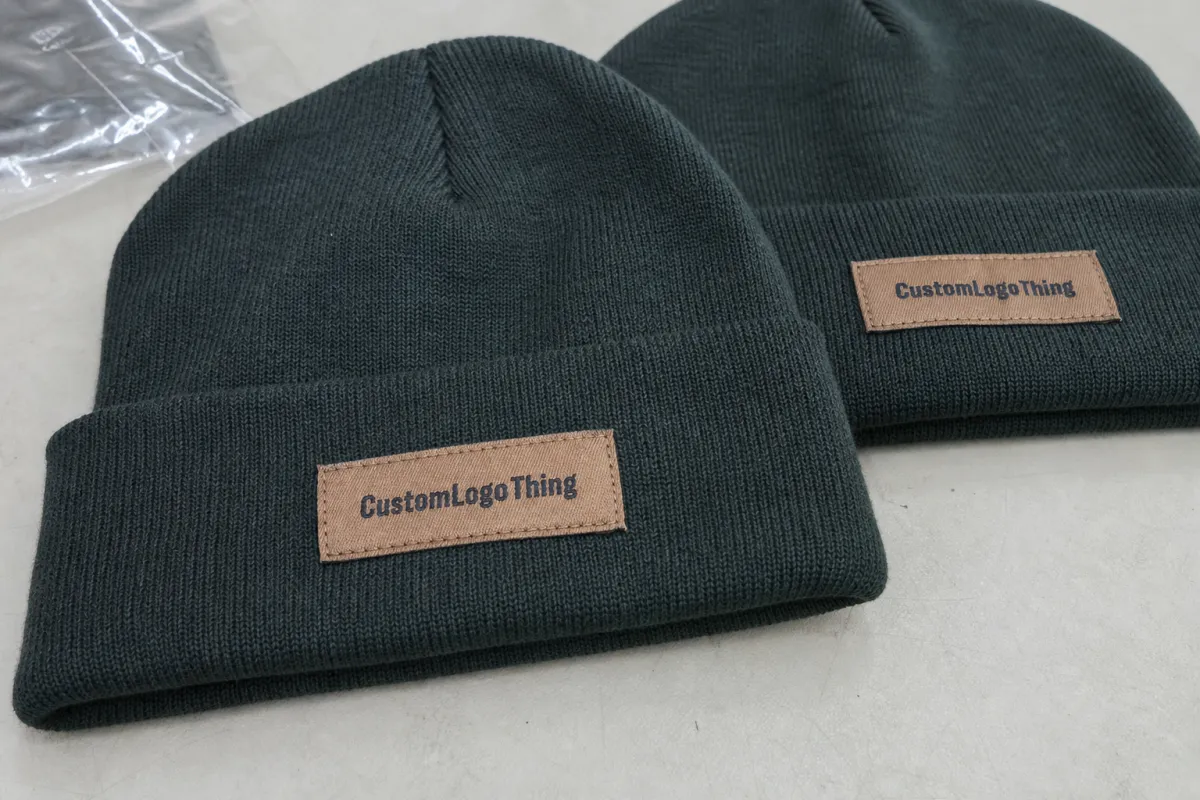
Custom knitwear is priced differently from off-the-shelf stock. A basic beanie can be produced in limited colors, packed quickly, and sold with little handling. A cuffed version usually requires more setup before production starts. The cuff creates a visible branding zone, but it also changes the knit path and finishing steps.
The price difference usually comes from three areas. First, the cuff construction adds material and a more exact finish. Second, the knit density changes yarn usage and machine time; tighter knits typically cost more than loose ones. Third, the branding setup adds labor. A woven label is straightforward, while embroidery, patches, or custom care labels require more steps and more inspection.
Small requests can move the number quickly. Shifting the logo to the cuff edge may require a different sewing route. Asking for a two-color stripe can mean a new yarn set or a longer approval loop. Adding a hangtag or insert card turns the job into a packing project as much as a knit job.
Lower unit cost usually depends on simple artwork, higher volume, and standard folding and packaging. Once the order adds more colors, more branding elements, or custom retail assembly, the quote rises. That is why two suppliers can give very different numbers even when both are being honest.
If setup, decoration, and pack-out are blended into one line, the number may look tidy but it is hard to compare. A proper review separates fixed charges from per-piece charges and checks whether both quotes use the same assumptions.
Construction Details That Affect Bulk Unit Cost
Construction details drive cost more than many buyers expect. A cuff that looks minor on a sketch can change the silhouette, the decoration area, and the amount of knit time required. A taller cuff gives more branding space and a heavier retail feel, but it also uses more material and can push the unit price up.
The main specs are cuff height, overall beanie length, knit gauge, yarn blend, fit profile, and decoration placement. Standard acrylic is usually the lowest-cost option. Acrylic-wool blends cost more but often look and feel closer to retail knitwear. Recycled blends can sit higher still because the yarn itself may cost more and the color range may be narrower. A tighter gauge usually means more machine time and a cleaner finish.
Decoration changes the quote as much as the knit itself. Woven labels tend to be the lightest cost addition. Embroidery uses thread, digitizing, and machine time. Patches can be moderate or expensive depending on the material, shape, and attachment method. Sewn-on labels are usually less costly than molded badges or multi-piece constructions. If the buyer wants a private label inside the cuff, that adds another finishing step and another chance for misalignment.
Color decisions matter too. A standard in-stock yarn color is faster and cheaper than a custom dyed one. Exact Pantone matching may be possible, but it can also trigger a higher minimum, a longer approval cycle, or a more limited yarn selection. That matters when the buyer wants a specific shade without paying for a full development run.
Sample pricing is another place where confusion starts. A pre-production sample often takes more hands-on work than the bulk run because the factory is checking structure, logo placement, and finish details. That sample cost should not be treated as the true bulk benchmark unless the sample was produced under production-level conditions.
Specifications Buyers Should Lock Before Requesting Samples
Most pricing problems begin with missing information. A supplier cannot price accurately if the brief is vague. If the buyer says the order is flexible but never defines the acceptable range, the quote usually comes back padded or incomplete. The cleanest orders start with a spec sheet, not a long email thread.
Before requesting samples, lock these basics:
- Finished size and fit target, such as adult retail, promotional, or one-size-fits-most.
- Cuff width and overall beanie height.
- Yarn blend and knit pattern.
- Decoration method and exact placement.
- Packaging format, including whether the item ships folded, bagged, tagged, or carton-packed.
Then define the details that are easy to overlook. Inside labeling, care tags, barcode placement, hangtag size, and folding method all affect the production line. If the beanie needs to fit a retail peg, shelf carton, or fulfillment carton, that should be stated early. A supplier can usually work around these needs, but only if they are told before the sample is approved.
Artwork also needs discipline. Vector files reduce errors. Logo size should be given in millimeters or inches, not “roughly this big.” Color references should be tied to a standard where possible. If a retailer, distributor, or marketplace has packaging rules, those should be included before sampling starts.
One spec sheet saves more money than repeated back-and-forth. It also makes a cost review more useful because each supplier is answering the same brief. That is the only fair way to compare a quote.
Pet Treat Cuffed Knit Beanies Unit Cost Review: Pricing, MOQ, and Quote Triggers
Here is the part buyers usually want first: what does it cost? For custom Cuffed Knit Beanies, pricing normally breaks into five pieces: setup charges, base manufacturing, decoration, packaging, and freight. If a supplier gives one all-in number without a breakdown, the quote is harder to compare and harder to audit.
For planning, these ranges are common:
| Option | Typical MOQ | Cost per Piece | Notes |
|---|---|---|---|
| Simple knit beanie with woven label | 300-500 pcs | $2.80-$4.80 | Lower setup, standard fold, basic polybag |
| Custom cuffed knit beanie with embroidery | 500-1,000 pcs | $3.60-$6.50 | More labor, more finish control, moderate setup charges |
| Premium version with patch, private label, and insert | 1,000+ pcs | $4.50-$8.50 | Higher pack-out cost, more parts, tighter approval cycle |
Those are planning bands, not promises. Yarn choice, color count, branding area, and packing specs can move the quote quickly. A custom yarn color may add time and cost even if the beanie itself is simple. Extra decoration on the cuff can also add more than expected because the cuff is the first thing people see and the last thing a factory wants to get wrong.
MOQ affects unit cost directly. Small orders carry a higher per-piece price because setup fees, sample work, and decoration prep are spread across fewer units. That does not make low MOQ orders bad; it means the buyer should expect less room for customization and less pricing efficiency. If a quote looks unusually cheap at a tiny quantity, check whether finishing, labeling, or freight were omitted.
Most quote triggers are easy to spot once you know where to look. More colors, more stitches, custom dyed yarn, patch tooling, special folding, individual bagging, and retail inserts all push cost upward. Even a packaging change can matter. A plain folded polybag is not the same as a retail-ready pack with a header card and barcode.
To compare sellers fairly, ask what is included in the unit price. Does it cover labeling? Does it include fold-and-bag? Is digitizing part of the number or billed separately? Are there additional fees for sample revision, color matching, or packaging proofs? If those answers are vague, the number is not clean enough for purchasing decisions.
Production Steps, Lead Time, and Turnaround Risks
Lead time is a chain, not a single number. A typical order moves through artwork approval, sample development, sample approval, bulk knitting, decoration, finishing, packing, inspection, and freight booking. If one step stalls, the schedule shifts.
For a standard custom knit order, bulk production often takes 12-20 business days after final approval, depending on volume and finish complexity. Sample timing sits before that and can vary widely. Transit time comes on top of production, so the full door-to-door timeline is longer than the factory promise on its own.
Late artwork changes are the biggest source of delay. Packaging edits come next. A label change may seem harmless, but it can alter counting, folding, and pack-out instructions. Once the sample is approved, those changes often create rework for production and QA teams.
Seasonality matters more than many first-time buyers expect. Winter retail resets, holiday campaigns, and gift programs crowd the schedule fast. A supplier with open capacity in spring may be fully booked by late autumn. Rush orders are possible in some cases, but they usually narrow color choice, reduce packaging flexibility, and shrink the room for negotiation on price.
There are also shipping and compliance details to watch. If cartons will move through distribution centers, it helps to check transit packaging against ISTA methods. If labels or inserts make sustainability claims, confirm the claim against the source documentation before print. For paper-based inserts or cartons, some buyers also ask for FSC-aligned paper where the claim is relevant.
The production team can only hold the unit cost steady if approvals are steady. Sloppy approvals make the order expensive. Slow approvals do too, just with more waiting and fewer good options.
What a Reliable Supplier Should Deliver Beyond the Quote
A reliable supplier is not just a price source. It is a filter. The right partner tells you what is practical, what is expensive, and what should be removed before the order starts. That kind of feedback cuts down on rework, and rework is where small margins disappear.
At minimum, a competent supplier should provide clear costing, quick spec checks, sample coordination, and realistic feedback on decoration and packaging. If the answer includes exact dimensions, exact counts, and a believable timeline, that is a positive sign. If the reply is vague and light on details, the buyer should slow down.
Quality control matters more on knitwear than many buyers assume. The checks should cover stitch consistency, cuff shape, logo alignment, label placement, fold accuracy, and pack count. On bulk orders, even a small packing error becomes a real issue fast. A 1% count problem on 5,000 pieces is 50 units, which affects inventory, fulfillment, and sometimes billing.
A solid supplier should also be able to document the order cleanly. Quote breakdowns, material notes, sample photos, and milestone updates make internal approval easier for purchasing, operations, and marketing. That matters because custom knitwear often sits between brand standards and warehouse reality. A beanie can look right in a photo and still fail on fold size, label placement, or carton fit.
There is also a difference between a manufacturer and a reseller. If a seller cannot explain tooling fees, setup charges, or why one decoration method costs more than another, the quote may be more marketing than manufacturing. That does not mean the number is useless; it means it needs more verification before it can be trusted.
Next Steps to Get an Accurate Quote and Order Plan
Start with the full spec set: target quantity, beanie size, yarn blend, branding method, packaging style, and delivery destination. Those pieces matter more than a broad request for “custom beanies.” Without them, the quote will either carry too much margin for uncertainty or leave out items that will be billed later.
Send artwork early. Tiny type, awkward placement, and color conflicts are cheaper to fix on a file than on finished knitwear. Once the sample is built, every correction costs more.
Ask for a line-by-line estimate that separates base unit cost, setup, decoration, packaging, and freight. If the seller can break the price apart, comparison becomes practical. If they cannot, the quote may still be real, but it is too opaque to use for a proper review.
A simple buying sequence works best:
- Approve the spec sheet.
- Review a sample or proof against the same spec.
- Confirm the bulk timeline and packing method.
- Lock the production slot.
If budget pressure is high, compare one premium version and one controlled-cost version. Often the difference sits in yarn, decoration, or packaging rather than in the beanie itself. That gives a real tradeoff instead of a false choice between cheap and nice.
The practical version of a cost review is simple: define the spec, separate the quote components, and compare like for like. That produces a cleaner price, a steadier schedule, and fewer surprises once production starts.
What changes pet treat cuffed knit beanies unit cost the most?
MOQ, decoration complexity, and custom yarn or label choices usually move the price fastest. Packaging changes and late artwork revisions also add cost because they create more labor and setup time.
What MOQ should I expect for custom pet treat cuffed knit beanies?
MOQ depends on the decoration method and how many color changes the design requires. Smaller orders are possible, but the unit cost usually rises because setup is spread across fewer pieces.
How long does production take after artwork approval?
Bulk production often runs 12-20 business days after final approval, with shipping added on top. Sample timing, packaging edits, and seasonal congestion can extend the total schedule.
Can I lower price without cutting quality on pet treat cuffed knit beanies?
Yes. Use standard packaging, reduce color changes, and keep the decoration method simple. The goal is to remove waste, not remove the features buyers actually notice.
What files and specs do you need for an exact quote?
Send vector artwork, target quantity, size, material preference, branding method, packaging request, and delivery destination. A clear spec sheet gets a cleaner quote and avoids the usual back-and-forth that slows ordering.


