Buyers often think knit headwear is easy until the first sample arrives and the tea color reads warmer than expected, the cuff feels too soft, or the surface finish changes the hand feel more than the artwork ever could. A tea Cuffed Knit Beanies material sample guide exists for that exact moment. It turns a single physical sample into evidence, not a polite preview. That difference matters because a beanie that photographs well can still fit poorly, pill quickly, or look off once it is worn under real light.
The best sample reviews answer a simple question: what are you actually approving? Fiber blend? Cuff recovery? Stitch density? Color under daylight? Packaging? If those variables are blended into one vague yes-or-no decision, the bulk run usually exposes the weak point later. Experienced buyers separate the variables, check them one by one, and keep the same standard throughout the project.
What a Tea Cuffed Knit Beanies Material Sample Guide Reveals
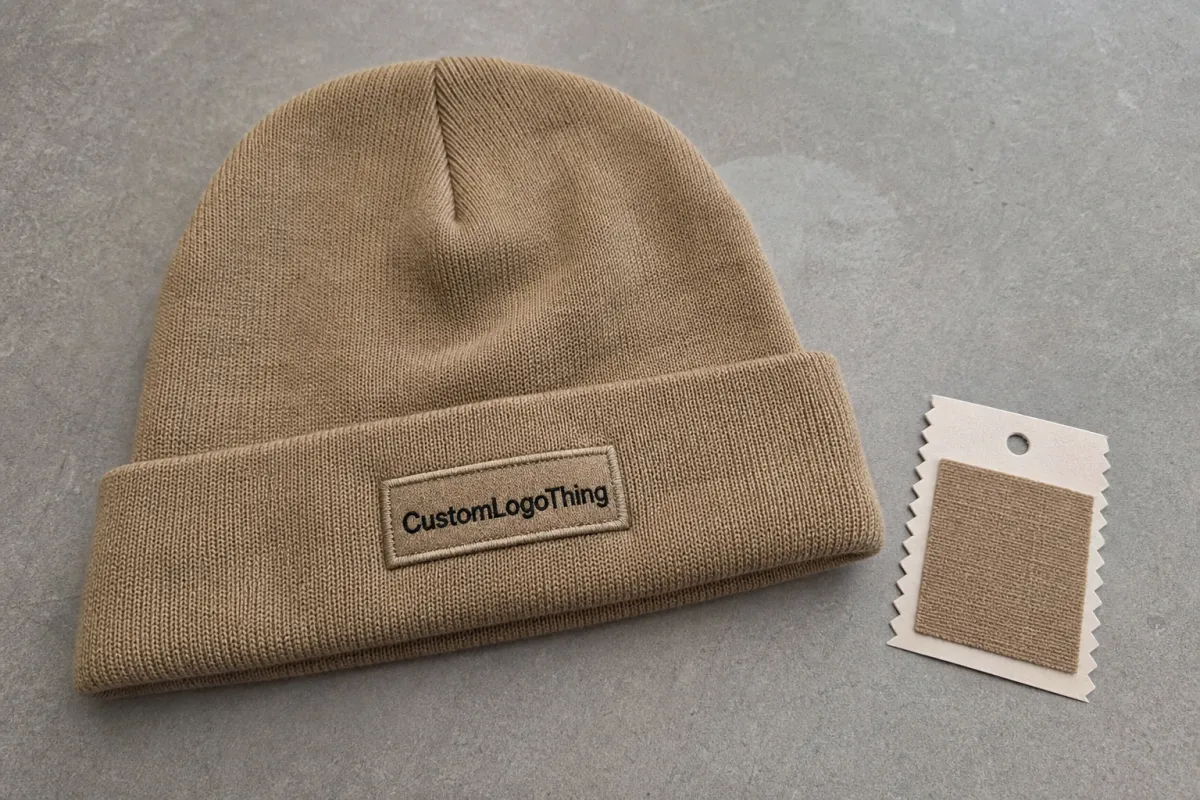
This tea Cuffed Knit Beanies Material Sample guide matters because the biggest problems rarely appear in the mockup. They show up in the hand. A sample can be the right size and still feel scratchy, the tea shade can shift in different lighting, or the cuff can lose shape after one stretch test. None of that is minor if the beanie is meant for retail, gifting, or seasonal promotion. It is the difference between a reorder and a write-off.
Tea tones are especially tricky. They can sit in a narrow band between brown, beige, olive, and gray, and small changes in fiber or dye uptake move them fast. Under warm indoor lighting, the shade may feel richer. Under daylight, the same yarn can look cooler and flatter. Buyers sometimes approve by screen image alone and then wonder why the bulk shipment looks slightly different. Screens are not a reliable color lab.
The sample also reveals whether the product has enough structure to hold its shape. A beanie that looks balanced on a table may collapse on the head if the knit is too open or the cuff is underbuilt. That is why logo placement should never be the first thing under review. The base fabric decides whether the branding feels premium or simply attached to a weak foundation.
“The sample is not a courtesy piece. It is the working draft for the final product.”
That mindset keeps the approval process clean. Merchandising can focus on appearance, sourcing can check cost and timing, and production can compare dimensions and tolerance. Everyone is looking at the same object. That is exactly how the process should work.
How Sample Knits Translate Into Real Wear
Start with the yarn, then the knit, then the finish. That order sounds simple, but it is where sample approvals often drift off course. Yarn blend determines softness, warmth, and cost. Knit construction controls density and stretch. Finishing changes the surface, the drape, and sometimes even the odor of the product when it first comes out of packaging. Once those layers are combined, you are no longer judging raw material. You are judging a finished wearable item.
A swatch alone tells only part of the story. A finished mini beanie or production sample tells more because it shows seam behavior, cuff thickness, crown shaping, and how the piece sits after assembly. If the style includes a cuff, the cuff deserves extra scrutiny. A 2.5-inch cuff and a 4-inch cuff do more than change the look. They affect grip, warmth, and the visual weight of the hat on the head.
Recovery is one of the simplest and most useful checks. Stretch the beanie gently, let it rest, and inspect it again after a few minutes. Does the ribbing snap back, or does it stay loose? Does the crown spring back into shape, or does it sag? That test is not fancy, but it catches a lot of poor construction before bulk production starts.
It also helps to match the sample to the actual use case. A promotional giveaway does not need the same hand feel as a retail winter accessory. Promo programs often accept a lighter knit, simpler trim, and less finishing. Retail programs usually need denser stitch work, cleaner edges, and a more controlled surface. Treating those as identical specs is one of the fastest ways to overspend or underbuild.
Packaging belongs in the same review. A premium knit sample sent in a glossy mailer but planned for bulk shipment in corrugated cardboard can create a mismatch between the sample experience and the final delivery experience. For many brands, kraft paper, recycled materials, and FSC certified cartons support the product story without adding much weight. If a supplier makes a sustainability claim, ask for proof, not just a green-looking insert.
Key Material Factors That Change the Hand Feel
Fiber blend is the first lever. Acrylic usually keeps costs predictable and gives a consistent hand feel from batch to batch. Wool adds warmth and a more natural feel, but it can lift the price and may require more careful handling during washing and finishing. Cotton feels softer and less bulky, though it does not trap heat as effectively. Recycled yarns and blends made with post-consumer waste help with sustainability goals, but they can feel slightly different from virgin fiber. That tradeoff is normal, and it should be judged openly rather than smoothed over in the sales language.
Gauge and stitch density come next. A tighter knit usually reads more polished and more durable, while a looser knit feels softer and more casual. The difference is not only visual. Tighter construction tends to resist distortion better and holds embroidery or patch placement more cleanly. Looser knits can feel relaxed and comfortable, but they may snag more easily and look less refined in product photography.
Cuff construction is where many buyers underestimate fit. A double-fold cuff adds insulation and gives the beanie more structure, but the height has to work with the intended head coverage. Rib tension matters just as much. Too much tension and the cuff feels restrictive. Too little and it sags after a short wear. If the cuff edge is unstable, the whole product reads lower quality even when the yarn itself is perfectly acceptable.
Finishing is the last variable, and sometimes the most misleading. Washing can soften the surface. Brushing can make the beanie feel more plush. Anti-pilling treatment can help the garment stay cleaner after repeated wear. The catch is that not every sample includes the same finish that the bulk run will use. Ask one direct question: Was this made with the final finishing process, or with a test finish? That clarification prevents expensive assumptions.
There are also small material details that affect approval more than buyers expect. Yarn twist changes how springy or flat the knit feels. Seam placement affects comfort at the forehead and crown. Even label backing can influence the inside touch point if the wearer is sensitive to rough trims. None of these issues show up clearly in a product photo. They show up after ten minutes on the head.
Material factors buyers should compare
- Blend: acrylic, wool, cotton, recycled yarn, or blended construction
- Gauge: tighter knit for structure, looser knit for softness
- Cuff: double-fold height, rib tension, and edge recovery
- Finish: washed, brushed, anti-pilling, or raw
- Sustainability proof: FSC certified packaging, recycled materials, and clear fiber documentation
Step-by-Step Sample Review Process
Open the sample and check the basics first: surface feel, smell, and consistency. That is not nitpicking. It is the fastest way to catch finishing issues before they become order-wide issues. A strong chemical odor can suggest overprocessing or poor storage. Uneven texture can point to yarn inconsistency, machine tension problems, or a finish that was applied unevenly. Those are meaningful signals.
Then measure the sample. Width, crown depth, cuff height, and stretch recovery should all be checked against the spec sheet. Memory is unreliable here. A beanie that feels close enough can still be off by several millimeters in more than one dimension, and small deviations matter once the product is packed, labeled, and shipped in quantity.
Document the sample in multiple conditions. One photo in daylight. One indoors. One on-head shot. If possible, compare the sample near warm and cool light sources. Those views usually catch most misunderstandings before approval. Daylight shows the truest color. Indoor light shows how the tea tone behaves in retail or office settings. On-head photos show whether the silhouette works or collapses.
It helps to create a review sheet instead of relying on scattered notes. One owner should collect comments, edit the approval sheet, and send consolidated feedback to the supplier. Three departments sending three different versions of the truth slows the process down and often leads to contradictory instructions. The factory then spends time reconciling opinions instead of improving the right detail.
Inspection language should stay precise. If the beanie will travel in a branded mailer, ask whether the outer pack is being tested to an ISTA approach and whether the packaging spec includes FSC or recycled-content requirements. For neutral references, the ISTA and FSC sites are useful starting points. They will not tell you whether the beanie feels premium, but they do help keep the shipping and sustainability claims grounded in something auditable.
Cost, Pricing, and MOQ Signals to Watch
Sample pricing rarely reflects raw material cost alone. Setup time, knitting time, finishing, label application, and freight usually matter more. That is why a sample can look expensive relative to its weight. A low sample fee is not always a bargain either; sometimes it means the supplier is sending a stripped-down version that will not match final production closely enough to be useful.
Ask whether the sample fee is credited back against the bulk order. That changes the effective project cost. It also makes vendor comparisons more honest. A supplier with a higher sample fee and full credit back may be cheaper overall than one with a smaller upfront charge but no credit and extra revision fees later.
MOQ affects more than quantity. It often determines whether the factory uses stock yarn, a custom dye lot, or a special finishing run. Lower MOQ usually means less flexibility on fiber choice and color matching. Higher MOQ may unlock better consistency and lower unit cost, but only if the buyer can absorb the inventory. That tradeoff should be clear before the first sample is even approved.
| Option | Typical Sample Cost | What Usually Changes | Best For |
|---|---|---|---|
| Stock yarn sample | $25-$60 | Fastest turnaround, limited color accuracy | Early fit and construction checks |
| Custom color sample | $60-$140 | Dye work, tighter shade matching, more revision risk | Brand color approval |
| Finished mini production sample | $80-$180 | Closer to bulk construction and finishing | Final approval before order release |
| Sample with custom packaging | $110-$220 | Insert cards, labels, kraft mailers, recycled cartons | Retail or gifting programs |
If revisions are billed separately, map the worst-case total before approval. Two or three re-samples can quietly eat the margin on a small project. That risk is higher when the tea shade needs a close match and the first round lands slightly warmer or cooler than intended. Small color corrections can trigger more time and more cost than buyers expect.
Unit pricing also tends to move with decoration method. A clean woven label is usually simpler than a dense embroidery build. Patches can add a premium feel, but they can also raise labor and raise reject risk if placement is not controlled. None of this is mysterious. It is just the way production time gets priced.
Production Steps, Lead Time, and Turnaround
Ask for the full path from yarn sourcing to packing. You want to know whether the order will move through yarn preparation, knitting, stitching, washing or brushing, inspection, and final packing. If one of those steps is missing from the quote, the schedule is incomplete. A lot of missed deadlines start as vague estimates on the front end.
Lead time often stretches when the buyer requests custom tea shades, woven labels, or special trims. That is not a delay so much as a consequence of extra handling. A basic sample may move quickly. A custom-dyed or fully finished sample usually takes longer because the supplier has to coordinate more variables before it can send anything that is truly representative.
Turnaround for a revised sample should be quoted separately from bulk production. Those are two different clocks. If internal teams confuse a one-week sample adjustment with the production schedule for several thousand units, the purchase order can be approved on unrealistic timing. The result is predictable: pressure, shortcuts, and compromise.
A cleaner workflow uses three checkpoints:
- Material approval: fiber blend, yarn feel, and color target
- Construction approval: cuff height, stitch density, and shape
- Final approval: color under target lighting, packaging, and label placement
That order matters. It keeps the factory moving without locking in the wrong detail too early. It also gives the buyer a readable approval trail if a dispute shows up later. In sourcing, clear records are cheap insurance.
Expect timelines to stretch when the order combines several custom elements. A tea color matched to a specific brand standard, an anti-pilling finish, a custom woven label, and FSC-certified packaging are all manageable requests. Together, they add coordination time. A realistic schedule is better than a fast one that misses the mark.
Common Mistakes That Skew Sample Decisions
The first mistake is approving the sample under the wrong light. Tea shades are particularly sensitive here. A warm bulb can make the color feel richer. A cool bulb can flatten it and push it toward gray. If the product will be photographed in daylight, judge it in daylight. If it will sit under LEDs in-store, check it there too.
Second, buyers sometimes ignore cuff elasticity. That matters because the cuff carries a lot of the fit and visual structure. A beanie can look polished flat on a table and still feel awkward on the head if the cuff is too tight. The opposite is true as well: too much looseness makes the product look sloppy even when the knit is otherwise solid.
Third, there are too few wear tests. One head shape is not enough. Compare a flat-lay, a stretched fit, and a worn fit if you can. Thin hair, thick hair, larger heads, smaller heads, and different styling preferences all change how the cuff sits. Complaints usually show up at the edges rather than in the middle of the sizing range.
Finally, never treat a prototype as final if it was made from a different yarn lot or a different finishing process. That sounds obvious, but it happens more often than many teams admit. The sample looks perfect, the bulk goods arrive, and the hand feel is firmer or the color shifts slightly. The issue is not always manufacturing error. Sometimes the reference piece was never a true match.
Packaging can create the same kind of false confidence. A sample packed in kraft paper and corrugated cardboard may feel sturdy and easy to recycle, but if the bulk plan uses a different insert or a lighter shipper, the final unboxing will not match the approved sample. If sustainability is part of the claim, ask for FSC certified board or evidence of recycled materials. If a supplier says the pack is eco-friendly, ask what that means in actual materials, not just in tone.
One more trap: overcorrecting for a single negative comment. If one reviewer says the beanie feels too soft, that may be a personal preference, not a defect. If three reviewers note the same loose cuff or thin crown, that is a pattern. Sample review should distinguish taste from performance.
Expert Tips and Next Steps for Approval
Request at least two references if the order is important: one for construction and one for color. A single sample is often asked to prove too much at once. Splitting those jobs makes the process cleaner. It also gives you a backup if one reference piece gets damaged or misplaced during internal review.
Use a scoring sheet. Softness, stretch recovery, cuff shape, visual consistency, label placement, and packaging all deserve a score, even if the scale is just 1 to 5. Numbers keep the discussion grounded. They also make supplier comparisons much easier later, especially when multiple vendors submit similar-looking hats with very different performance behind the surface.
Keep the approved sample, the photos, and the notes together as a reorder archive. That archive becomes the standard for future runs. It is one of the cheapest ways to cut repeat mistakes. Future buyers may never know why the next order went smoother, but the record will show it.
Before bulk release, ask for the full spec sheet. It should state the exact fiber blend, gauge, cuff height, finishing process, packaging materials, and any claim tied to biodegradable packaging or recycled content. If the supplier resists that level of detail, that is a signal worth paying attention to. A solid supplier should not have trouble documenting what they are making.
Used correctly, this tea Cuffed Knit Beanies material sample guide is less about approving a hat and more about approving the relationship between material, fit, color, and packing. If those four pieces line up, the bulk order is usually predictable. If they do not, the problems tend to show up quickly and in clusters.
How do I evaluate a tea cuffed knit beanie sample before bulk order?
Check the blend, cuff stretch, and surface feel under the same lighting you plan to use for approval. Measure the sample against your spec for width, depth, and recovery after stretching. Compare at least one on-head photo and one flat-lay photo so fit and finish are both reviewed, not just the color.
What should I look for in a cuffed knit beanie swatch?
Focus on stitch density, edge stability, and whether the fabric pills or sheds when rubbed. Confirm the swatch matches the intended finish, because brushed or washed samples can feel very different from raw knit. Ask whether the swatch reflects final bulk yarn or a test yarn, since that affects reliability.
How much do tea cuffed knit beanies material samples usually cost?
Sample cost is usually driven by setup time, knit time, finishing, and shipping rather than raw material alone. Some suppliers credit the sample fee back on bulk orders, which changes the real project cost. Extra revisions or special colors can add fees, so ask for a full quote before approving the first sample.
What is the normal lead time for a knit beanie sample?
Initial swatches may be quick, but finished sample turnaround often takes longer because knitting and finishing are separate steps. Custom yarns, labels, or trim details can extend the schedule beyond a standard swatch. Ask the supplier to separate sample lead time from bulk production lead time so planning stays realistic.
What if the color looks right but the beanie still feels off?
The issue is usually in gauge, fiber blend, or cuff tension, not the shade itself. Request a second sample with a tighter spec on recovery, thickness, or finishing. Approve only after the sample passes both visual checks and touch-based wear checks.