Pet treat Embroidered Baseball Caps Bulk Order planning can look straightforward until the logo has to sit on a curved front panel, stay readable, and still fit the budget. A design that looks balanced on a screen can crowd once it is stitched, especially if the art depends on fine lines, tight lettering, or too many thread colors.
The real challenge is not the idea. It is the production spec. Embroidery setup, sample approval, cap structure, and shipment timing all affect cost and schedule. Buyers who lock those choices early usually get cleaner quotes and fewer surprises later.
Why this cap order can look simple and still miss margin
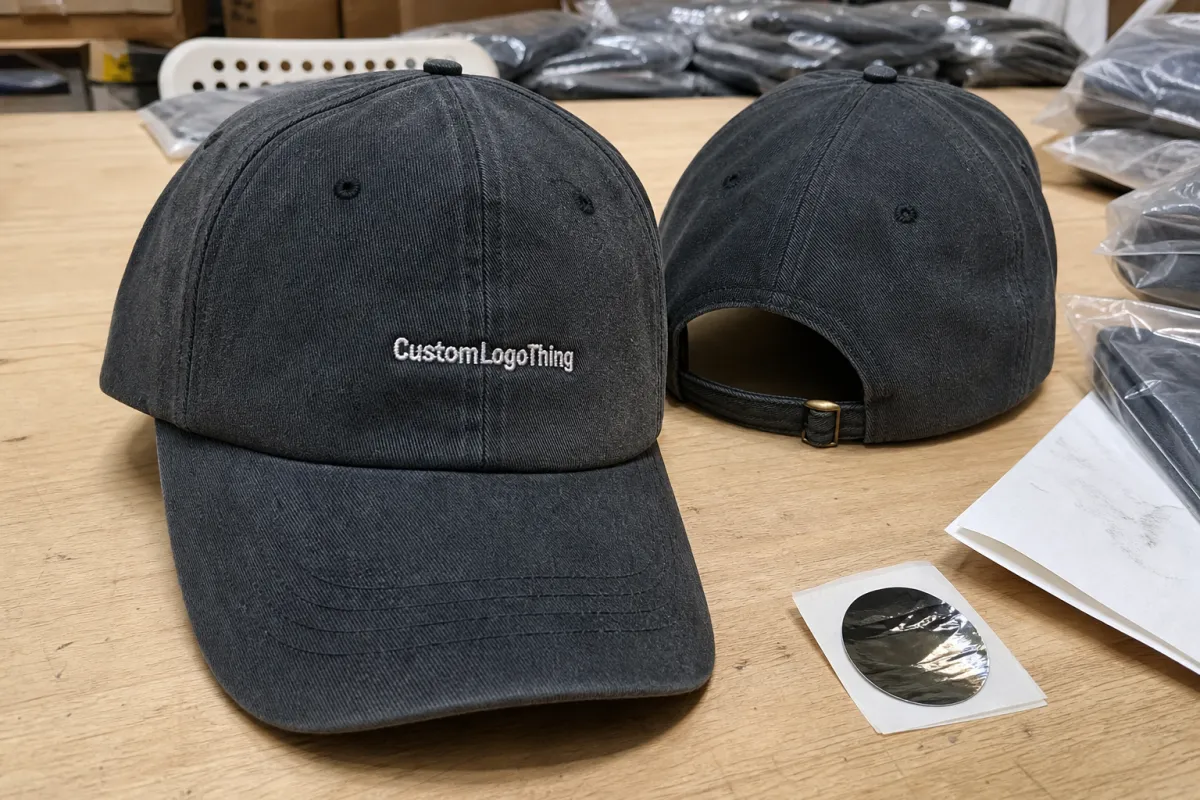
Most cap orders start with a simple request: place the logo on the front and quote the run. The problem is that a baseball cap is not a flat canvas. Once the front panel curves, artwork can stretch, tighten, or lose legibility. Fine type and intricate details are the first things to break down.
Margin disappears when the job needs extra handling. Redrawing artwork after the first proof, adding a second sample, or increasing stitch density all add cost without improving the core product. A buyer may not notice those changes line by line, but they show up in the final price and in the schedule.
Bulk orders also depend on repeatability. Whether the run is 250, 500, or 1,000 caps, each unit should carry the same placement, thread color, and crown shape. Small variations are normal; visible inconsistency is not. For branded merchandise, that difference affects how the caps look in photos, on shelves, and in customers' hands.
If the logo cannot survive the crown, it is not ready for bulk production.
That rule is useful because it forces a practical decision early. Premium does not mean complicated. In many cases, a cleaner logo, stronger contrast, and more breathing room will produce a better result than a crowded layout that needs constant correction.
Embroidery choices that keep a curved front panel readable
Flat embroidery is the safest default for most promotional caps. It handles curved fronts well, keeps setup and stitch costs under control, and works best with bold logos or simple text. For pet treat brands, it is often enough to create a clean mark that reads quickly without overworking the cap.
Low-profile puff embroidery adds dimension, but it works best with larger shapes and strong outlines. Raised fill can make the logo feel more substantial, yet small text and delicate lines often suffer. If the design depends on thin strokes, puff usually creates more risk than value. Mixed stitching can support a more premium look, but it raises digitizing complexity and makes approval more important.
Placement matters just as much as stitch style. Front embroidery offers the best visibility. Side embroidery can handle a smaller icon or secondary line, and back embroidery may suit staff or event use. Each extra location adds cost and reduces room on the cap, so more decoration is not automatically better.
| Embroidery option | Best use | Typical cost impact | Main risk |
|---|---|---|---|
| Flat embroidery | Simple logos, bold text, most promo caps | Lowest setup and stitch cost | Detailed art can blur on a curved panel |
| Low-profile puff | Large marks and premium presentation | Usually adds a moderate premium | Small text collapses quickly |
| Mixed stitching | Brands that want some depth without losing detail | Higher digitizing and stitch time | More approval steps and more chances for rework |
A simple test helps before sampling: shrink the logo to the size it will actually be stitched and look at it from normal viewing distance. If the smallest letters already feel cramped on screen, the sewn version will not improve on its own. Bold shapes and moderate spacing usually beat clever detail on a cap front.
Fabric, structure, and closure specs to lock before sampling
The cap body shapes the entire order. Structured caps hold the front panel upright, which gives embroidery a more stable surface and usually makes the cap feel more retail-ready. Unstructured caps sit softer and can feel more casual, but they provide less support for the logo. If the artwork needs a firm front, structured construction is usually the better choice.
Fabric affects both appearance and production behavior. Cotton twill is familiar and durable. Poly-cotton can be easier to manage in production while still holding shape well. Mesh-back caps suit warm weather or outdoor use, while washed finishes create a softer lifestyle look. Each fabric changes the quote, the hand feel, and the way the logo sits on the crown.
Crown height, brim shape, and closure type also matter. A taller crown gives more room for embroidery, but it may change fit. A flatter brim can feel more current depending on the style. Snapback is often the simplest bulk option because it handles a wide range of head sizes and keeps production straightforward. Strapback can feel cleaner, while a metal buckle can add a more finished look at a higher cost.
Other details are easy to overlook: eyelets, sweatband finish, seam reinforcement, and panel count all affect how the cap wears and how the embroidery lands. If the buyer wants a larger logo, the supplier needs to know whether the front panel has enough height and structure to support it. If the cap is meant for staff, events, or resale, that use should be clear before sampling begins.
Color approvals should also be handled together. Fabric shade, thread color, and packaging art should be reviewed in one pass, not spread across separate emails. A cap color that looks fine on its own can conflict with packaging or product boxes once everything sits together. Catching that mismatch early is much cheaper than fixing it after approval.
Ask for the spec sheet before sampling. It should show cap style, panel count, fabric, closure, embroidery location, and finish. If those details are missing, the order is still a concept, not a production plan.
Pricing, MOQ, and unit-cost levers that change the quote
Cap pricing usually moves with a small set of variables: stitch count, number of thread colors, embroidery locations, fabric choice, packaging, and quantity. MOQ matters because setup costs are spread differently depending on the run size. A 100-piece order and a 1,000-piece order do not share the same economics, even when the logo is identical.
For simple one-location embroidery, small custom runs often land around $3.50 to $6.50 per cap. Once the order moves into a more efficient bulk bracket, straightforward jobs may fall closer to $2.10 to $4.00 per cap. Puff embroidery, multiple placements, custom labeling, or retail-ready packaging can push the number back up. Those ranges reflect setup, labor, and materials rather than marketing estimates.
Digitizing is another cost buyers should expect. Many suppliers charge it once per design, especially for new artwork. Sample fees may also appear, and some vendors credit them back on the bulk order while others do not. Freight is separate. So are rush charges, carton labels, hangtags, barcode stickers, and individual polybags. Each line item is small enough to overlook and large enough to change the final margin.
The easiest way to compare quotes is to request a few quantity tiers. A 250-piece quote, a 500-piece quote, and a 1,000-piece quote usually reveal the real breakpoint. In some cases, a larger run lowers the unit cost enough to justify extra inventory. That is often more useful than trimming details on a logo that is already readable.
If the caps are giveaways, the spec can stay simpler. If they are for resale, staff use, or distributor kits, the quality bar rises and the buyer should expect higher finishing costs. The order structure should match the job the cap is meant to do.
Process and lead time from proof to shipment
The order flow should be predictable: quote request, mockup, digitizing or stitch planning, sample or pre-production proof, bulk production, inspection, packing, and shipment. If one step is skipped, the timeline usually pays for it later. The process is not glamorous, but it prevents guesswork.
Lead time depends on design complexity and order size. A simple one-location cap with a clean logo may move through production in roughly 12 to 15 business days after proof approval. More complex jobs, custom labeling, mixed cap colors, or higher stitch counts can stretch into 15 to 20 business days or more. Freight is separate from production, so the total calendar time can be longer than the factory schedule suggests.
Most delays trace back to a few familiar issues: artwork arrives in the wrong format, thread colors are left vague, the mockup takes too long to approve, or the buyer changes the sample after it has already been signed off. The factory may be working steadily while the order still slips because decisions are not locked.
The fastest orders usually have one art decision-maker, one quantity decision-maker, and one shipping decision-maker. That does not make the process rigid; it just keeps it from being rerouted every day. Buyers who want a tighter schedule need a tighter approval chain.
Quality control should happen before cartons leave the floor. Check stitch registration, logo placement, thread shade, crown shape, closure function, and carton count. A dependable supplier should also inspect for skipped stitches, loose threads, and uneven backing. If the order will travel a long distance or be handled several times, packout discipline matters too. Standards from ISTA are useful for transit protection, and FSC matters if the packaging uses certified paper materials.
A realistic lead time plan leaves room for approval, inspection, and freight. That is what keeps the cap order from turning into an emergency in the shipping department.
What a dependable supplier should show before you approve
A dependable supplier does more than quote a unit price. It should show a clear mockup, a readable spec sheet, a stitch estimate, and direct feedback if the design needs simplification. If the logo is too detailed for the cap panel, that should be stated before sampling begins. If the crown height is likely to distort the word mark, that should be flagged early.
That honesty matters because embroidery problems get expensive in multiples. A poor stitch path can affect every unit in the run. A bad thread match can make the whole order look inconsistent. A cap body with too little structure can force the logo to lean or flatten in a way the buyer only notices after the proof. Good suppliers catch those issues before approval, not after cartons are counted.
Consistency controls should be visible in the process. Dye lot checks help keep fabric shade stable across a mixed batch. Sample sign-off creates a clear approval point. Duplicate inspection catches visible defects before shipping. Carton labeling that matches the approved order reduces receiving errors. None of those steps is fancy, and all of them matter once the order leaves the production line.
Good service also shows up in the tone of the answer. A buyer should not have to chase down cap style, closure type, or logo placement. If the supplier can say, “Yes, but this part will need to be simplified,” that is usually a better sign than a quick yes that later turns into a correction. Production partners know where the limits are.
For pet treat brands, the most useful supplier is the one that can explain tradeoffs clearly: smaller stitch area means cleaner embroidery, fewer thread colors often means lower cost and faster approval, structured caps support the front panel better than soft caps, and rush timing narrows the room for revisions. Those are the answers that keep the order under control.
Pet treat embroidered baseball caps bulk order planning checklist
A good order starts with a complete brief. Send the logo in vector form if possible, specify the cap style, list the quantity by color, confirm embroidery location, and name the target ship date. If the order needs retail packaging, barcodes, hangtags, or polybags, say so before the quote is finalized. Suppliers can work with a wide range of specs, but they cannot fill in missing ones.
Before sampling, lock the non-negotiables: budget range, MOQ tolerance, closure preference, and intended use. A staff cap, an event cap, and a retail-ready cap are not interchangeable, even if they share the same logo. The decoration may be similar, but the finishing, price point, and durability requirements are not.
A simple approval sequence helps prevent drift:
- Review the mockup and confirm logo size.
- Check stitch count, thread colors, and placement.
- Approve the sample or pre-production proof.
- Lock quantity, cap color, and closure.
- Release production and confirm shipment method.
That order of operations keeps changes from sneaking into production after the price is already set. It also gives the supplier a clean point to build from. If the art keeps changing after proof approval, the schedule usually moves with it.
For pet treat embroidered baseball caps Bulk Order Planning, the best result is usually the least complicated one that still looks intentional. Simple art, a cap body that supports the stitching, a clear spec sheet, and a realistic quantity tier will do more for the final order than a fragile design ever will.
FAQ
What quantity usually makes pet treat cap orders price-efficient?
Most suppliers use tiered pricing, so unit cost generally improves as the order moves beyond the smallest run and into a true bulk bracket. The exact breakpoint depends on stitch count, thread colors, packaging, and whether the design uses one or two locations. In practice, 250, 500, and 1,000 pieces are the tiers that show the real cost pattern.
Can I use a pet treat logo with small text on an embroidered baseball cap?
Sometimes, but tiny text is the first thing to fail on a curved crown. If the lettering is thin, crowded, or split across too little space, the embroidery will look muddy at scale. Bold letters, clean spacing, and a larger stitch area usually produce a better result.
How long does production usually take after artwork approval?
A simple order may take about 12 to 15 business days after proof approval, while more complex runs can take 15 to 20 business days or longer. Rush changes, late revisions, and shipping swaps are the quickest ways to extend the schedule. Freight time should be added separately.
What is the best file format for a cap embroidery quote?
Vector artwork is the best starting point because it shows clean edges and scales without losing detail. If only a low-resolution image is available, expect extra clarification before the quote is final. The cleaner the file, the fewer surprises show up during digitizing.
Can I mix cap colors in one bulk order?
Usually yes, but mixed colors can affect MOQ, dye lot consistency, and how the factory groups production. Ask for pricing by color line so you can see whether variety helps the order or just complicates it. Sometimes a color mix is useful. Sometimes it only creates more admin.


