For pet brands, pet treat PVC garment Bags Bulk Order Planning is less about choosing the prettiest package and more about getting the right fit, closure, print area, and carton count. A bag that looks good on a product page can still fail in transit, slow down packing, or create extra scrap if it is undersized or too fragile for the shipment path.
Buyers who manage packaging well look at the whole system: filled dimensions, shelf presentation, handling speed, master carton efficiency, and damage risk. Clear PVC garment-style bags can support display and protection at the same time, but only when the spec is built around the actual product and the way it will be packed.
The lowest unit price is not always the lowest landed cost. Packaging mistakes create waste through rework, damage, and delays, so the real decision is whether the bag performs consistently at the target volume.
Why bulk PVC garment bags for pet treats can lower packaging waste and spoilage risk
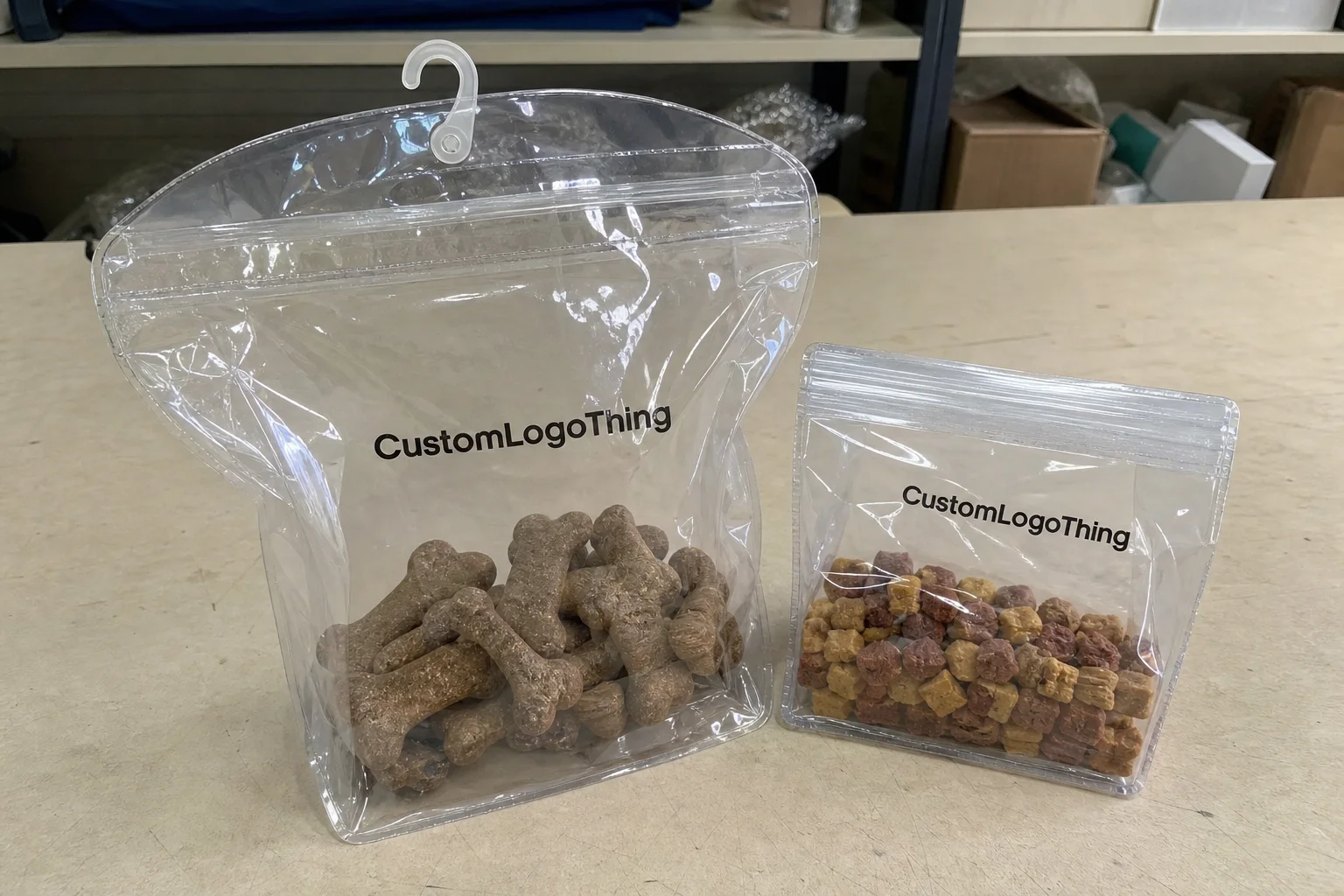
Bulk buyers often start with unit price, and that is where problems begin. If the bag is too thin, too small, or poorly matched to the fill process, the cheap option can trigger damaged cartons, crushed product, and extra labor. The package should be judged as part of the full packing system, not as a stand-alone commodity.
PVC is still common for garment-style packaging because it gives product visibility, a structured appearance, and decent scuff resistance during handling. For pet treats, that matters when color, shape, or texture needs to stay visible through the film. A clear PVC bag can also hold a cleaner retail profile than a loose pouch that wrinkles or collapses.
Fit affects stability. Too much empty space lets the product move, which increases seam stress and cosmetic damage. Too little room puts pressure on the closure and seals. The right balance reduces scrap and helps the bag reach the shelf looking intentional.
There is also a warehouse benefit. Well-sized bags pack more predictably into master cartons, palletize more evenly, and usually support faster case packing. Those gains matter because packaging cost includes labor, space, time, and the cost of rework, not just the invoice line.
The most economical bulk order is usually the one that fits the product, the line, and the shelf with the least correction later.
What to specify before requesting a quote
If the brief is vague, the quote will be vague too. For custom PVC Garment Bags for pet treats, start with the filled product dimensions, target fill weight, bag dimensions, closure style, and whether the bag is for display, transport, or secondary protection around an inner pack. A supplier can guess, but guessing usually creates revisions.
Material details matter just as much. Clear PVC comes in different gauges, and buyers should confirm thickness, flexibility, gloss level, and whether the application needs anti-static behavior or a softer hand. A stiffer film can hold shape better on shelf. A softer film may be easier to handle during manual packing.
Branding should be defined with the same discipline. A one-color logo, printed panel, or hang tag may be enough, but the printable area on a garment-style bag is often smaller than expected once seams, handles, and closures are accounted for. If artwork needs a large uninterrupted panel, state that before sampling.
Food-contact expectations need clear wording. Some pet treat packs are direct-contact, while others are outer display packaging around a sealed pouch or tray. Those are not the same thing, so the compliance question should be answered before production starts.
- Product dimensions: actual filled width, height, and depth
- Fill weight: per bag and per carton
- Closure: zipper, tuck flap, hook-and-loop, or top seal
- Display requirement: hang, stand, or lay-flat presentation
- Artwork: logo size, color count, and print location
Size, gauge, and construction specifications that affect performance
Size is usually where bulk orders drift off track. The bag should match the real filled product with enough room for loading, but not so much room that the contents slide around. Design around the actual folded or poured dimensions of the product, not the label size alone.
Gauge selection influences both appearance and durability. A thinner PVC film can reduce cost and may work for lightweight treats, but it can feel floppy, scuff sooner, and offer less protection in cartons. Heavier gauge material usually improves rigidity, helps the package stand better, and protects the contents from cosmetic damage. Many buyers test two or three thicknesses instead of assuming the thickest film is best.
Construction matters as much as the material. Flat-seal, side-seal, and bottom-seal structures all behave differently under load. Flat seals are often simpler and more cost-conscious, side seals can improve shape on some formats, and bottom seals may help with stacking or a more stable base. If the bag includes a gusset, it may hold volume better, but it also adds dimensional complexity and can affect how the bag nests in cartons.
Ask for tolerances, seam width, and closure placement before approving production. A bag that must hang straight under retail lighting has different requirements than one that only needs to lie flat in a shelf tray. That is why buyers should test the sample with the actual product, not approve it by appearance alone.
| Specification choice | Typical effect | Best use case |
|---|---|---|
| Thinner clear PVC | Lower material cost, lighter hand, less rigidity | Lightweight treats, short display cycles |
| Heavier clear PVC | Better stiffness, improved scuff resistance, cleaner shelf shape | Premium retail packs, longer distribution chains |
| Gusseted construction | More volume and better form, but tighter dimensional control needed | Bulkier treat formats, front-facing shelf display |
| Flat construction | Simpler build and easier packing, but less capacity | Compact products and lower-profile presentation |
For shipment testing, buyers often refer to packing and distribution standards such as ISTA methods and material guidance from the EPA when comparing packaging waste and transit performance. Those references do not choose the bag for you, but they help frame the cost of failure.
Cost, pricing, and MOQ factors that shape a bulk order
Pricing for custom PVC garment bags is driven by a handful of practical variables: film thickness, overall size, print complexity, closure type, packing method, and carton count. Add a zipper, reinforced edge, special insert card, or multi-color branding, and the cost moves accordingly. Quotes are often hard to compare because the buyer did not define those pieces the same way across vendors.
MOQ usually reflects production efficiency rather than arbitrary policy. Cutting patterns, printing plates, setup time, and material yield all affect the run size a factory can justify. Standardized specs and simple artwork usually support lower minimums, while complex builds or multiple SKUs push the quantity higher.
For a simple clear PVC garment bag with one-color branding, buyers may see quotes in the range of $0.18-$0.28 per unit at 5,000 pieces. Heavier gauge material, special closures, tighter tolerances, or multiple print colors can move that higher. At larger volumes, unit cost usually comes down if the spec stays stable and the artwork is already approved.
Ask for the quote in a way that exposes hidden variables. Good quotes separate unit price from tooling, sample fees, packing charges, and freight assumptions. If the supplier bundles everything into one number without explanation, comparing it against another bid becomes almost meaningless.
- Tooling/setup: cutting dies, printing plates, and initial machine setup
- Sample cost: pre-production sample or proofing charges
- Freight: EXW, FOB, or delivered assumptions
- Packaging extras: inserts, labels, inner packing, or custom cartons
- Artwork changes: Pantone matching, repositioning, or revision rounds
Common budget surprises include custom Pantone matching, several SKU versions, or special insert cards that were not part of the first request. Buyers who use Wholesale Programs often get better visibility into quantity tiers and reorder economics, especially if they already know their annual demand.
Process and timeline: from sample approval to mass production
The cleanest production flow usually starts with inquiry, then moves into specification review, sample or digital proof, approval, production, inspection, and shipment. Delays often happen when the buyer changes dimensions after sampling or sends artwork before the structure is finalized. If the schedule matters, finalize the build before the graphics are locked.
Lead time improves when the project arrives with complete artwork, final dimensions, and a single packaging configuration. A straightforward order usually moves faster than a multiple-SKU launch because there is less setup and fewer approval loops. Special closures, added testing, or reworked artwork can extend the schedule by several business days.
A pre-production sample is worth the time. It is the best way to confirm how the bag looks with actual fill weight, how the closure behaves, and whether the retail presentation matches the brief. A flat drawing cannot show how a package will stand under fluorescent light or how a seam will react once the bag is filled.
For straightforward builds, production after sample approval often lands around 12-15 business days. That estimate depends on quantity, seasonality, and finishing details. Freight, customs clearance if applicable, and internal receiving still need time before a shelf reset or promotion.
- Send filled product dimensions, artwork, and target quantity.
- Review the quotation and confirm all assumptions.
- Approve a sample or digital proof.
- Lock the spec sheet before production starts.
- Inspect the first lot and receive cartons before launch.
For reusable spec records, lot tracing, or repeat-order coordination, keep the approved drawing, sample notes, and carton details in one folder. That documentation reduces confusion when the next reorder arrives months later and the team member handling it is not the same one who approved the first run.
How to evaluate suppliers for repeatable quality and reliable bulk fulfillment
A supplier can quote well and still miss the mark on execution, so quality controls matter. Ask how they check dimensions, seal integrity, and visual consistency across the run. Do they inspect seam width? Do they verify closure placement? Do they confirm carton counts before shipment? Those details matter more than polished sales language.
Documentation is another strong signal. A reliable supplier should be able to provide material specifications, sample confirmation, packing details, and the final approved build record. That record helps a warehouse team receive the product without guessing and protects the buyer if the next reorder needs to match the original exactly.
Communication quality is easy to underestimate. Fast answers help, but accurate answers matter more. If a supplier responds clearly on dimensions, tolerance questions, and artwork revisions before the order is placed, there is a better chance they will handle production with the same discipline. That matters most for repeat programs, where the next reorder should follow the approved standard rather than be rebuilt from scratch.
Buyers should also ask whether the supplier can manage multiple SKUs without drifting on material or print consistency. A good partner can support branding needs and practical packaging requirements at scale, which is exactly what you want when a pet treat line grows beyond one size or one flavor.
- Quality checks: dimensional accuracy, seal strength, visual inspection
- Records: approved sample, final artwork, packing spec
- Reorder support: same build, same closure, same print reference
- Warehouse fit: carton labeling, pack counts, master carton consistency
Next steps to place a cleaner bulk order with fewer revisions
If you want fewer revisions and a smoother purchase, gather three things first: a filled product sample or exact dimensions, your target quantity, and the closure or display style you want. Those inputs eliminate a surprising amount of back-and-forth. Send artwork only after size and construction are confirmed so the logo lands within the real printable area.
Ask for a quote that shows quantity tiers, sample timing, and freight assumptions side by side. That makes comparison honest. One supplier may look cheaper until you realize the quote excludes packaging inserts or uses a different freight assumption. A fair comparison needs the same spec, the same terms, and the same delivery expectation.
Before final approval, review the sample under actual packing and shelf conditions. Put the filled bag in the carton. Stand it beside competing products. Check whether the closure still works after the bag is filled to the stated weight. A sample that looks fine on a flat table can behave differently once it is packed at line speed.
The strongest habit is simple: lock the specification early and keep it on file. That way, pet treat PVC garment Bags Bulk Order Planning stays on schedule, the reorder path is straightforward, and your team does not have to rediscover the same dimensions and print decisions every time you buy again.
FAQ answers are below for quick reference, but the real gain comes from a clean spec sheet, a confirmed sample, and a supplier who can repeat the same build without improvising.
What should I confirm before ordering pet treat PVC garment bags in bulk?
Confirm the filled product dimensions, target bag size, closure type, and whether the package is for display, shipping, or secondary protection. You should also ask whether the material, printing, and finish match your handling and retail requirements, especially if the bag will be packed alongside heavier cartons or stacked for distribution.
How does PVC gauge affect pet treat garment bag pricing and performance?
Heavier gauge usually costs more, but it improves stiffness, protection, and shelf appearance. Thinner gauge can reduce cost, yet it may be less durable during packing and transit, so the right choice depends on treat weight, display expectations, and how far the product has to travel.
What MOQ is typical for custom PVC garment bags for pet treats?
MOQ usually depends on size, print method, and setup requirements rather than a single fixed number. Standardized specs and simple artwork often allow more efficient minimum runs, while specialty closures, multiple SKUs, or complex print layouts generally push the minimum higher.
How long does bulk production usually take after sample approval?
Turnaround depends on artwork readiness, order size, and finishing details. A complete specification package and fast approval cycle usually shorten the overall schedule, and straightforward runs often move through production faster than orders that need extra revisions or testing.
Can I reorder the same pet treat PVC garment bag design later without changes?
Yes, if the original spec sheet, artwork files, and approved sample details are preserved. Keeping the same size, material, and closure reduces revision risk and speeds future production, which is exactly why disciplined documentation pays off on repeat programs.


