Skincare PVC Garment Bags Bulk Order planning gets easier when the bag is treated as a working part of the product line, not just a visual add-on. A sample can look clean on a desk and still fail in production if the zipper binds, the panel clouds under compression, or the finished size misses carton requirements. Most waste starts in that gap between appearance and actual use.
The buyer’s job is to define the bag clearly enough that the quote can be trusted. If size, thickness, closure, print area, or pack method are vague, the supplier fills in the blanks with assumptions. Those assumptions usually cost more later than they save up front.
The cheapest quote is often the one with the most missing detail.
Why Bulk Planning Cuts Waste
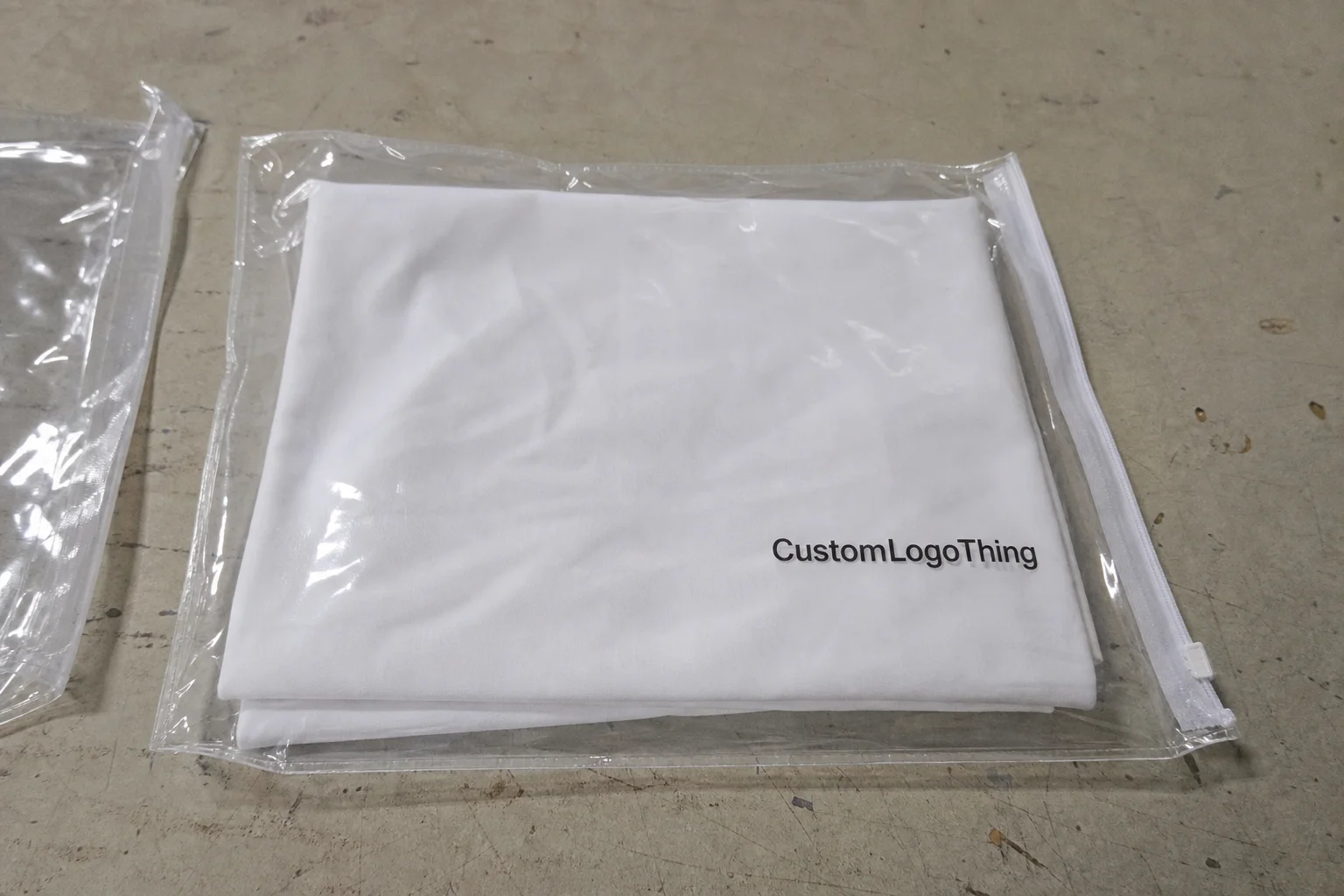
Start with use case, not catalogue imagery. Retail display, salon storage, travel kits, and sample distribution place different demands on the same basic structure. A retail bag needs repeatable presentation. A salon bag needs a closure that survives constant handling. A travel pack needs protection without unnecessary bulk. One spec rarely serves all four well.
Waste shows up quietly. A bag that is too small wrinkles the contents and strains the zipper. One that is too large shifts in transit and makes the product look careless. If the film is too thin, the bag can arrive with waves, stress marks, or a cloudy finish after carton compression. The order ships, but the presentation no longer matches the approved sample.
Bulk planning reduces that drift. Once the spec is fixed, replenishment runs can stay consistent across seasons and restocks. That matters more than many teams admit. A small unit savings disappears fast if the next batch has a different feel, different clarity, or different pack-out behavior and has to be reworked.
Use total landed value as the filter. A fair comparison should include unit price, setup, sampling, freight assumptions, and any labor needed to pack or insert the product. If the spec is incomplete, those costs get scattered across separate line items and the “cheap” option becomes hard to compare honestly. For broader purchasing references, the Wholesale Programs page is a practical place to review volume structures and order formats.
There is also a quality-control angle. Even without formal lab testing, buyers should define transit stress, closure endurance, and dimensional tolerance. Teams that set those expectations early usually get better samples and fewer surprises.
Material And Construction Details
PVC thickness is the first decision to lock. Thin film lowers cost, but it wrinkles, dents, and shows pressure marks more easily. Mid-range thickness usually gives the best balance for skincare display bags and garment-style packaging because it keeps visual clarity while adding enough body to hold shape. Thicker film works better for premium programs, hanging displays, and orders that need the bag to feel structured.
Buyers commonly compare film around 0.15 mm to 0.35 mm, or roughly 6 to 14 mil. Below that range, the bag can feel fragile. Above it, freight weight and material cost climb quickly. The right choice depends on how the bag is handled between packing and final sale.
Construction matters just as much as film. Zipper closures, snap buttons, heat-sealed edges, hanger holes, and reinforced top panels all change how the bag behaves under load. If the bag hangs in a retail fixture or closet environment, reinforcement at the stress points is not optional. That is where failures usually begin.
Clarity is a design decision, not just a material property. Fully clear PVC gives the most product visibility and is the obvious choice for skincare sets that need to be seen. Frosted or lightly tinted film can hide uneven contents and reads more premium when the product mix is less uniform. Matte or embossed finishes soften reflections, but they reduce transparency. The tradeoff should be intentional.
Surface finish affects maintenance too. Smooth film wipes down quickly and shows less dust during distribution. Textured finishes can hide scuffs, but they also change how the product reads under store lighting. Physical samples matter because photos flatten the material.
Buyers should confirm these points before approval:
- Film thickness in microns or mils
- Closure type and zipper grade
- Reinforcement at stress points
- Hanger hole size and placement
- Seam finish and edge consistency
Size, Print, And Packaging Specs
Dimensions should be based on the packed product, not the flat item alone. A folded garment, a skincare set with inserts, or a mix of bottles and cartons all need space for closure movement, tags, and handling tolerance. A few millimeters can be the difference between a bag that closes cleanly and one that bulges at the seam.
Print placement deserves the same discipline. Large logos can overwhelm a clear bag and reduce the product visibility that makes the format useful. Smaller marks, corner prints, or restrained branding usually work better because they support the package instead of turning it into a billboard. In skincare packaging, the customer still wants to see what they are buying.
Packaging method changes the quote more than many teams expect. Shipping flat, nested, folded, or prepacked with inserts all affect labor, carton count, and freight volume. A supplier cannot price that accurately if the buyer only provides the finished bag size. The pack-out needs to be defined as part of the spec.
Lock the spec in writing before asking for final pricing. Include finished dimensions, acceptable tolerance, thickness, closure type, print area, accessory count, and carton pack-out. Once those pieces are set, the quote becomes comparable across suppliers. Without that, each proposal is answering a different question.
A practical spec sheet usually includes:
- Finished dimensions and tolerance range
- PVC thickness and surface finish
- Closure style and hardware details
- Print method, color count, and logo placement
- Pack-out method and carton count
Cost, MOQ, And Quote Factors
Pricing is driven by more than size. Thickness, closure type, print complexity, packing method, and total quantity all move the unit cost. A simple clear bag with no print sits in one price band, while a custom branded version with reinforced seams and specialty hardware lands in another. Buyers comparing “the cheapest version” without specifying the build are often comparing different products.
MOQ is tied to setup cost and material efficiency. Lower quantities are possible, but they usually carry a higher unit price or fewer customization options. That is not a supplier tactic; it is how production economics work. If you want custom dimensions or custom print, the order usually has to absorb some setup cost before the unit price becomes reasonable.
Tiered quotes make the tradeoff visible. Ask for pricing at several volume breakpoints so you can see where the unit cost drops enough to justify a larger run. A 3,000-piece order may be too expensive per unit, while 5,000 or 10,000 pieces can bring the number down to something workable. The right choice is not always the biggest order. It is the one that fits demand without creating avoidable inventory risk.
Watch the quote line by line. Sampling fees, tooling charges, carton upgrades, special packing, and freight assumptions can alter the final landed cost sharply. If those items are not visible from the beginning, the lowest quote often becomes the most expensive order by the time it reaches the warehouse.
| Option | Typical Use | Indicative Unit Cost | Buyer Tradeoff |
|---|---|---|---|
| Clear PVC, no print | Basic retail or sample use | $0.15-$0.26 at 5,000 pcs | Lowest cost, least brand control |
| Mid-thickness PVC with small logo | Skincare sets and salon programs | $0.24-$0.40 at 5,000 pcs | Balanced clarity, structure, and branding |
| Thicker PVC with reinforced seams and custom hardware | Premium display or hang-to-ship programs | $0.38-$0.68 at 5,000 pcs | Stronger presentation, higher setup cost |
Sample costs are another place where buyers lose control. A simple unprinted prototype may be inexpensive, while a fully finished preproduction sample can cost more because it includes printing, hardware, and labor like the mass run. If the sample is cheap, verify what was actually included. If it is expensive, make sure it is representative of the finished order.
Production Steps And Approval Checkpoints
A disciplined production flow starts with inquiry, then spec confirmation, then sampling, then mass production. Skip one step and the order becomes vulnerable to size errors, artwork mistakes, or closure problems. The risk usually grows when a launch date starts looking tight.
Lead time depends on how much of the product is standard. Stock dimensions and standard closures move faster because the factory already has the tooling and workflow in place. Custom sizing, special hardware, heavier print coverage, or unusual packaging all add time. Buyers should plan for that instead of hoping for a shortcut the production line cannot support.
Approval checkpoints protect both sides. The sample confirms shape, clarity, and closure action. The proof confirms artwork position, color placement, and any text near the edge. A final inspection confirms the run matches the approved spec before shipment leaves the factory.
Typical planning ranges look like this:
- Sample preparation: often 5-10 business days
- Artwork and proof approval: 2-4 business days if the file is ready
- Mass production: often 12-20 business days depending on complexity
- Shipping time: varies by route, carton count, and freight mode
Quality control should be specific. Check actual dimensions against the approved tolerance. Open and close a sample set several times to see whether the zipper tracks cleanly. Look for haze, yellowing, seam distortion, and scuffing after compression. If the bags are going into retail fixtures, carton drop behavior matters too, because the bag that arrives perfect in one sample tray can look different after freight vibration and compression.
That timeline is not a promise. Seasonality, order size, raw material availability, and response time all change it. Still, it is a realistic starting point for skincare PVC garment Bags Bulk Order Planning.
What A Reliable Bulk Program Needs To Control
A reliable bulk program is not defined by a sales pitch. It is defined by repeatable control over fit, finish, and communication. The supplier should be able to speak clearly about tolerance ranges, packaging options, and which details affect the quote. If those answers stay fuzzy after sampling, the order is still at risk.
Retail buyers need shelf appeal and dimensional consistency. Salon and spa buyers need wipe-clean surfaces and closures that survive repeated handling. Travel programs need lighter builds that protect the contents without adding unnecessary bulk. Those are different operational problems, even if the bag shares the same material. A one-size-fits-all proposal usually sounds convenient and performs like a compromise.
Good supply habits are plain and boring. A spec sheet that is short but exact. A sample that matches the final intended use. A quote that shows where the price comes from. A packing method that does not create extra labor in receiving. Those details matter more than polished language because they decide whether the order runs once or keeps causing problems each replenishment cycle.
A stable spec also makes forecasting easier. When the dimensions, print area, and pack method stay fixed, reorders are simpler to schedule and inventory becomes easier to manage. That matters whether the bags support skincare launch kits, uniform storage, or a travel retail assortment. Variability in packaging sounds small until it starts hitting labor, freight, and stock counts at once.
For buyers comparing order structure and replenishment assumptions, the Wholesale Programs page can help frame the discussion. If the team still needs clarity on minimums, proofing, or shipment assumptions, the FAQ page is a faster reference than a long email chain.
Next Steps To Finalize Your Order Plan
Gather the packed dimensions, closure preference, print requirements, and target quantity before asking for pricing. If those details are missing, every quote will be partly guessed. That is usually where delays begin.
Request two sample directions if the budget allows it: one that stays closest to the target cost and one that prioritizes structure and finish. Seeing both makes the tradeoff concrete. Most buyers can make a clean decision once the differences are visible in hand rather than buried in a spreadsheet.
Approve the artwork, bag structure, and carton pack-out before mass production starts. Small changes after approval are expensive because they interrupt the production sequence and can force new proofs or new materials. If the order supports a launch, a seasonal refresh, or a replenishment cycle, the safest move is to lock the spec early and protect the schedule.
Plan the reorder window before inventory feels tight. Strong skincare PVC Garment Bags bulk order planning is less about chasing the lowest sticker price and more about controlling the variables that lead to waste: unclear specs, rushed approvals, and inconsistent reorders. Once the bag is defined properly, the process gets much easier to repeat.
How many skincare PVC garment bags should I order for a first bulk run?
Start from actual monthly or campaign demand, then add a buffer for damage, samples, and replacement stock. If the style is new, begin with the smallest quantity that still gives a workable unit price. Ask for pricing at two or three volume tiers so you can see where the savings justify the extra inventory.
What PVC thickness is best for skincare PVC garment bags in bulk?
Light builds can work for short-run promotional use, but they may wrinkle or feel flimsy in retail settings. Mid-range thickness is usually the practical middle ground because it balances clarity, structure, and cost. If the bag will hang on display or carry heavier contents, request a sample in the exact thickness before approving the full run.
Can I add a logo without blocking product visibility?
Yes. Keep the print area controlled and place it where it supports the layout instead of covering the whole front panel. Small logos, corner marks, and restrained branding usually preserve visibility better than large full-panel printing. A printed proof or sample is worth requesting because logo placement can look different under real lighting than it does on screen.
What affects the lead time for bulk PVC garment bag orders?
Lead time changes with custom dimensions, print complexity, hardware, sample approval speed, and how much of the build is standard versus custom. Standard structures move faster because the factory setup is already established. If the launch date is fixed, leave room for proofing and freight so the schedule does not collapse around one late approval.
What details do I need for an accurate quote?
Send the bag dimensions, quantity, thickness, closure type, print method, and carton pack-out requirements. Include the delivery location and target timeline so freight and production assumptions are accurate. The clearer the spec, the fewer surprise charges show up later.
Strong orders do not happen by accident. They happen because the buyer defines the spec before asking for pricing, checks the sample before approving mass production, and keeps the order logic simple enough for the supplier to execute without interpretation.


