Pet treat Frosted Zipper Bags bulk order planning gets easier when the pouch is treated as part of the product, not as a last-minute add-on. The bag affects shelf presentation, freight performance, and how quality reads before the pack is opened. A frosted finish helps soften the visual clutter that comes with biscuits, chews, and uneven snack shapes, especially when crumbs or oil sheen would be obvious in a clear pouch.
The key question is not whether the mockup looks good. It is whether the pouch still looks right after filling, whether the seal protects aroma and freshness, and whether the format fits the run size you actually need. That is where order planning should start.
Why frosted zipper bags work for pet treats
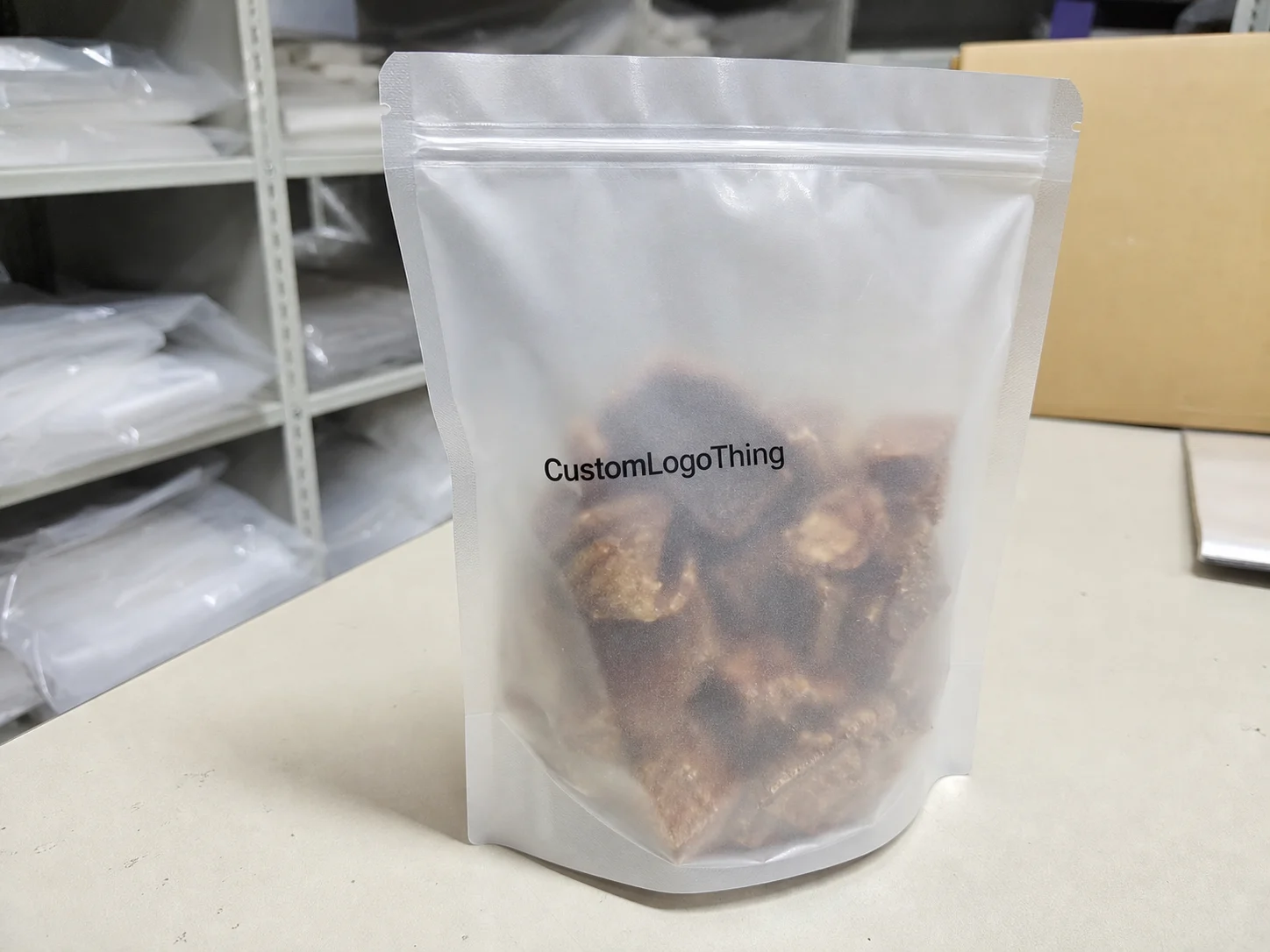
Frosted Zipper Bags solve a common packaging problem: pet treats are rarely uniform. Some are oily, some break easily, and some leave crumbs or dust during packing. A frosted surface reduces the visibility of those flaws while still giving the pouch a retail-ready look. It is a practical choice, not a decorative one.
The zipper adds convenience, but it does not do the main preservation work. Film structure, seal integrity, and barrier performance matter more. If the treats carry strong aroma, have oil content, or need better freshness retention, the pouch has to be built for that use case. A weak film with a nice zipper can still fail in storage.
That is why the first spec decision should be the product profile. Dry training treats have different needs from soft chews or baked snacks that migrate grease. One pack may only need basic moisture protection. Another may need a laminated structure with stronger seals and better barrier properties. Ignoring that difference usually means the first production run becomes a corrective project.
These bags are usually a strong fit when a brand needs:
- A resealable pouch with a premium front panel
- Less visual noise than a fully clear bag
- Better contrast for logo, copy, and flavor callouts
- Faster retail-ready packaging than jars, tubs, or cartons
For many private-label brands, this format sits between economy poly bags and higher-end laminated pouches. That middle position is useful because it improves presentation without forcing rigid packaging or a cost structure that only makes sense at very large volume.
Suppliers should be asked direct questions early: what film is being quoted, what kind of zipper is included, whether the pouch stands upright once filled, and how much seal area remains after forming. If you need broader order-term reference points, the FAQ page is a useful starting point, and Wholesale Programs is the better fit for repeat production planning.
A frosted pouch is not there to hide a weak product. It is there to present a good one without making the package look busy, cheap, or overdesigned.
Material, zipper, and barrier specs buyers should lock down
The bag is really four decisions bundled together: film structure, zipper style, barrier level, and format. If those are vague, quotes become difficult to compare. One supplier may price a thin mono-PE pouch, while another quotes a laminated pouch with a different appearance and better aroma retention. Both can call it a frosted zipper bag. Only one may fit the product.
For dry treats with low oil content, a standard polyethylene build may be enough. For aromatic chews, baked snacks, or products that need stronger freshness retention, a laminated structure is usually safer. Common constructions include PET/PE, PET/CPP, or similar laminated combinations with a frosted finish layer. The material choice affects stiffness, seal behavior, print quality, and cost.
Useful spec questions to settle before pricing:
- Finished width, height, and gusset depth
- Film thickness, often around 80 to 120 microns for this category
- Zipper style, such as single-track reseal or easy-open design
- Top seal details, including tear notch and hang hole if required
- Print finish, frost level, and any clear window request
Those details matter once the order reaches a warehouse. A pouch that is too thin can collapse in transit. A zipper that is stiff can frustrate retail staff. A bag that is too glossy can erase the visual benefit the frosted surface was meant to provide. None of these issues is dramatic on a sample table. They become obvious during packing, shipping, and shelf handling.
Food-contact requirements should be stated in the brief rather than buried in email follow-ups. If the order needs specific documentation for outer cartons, mention it early. Some buyers also ask for transit checks aligned with recognized packaging testing practices, such as those described by the ISTA community. That is sensible for a product that will be packed, palletized, and shipped before it reaches a store.
Pack-out details deserve the same attention. How many bags fit in a carton? Is an inner liner required? What is the target carton weight? These questions affect freight cost, warehouse handling, and damage risk. A quote built on incomplete pack-out assumptions is usually wrong in ways that become expensive later.
Artwork, sizing, and print details that affect the quote
Artwork is not a finishing touch. It drives setup, proofing time, and cost. The number of print colors, the amount of ink coverage, whether the artwork wraps the gusset, and how much legal copy sits on the back panel all affect the quote. A simple one-color logo on frosted film is a very different job from a full-coverage design with small type and multiple flavor variants.
Size the pouch from the fill plan, not from a guess. A four-ounce bag of lightweight treats may need more headroom than a denser treat of the same weight. The visible front panel is only part of the usable area. Once the zipper, seal margins, and forming tolerances are accounted for, the print-safe space shrinks. Artwork that ignores those constraints usually comes back for revision.
Good files reduce friction. Send vector artwork when possible, provide Pantone references if color matters, and mark the dieline with print-safe boundaries. Barcode placement matters too. If a barcode, ingredient panel, or flavor callout sits too close to a fold, the proof stage should catch it. If the team misses it there, the press may not.
Before any production quote, the following information should be ready:
- Bag dimensions and fill weight
- Product type and texture
- Print colors and coverage
- Matte or more pronounced frost finish
- Zipper preference and tear notch requirement
- Carton count and shipping destination
Design decisions that look harmless on screen can change the production path. A back panel with long ingredient text may force layout changes. A clear window may require a different film sequence. A logo that crosses a gusset can create alignment issues during forming. A digital proof is still worth doing if the artwork is not finalized because it catches the easy mistakes before they become paid mistakes.
For pet treat frosted zipper Bags Bulk Order Planning, proofing is one of the cheapest controls available. It is not paperwork. It is cost prevention.
Cost, pricing, MOQ, and unit-cost levers to watch
Pricing usually follows a simple pattern: unit cost falls as quantity rises, but only if the spec stays fixed. Change the bag size, the zipper, the film gauge, or the print coverage, and the savings can disappear fast. Buyers often think they are comparing two price breaks. In practice, they may be comparing two different packaging structures.
The main levers are straightforward:
- Bag dimensions
- Film structure and thickness
- Number of print colors
- Frost finish level
- Zipper style
- Carton pack count and freight assumptions
For planning purposes, simple frosted zipper bags in the 5,000-piece range often land around $0.18 to $0.28 per unit, depending on size and print coverage. Smaller runs can sit closer to $0.24 to $0.38 because setup costs are spread across fewer bags. Push toward heavier film, more colors, or a more complex pouch shape, and the number rises. At 10,000 pieces or more, the unit price may drop into the $0.14 to $0.22 range if the spec remains stable and the supplier can run efficiently.
| Order Profile | Typical Unit Cost | What Changes the Price | Buyer Tradeoff |
|---|---|---|---|
| 3,000 pieces | $0.24-$0.38 | Setup spread across fewer bags | Useful for trials, weaker on margin |
| 5,000 pieces | $0.18-$0.28 | Standard print and film structure | Usually the best balance for launches |
| 10,000+ pieces | $0.14-$0.22 | Better setup efficiency and freight planning | Lower cost, but higher inventory risk |
Hidden costs matter just as much as unit price. Samples can add time and expense if the brief is loose. Freight can increase if the carton size is awkward or the shipment is rushed. Remakes are the worst line item of all, and they usually come from unclear artwork, shifting dimensions, or a poorly defined spec. Cheap quotes are easy to obtain. Accurate quotes take discipline.
Suppliers should be compared on identical assumptions: same size, same film, same print colors, same zipper, same carton count. If one quote uses a lighter gauge or a simpler build, the price difference is not a real savings. It is a mismatch disguised as a deal.
Process, timeline, and production steps from proof to ship
The process should be dull in the best possible way: inquiry, spec confirmation, artwork check, digital proof, sample or pre-production approval, production, inspection, and shipment. If a supplier cannot explain that sequence clearly, delays are likely.
Most timing problems come from slow approvals, incomplete specs, or last-minute changes. Machine time is rarely the real bottleneck. For a standard build with a prepared brief, proof approval to shipment often takes about 12 to 15 business days. More complex structures, first-time sizes, special barrier films, or dense print coverage can extend that window. Reorders usually move faster if nothing changes.
Where buyers usually save days:
- Send bag size, fill weight, and product type with the first request
- Approve one proof version quickly instead of waiting for multiple rounds
- Avoid changing the structure after sampling begins
- Book freight early if the launch date is fixed
That last point is often ignored. A finished order that waits on transport is still late. Launch schedules are lost in the shipping window more often than in the production window. If the launch date matters, freight belongs in the planning stage, not after approval.
When pet treat Frosted Zipper Bags Bulk Order planning is handled properly, the work feels predictable. If every update triggers a new question about dimensions, seals, print, or quantity, the problem is usually not the factory. It is the brief.
Supplier checks that prevent reorders and shelf failures
A polished sample proves very little on its own. What matters is whether the supplier can repeat the spec on bulk production and hold it on the next order. Color consistency, zipper function, seal strength, carton packing, and dimensional control matter far more than a sample that looks perfect under showroom lighting.
Three questions are worth asking before approval:
- Can the supplier hold the same film and zipper spec on reorders?
- Do they check seal quality and zipper function on bulk runs?
- Do they ask about fill weight, oil content, and retail handling before quoting?
That last question is a useful signal. A supplier that asks detailed questions is usually trying to prevent a bad run. A supplier that only talks about the lowest price is usually trying to win the order, not solve the packaging problem.
Shelf failures are usually obvious and expensive. If the bag is too thin, the gusset collapses. If the seal is weak, scent escapes. If the print is strong but the pouch feels flimsy in the hand, the product seems cheaper than it should. Good packaging has to survive the warehouse and the shelf. One without the other is only a partial win.
For carton or transit planning, some brands use packaging testing references from groups such as the Institute of Packaging Professionals alongside their internal logistics checks. FSC-certified outer packaging can also help if the supply chain needs cleaner documentation. None of that replaces a solid pouch spec, but it reduces friction once the order moves from packaging to distribution.
Good vendors also give honest MOQ guidance. They will say when a small run is possible but inefficient, or when a requested structure does not make sense for the quantity. That kind of honesty saves more money than a low quote ever does.
Next steps before you request a quote
Put the brief into one clean document: bag size, fill weight, closure type, print colors, quantity, product description, shipping destination. That alone removes a lot of back-and-forth and gives suppliers something real to price.
Before sending it out, have these decisions nailed down:
- Target shelf life
- Whether the treats are oily, fragrant, or fragile
- Retail display requirement, such as stand-up presentation
- Whether the bag needs frequent resealing
- Whether the carton shipper needs FSC or similar documentation
Then compare two or three quotes on the same spec sheet: same quantity, same film, same zipper, same artwork assumption. If procurement, marketing, and operations all need sign-off, get a sample or digital proof before the order is locked. One approved version is cheaper than three teams debating a pack that was never defined well enough to produce.
For teams still early in the process, pet treat frosted zipper Bags Bulk Order Planning is best used as the organizing frame, not just a phrase in the email subject line. The packaging choice should follow the product, the shipping plan, and the shelf target. That is where the savings are, and where the mistakes start.
Clear spec. Clean artwork. The right film. That is the difference between a pouch that only looks good in a mockup and one that actually performs through production, freight, and retail handling.
What size should I choose for pet treat frosted zipper bags bulk order planning?
Choose size from both net weight and product shape. Light, bulky treats need more headspace than dense treats with the same weight. Ask for a filled-capacity recommendation or dieline before signing off on the final run.
How does MOQ change the price for frosted zipper pet treat bags?
Lower quantities usually mean higher unit cost because setup and printing fees are spread across fewer bags. A larger order usually lowers the piece price, but only if the size, film, and artwork stay consistent.
Can frosted zipper bags handle oily or aromatic pet treats?
Yes, if the film structure and seal quality are appropriate. The zipper alone does not control aroma or grease migration, so barrier guidance matters when the product is oily or strongly scented.
How long does the process usually take from proof to shipment?
A standard order with complete specs often takes about 12 to 15 business days after proof approval. New sizes, special film, or delayed approvals can extend the timeline.
What do I need ready before I request a bulk quote?
Have the bag size, quantity, print colors, zipper preference, fill weight, product type, and delivery address ready. If you can also share shelf-life expectations and carton needs, the supplier can quote the right structure the first time.


