Buyer Fit Snapshot
| Best fit | Poly Mailers for Book Subscriptions projects where brand print, material claims, artwork control, MOQ, and repeat-order consistency need to be specified before quoting. |
|---|---|
| Quote inputs | Share finished size, material target, print colors, finish, packing count, annual reorder estimate, ship-to region, and any compliance wording. |
| Proofing check | Approve dieline scale, logo placement, barcode or warning zones, color tolerance, closure strength, and carton packing before bulk production. |
| Main risk | Vague material claims, crowded artwork, missing packing details, or unclear freight terms can make a low unit price expensive after revisions. |
Fast answer: Poly Mailers for Book Subscriptions: Film, Print, MOQ, and Carton Packing should be specified like a repeatable production item. The safest quote records material, print method, finish, artwork proof, packing count, and reorder notes in one written spec.
Production checks before approval
Compare the actual filled-product size with the drawing, then confirm tolerance on folds, seals, hang holes, label areas, and retail display edges. Reserve space for logos, QR codes, warning copy, and material claims before decorative graphics fill the panel.
Quote comparison points
Review material grade, print process, finish, sampling route, tooling charges, carton quantity, and freight assumptions side by side. A quote is only useful when the supplier can repeat the same color, closure quality, and packing count on the next order.
Poly Mailers for Book Subscriptions: Smart Packaging Guide
Poly mailers for book subscriptions do a lot more than hold a book long enough to reach a mailbox. They can cut postage, speed up packing, and reduce those annoying corner dings that turn a clean shipment into a customer service ticket. Get the size and film right, and the whole operation feels calmer. Get it wrong, and every month gets a little messier than it needs to be.
Subscription brands live on repeatable fulfillment. Packaging has to protect a paperback, zine, or small reading bundle without adding dead weight, wasted space, or a clumsy unboxing. That is why poly mailers for book subscriptions keep showing up in recurring programs. They are light, compact, fast to seal, and easy to standardize once the packout is settled.
There is also a practical truth a lot of teams learn the hard way: the right mailer is usually boring in the best possible way. It shows up, fits, seals, scans, and ships. No drama. No repacks. No mystery tears in the bottom corner three days before launch.
Poly Mailers for Book Subscriptions: What They Are
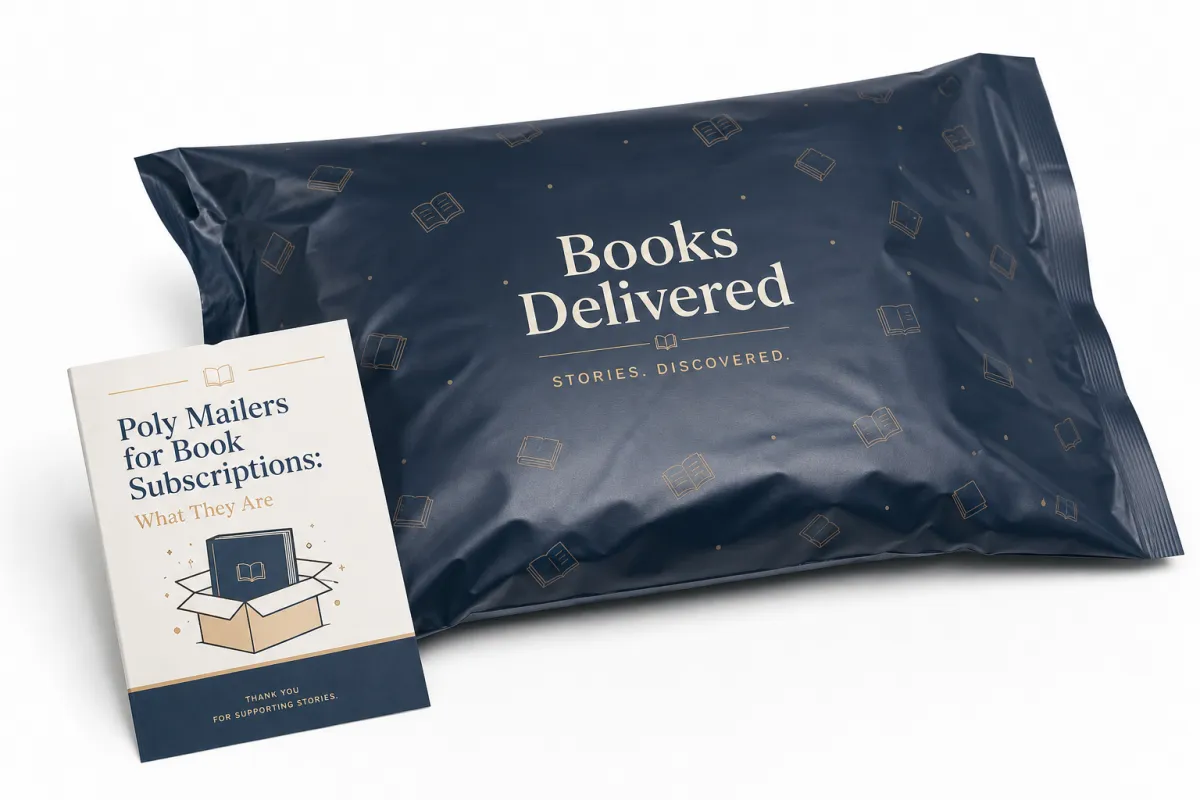
Poly mailers for book subscriptions are flexible shipping envelopes made for slim products that do not need a corrugated box’s crush resistance. Most are co-extruded polyethylene film. Some are opaque. Some are printed. All of them usually include a pressure-sensitive adhesive strip so the seal happens fast and nobody has to babysit a tape gun like it owes them money.
That matters for books because subscription shipments tend to be repetitive and predictable. A paperback, a small hardcover, a bookmark, a note card, and a publisher insert can often fit neatly in poly mailers for book subscriptions when the dimensions are chosen with some discipline. The package stays flatter, the weight stays lower than a box, and the line moves faster because the packer is not folding around void fill or wrestling flaps into place.
Think of poly mailers for book subscriptions as a fit-first format. Slim product, predictable shipment, cleaner choice. Bulky, fragile, or oddly shaped shipment, probably not. That simple split keeps the packaging decision tied to the actual item instead of brand habit or wishful thinking.
Recurring programs benefit from that consistency. Once a team locks in one or two mailer sizes, monthly packing gets easier to train, easier to stock, and easier to measure. Standardizing poly mailers for book subscriptions helps reduce handling errors and keeps the brand look steady from one cycle to the next. Packaging is not a one-off promo. It is part of the machine that has to work again next month without throwing a fit.
There is a presentation angle too. A well-sized mailer looks neat. It lies flat, seals cleanly, and gives the subscriber a controlled first impression before the book is even opened. The package does not need to scream for attention. It needs to look intentional, protect what is inside, and move through fulfillment without drama.
For a lot of book clubs and monthly reading boxes, that is the whole job. Not fancy. Just reliable.
How Poly Mailers for Book Subscriptions Work in Fulfillment
On a normal pack line, poly mailers for book subscriptions start with a measured book stack, an insert set, and a quick fit check. The packer slips the contents into the mailer, checks that the spine and corners are not pressing against a seam, pushes out excess air, and closes the adhesive flap. A shipping label goes on the flattest possible surface so sortation equipment can read it without wrinkling, lifting, or forcing the parcel into manual rework.
The process works because the film moves with the shape of the book stack. A rigid carton leaves more unused space unless the contents are packed tightly. Poly mailers for book subscriptions hug the product more closely, which helps limit internal movement for paperbacks and bundled reading kits that stay within a narrow thickness range. Put something too sharp-edged or too heavy in the bag, and the flexibility stops helping pretty fast. Plastic can stretch only so far.
Single-book mailings are the easiest version of the problem. A subscription that sends one trade paperback each month can often run with a slim mailer, a label, and maybe a paper insert. Bundles are messier. Add a postcard, bookmark, small journal, or promo card, and the thickness climbs fast. That is the moment when poly mailers for book subscriptions need real attention, because a package that looked perfect in a sample can turn into a bulgy, awkward mess once the extras show up.
The closure system deserves the same attention as the film. A good adhesive strip should stay shut through automated handling, stacking, and vibration in the delivery truck. Over thousands of poly mailers for book subscriptions, weak adhesive becomes a steady source of repacks and complaints. I want a seal that grabs with firm pressure, holds through temperature swings, and does not peel open just because the parcel rubbed against another box for a few miles.
Label behavior matters too. Flat, even surfaces make life easier for carriers and packers. Put the label across a seam, wrinkle, or bubble, and barcode scans get sloppy. Manual sorting starts creeping in. The line slows down. Avoidable friction shows up where nobody wants it. A clean label application is a tiny detail with a loud impact.
One more thing: if the package starts to balloon, it is gonna make everybody unhappy. The scanner room notices. The carrier notices. The subscriber notices when the corners arrive bent.
Practical rule: if a book slides around inside the mailer, it will probably slide around in transit too. Size the bag to the product, not to the shelf space you wish you had.
For brands comparing package formats, it helps to look at the broader setup in a structured way. Our Custom Poly Mailers can be matched to recurring book shipments, while the wider Custom Packaging Products range works well when a subscription grows beyond one mailer format.
Transit testing is the part many teams skip, and that usually bites them later. A good reference point is a simple parcel test plan based on a real shipping path instead of a desk check. The ISTA transit testing standards are a solid place to start if you want to see why vibration, drop testing, and compression matter so much for book shipments. A mailer can look fine on the packing table and still scuff, split, or peel after a few handling stages.
Choosing Poly Mailers for Book Subscriptions
Choosing poly mailers for book subscriptions starts with film thickness, because that is where puncture resistance and cost begin to split apart. Thinner films can work for lightweight paperbacks and slim inserts, especially when the package moves through a controlled fulfillment lane. Thicker films, usually in the heavier gauge range, make more sense when books have sharper corners, heavier covers, or a little more internal motion. There is no single perfect gauge for every program, which is why sample testing matters.
In practice, many teams end up somewhere around 2.5 to 4 mil, but that is a starting point, not a law of nature. A small indie club shipping softcovers does not need the same spec as a premium program that includes hardcover editions and art cards with sharp edges. I would not pretend otherwise.
Sizing matters just as much. A mailer that is too tight can bow at the seam, make sealing awkward, and leave the finished packout looking stressed. A mailer that is too loose lets the book slide, which is bad for presentation and bad for corner protection. For poly mailers for book subscriptions, I like to measure the packed product, not the naked book, then add room for the insert set, any tissue or wrap, and enough tolerance to close the flap without forcing anything.
Opacity and branding also deserve attention. Many subscription businesses want contents hidden, especially when they are shipping special editions or surprise picks. Opaque film handles that well, and printed mailers can add recognition without making the package feel overdesigned. Some brands keep it to a simple one-color logo on a solid-color mailer because it looks clean and keeps ink coverage under control. Others lean into a repeat pattern so the subscription is recognizable the second it lands on a porch or in a lobby.
Moisture and scuff resistance matter more than people think, especially if the subscription ships through damp climates or passes through distribution networks where packages get stacked, brushed, and shifted constantly. Poly mailers for book subscriptions do a good job of shedding light moisture, but not every film behaves the same. A real spec should account for seal strength, puncture resistance, and abrasion behavior, not just how the mockup looks. Paperbacks hate humidity, and matte covers show scuffs faster than most people expect.
Sustainability works best when the thinking is practical instead of theatrical. Source reduction usually delivers the easiest win: use less material, stop oversizing the package, and keep the shipment as small as the book allows. Recycled-content films can work if they still meet the packout’s performance needs. If you use paper inserts or book-wrap materials, look at FSC-certified paper options through the Forest Stewardship Council. That does not replace performance testing, but it does help keep sourcing honest.
Some subscriptions need extras like tear strips, reinforced seams, or dual adhesive closures. A tear strip can make opening easier and reduce the chances that a subscriber attacks the package with scissors. Reinforced seams help when the contents carry more weight or the route is rougher than average. Dual adhesive closures help if the packaging may be reused for returns or exchange programs. Those features cost more, so each one should have a real reason behind it.
One useful way to compare options is to lay out the tradeoffs in plain language.
| Mailer Option | Typical Use Case | Relative Unit Cost | Best Advantage | Main Limitation |
|---|---|---|---|---|
| Stock plain poly mailer | Slim paperbacks, low-complexity packing | Lowest | Fast to source and easy to reorder | Less brand presence |
| Custom printed poly mailer | Recurring subscription shipments with consistent branding | Moderate | Strong brand recognition | Higher MOQ and setup planning |
| Heavier-gauge poly mailer | Heavier books, sharp corners, rougher transit lanes | Moderate to higher | Better puncture resistance | More material cost |
| Mailer with tear strip or second seal | Premium unboxing or return-friendly programs | Higher | Improved opening or reuse experience | Extra specification complexity |
For many brands, the right answer is not the fanciest mailer on paper. It is the one that makes the rest of the operation easier. Poly mailers for book subscriptions should fit the book, support the brand, and keep the pack line moving at a steady pace. If the packaging team can work cleanly and the customer gets a crisp, undamaged parcel, the spec is probably in the right neighborhood.
Poly Mailers for Book Subscriptions: Cost and Pricing Factors
Cost is where a lot of subscription teams start, but it should not be where they stop. The unit price of poly mailers for book subscriptions is only one slice of the math. Freight, warehousing, labor, print setup, and damaged-order costs sit around that number and can change the real economics quickly. A cheaper mailer that slows packing by a few seconds per unit can end up costing more over a month of recurring shipments than a slightly better spec with smoother handling.
There is a common trap here: comparing mailer prices without looking at the full ship cycle. If a low-cost bag needs extra tape, a paper insert to stiffen the package, or a repack after every few damaged corners, the savings vanish fast. The same problem shows up if the mailer is too large and pushes postage into a higher tier. For poly mailers for book subscriptions, landed cost per shipped order usually tells the truth better than bag price alone.
Minimum order quantities can reshape the economics too. Smaller brands often want custom printing to make the subscription feel polished, but a large MOQ can lock up cash and storage space. Stock mailers are usually easier to buy in smaller runs, which helps when the program is still testing formats or expects seasonal variation. Once the packout is stable, custom printing can make sense because the package becomes a repeat brand asset instead of a plain shipping shell.
Heavier films and specialty finishes often raise unit cost, but they may lower total cost if they reduce returns, replacement books, or manual handling. That matters especially for poly mailers for book Subscriptions That Ship heavier paperbacks, deluxe editions, or bundles with sharp insert corners. A buyer who only looks at mailer cost misses the larger picture. A buyer who compares damage rates, pack time, and postage gets a much clearer answer.
Here is a simple way to think about the cost stack:
- Unit price: the quoted cost per mailer at your order quantity.
- Custom print: plate, setup, and art adjustments for branded runs.
- Freight: inbound shipping from the converter or distributor.
- Storage: pallet space, shelf space, and inventory carrying cost.
- Labor: the time needed to pack, seal, label, and sort each order.
- Damage risk: replacements, customer service work, and reshipments.
That breakdown is why pricing should be judged per shipment. If a mailer saves two cents but increases damage by one percent, the hidden cost can wipe out the gain. If a custom printed mailer reduces brand complaints and speeds pack-out by a few seconds, the higher price can pay for itself quickly. Poly mailers for book subscriptions are recurring expenses, so the evaluation needs to match the recurring nature of the program.
For businesses that want a useful benchmark, stock mailers often make the most sense in the earliest phase, while branded versions usually fit better once the monthly format is stable. A good supplier should be able to quote a range based on size, thickness, and print coverage. In many cases, a simple one-color print on a standardized size gives the best balance of cost and presentation. The goal is not to spend more. It is to spend where the package earns that spend back.
Step-by-Step Process and Timeline for Launching
The cleanest way to launch poly mailers for book subscriptions is to start with the actual packed product, not a guess. Measure the book after it is wrapped, sleeved, banded, or bundled, because the real pack size is what the mailer has to hold. A trade paperback with a bookmark and a card behaves differently from the same title shipped alone. Once the packed dimensions are known, the team can choose a mailer size that seals neatly without forcing the contents into a bend.
The next step is sample review. This is the part where the team checks the obvious but important stuff: does the adhesive close firmly, do the corners fit without stress, does the label stick cleanly, and does the bag stay flat enough to move well through the pack table? Poly mailers for book subscriptions should be tested with the heaviest ordinary shipment, not just the lightest one. If the spec passes on the busy month, it will usually behave better on the lighter month.
Artwork approval comes after sample review. Even a simple printed mailer deserves a real proof. Logos should sit in the right place, any copy should be readable, and the color should match what the brand expects. If the design includes recycling language, a subscription identifier, or warning copy, review it before production starts. Tiny print details are easy to miss on a screen and expensive to fix after the run begins.
Timeline planning is where many teams get squeezed. Custom Poly Mailers for book subscriptions usually take longer than stock bags because there is a print setup stage, a proof cycle, and then production plus freight. A straightforward custom order needs enough lead time to cover approval, manufacturing, and delivery before the next fulfillment cycle starts. If the subscription ships on a fixed date each month, the packaging order should go in early enough that an art delay does not threaten the ship date.
A small pilot is one of the best investments a brand can make. Send a limited batch through the real workflow, not just a hand-packed sample. Watch for label curl, corner wear, adhesive failure, and weird behavior during scanning or sorting. A pilot also reveals whether the mailer size creates a smooth opening experience or an awkward one. Poly mailers for book subscriptions can look great in mockup form and still fail the live test. The live test does not care about your mood board.
A useful launch plan often looks like this:
- Measure the most common packed book formats.
- Request samples in two or three nearby sizes.
- Check seal strength, fit, and label behavior.
- Approve artwork and print proof.
- Run a short pilot with real orders.
- Review damage rates, pack time, and customer feedback.
- Scale the order and set reorder points before inventory runs low.
That last point matters more than it sounds. Subscription shipping has a rhythm, and packaging shortages always seem to show up the moment the fulfillment team is busiest. Keep a simple reorder threshold, leave room for freight delays, and store enough inventory to cover at least one full cycle of demand. Poly mailers for book subscriptions work best when the supply chain is calm enough that the pack team never has to improvise.
Common Mistakes with Poly Mailers for Book Subscriptions
The most common mistake is picking a mailer that is too small. Tight packages may look tidy at first glance, but they stress the seam, make sealing harder, and can create a warped look once the book settles. If the subscription alternates between a thin paperback and a thicker special edition, that tight fit gets worse fast. Poly mailers for book subscriptions need enough room to close comfortably across the full range of product sizes the program ships.
The second mistake is using film that is too light for the book weight. A mailer can save a fraction of a cent and still fail if the spine presses through the film or the corner catches during transit. Heavy books, glossy covers, and sharp-edged inserts all raise the risk. If the bag splits now and then, the savings disappear into replacements, apologies, and extra customer-service time. A stronger film is often the cheaper decision over the long haul.
Another issue is ignoring month-to-month variation. One cycle may ship a slim paperback; the next may include a thicker edition, a sealed print, or a set of inserts that changes the profile completely. Poly mailers for book subscriptions should be sized around the real operating range, not the easiest month on the calendar. That is why a small packaging matrix is useful. It gives the team a quick, documented choice instead of a guess at the packing table.
Branding can distract from performance. A printed mailer may look polished in a mockup, but pretty graphics do not stop a spine from puncturing film. The seams, adhesive, gauge, and fit matter more than the artwork if the goal is to get the book to the subscriber in one piece. I have seen brands spend heavily on print while under-specifying the film, and the package looks strong right up until the first rough carrier route exposes the weakness.
Operational friction is another quiet problem. If label placement is inconsistent, if the opening direction is awkward, or if the mailer size forces packers to wrestle each order into position, the line slows down. Poly mailers for book subscriptions should reduce handling steps, not add them. A good format feels easy in the hand. The book slips in naturally, the flap closes cleanly, and the label lands where the scanner can read it without a fight.
Skipping live transit testing is the final mistake, and it usually shows up later with a bill attached. A package can pass a quick warehouse check and still fail after stacking, vibration, weather exposure, or long dwell times in a distribution center. Real shipment tests matter for a reason. A few test parcels sent through the actual carrier path tell you a lot more than a perfect-looking sample on a table.
Common warning signs include:
- Corners pressing through the film before sealing.
- Adhesive that lifts after a short hold.
- Labels wrinkling across seams or folds.
- Books sliding inside the mailer during shake testing.
- Subscribers reporting bent corners or scuffed covers.
Expert Tips and Next Steps for Poly Mailers for Book Subscriptions
The best teams build a small packaging matrix and keep it near the pack station. That matrix should match the mailer size to the most common book formats, the usual insert bundle, and any seasonal variations that show up often enough to matter. Poly mailers for book subscriptions become much easier to manage once the team has a short written decision guide instead of relying on memory or improvisation.
Seasonal testing earns its keep. Humidity changes how paper inserts behave. Cold weather can make some films feel stiffer. A heavier holiday bundle can push a once-perfect size into a tight fit. If your subscription has one month with a premium edition or a bundled gift, test that month separately. Poly mailers for book subscriptions are usually judged by the average order, but the edge cases are what create surprise failures.
A pilot batch with real orders is one of the best next steps before a full rollout. Compare damage rates, labor time, and customer feedback against the current setup. Look at how long it takes to pack a normal order, how often the adhesive needs a second press, and whether the parcel still looks clean when it reaches the subscriber. A pilot gives you actual data instead of a feeling, and packaging decisions should be based on something sturdier than vibes.
For the pack line itself, a short quality checklist goes a long way. The checklist does not need to be fancy; it just needs to be used. Seal check, label placement, corner feel, and a quick glance for bulging usually catch most issues before the package leaves the table. Poly mailers for book subscriptions are simple, but simple packaging still benefits from discipline. A 10-second inspection can prevent a much longer customer service conversation later.
Here is the practical takeaway: size the mailer to the packed book, test the real shipment path, and judge the spec by landed cost instead of bag price alone. That kind of spreadsheet honesty beats wishful thinking every time.
If you are comparing formats now, start with one typical shipment, request a few samples, and compare unit cost with landed cost, labor time, and damage risk. Then trial poly mailers for book subscriptions on one fulfillment run and watch what happens in the real world. The answer usually gets pretty obvious once real orders start moving. The best choice is the one that balances protection, speed, and presentation for the exact books you ship most often.
FAQs
What size poly mailers for book subscriptions should I start with?
Start with the packed book size, not the cover size, and include any tissue, bookmark, postcard, or insert that ships with the order. Choose a mailer that leaves enough room for a clean seal without letting the contents slide around. It is smart to test one slim paperback, one average trade paperback, and one heavier bundle before placing a full order for poly mailers for book subscriptions.
Are poly mailers for book subscriptions safe for hardcover books?
They can be safe for some hardcovers if the book is not too heavy and the film has enough puncture resistance. Corner protection matters more with hardcovers, so fit and film strength should be tested carefully. For premium editions or oversized books, a box may still be the safer option, even if poly mailers for book subscriptions work well for standard paperback formats.
How much do poly mailers for book subscriptions usually cost?
Pricing depends on size, film thickness, print coverage, and order quantity, so unit cost can vary quite a bit. Stock mailers are usually cheaper up front, while custom printed mailers cost more but can add brand value. The best comparison is total shipped cost, including labor and damage replacements, rather than the bag price alone for poly mailers for book subscriptions.
Can I use branded poly mailers for book subscriptions without raising costs too much?
Yes, especially if branding stays simple and the mailer size is standardized across most shipments. One-color print or a repeat pattern is often more cost-friendly than full-coverage graphics. The right balance is a mailer that supports the brand while still keeping fulfillment fast and predictable, which is why many teams choose Branded Poly Mailers for book subscriptions after the packaging format stabilizes.
How do I reduce damage when shipping books in poly mailers?
Use the correct size so the book cannot shift too much or press against a weak seam. Choose a film thickness that matches the weight and edge sharpness of the book format. Test real shipments, because handling, stacking, and weather exposure can reveal weak points quickly. That field test is often the most useful step in dialing in poly mailers for book subscriptions.

