Buyer Fit Snapshot
| Best fit | Poly Mailers Prototype Ordering projects where brand print, material claims, artwork control, MOQ, and repeat-order consistency need to be specified before quoting. |
|---|---|
| Quote inputs | Share finished size, material target, print colors, finish, packing count, annual reorder estimate, ship-to region, and any compliance wording. |
| Proofing check | Approve dieline scale, logo placement, barcode or warning zones, color tolerance, closure strength, and carton packing before bulk production. |
| Main risk | Vague material claims, crowded artwork, missing packing details, or unclear freight terms can make a low unit price expensive after revisions. |
Fast answer: Poly Mailers Prototype Ordering: Specs, Pricing, Timing should be specified like a repeatable production item. The safest quote records material, print method, finish, artwork proof, packing count, and reorder notes in one written spec.
Production checks before approval
Compare the actual filled-product size with the drawing, then confirm tolerance on folds, seals, hang holes, label areas, and retail display edges. Reserve space for logos, QR codes, warning copy, and material claims before decorative graphics fill the panel.
Quote comparison points
Review material grade, print process, finish, sampling route, tooling charges, carton quantity, and freight assumptions side by side. A quote is only useful when the supplier can repeat the same color, closure quality, and packing count on the next order.
Poly Mailers Prototype Ordering: Specs, Pricing, Timing
Poly mailers prototype ordering is where packaging stops being a nice idea and starts acting like a real job. A rendering can look polished and still fail the minute it hits a packing table. The flap is short. The adhesive grabs too early. The artwork sits just a hair too close to the edge. Tiny misses, big headaches. That is why poly mailers prototype ordering matters: it catches the stuff that gets expensive later.
From a buyer's seat, the sample is not a keepsake. It is evidence. Operations wants to know whether the bag loads fast and closes cleanly. Marketing wants to know whether the logo still reads well under warehouse lights and in a customer’s hands. Procurement wants the price, the minimum order, and the timeline to line up without surprises. Poly mailers prototype ordering gives you all of that, but only if the sample is close enough to final production to mean something.
The first sample should answer a short list of questions. Does it fit the product? Does the seal hold? Does the print stay crisp at the edges? Does the film tolerate normal handling, sorting, vibration, and the occasional rough toss onto a conveyor? If any of those answers is shaky, you want to know now, not after a full run is already printed and packed.
One sample tells you more than a stack of renderings. It shows fit, closure performance, and print quality under real handling.
That is why teams use poly mailers prototype ordering before launch, during a packaging refresh, or anytime a product changes by even a few millimeters. A garment that fit fine in a carton can behave differently in a mailer. A glossy design that looked bold on screen can print flatter on film. A closure that felt strong in a spec sheet can start peeling once it sees heat, dust, or repeated pressure along the flap. Packaging has a way of humbling people. Fast.
Poly Mailers Prototype Ordering: What One Sample Reveals
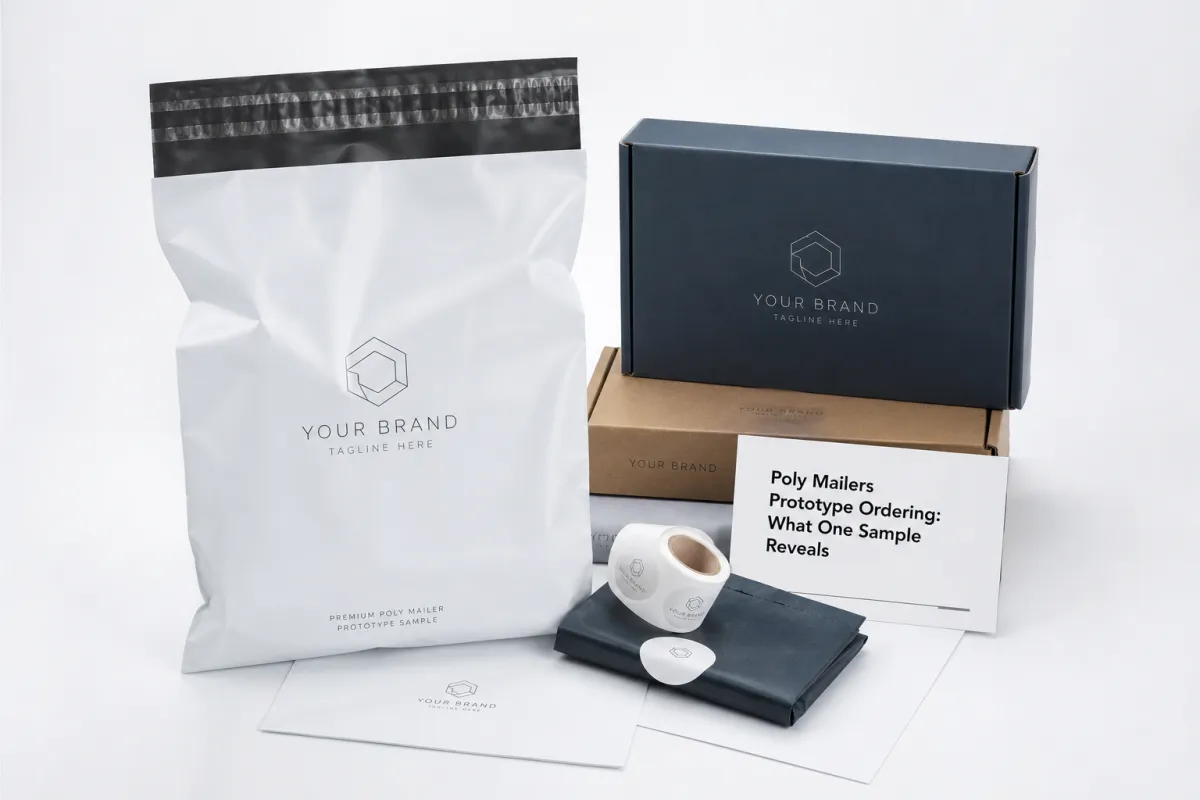
Poly mailers prototype ordering reveals more than dimensions. It shows how the material behaves under real packing pressure. A bag that looks roomy on a dieline can feel tight once a folded garment, accessory kit, or boxed item is inside. A package that looks balanced in a mockup can end up too tall, too shiny, or too plain once someone holds it at arm’s length in a warehouse aisle. Treat the sample like a live test. Not a formality. Not a checkbox. A live test.
The first thing the sample exposes is fit. A mailer that is off by a quarter inch may still close, but that tiny mismatch can affect insert speed, seam stress, and the final customer impression. The second thing is closure behavior. Pressure-sensitive adhesive, tamper-evident strips, and return-strip formats all behave differently. The third thing is print quality. Fine text, small logos, and edge bleed need to be checked on actual film, not on a monitor. You can guess, sure, but guessing is a lousy plan when a production order is on the line.
It also helps teams compare shelf impact and shipping efficiency with less arguing. A darker opaque film may feel more premium but add a little weight. A translucent film may lower material cost but expose contents more than the brand wants. Poly mailers prototype ordering lets the team compare real options instead of debating renderings, and that matters because the same package has to do three jobs at once: pack efficiently, survive transit, and present the brand clearly when the customer opens it.
Honestly, a lot of programs get overconfident here. They approve artwork first and only later discover that the mailer size or closure format creates friction on the line. Poly mailers prototype ordering flips that order. It asks the basic questions first, and those questions are usually the expensive ones. Kind of annoying. Also kind of useful.
- Operations: Does the bag load cleanly, close reliably, and move at the expected pack-out speed?
- Marketing: Does the logo read cleanly, and does the color feel right under real lighting?
- Procurement: Does the sample cost make sense relative to the risk of a bad production run?
Product Details: Materials, Printing, and Closure Options
Poly mailers prototype ordering works best when the buyer understands the construction choices before a sample is made. Standard polyethylene is still the baseline for a lot of programs because it is economical, flexible, and easy to convert into a wide range of sizes. Recycled-content film is showing up more often for brands that want to reduce virgin plastic use, although the exact recycled percentage and hand feel vary by supplier and resin stream. There is no magic material that fixes bad specs. The substrate still has to match the product and the pack-out method.
Printing matters just as much as the film. Flexographic printing is common for larger production runs because it scales well and delivers consistent color once plates are dialed in. Digital print is often better for short runs, seasonal artwork, or prototypes that need speed and flexibility. If the artwork uses tiny type, hairline rules, or a dark background with fine white text, the prototype needs to prove that the design still holds together on the actual film. Screens lie. Samples do not.
Closure options deserve the same attention. A standard peel-and-seal flap may be enough for single-use shipping. A dual-seal or return-strip format makes sense when customers may need to send items back. Some programs also add a tear strip or a second adhesive line for returns. The right choice depends on how much security the package needs, how often it gets reopened, and how much labor the pack line can tolerate. If the adhesive is too aggressive, you are gonna hear about it from the warehouse team. They never miss a bad seal.
Surface finish affects the final look more than people expect. A matte film usually feels softer and hides scuffs better. A gloss finish pops under light but can show fingerprints and abrasion faster. Clear or translucent films can be useful for visibility, but they also give up privacy. None of these choices is inherently better. They are tradeoffs, and poly mailers prototype ordering is where those tradeoffs become obvious instead of theoretical.
Specifications That Affect Fit and Performance
Small spec changes can throw off the whole package. Size is the obvious one, but it is not the only one. Film thickness, flap depth, adhesive width, gusset design, and seal placement all affect how the mailer performs. A sample that looks close on paper may still pack badly if the load profile changes. That is why experienced buyers look at the full spec stack, not just the outside dimensions.
Thickness is usually discussed in mils, and the right number depends on the product weight, the amount of abrasion expected in transit, and the level of puncture resistance needed. Thicker film can help with durability, but it can also add stiffness and cost. Stiffness changes packability. Packability changes labor. Labor changes budget. Simple chain, not always simple outcome.
Adhesive width and placement deserve more respect than they get. If the seal zone is too narrow, the flap can lift during transit. If it is too wide, the flap may be harder to close cleanly at speed. The best prototype samples show whether the adhesive bonds on the first press, how it behaves after a second press, and whether it resists tampering. A mailer that opens in transit is not a marketing problem. It is an operational mess.
Dimensions should be checked with the real product inside, not with a guessed load. Folded apparel, boxed cosmetics, and accessory kits all behave differently. Some products compress. Some spring back. Some create edges that stress the corners of the mailer. The sample should show how much working room remains after insertion, because just enough room on a spreadsheet can turn into no room at all in practice.
Need a straightforward rule? Measure the product as it will be packed, not as it sits on a shelf. Then add enough allowance for insertion, seal closure, and a little real-world abuse. That allowance changes by category, which is why one-size-fits-all advice is mostly useless here.
Pricing and MOQ for Poly Mailers Prototype Ordering
Pricing for poly mailers prototype ordering usually looks different from production pricing, and that is normal. A prototype often carries extra setup cost because the supplier is creating a small, specific run instead of spreading setup across thousands of units. Digital samples, printed proofs, and pre-production examples all sit in this category. The per-piece cost is higher. The risk is lower. That is the trade.
MOQ, or minimum order quantity, can also vary a lot. Some suppliers will make a single sample or a small short run for approval. Others require a higher minimum if the artwork, material, or closure system needs a dedicated production setup. If someone promises a universal MOQ for every mailer, they are bluffing. Size, print method, film choice, and finish all change the economics.
As a practical range, prototype pricing is usually influenced by three things: whether the sample is blank or printed, whether the artwork needs a dedicated proof or final-production setup, and whether the supplier is shipping one piece or several variants. The sample may cost more than people expect. That does not mean the quote is off. It usually means the order is asking for flexibility, speed, or both. Those things are not free.
For budgeting, it helps to separate prototype spend from production spend. Prototype cost should be treated like insurance against the wrong bag, the wrong print, or the wrong closure. Production cost should be evaluated after the sample clears the fit and performance check. Mixing those two numbers is how teams end up arguing about the wrong thing.
Poly Mailers Prototype Ordering Process and Timeline
The process usually starts with a spec sheet or a sample request. Good requests include bag size, product dimensions, film type, print colors, closure type, and target quantity. If you can add a photo of the packed product, even better. It saves everyone from playing detective over email, which is always slower than it should be.
Once the request is clear, the supplier confirms material availability, print method, and estimated turnaround. For a plain sample, the timeline can be fairly quick. For a printed prototype, the lead time depends on artwork prep, proof approval, and whether plates or digital files need adjustments. A simple sample might move in a few days. A printed prototype may take longer, especially if the artwork needs color correction or the spec needs a second revision.
Shipping matters too. A sample that looks fast on paper can still arrive late if the approval window is vague. Build in time for review, because packaging teams rarely approve the first sample on the first pass. They should not. The sample exists to surface problems. If it comes back perfect the first time, great. If it does not, that is still useful.
Here is the usual flow:
- Send product dimensions, target mailer size, artwork files, and closure preferences.
- Confirm the film type, print method, and whether the sample should match final production or just approximate it.
- Review the proof for copy, color placement, and flap layout.
- Receive the prototype, test fit and closure, then check print quality under real lighting.
- Revise specs if needed before releasing the production order.
That sequence keeps the project from drifting. Once the sample is in hand, the real evaluation begins. Check insert speed. Check whether the seal grabs on the first press. Check whether the package sits flat after closing. Check whether the logo still looks sharp after handling. If a problem shows up, document it with photos and measurements, not vague complaints about “feel.” Feel matters, but it needs backup.
Why Choose Us for Prototype Orders
If you are comparing prototype partners, start with their response quality. A good supplier should ask for the packed product size, the intended use case, the print method, and the closure format before they quote. That sounds basic because it is basic. Yet a lot of bad samples begin with one lazy assumption and a quote that moves too fast.
Look for a team that is comfortable talking about material behavior, not just selling a bag. They should be able to explain why one film prints cleaner, why one adhesive needs more pressure, or why a larger flap helps one category but slows another. That kind of guidance usually comes from experience on the factory side, not from staring at a catalog. The difference shows up in the sample.
Transparency matters as well. A trustworthy partner will tell you when a prototype is close to final production and when it is only a visual proof. Those are not the same thing. If a sample uses substitute film or a different print setup, that needs to be clear before anyone approves it. Hidden substitutions are how teams end up frustrated later. No one enjoys the “surprise, this was only directional” conversation.
Good prototype support also means honest limits. Sometimes the first sample is enough to approve. Sometimes it exposes a packaging issue that means resizing the bag or changing the closure. That is not failure. That is the point of poly mailers prototype ordering. The best suppliers do not pretend otherwise.
Next Steps After Reviewing Your Prototype
Once the sample arrives, evaluate it in the same way the final order will be used. Pack the real product. Close it on the real line, if possible. Hold it under warehouse lighting. Ship a few test units if the schedule allows it. A sample that looks fine on a desk but fails after one day in transit is not an approved sample. It is a warning label.
Document three things before you sign off: fit, closure, and print. Fit includes insertion speed and final package shape. Closure includes adhesive strength, flap alignment, and any return functionality. Print includes color accuracy, legibility, and edge quality. If you want a fast approval process, keep those notes specific. “Looks good” is not a spec. It is a shrug.
If changes are needed, make them while the order is still small. Adjusting the mailer size by half an inch, widening the flap, or simplifying the print layout can save a lot of grief later. Once production starts, every revision costs more. That is just how the math works.
The actionable takeaway is simple: run poly mailers prototype ordering with the final product inside the sample, a real closure test on the pack line, and a written check on print and dimensions before you approve anything. Do that, and you will catch most of the expensive mistakes before they turn into inventory sitting on a dock.
Frequently Asked Questions
How close should a prototype be to the final mailer?
Close enough to test fit, closure, and print under real conditions. If the sample uses different film, different adhesive, or a different print process, you should treat it as directional unless the supplier says otherwise.
Can I order just one prototype mailer?
Often, yes. Many suppliers can produce a single sample or a short run for approval. The price per piece will usually be higher than a production order, but that is normal for poly mailers prototype ordering.
What should I send with the request?
Send product dimensions, packed shape, artwork files, color targets, closure preference, and any special requirements like recycled-content film or returnability. A photo of the packed item helps more than people expect.
How long does prototype ordering take?
It depends on the print method, setup needs, and shipping distance. Blank samples can move quickly. Printed prototypes usually take longer because proofing and approval add time. If a timeline is critical, say so early.
What causes the biggest prototype mistakes?
Wrong size, weak or misaligned closure, and artwork that was designed for a screen instead of film. Those are the recurring offenders. They show up a lot because teams skip the sample or rush the review.
Should recycled-content film change the way I order samples?
Yes. Recycled-content film can behave a little differently in hand feel, opacity, and print consistency depending on the resin mix. Always test the exact construction you plan to buy, not a generic substitute.


