Buyer Fit Snapshot
| Best fit | Poly Mailers with Custom Stickers projects where brand print, material claims, artwork control, MOQ, and repeat-order consistency need to be specified before quoting. |
|---|---|
| Quote inputs | Share finished size, material target, print colors, finish, packing count, annual reorder estimate, ship-to region, and any compliance wording. |
| Proofing check | Approve dieline scale, logo placement, barcode or warning zones, color tolerance, closure strength, and carton packing before bulk production. |
| Main risk | Vague material claims, crowded artwork, missing packing details, or unclear freight terms can make a low unit price expensive after revisions. |
Fast answer: Poly Mailers with Custom Stickers: Material, Adhesive, Artwork, and MOQ should be specified like a repeatable production item. The safest quote records material, print method, finish, artwork proof, packing count, and reorder notes in one written spec.
Production checks before approval
Compare the actual filled-product size with the drawing, then confirm tolerance on folds, seals, hang holes, label areas, and retail display edges. Reserve space for logos, QR codes, warning copy, and material claims before decorative graphics fill the panel.
Quote comparison points
Review material grade, print process, finish, sampling route, tooling charges, carton quantity, and freight assumptions side by side. A quote is only useful when the supplier can repeat the same color, closure quality, and packing count on the next order.
Poly Mailers with Custom Stickers: Smart Branding Tips
Poly mailers with custom stickers look modest at first glance, and that is exactly why they work. The package stays simple, but the branding still reads clearly. I have seen brands spend heavily on printed packaging and end up with muddy artwork, weak color control, or a layout that looked stronger in a mockup than it did on a warehouse table. A 2023 Dotcom Distribution survey found that 40% of consumers are more likely to buy again from brands that use premium packaging. That does not mean packaging has to be expensive. It means customers notice care fast, and a clean sticker on a stock mailer can carry that message without a lot of noise.
This format also fits neatly into a broader packaging system. If you already use Custom Packaging Products, or you are comparing Custom Poly Mailers with Custom Labels & Tags, the sticker route sits in the middle. It protects the product, keeps setup straightforward, and gives you room to change artwork without writing off a warehouse full of old bags. For brands that test, tweak, and relaunch often, that flexibility is not a minor perk. It is the whole point.
A plain mailer with a sharp sticker can feel more expensive than a printed bag that was overdesigned, handled badly, or approved in a hurry.
That is the practical appeal of poly mailers with custom stickers. The bag stays stock. The sticker carries the logo, a campaign line, a return prompt, or a seal. Limited drops, seasonal releases, and lean product lines all benefit from that split. Nobody wants to find out 5,000 bags are obsolete because the logo was redrawn or the brand shifted direction. Sticker-based branding keeps that kind of waste from becoming a line item you have to explain later.
Poly Mailers with Custom Stickers: The Smart Shortcut
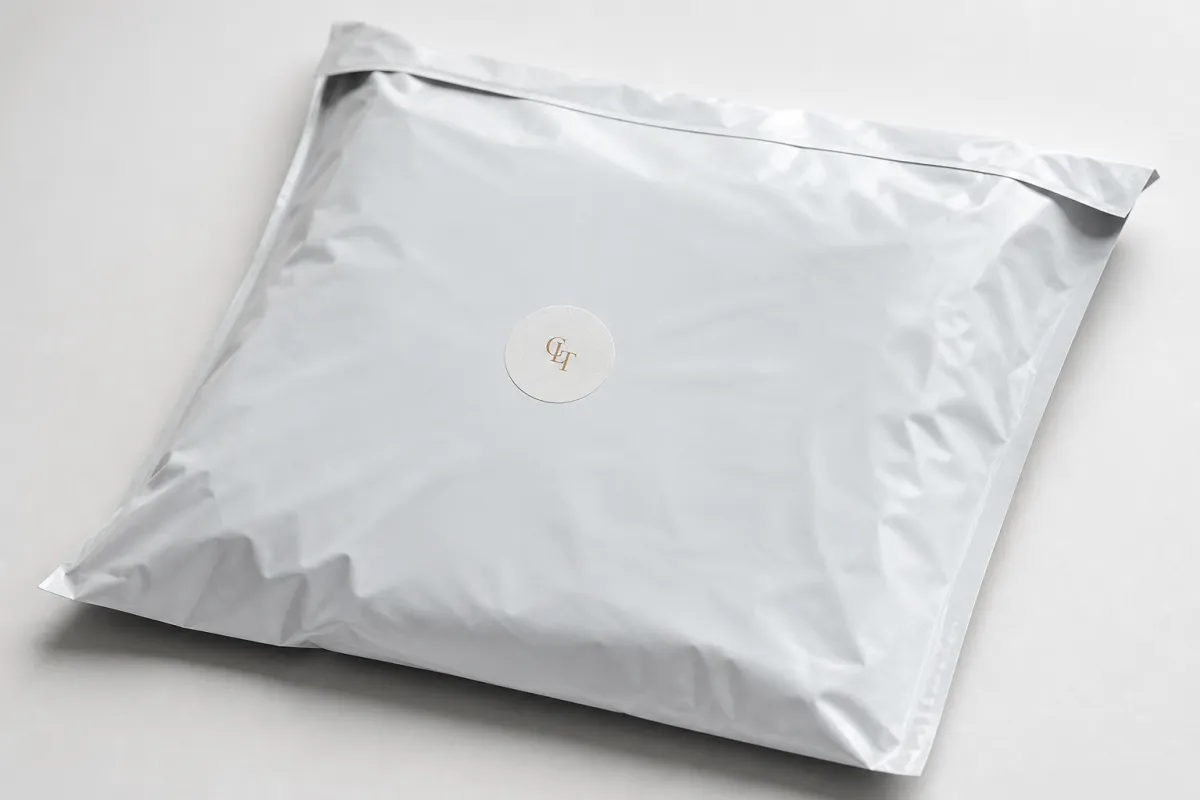
Poly mailers with custom stickers work because the jobs are divided cleanly. The mailer handles transit, the sticker handles identity. That sounds basic. It is basic. And basic is useful when packaging has to move quickly, stay flexible, and still look intentional. A stock mailer can remain generic while the sticker shifts from logo mark to promo message to launch badge without forcing a full reprint.
Product launches benefit from that flexibility. So do short-run seasonal campaigns, flash sales, and drops that change art every few weeks. Small catalogs especially like this approach because it keeps the shipping presentation consistent without requiring enough volume to make a printed bag sensible. If you are shipping three or four core SKUs, poly mailers with custom stickers can keep the visual system tight without locking you into a long production run. That is a useful place to be.
Sticker placement changes the message. Front-center placement puts the brand in the first frame. A flap seal looks neater from the top and creates a more restrained profile. Inside placement pushes branding to the opening moment, which works if you want the exterior to stay quiet. Each version changes the order in which the package is read. The best option depends on the mailer size, the packing line, and whether the brand wants to announce itself or stay a little understated.
Poly mailers with custom stickers also reduce the cost of changing direction. That is not theoretical. A fully printed bag locks you into a visual system that can age faster than the product itself. Shift the logo weight, adjust the campaign language, or rename a collection, and old inventory starts to look like evidence of a decision that no longer fits. Sticker branding keeps those changes manageable. It also pairs well with short-run custom printed boxes when part of an order ships in cartons and part ships in mailers. One brand system, two packaging forms, fewer mismatched pieces.
There is a perception benefit too. A consistent sticker size and a simple mailer often read as more controlled than a package covered in competing graphics. Buyers notice restraint, even if they would not use that word. In e-commerce, the parcel is often the first physical proof that the brand knows what it is doing. A packaging system with fewer visual interruptions usually looks more deliberate than one trying to prove itself from every angle.
I once watched a subscription brand switch from fully Printed Poly Bags to stock black mailers with a white logo sticker and a small insert card. Their product did not change, but the feedback did. Customers described the package as “cleaner” and “more premium,” which was kinda the whole goal. The interesting part was operational: their packers actually moved faster because they were no longer sorting through multiple bag versions.
How Poly Mailers with Custom Stickers Actually Work
The setup is simple, though the details decide whether it holds up. In poly mailers with custom stickers, the mailer ships the item and the sticker carries the visible message. That message can be a logo, a QR code, a shipping note, a seasonal offer, or a tamper seal. The mistake many teams make is treating the sticker like decoration. It is not. It needs to survive handling, friction, temperature swings, and whatever rough treatment a carrier line can produce before the parcel reaches the customer.
Sticker selection is where quality usually slips. Pressure-sensitive labels are the common choice because they apply quickly and come in many finishes. Matte stock reads quieter and more contemporary. Gloss stock tends to lift the color and create a brighter surface. Permanent adhesive makes sense for shipping pieces that need to stay put through transit. Removable adhesive can help with temporary promos or internal sorting, but it is a weaker choice for core package branding. A label that curls at the corner after a damp delivery route is not doing the job.
Mailer surface changes the result more than many buyers expect. Dark bags need stronger contrast so the sticker does not disappear. Soft-touch film can feel more expensive, yet it can also change how the adhesive bites. Recycled-content bags and textured films behave differently from standard smooth poly. That is why poly mailers with custom stickers should be tested together, not chosen separately from a spec sheet and hoped for the best. A proof can look sharp and still fail once it hits a real packing station.
Application method depends on volume. A small brand can hand-apply labels if the design is simple and the packing table stays organized. A growing operation needs a repeatable routine: mailers stacked flat, labels kitted in order, placement standardized so the next parcel looks like the last one. For shops shipping many SKUs, pre-kitted sticker sets cut mistakes and save time. That matters because the cost of extra seconds adds up fast. A label that slows the line is not clever. It is labor disguised as branding.
Front-facing stickers and seal stickers serve different roles. The front-facing version should usually be larger and legible from arm's length. The seal can be smaller, but it needs stronger adhesive and more accurate placement because it is touched more often. Dust, oil, and static all affect performance. Poly mailers with custom stickers work best when the packer applies consistent pressure and the bag surface is clean and dry. No amount of design polish can rescue a label that never bonded properly.
Layering helps when the package needs more structure. The outer layer can be a mailer with a logo sticker. The second layer might be tissue or an insert card. The third layer can carry a product note, a care tip, or a return reminder. That is standard retail packaging logic. It gives the shipment enough order to feel deliberate without pretending every parcel deserves the treatment of Luxury Rigid Boxes.
Key Factors That Decide Whether It Looks Premium
Poly mailers with custom stickers look premium or cheap for reasons that are almost embarrassingly small. Size is one of them. A tiny label looks like a spare part. A huge label can crowd a small mailer and make the package feel overworked. Many brands land somewhere around 3 x 3 inches to 4 x 6 inches for front labels, with larger sizes reserved for bigger bags or layouts that need more than a logo. The right size depends on reading distance, type complexity, and whether the sticker needs to hold a QR code or promo line as well.
Hierarchy comes next. The eye should know where to go first. A logo, tagline, web address, and social handle all competing at the same level create visual noise. Strong package branding usually gives the logo one clear point of emphasis, then pushes support details down the page. That rule shows up in branded packaging, product packaging, and custom printed boxes. The package does not need more content. It needs a cleaner order of reading.
Material matching is where many budgets get too thin. Mailer thickness, opacity, sticker stock, and adhesive strength all shape the final impression. A flimsy bag paired with a heavy glossy label feels mismatched. A thicker 2.5 to 3 mil mailer with a matte sticker can feel more composed. If the bag is translucent, the contents may show through in a way that undermines the presentation. If the adhesive is weak, the package feels careless before it is even opened. Poly mailers with custom stickers work best when the visual weight and physical weight line up.
Contrast is non-negotiable. White or pale labels usually read best on black or dark gray mailers. Darker ink can work on light mailers, but fine lines and ultra-thin fonts need enough stroke weight to survive production and transit. Hairline borders, tiny copy, and delicate typography are risky choices if the bag will be stacked, scanned, photographed, and handled in imperfect lighting. A package that only looks correct in a mockup is not finished.
Whitespace changes perception quickly. A sticker with breathing room around the mark can look more expensive than a dense, overfilled layout. Packaging design has a strange rule: restraint often looks like intention. The weakest version of poly mailers with custom stickers is the one where the label was shoved onto the bag with no margin, no alignment plan, and no reason beyond “we needed branding.” Customers can spot that sort of shortcut almost immediately.
If the goal is a sharper-looking parcel, a few small tests help before you commit:
- Label size: compare one version that feels generous and one that is just slightly smaller.
- Finish: matte, satin, and gloss each behave differently under warehouse light and phone cameras.
- Placement: front center, lower corner, and flap seal produce different visual hierarchies.
- Color contrast: check that the logo still reads in a photo, not just on a proof.
That kind of testing is unglamorous. It also saves money. Packages often look polished because the logo is not too small, the spacing is deliberate, and the label is not fighting the bag for attention. Most of the time, that is the difference between packaging that feels branded and packaging that feels improvised.
Poly Mailers with Custom Stickers: Cost, Pricing, and MOQ
Poly mailers with custom stickers usually win on upfront cost because they avoid the setup burden of a fully printed mailer. That is the main appeal. Stock mailers can be bought quickly, sticker runs can stay small, and design changes do not leave a trail of useless inventory behind them. For small and mid-size orders, that flexibility often saves more money than a lower per-unit print price on a fully custom bag. If the artwork changes often, the sticker route usually makes better financial sense.
Here is a practical comparison. These are working ranges, not fixed promises. Final numbers move with size, color, coverage, print method, and quantity.
| Option | Typical Setup Cost | Typical Unit Cost | Best For | Main Tradeoff |
|---|---|---|---|---|
| Stock poly mailer + custom sticker | $0 to $75 for basic label setup | $0.15 to $0.40 all-in at small to mid quantities | Launches, seasonal promos, changing artwork | More manual application labor |
| Fully printed poly mailer | $75 to $300+ depending on print method | $0.22 to $0.55 at common order sizes | Stable brands with consistent artwork | Higher upfront commitment and more dead stock risk |
| Stock mailer + sticker + insert card | $25 to $150 | $0.20 to $0.50 | Brands wanting a stronger unboxing layer | More pack-out steps and more touch time |
That table leaves out a few things that matter in the real world. Sticker size changes the number. A 2 x 2 inch logo seal costs less than a larger front label, but the larger one may be the piece that actually makes the package feel branded. Finish changes the number too. Matte labels can cost a bit more than standard gloss, and specialty stocks such as kraft-look, weather-resistant, or tamper-evident materials push pricing upward again. If you want poly mailers with custom stickers to look intentional, do not chase the cheapest stock because it looks tidy in a spreadsheet.
MOQ tends to be lower for stickers than for printed mailers, which is a big reason this setup is so common. Digital label runs can start small enough for test orders. Printed mailers usually need higher quantities before the pricing gets attractive. Low MOQ does not erase labor, though. If every parcel gets a sticker by hand, line speed matters. A packing station can apply labels quickly when the format is simple and the placement is fixed. It slows down when there are multiple SKUs, multiple shapes, or multiple campaign messages that need to be matched by hand.
Budgeting should include the full pack-out process, not just the material line. Count the mailer, the sticker, any insert card, the time needed to apply each piece, and the rework rate if labels are placed poorly. A cheap label that adds 30 seconds to every order is not cheap for long. The labor quietly eats the savings. That is why poly mailers with custom stickers have to be evaluated as a complete system instead of a per-unit bargain.
A realistic budget for a small brand might look like this:
- Basic branded mailer: stock bag plus single-color sticker, often around $0.15 to $0.25 per shipment in simple runs.
- Mid-level presentation: nicer mailer film, larger label, and a small insert, often around $0.25 to $0.45 per shipment.
- More polished presentation: premium mailer, high-contrast label, and a coordinated insert system, often around $0.40 to $0.70 per shipment.
If those ranges feel wide, packaging pricing is wide. Film gauge, adhesive chemistry, label finish, and labor efficiency all shift the total. The real question is not whether the package can be made cheaply. It is what the package needs to say, and how much work the brand is willing to put into making that message land.
Process, Timeline, and Lead Time for Poly Mailers with Custom Stickers
The production flow for poly mailers with custom stickers is easy to describe and easy to delay. Artwork comes first. Proofing comes next. Then the sticker is printed, the mailer is sourced, quality checks happen, and the final pack-out begins. If any step circles back for a revision, the schedule moves. That is not unusual. Packaging work often depends on multiple pieces arriving at the same time, and a delay in one place ripples through the rest.
Sticker printing is often the faster part. Mailer sourcing tends to slow things down, especially if the order calls for a specific color, thickness, or recycled-content film. Common neutral colors usually move faster than unusual custom shades. Standard mailer sizes also reduce friction because suppliers keep them in regular rotation. A strange size might look efficient on paper. It usually adds lead time in practice.
Stock mailers plus printed labels can often move in the 7 to 15 business day range after proof approval, depending on order size and supplier capacity. More complex builds, or builds with inserts and multiple label versions, can stretch to 12 to 20 business days. Art revisions are the usual culprit. Each round trip adds time, and each delay increases the odds that the launch team accepts a compromise they did not want.
Poly mailers with custom stickers move more smoothly when a few decisions are locked early:
- Fix the mailer size before finalizing the label layout.
- Choose one sticker shape and one main placement.
- Keep typography readable at production size, not only on-screen.
- Confirm whether the label has to survive cold storage, humidity, or rough transit.
- Approve the proof quickly so production does not sit idle.
Launches and peak sales periods need buffer. Packaging deadlines slip most often when someone assumes a proof can wait for a week and still keep the schedule intact. It cannot. Working backward from the launch date gives the team room for revisions, freight, and one irritating surprise. There is almost always one irritating surprise. Planning for it saves the tone of the whole project.
Standards-based testing helps here. If the mailer is carrying a shipping-critical presentation, parcel testing through ISTA protocols can reveal problems before the order scales. A label does not need to become a laboratory project, but the package should survive transit, compression, and regular handling. That line separates a nice mockup from a package That Actually Works.
If sustainability claims matter, a paper insert or sticker stock with FSC certification can support the message, provided the claim is accurate and the chain of custody is real. Brands get into trouble when they talk loosely about eco-friendly packaging. The material has to match the claim. If it does not, customers notice sooner than the brand expects, and the gap between message and material starts to look careless.
Common Mistakes with Poly Mailers and Stickers
Weak adhesive is the fastest way to make a package look cheap. A label can look perfect on day one and still peel during transit if the bag surface is dusty, humid, oily, or simply incompatible with the adhesive. That problem shows up quickly on unusual poly films, and it shows up just as fast on rushed pack lines where bags are handled with warm hands and stacked before the adhesive settles. Poly mailers with custom stickers need a clean, dry surface and a label built for that surface. There is no shortcut that replaces that match.
Low contrast is another classic mistake. Thin gray type on a dark mailer may look elegant on a screen, then vanish in the real world. The customer should be able to read the logo and main message without leaning in. If the package only looks good under perfect lighting, the design depends too much on the mockup. That is a packaging issue, not a photography issue.
Overdesign causes its own problems. Some brands cram the outside of the bag with copy, graphics, social icons, discount codes, and mission statements. The result is a billboard, not a package. The strongest package branding usually stops early. A clear logo, one short line of copy, and maybe a seal is often enough. Anything extra needs a strong reason to be there.
Shipping labels still need space. Carrier labels, return information, barcodes, and scan zones are not optional. If the branding sticker sits in the wrong place, the packer has to work around it at the final step, which slows the line and raises the chance of a mis-scan. Good design leaves room for logistics. Product packaging and delivery performance share the same surface, so they have to cooperate. That is true in retail packaging too. Looks matter, but the package still has to move.
Some brands make the sticker too small because they want to save a few cents. That is false economy. Smaller labels leave less room for readable type and make the branding feel accidental. A tiny mark can work as a seal, but it rarely carries the full identity well. If you want poly mailers with custom stickers to read as intentional, the label needs enough size to breathe.
Before you scale, check a few failure points:
- Adhesion test: rub the label edge, flex the bag, and see whether the corners lift.
- Readability test: view the package from arm’s length and on a phone photo.
- Pack-out test: time how long it takes to apply the label during a real shift.
- Transit test: ship a few samples through a normal parcel journey before buying in volume.
There is a larger brand issue hiding underneath all of this. When the website, inserts, and shipping pieces look unrelated, the package feels assembled instead of designed. Packaging loses value the moment it starts looking improvised. The mailer is not only a shipping shell. It is part of the memory of the brand. That is why customers notice inconsistency almost instantly, even when they cannot explain what feels wrong.
For that reason, poly mailers with custom stickers should be judged as part of the whole packaging family. If the brand already uses custom printed boxes, the mailer label should feel related, not copied. Same tone. Similar type treatment. Consistent visual discipline. The pieces do not need to match exactly, but they should clearly belong together.
Action Steps for Your First Order of Poly Mailers with Custom Stickers
If you are placing a first run of poly mailers with custom stickers, start with a tight spec sheet. Choose the mailer size, film color, and thickness first. Then pick the sticker size, finish, and adhesive. Then finalize the artwork. That sequence matters because changes in size can force design revisions, and revisions create delays that cost time and patience. A clean spec sheet also makes supplier quotes easier to compare, which cuts down on surprise costs later.
Ask for samples before you place the full order. Not digital proofs. Physical samples. Test the exact sticker on the exact mailer. Check how it lays on the bag, how the colors read in normal warehouse light, and whether the adhesive grips after a few minutes. Dark mailer? Check contrast. Recycled-content film? Check bond strength. Packaging gets interesting only after it touches real materials.
A small pilot is worth the effort. One mailer color. One sticker finish. One size. A modest quantity. Enough to see what happens in actual pack-out, but not enough to create a warehouse problem if the choice misses the mark. With poly mailers with custom stickers, the pilot teaches more than the mockup ever will. The mockup can tell you whether the design is decent. The pilot tells you whether the package works in practice.
Use the pilot to check four things:
- Adhesion: do the corners stay flat after handling and transit?
- Readability: does the branding still read on camera and at arm’s length?
- Pack speed: does the label placement slow the line?
- Customer response: do buyers mention the packaging in a positive way?
If the package passes those checks, scale with more confidence. If one part fails, fix that weak point before placing a larger order. Brands skip this step all the time because they want to launch quickly. Speed is useful. Excitement is not a production plan.
There is a hard-nosed business reason to keep the system simple. Poly mailers with custom stickers let you refresh the visual identity without rebuilding the entire packaging program. A launch can get a fresh message. A seasonal campaign can get its own sticker. The package branding can shift without forcing old stock into the trash. For small brands and growing catalogs, that flexibility is often worth more than a slightly lower unit price on a custom printed bag that no longer fits six months later.
If you want a straightforward buying sequence, use this:
- Set the budget per shipment, not just per component.
- Choose the mailer size and color from your actual product dimensions.
- Pick a sticker format that stays readable and is easy to place.
- Request a sample or proof and test adhesion on the real surface.
- Start with a pilot quantity, then scale if the results are clean.
That approach keeps the decision grounded in how packaging behaves outside a render. You are not buying a bag and a label. You are building a shipping experience that has to work under real speed, with real margins, and under real pressure from transit. If the pieces hold together, poly mailers with custom stickers can look polished, stay flexible, and keep costs under control. That is the sweet spot most brands are chasing.
Are poly mailers with custom stickers cheaper than printed mailers?
Usually yes for small and mid-size runs because you avoid the heavier setup cost of a printed bag and can use stock mailers. Printed mailers can become cheaper at higher volumes if your design stays stable and the upfront commitment is not a problem.
Will custom stickers stay on poly mailers during shipping?
They should if you use a pressure-sensitive adhesive that matches the mailer surface and the bag is clean and dry when applied. Test for corner lift, rubbing, and temperature changes before you place a real order. Cheap labels fail fast, and transit does not care about optimism.
What size sticker works best on poly mailers?
Big enough to read from arm's length, which is usually larger than first-time buyers expect. Leave enough whitespace so the label looks designed, not shoved onto the bag as an afterthought.
How long does it take to produce poly mailers with custom stickers?
Stock mailers plus printed stickers can move quickly if the artwork is ready and proofs are approved without delay. Most timeline issues come from revisions, sourcing the right mailer color, and shipping bottlenecks rather than the label print itself.
Can I use poly mailers with custom stickers on eco-friendly mailers?
Yes, but confirm the adhesive works on that exact film because recycled and compostable materials can behave differently. If sustainability matters, check both the sticker material and mailer claims so the final packaging does not overstate anything.
For brands that want practical branded packaging without locking themselves into one rigid look, poly mailers with custom stickers are a smart place to start. They keep costs under control, they adapt well to changing campaigns, and they still leave room for a polished customer experience. The most useful next step is simple: lock one mailer size, one sticker finish, and one placement, then run a small pilot on real orders before you scale. If that version survives handling, reads clearly in a photo, and keeps the pack line moving, you have a packaging system that can grow with the brand instead of boxing it in.

