Buyer Fit Snapshot
| Best fit | Printed Poly Bags with Logo projects where brand print, material claims, artwork control, MOQ, and repeat-order consistency need to be specified before quoting. |
|---|---|
| Quote inputs | Share finished size, material target, print colors, finish, packing count, annual reorder estimate, ship-to region, and any compliance wording. |
| Proofing check | Approve dieline scale, logo placement, barcode or warning zones, color tolerance, closure strength, and carton packing before bulk production. |
| Main risk | Vague material claims, crowded artwork, missing packing details, or unclear freight terms can make a low unit price expensive after revisions. |
Fast answer: Printed Poly Bags with Logo: Film, Print, MOQ, and Carton Packing should be specified like a repeatable production item. The safest quote records material, print method, finish, artwork proof, packing count, and reorder notes in one written spec.
Production checks before approval
Compare the actual filled-product size with the drawing, then confirm tolerance on folds, seals, hang holes, label areas, and retail display edges. Reserve space for logos, QR codes, warning copy, and material claims before decorative graphics fill the panel.
Quote comparison points
Review material grade, print process, finish, sampling route, tooling charges, carton quantity, and freight assumptions side by side. A quote is only useful when the supplier can repeat the same color, closure quality, and packing count on the next order.
Printed poly Bags With Logo: how to spec them with confidence.
Printed poly Bags with Logo are not just a wrapper around a product. They are the first piece of packaging a customer actually handles, and that first touch carries more weight than people expect. A bag that lands crisp, fits the product properly, and prints cleanly makes the whole order feel considered. A bag that wrinkles, hangs too loose, or looks cheaply made sends the opposite signal before the product even comes out.
From the buyer's side, printed poly Bags With Logo have to do three jobs at once: protect the product, keep packing efficient, and carry the brand without adding avoidable cost or weight. That balance matters. Overbuild the spec and you pay for features nobody asked for. Underbuild it and the packaging starts creating waste, returns, and rework. Packaging budgets rarely fail from one dramatic mistake. They usually slip away through a bunch of small compromises that seemed harmless at the time.
"The bag is the first surface a customer handles. If it looks off, the whole shipment feels off."
That is why printed poly bags with logo show up so often in ecommerce, retail fulfillment, subscription boxes, and secondary packaging for soft goods. A plain bag with a sticker can get a job done for a short run. So can a generic mailer with a label. Once volume climbs, though, printed poly bags with logo usually pack faster, look more polished, and build stronger brand recall without pushing freight costs into another bracket. The real work is choosing the film, the print method, and the quantity that fit the line you actually run.
What Printed Poly Bags With Logo Really Are
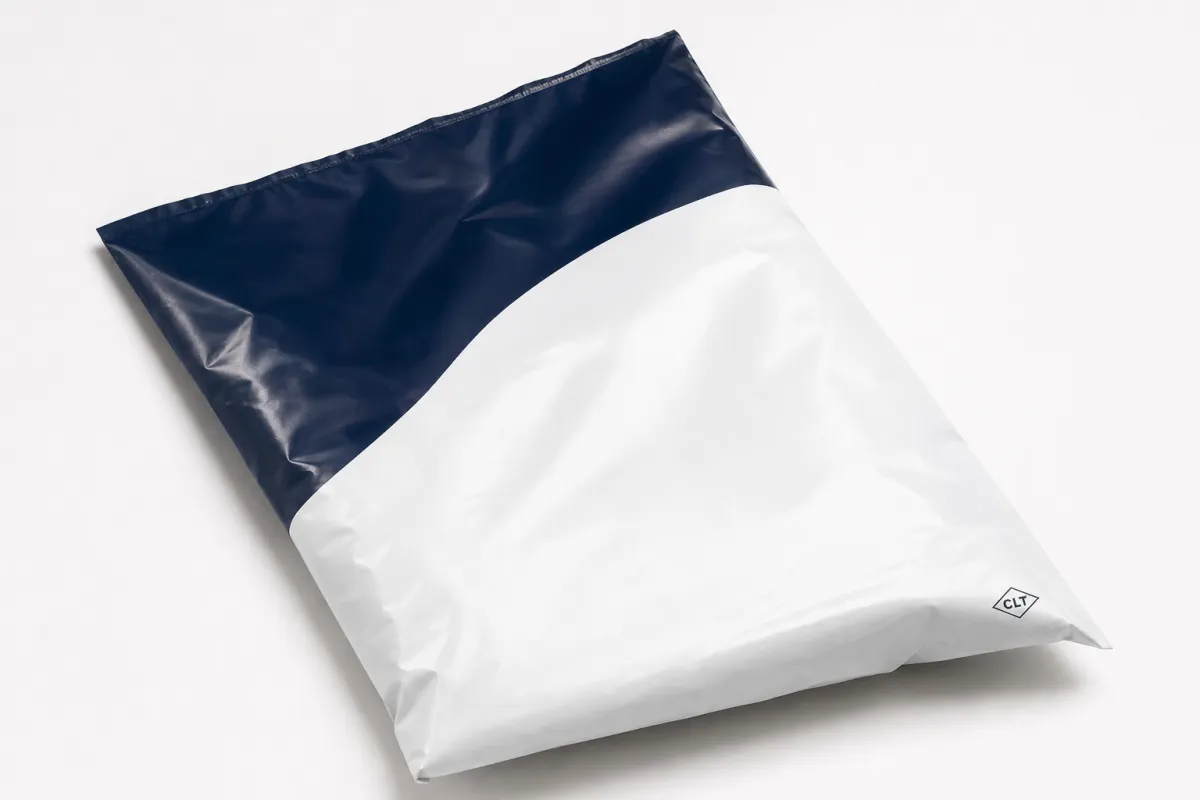
Printed poly bags with logo are lightweight plastic bags or mailers made from polyethylene film and printed with a brand mark, message, or artwork. They combine the package and the branding into one part, which means there is no second labeling step later in the process. That matters on a busy packing line. Fewer handoffs usually mean fewer mistakes, and the brand mark ends up built into the package instead of added at the last minute.
Most buyers use printed poly bags with logo for apparel, accessories, subscription goods, sample kits, cosmetics, and small parts. They make the most sense when the product does not need a rigid carton, but still needs protection from dust, moisture, scuffing, and casual inspection. A simple one-color logo on a white or tinted bag can look sharper than people expect. Full coverage is not required to make the packaging feel deliberate.
They also solve a few practical problems that show up in daily fulfillment. On high-volume lines, a preprinted bag removes the need to apply a separate label to each order. A fixed print format keeps branding consistent from one packout to the next. When the bag itself is part of the customer experience, printed poly bags with logo usually feel more finished than a plain bag with a sticker slapped on later.
There is a cost angle here that gets overlooked. A logo printed on a poly bag often adds less to carton weight and freight than a heavier custom box. That makes printed poly bags with logo a useful middle ground between plain utility packaging and a more expensive retail box. You get visible branding without turning the package into a custom engineering project for every shipment.
If you are sorting through packaging options, the bag is only one part of the system. Outer cartons, inserts, pouches, and void fill may still matter depending on the product. For a broader view of stock and custom packaging choices, review Custom Packaging Products alongside your bag spec so you can see where the bag fits in the larger packout.
How Printed Poly Bags With Logo Are Made: Process and Timeline
Printed poly bags with logo usually move through artwork review, film selection, print setup, production, quality checks, and final packing. That sequence sounds tidy on paper. In practice, the first friction point is usually the art file. A logo that looks fine on a screen can fail on a narrow mailer if the print area is too small, the bleed is wrong, or the safe zone gets ignored.
The print method changes the job from the start. Flexographic printing is common for larger runs because the unit cost drops as volume climbs, though it requires plates and more setup time. Gravure can deliver strong consistency on very large programs, yet it usually makes sense only at higher quantities. Digital printing works better for shorter runs and faster design changes, but the unit price is often higher and the film choices can be narrower. For a test run of printed poly bags with logo, digital may be the practical choice. For a long-running SKU, flexo tends to make more commercial sense.
Timeline is where expectations often drift out of alignment. A typical path might be 1 to 3 business days for artwork review, 2 to 5 business days for proofing, 7 to 15 business days for production, and then freight after that. Rush orders can move faster if the supplier has room in the schedule and the art is already clean, but last-minute color changes, size changes, or die updates can wipe out the timeline quickly. A buyer who waits until inventory is already low is not dealing with a print problem. That is a planning problem showing up late.
Simple artwork moves faster through proofing. Designs with gradients, metallic effects, white underprint, or multiple branded elements need more attention. For printed poly bags with logo, the slowdowns usually come from low-resolution art, missing dielines, blurry brand color references, or a logo that was described in vague terms instead of specified clearly. "Close enough" is not a color standard. If the logo matters, define the target with Pantone references or another clear print reference.
The production floor has its own rhythm. Film gets converted, printed, cured or dried, slit or folded if the format calls for it, inspected, counted, and packed. Good quality control is not just about a neat look. Bags should be checked for registration, seal integrity, print clarity, and the correct carton count. For shipments that have to survive rough handling, many teams also look at ISTA test logic. The ISTA packaging test standards are useful reference points if the bags will travel with heavier contents or repeated handling. If the packaging program also includes a sustainability review, the packaging resources at packaging.org give practical industry context without turning the topic into marketing fluff.
Printed Poly Bags With Logo Cost: Pricing, MOQ, and Quote Drivers
Printed poly bags with logo pricing depends on a lot more than the bag size. Film thickness, bag dimensions, number of print colors, ink coverage, order quantity, and special features all shape the quote. Add resealable tape, hang holes, perforations, a custom flap, or a specialty finish, and the number can move faster than most buyers expect. A one-color logo on a standard white mailer is one kind of order. A full-coverage, multi-color design on a thicker custom bag is a different thing entirely.
As a rough buying range, simple printed poly bags with logo at moderate quantities can land around $0.08 to $0.22 per unit at 5,000 pieces, depending on size and print coverage. Smaller runs often cost more per bag, sometimes around $0.20 to $0.75 each if the method is digital or if setup charges are spread across fewer units. Larger programs can push the unit price lower, especially when the artwork stays stable and the supplier does not need to remake tooling every time. A quote that looks high at 1,000 units may be entirely reasonable at 10,000.
MOQ changes the economics. Digital suppliers may accept 250 to 1,000 pieces for printed poly bags with logo, while flexographic programs often begin around 3,000 to 10,000 pieces, and gravure can sit much higher. The lowest unit price is not always the lowest total cost. If you buy more bags than you can use just to chase a smaller unit rate, you can end up with stale inventory, storage costs, or a design that becomes outdated before the last carton leaves the shelf. A bargain that sits in a warehouse for 14 months is not really a bargain.
Most quotes include more than the unit price. Expect setup fees, plate charges, artwork cleanup fees, sample charges, and freight to show up somewhere in the stack. With flexo, plate or tooling charges often run in the tens or low hundreds per color, depending on the supplier. Digital may reduce the setup burden, but the per-unit price often rises. Freight can become a meaningful part of landed cost too, since poly bags are light but can occupy plenty of space. Shipping has a habit of hiding in plain sight.
Here is a simple comparison buyers can use when reviewing printed poly bags with logo quotes:
| Print Method | Typical MOQ | Best For | Quote Behavior | Watch-Out |
|---|---|---|---|---|
| Digital | 250 to 1,000 units | Samples, short runs, frequent artwork changes | Higher unit cost, lower setup burden | Can get expensive as quantity rises |
| Flexographic | 3,000 to 10,000 units | Repeat orders, steady SKUs, one to few colors | Better unit pricing at volume, plate costs up front | File prep and color control matter a lot |
| Gravure | 25,000+ units | Large programs, consistent high-volume packaging | Strong cost efficiency at scale | Less flexible if your design changes often |
When you compare printed poly bags with logo quotes, line up the same assumptions across every supplier. Match bag size, thickness, film type, number of print colors, print coverage, count per carton, freight terms, and setup charges. If one quote includes plates and another does not, the comparison is misleading. If one quote assumes a 2 mil bag and another assumes 3 mil, the numbers do not help. Clean specs save money because they remove guesswork.
If you also buy poly mailers, a side-by-side view can help separate bag pricing from shipper pricing. See Custom Poly Mailers if you are comparing printed bags against mailer-style packaging for your fulfillment flow.
Key Factors That Change Print Quality and Durability
Printed poly bags with logo can look sharp or sloppy based on a few details that are easy to miss during sourcing. Film type is one of the biggest. LDPE is softer and more flexible, which makes it common in many mailer-style applications. HDPE is thinner and crisper, often used where a lighter feel matters. Coextruded film blends layers to balance strength, appearance, and handling. If the bag will be folded, stuffed, or sealed repeatedly, the film choice affects the look of the print and how the bag behaves on the packing line.
Thickness matters just as much. A 1.5 to 2 mil bag can work well for lightweight apparel or insert kits. A 2.5 to 3 mil bag is often a safer middle ground for general ecommerce use. Heavier or sharper contents may call for 3 to 4 mil film or a different structure altogether. Printing on very thin film can still look good, but the bag may wrinkle or distort more easily, which makes the logo look worse in real use. Durable branding starts with a bag that can hold its shape under normal handling.
Print placement and opacity change the result too. A dark bag with a light logo often needs a white underprint so the brand color does not disappear into the film. Full-coverage artwork can make the package look premium, but it also raises the chance of banding, register issues, or color shifts if the press is not tuned correctly. Give the logo enough white space so it can breathe. A mark crowded against seams, folds, or tear zones looks accidental rather than designed.
Think about the shipping path, not just the sample on your desk. Will the bag only be touched once, or will it be dragged across tables, dropped into bins, and stacked in cartons? Printed poly bags with logo for soft goods may only need solid puncture resistance and decent seal strength. Bags for cosmetics or moisture-sensitive items may need tighter seals and cleaner film clarity. Bags for industrial parts may need more puncture resistance and a direct conversation about whether a film bag is even the right package.
Testing helps cut through opinion. ASTM methods such as ASTM D882 for tensile properties or ASTM D1709 for impact resistance are useful references when comparing film performance. They do not tell the whole story, but they give you a precise way to ask better questions. If your packaging program includes paper cartons, inserts, or display boxes, FSC certification may matter there even if the poly film itself is not FSC-certified. Different materials carry different claims, and that distinction matters.
If your team wants to reduce packaging waste, the better question is not, "Can we make the bag thinner?" The better question is, "Can we keep the bag strong enough while avoiding unnecessary material?" The EPA has practical recycling and materials guidance at epa.gov, and that kind of thinking helps buyers separate real material decisions from marketing language. A lighter bag only helps if it still survives the trip.
Step-by-Step: Ordering Printed Poly Bags With Logo
Ordering printed poly bags with logo goes more smoothly when the project is treated like a mini spec build instead of a casual reorder. Start with the product itself. What are the dimensions, the weight, the packing method, and the shipping conditions? A 10-ounce apparel item in a controlled warehouse is not the same as a moisture-sensitive component moving through a humid supply chain. The bag should fit the product, not just vaguely cover it.
After that, decide what the branding needs to do. A single centered logo may be enough for one program. Another project may need a return message on the back, a full bleed pattern, or a reseal panel with a brand mark on the flap. Printed poly bags with logo should match the use case. For a subscription insert, a small logo can be enough. For retail resale, the bag may need more visual presence so it feels like part of the shelf story.
Artwork prep is where many orders drift off course. Send vector art whenever possible, usually AI, EPS, or PDF. Keep the logo in a clean spot color or a clearly defined CMYK build. Ask for the dieline before you finalize the artwork, because safe areas, bleed, and trim behavior change with the bag size. If the brand color matters, include Pantone references or another clear print target. A monitor is not a color standard, no matter how polished the presentation looks.
Then request quotes from two or three suppliers using one clean spec. That spec should include size, film thickness, bag style, print location, print colors, quantity, freight destination, and target ship date. If you need printed poly bags with logo for multiple SKUs, quote the most common size first and then see whether any standard film can be shared across the line. Standardization usually beats one-off custom decisions when the goal is volume buying with fewer headaches.
Once the quote comes back, review the proof like it matters. Check spelling, logo placement, color notes, seal orientation, pack counts, and any packaging notes that affect assembly. Then lock the schedule. A practical workflow usually looks like this:
- Measure the product and define the required bag size.
- Choose the film thickness and print method.
- Prepare vector artwork and color references.
- Request apples-to-apples quotes from selected suppliers.
- Approve the proof only after checking layout, size, and color notes.
- Confirm production timing, freight method, and receiving date.
That workflow sounds basic because it is. The hard part is sticking to it when schedules get tight. Printed poly bags with logo are much easier to buy when the brand team, operations team, and supplier are all working from the same file and the same timeline. If you want a broader reference point for how printed bags fit into a larger packaging rollout, use Custom Packaging Products as a comparison point across the full packout.
Common Mistakes With Printed Poly Bags With Logo
The most common mistake with printed poly bags with logo is guessing at size. Oversized bags waste material and can make the product look lost. Undersized bags create rework, weak seals, or returns if the item is forced in and damaged. This happens often: someone orders for the product they think they have, not the product they actually pack after fold lines, inserts, tags, or tape are added. Measure the real packed item, not the idealized version.
Another mistake is sending low-resolution art and expecting the press to clean it up. It will not. A stretched logo, fuzzy type, or overcomplicated artwork can make printed poly bags with logo look cheaper than plain film would have looked. Too many ink colors can cause trouble too. Every added color increases setup complexity and the chance of register drift. A clean one-color logo on a good film often looks stronger than a busy full-color layout that fights the material.
Timing mistakes hurt the most. If art approval runs late, the order can get pushed into rush production or air freight. That is how a reasonably priced bag turns into a budget headache. Build the schedule backward from the date inventory must be on hand, then add buffer for proof revisions, transit, and receiving delays. Printed poly bags with logo are not difficult to plan for, but they are easy to delay when packaging gets treated like an afterthought.
Compliance and handling mistakes show up too. If you claim recycled content, make sure the supplier can support the claim. If the bag is too slick for your packing station, the team will fight it all day. If the adhesive strip is weak, the package may fail in transit. If you make environmental claims, do not improvise. Match the statement to the material, the claim support, and the actual supply chain. That is basic trust, not decorative marketing.
My simplest fix-it-before-you-buy-it rule is this: ask what could go wrong on the first proof. Is the logo too close to the edge? Is the bag too long? Is the color too dark on the chosen film? Are the seals clear? Those questions cost nothing. Answering them after 20,000 units are printed costs a lot more. Printed poly bags with logo reward careful buyers and punish rushed ones. Packaging can be a blunt process that way.
Expert Tips and Next Steps Before You Request Quotes
Before you request quotes for printed poly bags with logo, ask for a sample pack or at least a few print references. A real sample tells you more than a polished mockup. You can feel the film, judge the seal, and see how the print sits on the material. If a supplier cannot show examples from a similar thickness or a similar print style, you are buying with too much trust and too little evidence. I have seen buyers approve a bag from a screen image, only to discover the logo sat too close to a fold line once the first production run landed. That kind of miss is avoidable.
Do not chase the lowest unit cost before you decide what matters most. A slightly higher price can buy a better film, a cleaner print, or a shorter lead time. Sometimes it buys all three. Other times it only adds margin. A decision matrix keeps that from getting fuzzy. Rank your priorities: brand look, speed, durability, or budget. Then rank suppliers against the same criteria. Printed poly bags with logo are easier to source when everyone agrees on what "best" actually means.
Volume planning can lower costs too. If you know your reorder pattern, ask whether repeat orders reduce setup costs or improve the per-unit rate. Standard film specs often cost less than one-off custom structures. A simple white or clear bag with one or two print colors is usually easier to repeat than a specialty film with a custom finish. For many brands, boring is profitable. That is not an insult. That is what margin looks like in practice, and it is kinda the point when packaging has to work every day.
Here is a simple buying checklist you can use before sending a request:
- Measure the packed product and confirm bag size.
- Choose the film thickness based on handling and shipping risk.
- Prepare vector artwork and brand color references.
- Decide how many print colors you actually need.
- Ask for MOQ, setup fees, freight terms, and proof timing.
- Confirm whether the quote includes plates, sampling, and reorders.
Send one clean spec to two or three suppliers and compare line by line. That sounds dull because it is. Dull is useful in purchasing. Dull keeps you from paying for avoidable mistakes. If your packaging program includes more than just bags, treat printed poly bags with logo as one piece of the system rather than the whole system. That is how packaging teams stay sane and keep the budget under control.
My practical takeaway is simple: lock the packed size, the film, and the color target before you ask for pricing. Those three decisions shape almost everything else, and they are the ones that cause the most trouble when they are left vague. Get them right early, and printed poly bags with logo will do their job cleanly from the first proof through the last carton.
What is the minimum order for printed poly bags with logo?
MOQ depends on the print method. Digital orders for printed poly bags with logo can start around 250 to 1,000 pieces, while flexographic runs often begin much higher, commonly 3,000 to 10,000 pieces. Ask whether setup fees, plates, or tooling are included, because a low MOQ can still carry a higher total cost. If you reorder often, a higher MOQ may lower your unit cost enough to justify the inventory.
How long do printed poly bags with logo take to produce?
The full timeline includes artwork approval, production, and freight, so it runs longer than the printing step alone. For printed poly bags with logo, simple jobs may move through in roughly 2 to 4 weeks end to end, while jobs with special film, proof revisions, or complex artwork can take longer. Build buffer time into the plan before inventory is needed so you are not forced into rush shipping at the last minute.
Are printed poly bags with logo better than stickers on plain bags?
Usually, yes, if speed and a cleaner look matter. Printed poly bags with logo keep the branding built into the package instead of sitting on top of it, and that saves packing labor. Stickers still make sense for very small runs, frequent design changes, or test orders where you do not want to commit to a full print run. For repeated fulfillment, printed bags usually look more intentional.
What file should I send for printed poly bags with logo?
Send vector artwork when possible, usually AI, EPS, or PDF, so the logo stays sharp at print size. Include Pantone references or clear color targets if brand color accuracy matters. For printed poly bags with logo, also ask for the dieline, bleed, and safe area rules before you finalize the file. A file that looks fine in a presentation deck may still fail on press if it was built without the bag geometry in mind.
How do I compare quotes for printed poly bags with logo?
Match the same bag size, film thickness, print colors, quantity, and freight terms across every quote. Check whether setup fees, plates, proofing, and reorders are included or billed separately. The cheapest printed poly bags with logo quote is only cheap if the spec, quality, and timeline actually line up. If one supplier is quoting a different film or a different quantity break, you are not comparing the same product.


