Buyer Fit Snapshot
| Best fit | Price for Branded Magnetic Closure Boxes projects where brand print, material claims, artwork control, MOQ, and repeat-order consistency need to be specified before quoting. |
|---|---|
| Quote inputs | Share finished size, material target, print colors, finish, packing count, annual reorder estimate, ship-to region, and any compliance wording. |
| Proofing check | Approve dieline scale, logo placement, barcode or warning zones, color tolerance, closure strength, and carton packing before bulk production. |
| Main risk | Vague material claims, crowded artwork, missing packing details, or unclear freight terms can make a low unit price expensive after revisions. |
Fast answer: Price for Branded Magnetic Closure Boxes: What Drives It should be specified like a repeatable production item. The safest quote records material, print method, finish, artwork proof, packing count, and reorder notes in one written spec.
Production checks before approval
Compare the actual filled-product size with the drawing, then confirm tolerance on folds, seals, hang holes, label areas, and retail display edges. Reserve space for logos, QR codes, warning copy, and material claims before decorative graphics fill the panel.
Quote comparison points
Review material grade, print process, finish, sampling route, tooling charges, carton quantity, and freight assumptions side by side. A quote is only useful when the supplier can repeat the same color, closure quality, and packing count on the next order.
Price for Branded Magnetic Closure Boxes: What Drives It
The magnet is usually not the line item that makes people blink. The price for branded magnetic closure boxes tends to move because of the board, the wrap, the print coverage, the finishing, and the labor needed to keep everything square and presentable. A tiny magnet hidden in the lid rarely makes or breaks the quote. What does move the number is the decision to build a rigid box That Feels Premium instead of a lightweight carton that only looks good in a render.
From a packaging buyer’s standpoint, the real question is not whether the mockup looks attractive. It is whether the box protects the product, supports the brand, and avoids waste in the process. I have seen buyers save a little on the front end and then pay for it later through dented lids, damaged corners, or packaging that makes an otherwise solid product look rushed. A higher price for branded magnetic closure boxes can actually be the cheaper choice once returns, replacement shipments, and weak shelf presentation are added up.
I prefer to keep this practical. No filler. No inflated language that sounds fancy but says very little. If you want to compare the price for branded magnetic closure boxes, you need a clear picture of what changes the quote, what stays stable, and where a buyer can trim cost without turning the box into something flimsy or forgettable. That is the part worth paying attention to.
A low quote only counts as a win if the box survives shipping, closes properly, and still looks like someone cared.
People do not really buy cardboard. They buy presentation, protection, and consistency. If the packaging needs to travel through warehouses, sit on retail shelves, or show well in photos and unboxing videos, the price for branded magnetic closure boxes should be judged against that job, not against the cheapest rigid box you can find in a catalog.
Price for Branded Magnetic Closure Boxes: A Fast Reality Check
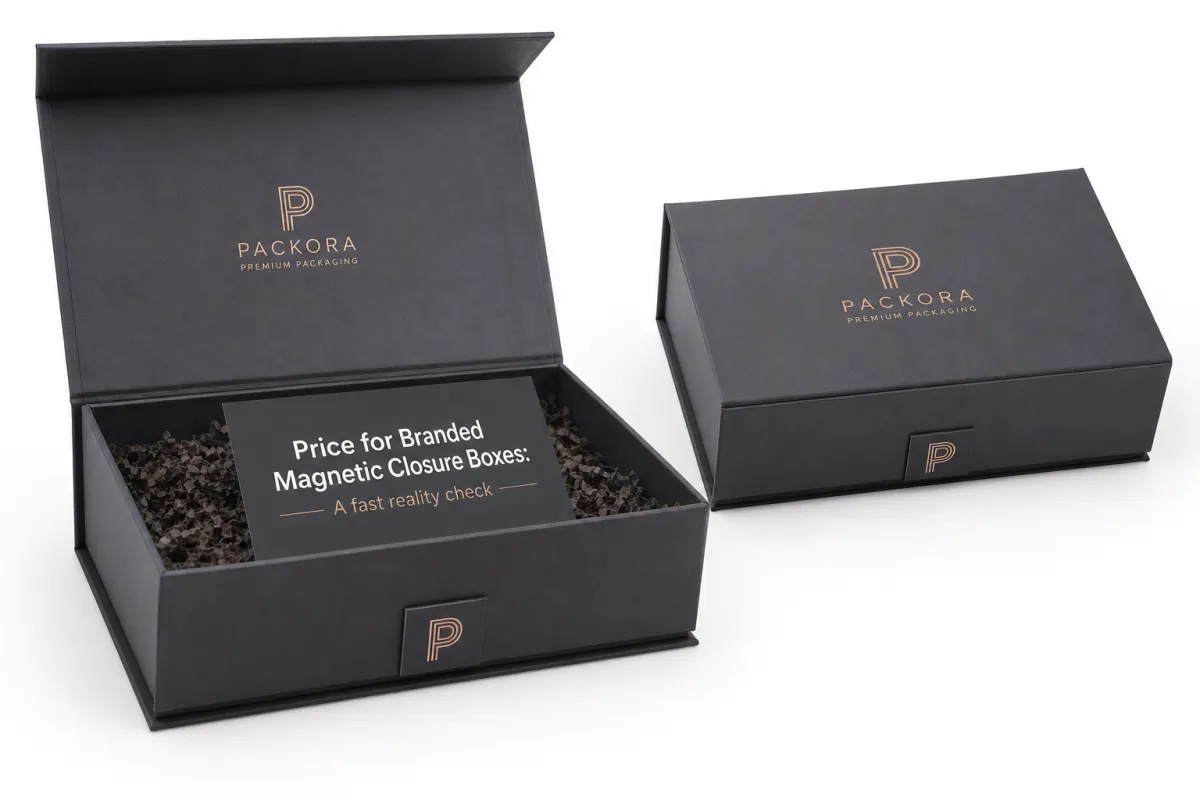
The quickest way to understand the price for branded magnetic closure boxes is to stop treating the magnet as the main expense. In most builds, the magnet is a small part of the cost. The real money goes into the rigid board, the paper wrap, the precision of assembly, the print method, and the finish on the surface. That is why two boxes with the same outside dimensions can come back with noticeably different quotes.
A rigid magnetic closure box is usually made from chipboard or greyboard, wrapped in printed or specialty paper, and fitted with magnets inside the lid and front wall. That layered structure is what gives the box its premium feel, but it also means the carton is not built from a single sheet. If the spec includes full-coverage printing, foil stamping, embossing, soft-touch lamination, spot UV, or inside printing, the price for branded magnetic closure boxes can climb quickly even before inserts are added.
Here is the practical part: the higher quote can still be the better buy. If the lower-cost box dents, arrives misaligned, or needs replacements, the shipping costs and damage claims can wipe out the savings in a hurry. That matters even more for cosmetics, candles, electronics accessories, and gift sets, where the packaging is part of the product story. The price for branded magnetic closure boxes should reflect the brand risk, not just the material stack.
Buyers usually fall into three broad groups. Some want the cleanest possible box at the lowest spend. Some need a branded retail presentation with dependable protection. Others want a true luxury reveal, where the box feels like part of the purchase. Those are not the same spec, and they should not produce the same price for branded magnetic closure boxes.
Use this rule: if the box needs to look premium from a few feet away, start with structure, wrap quality, and alignment. Decoration only helps after those basics are right. A weak build with shiny add-ons still looks weak, kinda like wearing a sharp jacket over a wrinkled shirt. Packaging buyers notice that immediately, even if marketing tries to dress it up.
Common style choices and how they affect the number
| Style or finish | Typical use | Price impact | What to watch |
|---|---|---|---|
| Solid-color wrapped rigid box | Apparel, simple gifts, entry-level premium kits | Lowest baseline | Good for clean branding without paying for decoration you do not need |
| Full-coverage printed wrap | Retail displays, colorful branded launches | Moderate increase | Ink coverage, color matching, and trim accuracy affect the price for branded magnetic closure boxes |
| Foil stamping | Beauty, luxury gifts, premium sets | Moderate to high increase | Coverage area matters more than the logo size people imagine |
| Emboss or deboss | Minimal luxury branding | Moderate increase | Tooling and setup raise the price for branded magnetic closure boxes more than the press time itself |
| Soft-touch lamination | High-end retail and gift packaging | Moderate increase | Feels expensive, but it must be paired with a clean print file and solid board |
| Inside print | Unboxing-led brands, subscription kits | Higher increase | Nice touch, but only worth it if customers will actually see it |
For a packaging buyer, the smartest move is not to ask for every finish under the sun. It is to decide which one or two features actually support the product. A clean wrap, strong closure, and one strong branding treatment often create a better result than a box covered in every available effect. That is how you control the price for branded magnetic closure boxes without making the packaging feel stripped down.
Style should follow use case. A candle brand, a luxury apparel label, and a subscription kit do not need the same spec. The box for a gift set may need a heavier board and a richer wrap. The box for folded apparel may need less internal structure and more shelf impact. The price for branded magnetic closure boxes changes because the job changes.
Specifications That Change the Quote
The quote is built from specifics. If the buyer gives only a rough size and a logo idea, the price for branded magnetic closure boxes becomes a guess, and guessing is expensive. The more exact the spec, the cleaner the quote. That means length, width, height, board thickness, wrap type, insert style, magnet count, print coverage, and finish all need to be nailed down before anyone pretends to have a real number.
Dimensions matter more than most people expect. A small change in width or depth can alter board usage, waste on the sheet, carton packing efficiency, and sometimes freight cost. If a box layout forces more scrap, the unit cost rises. If the box fits the cutting sheet neatly, the price for branded magnetic closure boxes can drop without changing the visual appearance at all. That is not a trick. It is material efficiency doing its job.
Board thickness matters too. A lighter board may save money, but it can also reduce rigidity, weaken the corner feel, and make the lid close with less confidence. For many magnetic closure formats, buyers look at chipboard in the neighborhood of 1.5 mm to 3 mm depending on box size and product weight. There is no universal best choice. The right board is the one that protects the product and still feels intentional. The price for branded magnetic closure boxes should not be pushed higher just to chase unnecessary heft.
Insert selection is another quiet cost driver. Foam inserts look neat and secure, but they are not always the smartest option. Paperboard inserts can be cheaper and more recyclable. Molded pulp may fit sustainability goals better. EVA gives a more precise fit for fragile items, but the budget reflects that precision. No insert at all can work for apparel or flat goods. The point is simple: the insert must fit the product, not the mood board. That choice affects the price for branded magnetic closure boxes more than most buyers realize.
Specs that move the number fastest
- Outer size: Small changes can shift board usage and waste.
- Board thickness: Heavier board usually means better structure and a higher quote.
- Wrap stock: Standard art paper, textured paper, and specialty paper all price differently.
- Print coverage: Full wrap printing costs more than a single-logo layout.
- Insert type: Foam, EVA, molded pulp, and paperboard each have different cost behavior.
- Closure setup: Magnet quantity, strength, and placement affect assembly time and reject risk.
- Finish complexity: Foil, spot UV, embossing, and soft-touch lamination raise the price for branded magnetic closure boxes.
Tolerance matters too. Tight-fit luxury boxes require cleaner die-cutting and better hand assembly. That raises the quote, but it also reduces friction, crooked lids, and damaged corners. Buyers sometimes chase the lowest number and then complain that the box feels sloppy. That is backwards. If the package has to look sharp, the price for branded magnetic closure boxes should include enough production control to keep the box square and the lid aligned.
Here is the easiest decision rule I know: choose the weakest specification that still protects the product and still looks intentional on a shelf or in a video. That does not mean cheap. It means efficient. A good supplier should be able to explain where the price changes and which feature is doing the real work. If they cannot, the price for branded magnetic closure boxes is probably padded with vague assumptions.
Cost, Pricing, MOQ, and Unit Cost: What to Budget
Packaging quotes often look confusing because they mix material, labor, printing, finishing, inserts, packing, freight, and setup costs in one number. Break them apart and the price for branded magnetic closure boxes becomes much easier to read. The structure is simple: raw material cost, production labor, decoration, assembly, quality checks, shipment packing, and delivery. If a quote leaves out one of those pieces, the buyer will pay for it later.
MOQ changes the math more than almost anything else. Lower quantities carry a heavier share of setup and prepress work per unit. Larger runs spread those costs out. That is why a 100-piece order can look expensive next to a 1,000-piece order even if the box is the same. The price for branded magnetic closure boxes falls as quantity rises because the fixed work gets diluted across more units.
For budgeting, ask for tiered quotes. 100, 300, 500, and 1,000 units is a practical spread because it shows where the unit cost starts to bend. Some buyers are surprised by how sharp the drop can be between small and mid-size runs. Others are surprised that the premium finish barely changes the unit cost once volume gets high enough. The price for branded magnetic closure boxes only makes sense when you see the quantity curve, not a single line item.
| Quantity | Lean spec estimate | Premium spec estimate | What the buyer learns |
|---|---|---|---|
| 100 units | $7.50-$14.00 per box | $12.00-$22.00 per box | Setup cost is heavy, so the price for branded magnetic closure boxes looks steep |
| 300 units | $4.50-$8.50 per box | $7.50-$14.50 per box | Better spread on tooling and labor |
| 500 units | $3.10-$6.20 per box | $5.50-$10.50 per box | Often the first tier where the quote starts to feel usable |
| 1,000 units | $2.25-$4.80 per box | $4.20-$8.00 per box | Unit cost drops, but the price for branded magnetic closure boxes still depends on finish and insert complexity |
Those are budgeting ranges, not promises. Size, print coverage, and finish level can move the number quickly. A large gift box with specialty paper and a fitted insert will sit at the high end. A simple apparel box with one logo hit and a paperboard insert will sit much lower. Freight also matters. I have seen a low quoted unit price turn into an annoying total once shipping, duties, and replacement risk are added. So yes, compare the price for branded magnetic closure boxes, but compare the landed cost, not the sticker price.
Do not ignore freight packaging either. If the boxes are shipped nested or flat-packed, carton efficiency changes the total bill. If the shipment needs extra protection because the finish scratches easily, that adds cost too. A quote should show whether the price includes packing for export, local delivery, or just the box itself. Otherwise the price for branded magnetic closure boxes is not a real number. It is a placeholder.
Think about the product value too. A $25 retail item does not need the same box spend as a $250 item. A cheap box can still ruin a premium product if the brand is trying to create a strong first impression. Good buyers compare the price for branded magnetic closure boxes against product margin, damage exposure, and the cost of weak presentation. That is a more honest way to buy.
Process and Timeline: From Artwork to Delivery
The production path is usually straightforward, but only if the buyer sends clean information. A solid supplier workflow starts with inquiry, then spec confirmation, quote, dieline, artwork review, sample approval, production, quality check, packing, and shipment. Each step matters because a mistake early on changes the price for branded magnetic closure boxes later through rework, delays, or scrap.
The biggest schedule killers are predictable. Missing dimensions. Slow artwork approvals. Back-and-forth over finish details. Vague statements like "make it premium" without a clear reference. None of that helps. If the buyer wants a reliable number and a realistic lead time, the supplier needs one clean specification package. That keeps the price for branded magnetic closure boxes tied to actual production steps instead of guesswork.
For simple builds, the timeline can move quickly once the proof is approved. More complex jobs take longer because special finishes, custom inserts, and layered artwork require more checks. A simple run might sit around 12-15 business days after proof approval. A more demanding spec with special coating, custom insert tooling, or overseas shipping can move into the 18-25 business day range or more. That is not slow. That is normal production reality. The price for branded magnetic closure boxes often reflects this complexity because more stages mean more labor and more chances to catch defects before shipping.
Approval points should never be skipped. The structural drawing confirms the size and fold logic. The printed proof checks color and placement. The sample box reveals whether the lid aligns, the magnet closes correctly, and the insert fits the product. Final sign-off locks the job. If a buyer approves quickly without checking these steps, the project may still run faster, but that speed can damage the final result and raise the true price for branded magnetic closure boxes once corrections start.
Where delays usually happen
- Artwork arrives in the wrong format or with low-resolution images.
- The box size changes after the quote is already issued.
- The insert needs to be rebuilt because the product dimensions were approximate.
- Finish choices change after the sample has already been made.
- Shipping instructions are unclear, so packing and freight planning stall.
If the packaging will travel long distances, ask about test expectations too. For transit-heavy programs, suppliers should be thinking about drop, vibration, and compression performance. The ISTA testing standards are a useful reference point for buyers who want packaging that survives real handling instead of looking good only on a desk. If sustainability is part of the brief, ask whether the wrap or board can be supplied under FSC chain-of-custody documentation through FSC. Both points can affect the price for branded magnetic closure boxes, but they also affect trust.
The best orders are the ones where the supplier gets one clean specification package instead of ten scattered emails. That keeps the process calmer, the quote cleaner, and the price for branded magnetic closure boxes easier to defend when someone upstairs asks why the number looks the way it does.
Why Choose Us for Branded Magnetic Closure Boxes
Good packaging suppliers do not hide behind vague language. They explain the build, the print, the finish, and the reason the number lands where it does. That is the standard buyers should expect for the price for branded magnetic closure boxes. At Custom Logo Things, the value is not in drama. It is in clear quoting, straight answers on MOQ, and steady production control so the box arrives the way it was approved.
Stable magnet alignment matters. Clean corners matter. Sharp print registration matters. If any of those drift, the box stops feeling premium. That is why I care more about repeatability than flashy claims. A well-built box should close properly every time, hold its shape, and present the artwork cleanly. Those are the things that justify the price for branded magnetic closure boxes. Not marketing language. Actual output.
Communication also matters more than people admit. Buyers should get realistic timelines, clear proofing steps, and honest guidance on what each finish adds to the cost. If a finish is decorative but not useful, say so. If a heavier board improves the feel but adds freight cost, say that too. The best vendor relationship is blunt and useful. That is how the price for branded magnetic closure boxes stays under control without turning into a guessing game.
If you want to compare formats first, our Custom Packaging Products page is a practical starting point. If you want to see how spec decisions play out in real orders, our Case Studies page shows how structure, print, and finish affect the final packaging result. Those pages help buyers sort out whether they need a simple premium wrap or a more complex presentation build before asking for the price for branded magnetic closure boxes.
From a sales point of view, the best packaging pitch is not "we can add more stuff." It is "we can deliver the right spec without padding the bill." That means accurate quoting, no mystery fees, and a box that actually supports the product. If a supplier cannot explain why the price for branded magnetic closure boxes looks the way it does, the quote is not ready.
Next Steps to Get an Accurate Quote
If you want a clean quote, gather the basics before you ask. Product dimensions. Product weight. Insert needs. Target quantity. Delivery country. Required date. Finish preference. Any sustainability requirement. Those details give a supplier enough to produce a serious price for branded magnetic closure boxes instead of a rough estimate that will change three times.
Ask for two versions if you can. One lean spec. One premium spec. That comparison is useful because it shows exactly where the spend goes. Maybe the soft-touch coating is worth it. Maybe it is not. Maybe the inside print adds value. Maybe it only adds cost. With two options in front of you, the price for branded magnetic closure boxes becomes a decision tool instead of a mystery number.
Share artwork only after the structure is confirmed. Bad artwork on the wrong dieline burns time and money. If the product is fragile, or if the unboxing experience is a key part of the sale, request a sample or prototype before the full order. That is especially true for premium retail items where the box is part of the perceived product value. A sample may cost more up front, but it often protects the final price for branded magnetic closure boxes from expensive surprises.
One more practical tip: ask how the boxes will be packed for shipment. Nested, flat-packed, wrapped, boxed, palletized, export-packed, or mixed. Packaging for shipping is not a trivial line item. It can affect damage risk, freight, and the number of usable boxes that arrive. A quote should make that clear. If it does not, the price for branded magnetic closure boxes is still missing part of the picture.
Give the supplier one clean spec package, not a pile of scattered notes. You will get a better number and fewer headaches.
Use those details to request the price for branded magnetic closure boxes, then choose the spec that protects the product without padding the bill. That is the smart buy. Not the fanciest buy. The smart one.
Frequently Asked Questions
What affects the price for branded magnetic closure boxes most?
Board thickness, box size, print coverage, and finish are usually bigger cost drivers than the magnet itself. Insert type, custom inside printing, and tight construction tolerances can push the quote up fast, so the price for branded magnetic closure boxes usually moves with structure and decoration, not with the closure hardware.
How does MOQ change branded magnetic closure box pricing?
Lower MOQs usually carry a higher unit cost because setup, tooling, and production prep are spread across fewer boxes. Ask for tiered quotes at 100, 300, 500, and 1,000 units so you can see where the price for branded magnetic closure boxes starts to drop in a meaningful way.
Can I lower the cost without making the box look cheap?
Yes. Keep the structure clean, reduce unnecessary finishes, and use a smarter insert instead of stacking decorative extras. A simple wrap with one strong branding touch often looks more premium than a box covered in every available embellishment, and that keeps the price for branded magnetic closure boxes under control.
How long does production usually take?
Lead time depends on artwork approval, sample approval, finish complexity, and order quantity. Simple builds move faster; custom inserts, special coatings, and overseas shipping add time. For many orders, the price for branded magnetic closure boxes is tied to how many approval rounds the project needs before production can start.
Should I approve a sample before ordering?
Yes, especially for fragile products or high-value retail packaging where fit and finish matter. A sample catches magnet alignment, corner quality, print issues, and insert problems before the full run starts, which protects both the product and the final price for branded magnetic closure boxes from expensive surprises.


