Buyer Fit Snapshot
| Best fit | Price of Corrugated Pallet Shippers projects where brand print, material claims, artwork control, MOQ, and repeat-order consistency need to be specified before quoting. |
|---|---|
| Quote inputs | Share finished size, material target, print colors, finish, packing count, annual reorder estimate, ship-to region, and any compliance wording. |
| Proofing check | Approve dieline scale, logo placement, barcode or warning zones, color tolerance, closure strength, and carton packing before bulk production. |
| Main risk | Vague material claims, crowded artwork, missing packing details, or unclear freight terms can make a low unit price expensive after revisions. |
Fast answer: Price of Corrugated Pallet Shippers: Material, Print, Proofing, and Reorder Risk should be specified like a repeatable production item. The safest quote records material, print method, finish, artwork proof, packing count, and reorder notes in one written spec.
Production checks before approval
Compare the actual filled-product size with the drawing, then confirm tolerance on folds, seals, hang holes, label areas, and retail display edges. Reserve space for logos, QR codes, warning copy, and material claims before decorative graphics fill the panel.
Quote comparison points
Review material grade, print process, finish, sampling route, tooling charges, carton quantity, and freight assumptions side by side. A quote is only useful when the supplier can repeat the same color, closure quality, and packing count on the next order.
Price of Corrugated Pallet Shippers: Real Cost Guide The price of corrugated pallet shippers looks tidy on a quote sheet until one crushed pallet turns the math inside out. Buyers often stare at the unit price and miss the freight claim, the labor to rebuild the order, the product write-off, and the awkward call to a customer who expected a clean delivery. A packaging line item can be small; the fallout rarely is.
I have sat through enough claim reviews to know how this usually goes. Someone saves a few cents a unit, feels smart for a week, and then one bad lane eats the savings many times over. The price of corrugated pallet shippers is not just a paper cost. It is a control point for breakage, handling time, and customer trust.
For loads that have to survive forklift tines, stacking pressure, long warehouse holds, and the kind of trailer rides that rattle loose screws, the price of corrugated pallet shippers should be judged against failure risk, not against the prettiest number in a spreadsheet. A shipper that saves $1.20 per unit but increases damage by even a few percentage points is not a bargain. It is a delayed expense with better typography.
That sounds blunt because the economics are blunt. If a 1.5% damage rate on a $40,000 palletized program turns into $600 in replacement goods, plus labor and freight, the packaging "savings" start looking a little silly. The box is not the whole story, but it is often the part people can still change before the next shipment goes out.
Why the Price of Corrugated Pallet Shippers Is Usually Lower Than Damage Costs
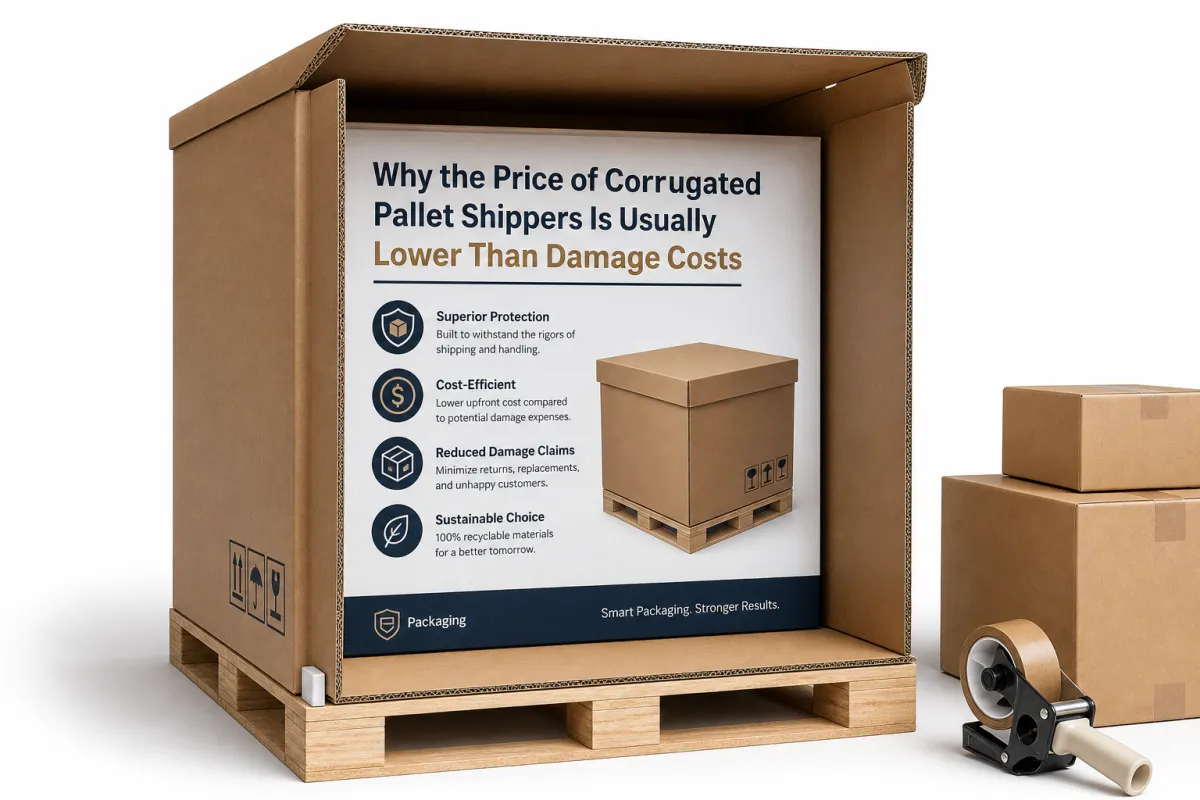
The price of corrugated pallet shippers is usually the smallest line in the larger failure story. One crushed pallet can set off freight claims, replacement product, warehouse labor, and a service issue that hangs around long after the broken freight has been cleared away. In many operations, the damage bill lands in the hundreds or thousands of dollars before anyone realizes the box was the cheap part.
Some buyers chase the lowest carton quote because the difference looks trivial. Then the load moves through a hot trailer, gets double-stacked, or takes a hard corner during stretch wrap. The price of corrugated pallet shippers stops looking like a packaging cost at that point. It starts acting like an insurance premium with a die-cut edge.
Cheap packaging gets expensive after the first crushed pallet. The quote on paper is not the whole bill.
A better way to read the price of corrugated pallet shippers is to compare it with the cost of a bad lane. If one failed shipment costs $300 to $1,500 in freight, labor, rework, and replacement goods, a stronger build can pay for itself quickly. Heavy units, sharp corners, and routes with multiple handoffs tend to expose weak packaging fast. The damage curve is rarely polite.
The right build depends on the load. Weight matters. Stack height matters. Route length matters. Handling style matters too. A 40 x 48 pallet that moves through a dry regional lane is not the same thing as an export load that sits in a humid port and changes hands three times. The price of corrugated pallet shippers should reflect that reality, not a generic spec pulled from a catalog shelf.
Teams that manage claims usually learn this the hard way. The cheapest quote often becomes the most expensive mistake. A tighter spec can reduce breakage, keep the warehouse moving, and lower friction with the receiving dock on the other end. That is why the price of corrugated pallet shippers belongs in the category of risk management, not just packaging spend.
There is a simple comparison that helps here. If a stronger shipper adds $2.10 to a unit and protects a $180 load from even occasional breakage, the economics are already leaning one way. Not every lane needs the most expensive build, of course. But pretending all palletized freight faces the same abuse is how buyers end up paying twice.
What Corrugated Pallet Shippers Are and Where They Fit
Corrugated pallet shippers are pallet-sized paperboard containers built to protect bulk goods, heavy units, or odd-shaped products during storage and transport. They are larger and stronger than ordinary cartons, and they are designed for the realities of pallet movement: compression, stacking, vibration, and the occasional forklift bump that no one wants to discuss at the meeting. That is why the price of corrugated pallet shippers usually runs above standard shippers, yet often lands well below the cost of damage they are built to prevent.
These shippers appear in industrial parts, food and beverage, ecommerce replenishment, and retail-ready transport. They also work for mixed-SKU kits, seasonal programs, and products that need cleaner warehouse handling than shrink wrap alone can deliver. In many operations, the price of corrugated pallet shippers makes sense because they speed pack-out and simplify pallet counts. A line worker who can close a load in minutes instead of fighting wrap and loose corners is not just faster; the whole lane gets calmer.
- Industrial parts: heavy or sharp-edge components that need puncture resistance and stable stacking.
- Food and beverage: bulk cases, bottles, or ready-to-distribute units that benefit from a clean pallet footprint.
- Ecommerce replenishment: high-volume fulfillment where fast pack-out matters more than decorative print.
- Retail transport: distribution loads that move from DC to store with fewer touches in between.
From a landed-cost view, pallet shippers outperform ordinary cartons when they reduce dunnage, lower breakage, and shorten packing time. A corrugated structure can also help a load use the pallet cube more efficiently, which matters when freight rates are already trimming margins. If a project needs smaller branded cartons inside the load, the right setup can include Custom Shipping Boxes for the secondary pack-out and corrugated pallet shippers for the master shipper.
The price of corrugated pallet shippers also becomes easier to justify when the alternative is stretch wrap, slip sheets, or a flimsy tray that folds under pressure. There is a point where more material is not wasteful; it is cheaper than damage. The trick is choosing the correct structure, not the heaviest one that happens to look impressive in a drawing.
For bulky, stackable, or fragile loads, pallet shippers usually beat improvised wrap-and-hope methods. The price of corrugated pallet shippers should be measured against handling efficiency and breakage risk, not just the sheet count on the quote. That comparison is plain, almost boring, and that is exactly why it works.
Specifications That Move the Price of Corrugated Pallet Shippers
The price of corrugated pallet shippers changes quickly once the spec changes. Flute type, board grade, wall construction, dimensions, reinforcements, and finish all affect how much paper goes into each unit and how much work it takes to convert a blank into a shipper that can do real work. A small design tweak can alter board yield, nesting efficiency, and die-cut waste. Two boxes that look alike from ten feet away can land in very different price bands.
Flute choice is one of the biggest levers. B-flute is thinner and better for tighter print detail or moderate protection. C-flute brings more cushioning and compression resistance. BC double-wall steps in when the load needs stronger stacking performance, better puncture resistance, or longer transit protection. The price of corrugated pallet shippers usually climbs as board construction gets heavier because more material is doing more of the heavy lifting.
Board grade matters too. ECT ratings, burst strength, and liner quality all affect the final quote. For lighter pallet applications, 44 ECT or 48 ECT single-wall can be enough. Heavier loads, taller stacks, or less forgiving lanes often move into double-wall territory. Transit testing still matters, and so does basic common sense. For buyers comparing compression and distribution requirements, resources from ISTA and the broader packaging community at packaging.org are useful starting points.
Dimensions influence the price more than people expect. A box that fits neatly on a 40 x 48 pallet with efficient nesting is usually cheaper than one with overhang, wide flaps, or a custom lock feature that slows converting. The price of corrugated pallet shippers can rise when the internal size has to stay extremely tight around the product because that reduces manufacturing flexibility and creates more trim waste. It is a little like tailoring a suit with no allowance for breathing room: precise, expensive, and unforgiving.
Structural add-ons are where budgets can disappear if nobody is paying attention. Reinforced corners, double-wall panels, inserts, dividers, hand holes, glued tabs, and taped closures all add cost. Moisture-resistant coatings and white outer liners do too. If the shipment sits in a humid trailer or crosses climates, that protection may be worth every cent. If the lane is clean and controlled, it can become an expensive badge with no practical purpose.
- Single-wall vs. double-wall: more wall strength usually means better crush resistance and a higher unit price.
- Exact size tolerance: tighter tolerances can raise setup complexity and reduce sheet efficiency.
- Print coverage: one-color identification is far cheaper than broad branded coverage.
- Moisture treatment: coatings and barrier options help in rough lanes but add material cost.
- Closures and inserts: every extra part adds labor, die work, or finishing steps.
One practical rule holds up across most jobs: if the quote jumps hard after a one-inch size change, the price of corrugated pallet shippers is telling you the board layout got worse. That is not a sales trick. It is sheet economics. Smart buyers ask why the layout changed instead of assuming the increase is random.
Another way to think about it: the quote is often responding to the sheet, not just the box. Change the grain direction, the blank fit, or the nesting pattern, and the supplier may lose several usable units per master sheet. That lost yield shows up fast. It can feel annoying. It is also real.
How Does the Price of Corrugated Pallet Shippers Get Calculated?
The price of corrugated pallet shippers is built from four moving parts: material, conversion, setup, and freight. Material is the obvious one, but it rarely tells the whole story. A thicker board, a stronger liner, or a moisture-resistant coating changes the raw cost fast. Conversion matters just as much because die cutting, scoring, gluing, and print registration all add labor and machine time.
Setup can be the quiet budget eater. If a custom shipper needs a fresh die, new print plates, or special assembly steps, the first run carries a heavier burden than the rest. That is why the price of corrugated pallet shippers often drops as volume rises. The setup cost gets spread over more units, and the supplier can optimize board use across the run instead of treating each box like a one-off prototype.
Freight is the last piece, and it matters more than many buyers expect. A pallet shipper is a freight item before it is a packaging item. Heavy-duty builds can increase pallet weight, which affects LTL freight rates and sometimes the handling method itself. A quote that ignores delivery cost is not really a quote; it is a starting guess. The real number is the landed cost, not the carton line alone.
The easiest way to lower the price of corrugated pallet shippers without sacrificing performance is to remove guesswork. Give exact dimensions, the full weight per load, the pallet footprint, stack height, destination, and the handling path. That lets the converter Choose the Right board grade and the right structural profile instead of padding the spec for safety or underbuilding it for convenience. Accurate data is cheaper than revision cycles.
There is also a design side that buyers overlook. A clean dieline with fewer folds and fewer add-on parts often converts faster and wastes less board. That does not always matter on a tiny run. On a larger program, it can move the quote in a noticeable way. Kind of unglamorous, but very real.
Pricing and MOQ: What Drives the Price of Corrugated Pallet Shippers
Here the price of corrugated pallet shippers gets real. Material usage, converting complexity, print coverage, order volume, and freight method all show up in the quote. Board cost is only one part of the picture. Die cutting, scoring, gluing, print setup, and scrap all leave fingerprints on the final number. If a supplier gives you one price with no build detail, that number is mostly a guess wearing a collared shirt.
MOQ follows setup efficiency. Custom sizes and printed runs usually need a higher minimum than stock formats because the supplier has to buy board, set the die, and run the job in a way that makes economic sense. The price of corrugated pallet shippers falls as order volume rises because setup cost is spread across more units and materials can be purchased more efficiently. Small runs can still be worth it. The unit price just tends to be less forgiving.
| Build Type | Typical MOQ | Common Unit Price Range | Best Fit |
|---|---|---|---|
| Basic single-wall shipper | 250-500 units | $5-$11 each | Light to medium loads, shorter routes, simple identification |
| Reinforced double-wall shipper | 500-1,000 units | $9-$18 each | Most industrial and retail replenishment programs |
| Heavy-duty shipper with inserts or dividers | 500-1,500 units | $14-$32 each | Fragile, mixed-SKU, or high-stack-pressure loads |
| Prototype or sample build | 1-10 units | $45-$120 each | Testing a new fit, route, or closure before production |
Those ranges are planning numbers, not a formal quote. A larger footprint, heavy print coverage, or moisture treatment can push the price of corrugated pallet shippers upward. A simpler shape, lighter board, and stronger sheet nesting can pull it down. Freight is separate as well. A sample may ship by parcel or LTL for a modest amount, while production quantities are usually booked as freight on pallets.
One common mistake is comparing apples to oranges. One quote may be for 32 ECT single-wall with plain kraft and no closure hardware. Another may be BC double-wall with a white outer liner, printed graphics, and corner reinforcements. Those are not competing numbers. They are different products, and the price of corrugated pallet shippers should be compared spec to spec.
Another mistake is ignoring the actual usage pattern. If the load ships once and sits in controlled storage, you may not need the same build as a pallet that gets moved three times before reaching the customer. If the load is temperature sensitive or humidity sensitive, the quote should reflect that. The question is not, "what is the lowest price of corrugated pallet shippers?" The better question is, "what spec keeps the load intact at the lowest total cost?"
Quote trap checklist:
- No exact internal dimensions.
- No product weight or load count.
- No pallet footprint or stack height.
- No print detail or finish note.
- No destination or handling condition.
That list matters because vague specs create vague prices. The cleanest way to lower the price of corrugated pallet shippers is not to ask for a miracle. It is to give precise information so the converter can build the right box the first time. That saves more time than haggling over a quote by a few cents.
Process and Timeline for Corrugated Pallet Shippers
Getting a quote for the price of corrugated pallet shippers moves faster when the request is specific. The usual flow begins with a quote request, followed by a specs review, structural approval, sampling, production, and freight booking. Each step matters because a pallet shipper is a load-bearing package, not a decorative carton. The more complete the starting data, the less likely the schedule gets chewed up by revisions.
- Quote request: share product dimensions, total weight, pallet footprint, quantity, and target ship date.
- Specs review: confirm board grade, wall construction, closure style, and print needs.
- Structural approval: review the dieline or sample for fit, stacking, and handling.
- Sampling: test the build before full production if the load is heavy, fragile, or expensive.
- Production: run the approved spec once sign-off is complete.
- Freight booking: schedule delivery based on pallet count and destination.
For most programs, a sample or prototype can take about 5-10 business days after the design is confirmed. Full production often runs 12-20 business days after approval, though larger or more complex jobs can take longer. The price of corrugated pallet shippers does not sit outside the schedule; it is tied to it. Rush orders can cost more if they require premium material, a tighter press schedule, or extra labor to hit a hard date.
Revisions are the biggest timeline killer. If the internal size changes after the first sample, the die may need adjustment. If the print changes, file review starts again. If the closure method changes, the assembly method may need another test. The price of corrugated pallet shippers can shift when a revision forces a different board layout, so it is smarter to settle the basics early than to chase a cheap number and fix it later.
Rush jobs are possible, but they are not magic. They usually require fewer finish options, in-stock board, and fast sign-off. The best way to protect lead time is to send complete information on day one. A supplier can only quote the price of corrugated pallet shippers with confidence if they know the load, the lane, and the destination.
If a shipment is critical, tell the factory the actual ship date, not a vague "ASAP." A real deadline changes how the schedule is built. A fuzzy deadline just creates noise. The price of corrugated pallet shippers is easier to control when production and freight are planned together instead of being treated like separate emergencies.
One more thing: if the sample looks right but the assembled load feels awkward in the warehouse, do not ignore that signal. Operators notice the weak points long before a damage report does. I have watched a "good enough" design get rejected by the floor team because it was annoying to close, and they were right. A package has to work for the people moving it, not just for the CAD file.
Why Choose Us for Corrugated Pallet Shippers
At Custom Logo Things, the goal is not to sell the heaviest possible build. The goal is to match the packaging to the load and keep the price of corrugated pallet shippers grounded in reality. That means looking at board grade, lane conditions, print needs, and warehouse handling instead of pushing a one-size-fits-all answer. A proper quote should explain the tradeoffs instead of hiding them behind a polished number.
Good structural guidance saves money. A box that is overbuilt may feel safe, but it also burns margin and can create unnecessary freight weight or material spend. A box that is underbuilt might look cheap until the first damage claim arrives. The price of corrugated pallet shippers should sit between those extremes, where the build is strong enough to protect the load and efficient enough to keep the program under control.
We also keep the quoting process clear. Clean board specs, controlled revision handling, and consistent print expectations reduce surprises later. Buyers Should Know whether they are paying for a plain kraft shipper, a branded outer, or a reinforced transport build. If the project also needs smaller inserts, presentation cartons, or secondary pack-out, our Custom Shipping Boxes can keep the system aligned instead of forcing one package type to do every job.
What buyers usually care about:
- Fewer shipping surprises and fewer damaged pallets.
- Quotes that explain the price of corrugated pallet shippers in plain language.
- Sampling support before production on heavier or more fragile loads.
- Print consistency that holds up on repeat orders.
- Packaging output that fits real warehouse conditions, not a perfect mockup.
There is no prize for paying for strength you do not need. There is also no prize for cutting corners and then spending the next quarter dealing with claims. Honest packaging guidance is boring in the best way. It keeps the load moving. That is how the price of corrugated pallet shippers becomes a business decision instead of a guessing game.
We keep the conversation practical: dimensions, compression target, pallet footprint, handling path, and finish. If those variables are clear, the quote gets clearer. If they are fuzzy, the quote gets fuzzy. The price of corrugated pallet shippers should be built from the load outward, not from a sales target backward.
Next Steps After Comparing the Price of Corrugated Pallet Shippers
Start with the basics. Gather exact product dimensions, product weight, pallet count, stack height, and the target ship date before asking for pricing. That is the fastest way to get a useful answer on the price of corrugated pallet shippers. A quote built from real data usually beats one built from guesswork and optimism.
Then ask for two or three build options. One should be a lean option, one should be a reinforced option, and one should reflect the most likely production spec. Comparing the price of corrugated pallet shippers side by side shows where the strength jumps, where print changes the cost, and where MOQ begins to matter. A single number tells almost nothing. A range tells a story.
If the load is heavy, fragile, or temperature sensitive, order a sample or prototype before full production. That small step can expose fit issues, closure problems, or compression weakness before a truckload of product is involved. The price of corrugated pallet shippers looks a lot better after a sample passes the real test, because the team knows the build is not theoretical.
Use this simple action plan:
- Confirm product size, weight, and pallet footprint.
- Request pricing on at least two board builds.
- Compare MOQ, unit price, and lead time together.
- Approve a sample if the load is critical.
- Move into production only after the spec is locked.
If you want the price of corrugated pallet shippers to make sense, stop treating it like a commodity line item and start treating it like a load-performance decision. That is the difference between a quote that looks cheap and a package that actually saves money. Send the spec, compare the build options, and choose the version that protects the freight without paying for strength you do not need.
The cleanest takeaway is simple: compare landed cost, not just the carton price. If the stronger build lowers claims, shortens handling time, or keeps a customer from receiving damaged freight, it is usually the better buy. If it does not, trim it back. That balance is where the real savings live.
What affects the price of corrugated pallet shippers the most?
Board grade, wall construction, and total board usage usually move the price of corrugated pallet shippers more than anything else. Custom dimensions, print coverage, and added reinforcements also add cost because they change both material use and setup work. Order volume matters too, since higher runs spread setup and tooling across more units.
How do I estimate the price of corrugated pallet shippers for my load?
Start with product dimensions, total weight, pallet footprint, and how many units need to fit in each shipper. Add handling details such as stack height, route length, and any moisture or crush protection needs. Then ask for at least two specs so the price of corrugated pallet shippers can be compared against both strength and freight risk.
Is a higher MOQ always better for corrugated pallet shipper pricing?
Usually yes on unit price, because setup and material purchasing get spread over more pieces. But not always yes for cash flow, storage, or product changes. The smarter move is to compare breakpoints and lead times, not just chase the biggest order. The price of corrugated pallet shippers only helps if the inventory plan still works.
Can printed corrugated pallet shippers still stay cost-effective?
Yes, especially if the print is simple and the graphics replace labels or improve warehouse identification. One- or two-color print is usually far more efficient than heavy coverage. Ask for plain and printed quotes side by side so you can see whether the branding premium is actually worth it. The price of corrugated pallet shippers should support the program, not just the logo.
How fast can corrugated pallet shippers be produced after approval?
Prototype timing is usually separate from full production, so do not combine the two when planning a launch. Once specs are approved, production lead time depends on board availability, print complexity, and order size. If timing is tight, give the ship date up front so the factory can quote realistic options instead of fantasy. That is the only way the price of corrugated pallet shippers and the schedule stay honest.
If you are comparing the price of corrugated pallet shippers right now, collect the spec, compare at least two build levels, and ask for a sample before you commit to full volume. That is the practical path. Not glamorous. Just cheaper. If the quote still looks high, compare it against claims, labor, and freight damage one more time. The price of corrugated pallet shippers makes a lot more sense when it is measured against the cost of not using them.