Buyer Fit Snapshot
| Best fit | Price of Custom Corrugated Shipping Sleeves Explained projects where brand print, material claims, artwork control, MOQ, and repeat-order consistency need to be specified before quoting. |
|---|---|
| Quote inputs | Share finished size, material target, print colors, finish, packing count, annual reorder estimate, ship-to region, and any compliance wording. |
| Proofing check | Approve dieline scale, logo placement, barcode or warning zones, color tolerance, closure strength, and carton packing before bulk production. |
| Main risk | Vague material claims, crowded artwork, missing packing details, or unclear freight terms can make a low unit price expensive after revisions. |
Fast answer: Price of Custom Corrugated Shipping Sleeves Explained should be specified like a repeatable production item. The safest quote records material, print method, finish, artwork proof, packing count, and reorder notes in one written spec.
Production checks before approval
Compare the actual filled-product size with the drawing, then confirm tolerance on folds, seals, hang holes, label areas, and retail display edges. Reserve space for logos, QR codes, warning copy, and material claims before decorative graphics fill the panel.
Quote comparison points
Review material grade, print process, finish, sampling route, tooling charges, carton quantity, and freight assumptions side by side. A quote is only useful when the supplier can repeat the same color, closure quality, and packing count on the next order.
Price of Custom Corrugated Shipping Sleeves Explained
The Price of custom corrugated shipping sleeves can look modest on paper, then swing the economics of an entire packing line once damage, repacking, and freight claims enter the picture. That is the number buyers actually feel. A sleeve is not just corrugated board cut to size; it is a control point for waste reduction, carton protection, and presentation. Miss that, and the spreadsheet tells the wrong story.
A sleeve priced a few cents higher can still be the cheaper move if it prevents a return, saves a crushed shipper, or trims a minute from pack-out. Misspec it, and the bargain quote becomes the expensive one. The real comparison is unit price against the full cost of shipping, handling, and rework. A sleeve that survives a rough route at 8 cents more can outperform a flimsy option that saves 8 cents and costs far more downstream.
Buyers comparing corrugated sleeve packaging, protective shipping sleeves, and other carton sleeves usually find the same pattern: the low quote is not always the low-cost outcome. Material grade, fit, and print coverage change the math faster than most purchasing teams expect.
What Drives the Price of Custom Corrugated Shipping Sleeves?
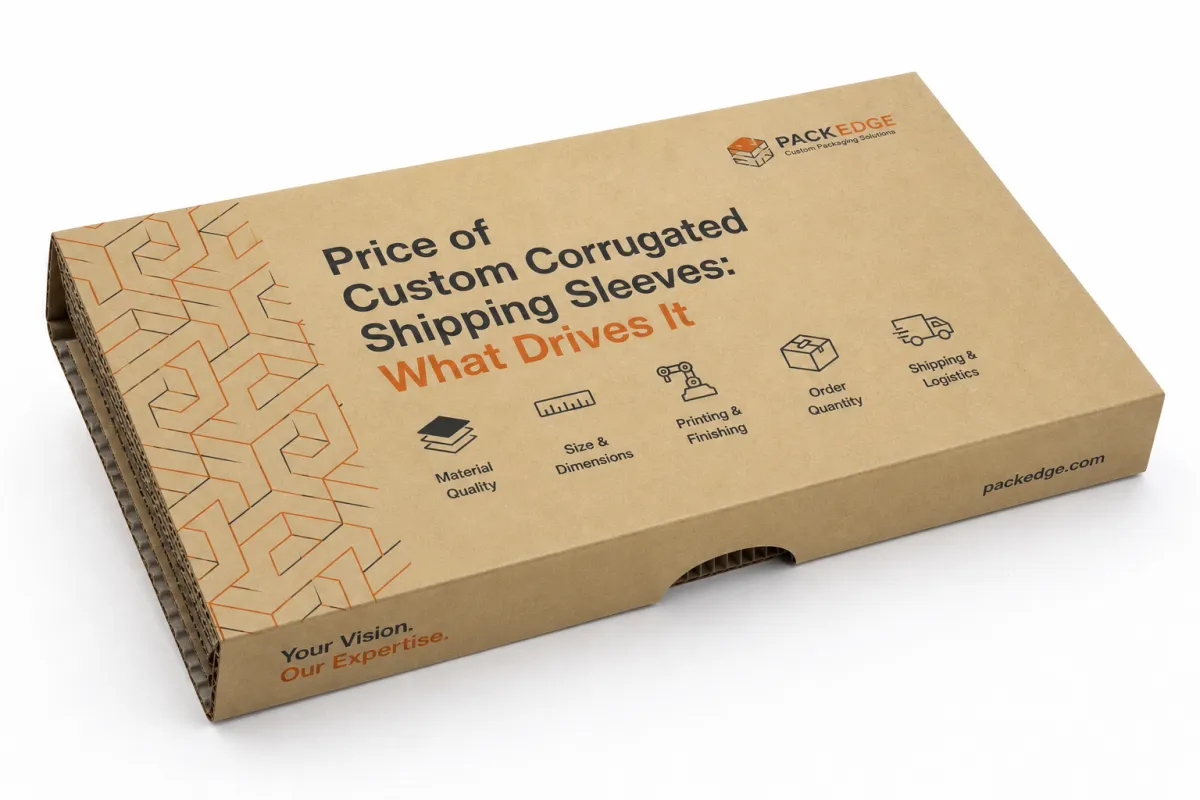
The price of custom corrugated shipping sleeves starts with a blunt reality: two sleeves that look nearly identical can land in very different cost buckets once board grade, dimensions, print coverage, and quantity are added to the spec. Buyers sometimes line up two quotes side by side and assume the numbers describe the same product. They usually do not. One may use lighter board, looser tolerances, and no print. The other may fit more tightly and hold up better under compression. Same category. Not the same job.
From a packaging buyer's point of view, the sleeve is usually a small line item that protects a much larger one. A shipment carrying premium apparel, electronics, subscription kits, or fragile components can justify a higher price of custom corrugated shipping sleeves if the sleeve lowers damage risk and keeps the box looking intentional. I've sat in reviews where a 6-cent difference looked painful until the returns report came back. That is when the room goes quiet. A difference of $0.08 can be negligible beside a $12 return label or a $40 rework event. That gap adds up fast across thousands of orders.
Most sleeve pricing comes back to four levers: the board itself, the physical size, the print method, and the order quantity. The price of custom corrugated shipping sleeves rises when the board gets heavier, the shape becomes more complex, or the artwork needs more setup. It falls when the design is standardized, the run is larger, and the manufacturing path stays simple. That is not sales language. It is how corrugated production works.
The smarter comparison is the quote against the shipping problem, not against the cheapest corrugated option on the market. A sleeve that protects a high-value carton or sharpens the branded packaging experience can pay for itself through fewer claims, faster fulfillment, and fewer handoffs in the warehouse. The price of custom corrugated shipping sleeves makes the most sense as a waste-reduction decision, not a race to the bottom on unit cost.
I use a simple filter: if the sleeve improves packaging design, supports retail packaging presentation, and protects the shipment in transit, the number should be judged on performance per dollar, not paper weight per dollar. A box that arrives intact and presentable is doing work a cheap sleeve never touches.
What Custom Corrugated Shipping Sleeves Are Made To Do
A corrugated shipping sleeve is a lightweight protective wrap that slides around a carton, bundle, or product to add strength, reduce scuffing, or improve the appearance of a shipment. It can reinforce a box wall, stabilize a printed surface, add package branding, or create a secondary skin around a retail-ready pack. The price of custom corrugated shipping sleeves only becomes meaningful once the actual task is clear. A sleeve protecting a shelf-ready carton solves a different problem than one that simply keeps corners from rubbing in transit.
Use cases are straightforward. In ecommerce shipping, sleeves help protect printed boxes from warehouse abrasion. In retail packaging, they can make a plain carton feel more deliberate without the expense of a full custom shipper. In fulfillment centers, they can keep multiple units bundled together so pack-out stays orderly. Many operations also use sleeves to reduce tape, lower label clutter, or create a cleaner face for barcodes and branding.
That operational value is why the price of custom corrugated shipping sleeves often comes in below the cost of a larger corrugated build. A full box uses more board and more assembly time. A mailer may work for some products, but it is not the right shape or strength for every shipment. A sleeve uses less material, can be faster to apply, and may fit existing pack lines without a major process rewrite. For many programs, that balance is the sweet spot.
Presentation matters too. A sleeve can make a plain carton feel deliberate, which matters in branded packaging and product packaging where the customer sees the shipping format before they see the product. That is why sleeves tend to sit between utility and marketing. They are practical enough for logistics teams and visible enough for brand teams. In a market where physical touchpoints still shape perception, that crossover carries weight.
For teams comparing packaging formats, the larger system deserves a look. Full shipper structures live in Custom Shipping Boxes. Lightweight mail-ready programs often fit better with Custom Poly Mailers. Broader sourcing across formats starts at Custom Packaging Products.
Transit performance usually gets measured against standards rather than sales copy. ISTA protocols help define drop, vibration, and compression expectations in practical terms. If fiber sourcing or chain-of-custody matters, FSC certification can enter the conversation too, especially for brands that want packaging design to align with sourcing claims.
The price of custom corrugated shipping sleeves is easiest to defend when the sleeve is tied to a measurable function: protecting a carton surface, improving stack stability, or reducing repack labor. Remove those functions and the discussion changes. Then it is decoration wearing a logistics costume.
Sizing, Board Grades, and Print Specs That Change Cost
The clearest way to understand the price of custom corrugated shipping sleeves is to break the spec into pieces. Size, board grade, print coverage, and converting style each move the number in a different direction. A sleeve that is one inch wider or built on a thicker flute can cost more than a sleeve with a simpler print layout. That is why buyers should request quotes only after the dimensions are settled.
Size is the obvious variable, but it is not only length and width. Sleeve depth, overlap, score location, and fit tolerance all matter. A tighter sleeve may use less board in the final formula, yet it can require more precise converting and a sharper die. A looser sleeve may run more easily, but it may look sloppy or fail to grip the carton securely. The cheapest geometry is not always the best geometry.
Board grade shifts both cost and performance. In corrugated terms, the real conversation is usually flute profile plus strength test, not just a single label. E-flute gives a cleaner print surface and a slimmer profile. B-flute brings more cushion and can handle a little more abuse. Single-wall constructions with stronger test values are often enough for low-risk shipments, while heavier calipers or higher ECT ratings make sense for heavier loads and rougher distribution. A 32 ECT board may be fine for simple protection, while a 44 ECT spec can be worth the extra spend when compression or stacking is a concern. The price of custom corrugated shipping sleeves follows that logic closely: more fiber, better performance, higher cost.
Print changes pricing in a way buyers sometimes underestimate. One-color flexo can be efficient at scale. Multi-color branding, large flood coverage, or tighter registration can add setup effort and production complexity. If the sleeve carries retail branding, product messaging, regulatory marks, or a high-visibility logo, the print specification should be written clearly before the quote request goes out. Vague art briefs lead to vague prices. That is a packaging law more than a packaging opinion.
Converting style matters too. A scored and slotted sleeve is usually simpler than a die-cut design with unusual cutouts or tabs. Unique shapes can improve fit, but they can also raise tooling cost and scrap. Buyers who standardize dimensions across product families often get a better price of custom corrugated shipping sleeves over time because reorders are cleaner and the manufacturing path stays predictable.
| Spec level | Typical use | Approximate unit range | Cost impact |
|---|---|---|---|
| Standard single-wall, unprinted | Basic carton protection, simple bundling | $0.18-$0.32 at 5,000+ units | Lowest material and setup load |
| Heavier board, one-color flexo | Branded packaging with moderate transit protection | $0.26-$0.45 at 5,000+ units | More board and print setup |
| Tighter fit, multi-color print | Retail packaging presentation, stronger stack behavior | $0.40-$0.75 at 5,000+ units | Higher converting complexity and artwork setup |
| Die-cut or specialty format | Complex shape, premium package branding | $0.60-$1.10 at lower volumes | Tooling, waste, and slower throughput |
Those numbers are planning ranges, not universal quotes. Freight, regional board supply, flute choice, and the final ship-to destination can move the result. Still, they are useful because they show how quickly the price of custom corrugated shipping sleeves changes once print and structure become more demanding. A buyer who sees that pattern early can shape the spec before asking for bids.
A practical rule helps here: if the sleeve is there to protect a carton surface or support a retail-ready display, keep the geometry as standard as possible and put the money into the board grade where it matters. If the sleeve is there to carry branded packaging or a customer-facing message, spend carefully on print coverage and keep everything else efficient.
Price of Custom Corrugated Shipping Sleeves: MOQ and Volume Breaks
The price of custom corrugated shipping sleeves usually drops as quantity rises because fixed costs are spread over more units. Setup, artwork prep, cutting, scoring, and press adjustments do not disappear at higher volumes, but they become less visible in the unit price. That is the main reason a quote for 1,000 pieces can look surprisingly high next to a quote for 5,000 or 10,000.
Minimum order quantity is not a penalty. It reflects how corrugated production works. If a job needs custom cutting or a specialized print setup, the plant has to recover those fixed costs somewhere. That is why the price of custom corrugated shipping sleeves often looks less attractive on short runs and more attractive on repeat programs where the spec is already approved. The same sleeve can cross a meaningful price threshold simply by moving from a short pilot to a production-scale order.
| Run size | Typical unit range | What usually happens |
|---|---|---|
| 500-1,000 units | $0.65-$1.10 | Setup is spread across very few pieces, so tooling and prep cost dominate |
| 2,500 units | $0.34-$0.62 | Unit price starts improving, but print and cut costs are still visible |
| 5,000 units | $0.22-$0.42 | Production becomes more efficient, especially on standard sizes |
| 10,000+ units | $0.16-$0.30 | Material buying and throughput improve, especially on repeat specs |
That table is a reminder that volume breaks can matter more than small design changes. A buyer might save two cents by shaving a flute spec, then lose ten cents because the run is too small. The price of custom corrugated shipping sleeves is often more sensitive to quantity than people expect, especially when any custom print or die work is involved.
Other cost items should be asked about directly. Tooling charges, plate or die costs, proofing, pallet quantity, and freight to the final destination can all affect the true landed number. If a supplier gives only a unit price and omits shipping, the quote is incomplete. If one quote includes a sample and another does not, that difference should be called out. Clean quoting depends on apples-to-apples specifications.
"The cheapest quote only looks cheap until the damaged units show up."
That line comes up often in packaging meetings because it captures the real issue. A sleeve that reduces scuffing by even a small percentage can save more than it costs, especially in ecommerce shipping where returns and presentation failures are expensive. The price of custom corrugated shipping sleeves should be compared against avoidable losses, not another carton item on a spreadsheet.
For a one-time campaign, a higher unit price may be acceptable if the timeline is tight. For recurring order fulfillment, a cleaner recurring spec and a better volume break usually make more sense. Repeat orders reward consistency. Stable dimensions, a standard board choice, and a clear print file usually outperform a custom one-off every time.
From Proof to Pallet: Process and Timeline
The quote is only one step. The price of custom corrugated shipping sleeves also depends on how quickly the project can move through proofing, sample approval, and production scheduling. Simple unprinted sleeves are generally quicker because there is less prepress work, fewer approval loops, and less risk of artwork correction. Printed sleeves take longer, and a new structural sample can add another round of review before the job is cleared.
A standard workflow usually looks like this: gather dimensions, confirm board grade, review artwork, approve the quote, approve the dieline or proof, produce a sample if needed, then move into cutting, scoring, printing, packing, and shipment. Each step is ordinary on its own, but together they shape the final timeline. The price of custom corrugated shipping sleeves may stay stable from one week to the next, while lead time can stretch fast if the artwork is not final or the fit needs to be revised.
For many projects, straightforward production lands in the 12-15 business day range after proof approval. Add a sampling round, and the calendar can stretch by several days. Add a new artwork revision or a tight launch window, and the pressure rises quickly. That is why planning matters. A sleeve tied to a seasonal promotion, warehouse changeover, or subscription launch should not be quoted like a stock item. It is custom work, and the schedule should be treated that way.
There is also a testing side to the process. If the sleeve is meant to protect a premium carton or manage rough distribution, buyers should ask whether the design needs a transit test or compression benchmark. Standards such as ISTA procedures and ASTM methods help teams describe performance expectations without guessing. That does not mean every sleeve needs a formal lab program. It does mean the price of custom corrugated shipping sleeves should be connected to the actual abuse the package has to survive.
One practical tip is simple: if the project matters, build in a review buffer. A few extra days for proofing is cheaper than a full reprint caused by a bad dimension or a misplaced barcode. That is especially true for packaging design projects that sit between logistics and brand teams. When both groups need signoff, the schedule should assume more than one round of feedback.
Good production discipline shows up in small details. Clear naming on artwork files. Exact carton dimensions. Explicit print locations. Honest freight assumptions. When those details are handled early, the price of custom corrugated shipping sleeves becomes easier to manage because the job does not need avoidable corrections.
For buyers who already know their shipper format, the process gets smoother. If the sleeve supports a broader carton program, the structural logic can be compared with Custom Shipping Boxes or a combined packaging lineup from Custom Packaging Products. That comparison often reveals whether the sleeve should stand alone or act as part of a bigger system.
Why Buyers Choose Our Sleeves for Shipping Protection
Buyers do not just want a quote. They want confidence that the price of custom corrugated shipping sleeves matches the carton, the product, and the distribution path. The strongest packaging partner is the one that explains the tradeoffs plainly: where a lighter board is acceptable, where a stronger spec is worth the extra spend, and where the layout can be standardized to save money on future orders.
That matters because the best packaging decisions are rarely the flashiest ones. They are the ones that protect product, reduce mistakes, and keep the line moving. A sleeve that fits correctly can speed order fulfillment, lower repack labor, and cut down on damaged product packaging. A sleeve that misses the mark can slow packing, confuse warehouse staff, and create a false sense of savings. The price of custom corrugated shipping sleeves should never hide those downstream effects.
There is also a brand side to the decision. A sleeve can sharpen package branding without forcing the buyer into a fully custom printed box. For some programs, that is the best of both worlds: the carton stays efficient, while the outer sleeve provides the customer-facing look. For other programs, a sleeve becomes a bridge between basic protection and more polished retail packaging. That middle ground is where corrugated often earns its keep.
From a sourcing perspective, repeatability matters. Buyers remember whether a supplier delivers the same dimensions every time, whether proofs are clean, and whether the promised lead time is realistic. Those points may sound unglamorous, but they shape the true price of custom corrugated shipping sleeves more than a one-time discount ever will. A cheap quote with inconsistent fulfillment is not a good deal. It is an unstable supply chain with better branding.
The same logic applies to other packaging formats. If a shipment needs rigid box structure and internal cushioning, the sleeve may not be the right answer. If the product is lightweight and the priority is low-cost mailability, a poly mailer may outperform corrugated. Matching the format to the use case is what keeps branded packaging from becoming wasteful packaging.
That is where many buyers get tripped up. They start with aesthetics, then try to force the supply chain to follow. Better results usually come from the reverse: define the shipping abuse, define the brand need, then build a sleeve around that reality. Once that happens, the price of custom corrugated shipping sleeves becomes a clean business decision instead of a guessing game.
Next Steps to Quote the Price of Custom Corrugated Shipping Sleeves
If you want a quote that actually holds up, start with the facts. The price of custom corrugated shipping sleeves gets much easier to calculate when the specification is complete before the request goes out. That means exact dimensions, target product weight, ship method, quantity, board preference, and any print requirements. If the sleeve must stack inside a master carton, fit a retail display, or survive rough warehouse handling, that should be written down too.
Use this checklist before you request pricing:
- Exact dimensions: length, width, depth, and any overlap requirement.
- Board spec: E-flute, B-flute, single-wall construction, or another approved construction.
- Quantity: pilot run, production run, or recurring order volume.
- Print needs: one-color logo, multi-color branding, flood coverage, or no print.
- Handling notes: stacking pressure, warehouse automation, or high-scuff transit.
- Timeline: launch date, replenishment date, or seasonal shipping window.
Then compare quotes only on the same specification set. A lower unit price means little if one quote uses a lighter board or excludes shipping. A higher unit price may be justified if it includes a more accurate fit, cleaner print, or lower risk of crushed cartons. That is why the price of custom corrugated shipping sleeves should always be read with the spec sheet in hand.
When fit is critical, ask for a structural mockup or sample. One round of verification can prevent expensive rework later. The sample helps confirm the feel of the board, the accuracy of the dieline, and the placement of the logo or barcode. That step is especially useful for ecommerce shipping programs where even a small misfit can create damage or slow the packing line.
The final decision should be simple: does the sleeve protect the product, improve the presentation, and support the operation without creating extra waste? If the answer is yes, the price of custom corrugated shipping sleeves becomes a straightforward sourcing decision. If the answer is no, the spec needs another look. Either way, the quote should be tied to the real job the package performs, not just to the paper on the spreadsheet.
For most buyers, that is the cleanest path forward. Once the dimensions, board grade, print, and quantity are settled, the price of custom corrugated shipping sleeves stops being a mystery and starts behaving like any other disciplined packaging purchase: measurable, comparable, and defensible. The actionable takeaway is simple: lock the spec, ask every supplier to quote the same landed scope, and judge the result by damage risk and labor saved, not by the lowest number in isolation.
How is the price of custom corrugated shipping sleeves calculated?
The price of custom corrugated shipping sleeves is usually based on size, board grade, print coverage, and order quantity. Setup costs matter too, especially on shorter runs. If freight is excluded from one quote and included in another, those numbers are not directly comparable. The cleanest comparison uses the same dimensions, the same material spec, the same print method, and the same shipped quantity.
What MOQ should I expect for custom corrugated shipping sleeves?
MOQ varies by sleeve size, print method, and whether the design needs special tooling or die-cutting. Smaller runs are possible, but the unit price is usually higher because setup is spread across fewer pieces. Larger orders usually improve the price of custom corrugated shipping sleeves quickly, especially when the design is standard and repeatable.
Can I get a sample before placing a full order?
Yes. A sample or structural mockup is a smart move when fit matters. Sampling helps confirm dimensions, board feel, and print placement before production begins. That is often the safest way to avoid costly rework on a full run, and it gives buyers a clearer read on whether the price of custom corrugated shipping sleeves is justified by the actual performance.
How long does production usually take?
Timing depends on whether the sleeve is unprinted, printed, or requires new artwork approval. Straightforward jobs are usually faster than projects with revised sizing or artwork changes. If the sleeves must arrive before a launch, warehouse change, or seasonal spike, build in extra time so the price of custom corrugated shipping sleeves is not the only variable you have to manage.
What details do I need for an accurate quote?
Provide exact sleeve dimensions, quantity, board grade preference, and print requirements. Add the product type, shipping method, and any stacking or handling concerns. The more complete the spec sheet, the more reliable the timeline and the price of custom corrugated shipping sleeves will be. In practice, that is what separates a useful quote from a placeholder number.

