Buyer Fit Snapshot
| Best fit | Printed Address Labels Bulk projects where brand print, material claims, artwork control, MOQ, and repeat-order consistency need to be specified before quoting. |
|---|---|
| Quote inputs | Share finished size, material target, print colors, finish, packing count, annual reorder estimate, ship-to region, and any compliance wording. |
| Proofing check | Approve dieline scale, logo placement, barcode or warning zones, color tolerance, closure strength, and carton packing before bulk production. |
| Main risk | Vague material claims, crowded artwork, missing packing details, or unclear freight terms can make a low unit price expensive after revisions. |
Fast answer: Printed Address Labels Bulk: Pricing, Specs, and Turnaround should be specified like a repeatable production item. The safest quote records material, print method, finish, artwork proof, packing count, and reorder notes in one written spec.
Production checks before approval
Compare the actual filled-product size with the drawing, then confirm tolerance on folds, seals, hang holes, label areas, and retail display edges. Reserve space for logos, QR codes, warning copy, and material claims before decorative graphics fill the panel.
Quote comparison points
Review material grade, print process, finish, sampling route, tooling charges, carton quantity, and freight assumptions side by side. A quote is only useful when the supplier can repeat the same color, closure quality, and packing count on the next order.
Printed Address Labels Bulk: Pricing, Specs, and Turnaround
One handwritten label. One reprint. One carton that gets set aside in receiving because the address printed faint, smeared, or peeled up before it ever reached the dock. That is the kind of friction printed address labels bulk is supposed to remove. For teams that ship every day, the payoff is not flashy. It shows up as fewer mistakes, less manual labor, and a steadier handoff from packing to carrier. Printed address labels bulk only makes sense when the spec stays stable, but once the address block, label size, and packing flow settle in, the savings are hard to miss.
Most buyers start looking at printed address labels bulk after the same waste keeps cropping up in different places. The address gets typed over and over. A template gets rebuilt again. Damaged cartons need fresh labels because the original got torn during storage or in transit. After a while, the label stops acting like a small supply item and starts behaving like part of the shipping system. Treat it that way, and the numbers usually improve.
Printed Address Labels Bulk: What You Actually Save
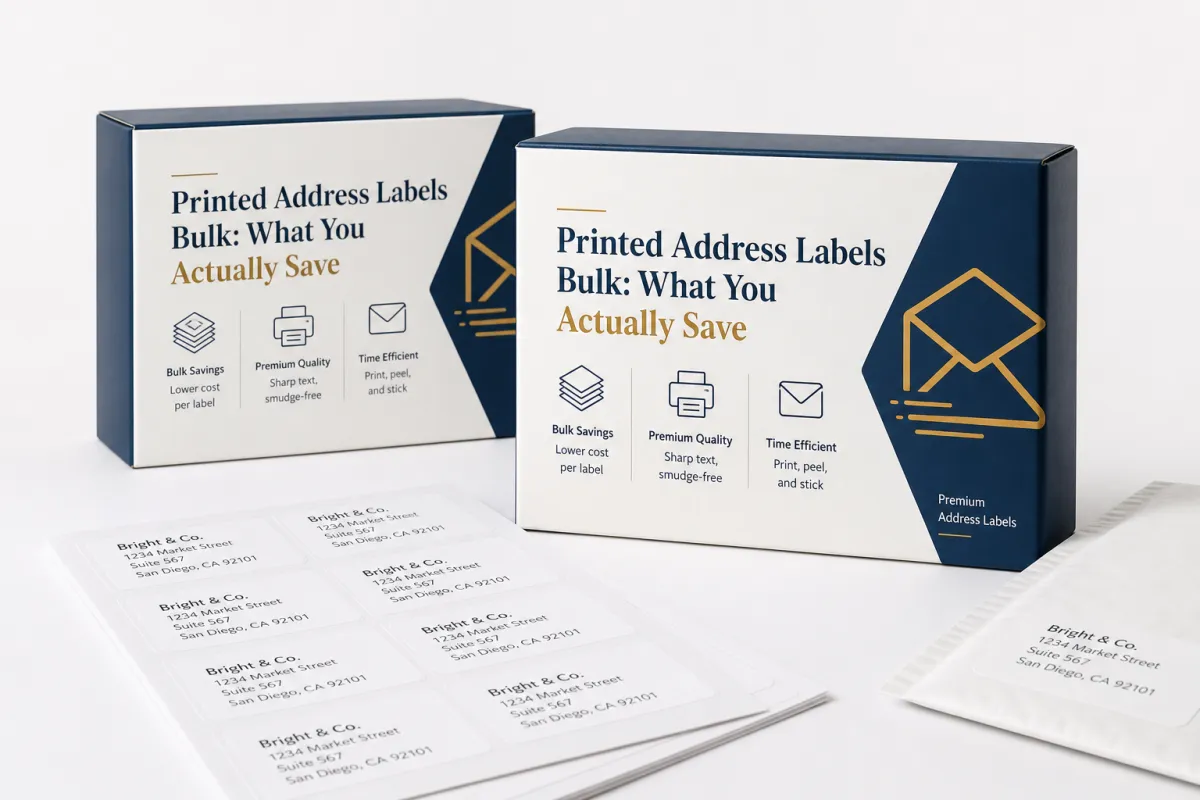
Labor is usually the first place the savings show up. Someone printing small batches, peeling labels one by one, and fixing feed errors can burn several minutes per carton without anyone feeling the drag in the moment. Spread that across a few hundred parcels a week and printed address labels bulk starts to look less like a print purchase and more like a process decision. A five-second cut per package sounds tiny. At 2,000 shipments a month, it turns into a real line item.
Fewer mistakes follow close behind. Handwritten labels drift out of control fast. Desktop prints can land crooked. Reprints happen because a label was folded, stained, or lost in the rush at the packing bench. Printed address labels bulk reduces that churn because the address, branding, and barcode placement are fixed before production starts. The warehouse does not have to improvise. The line just keeps moving.
Waste comes down as well. Short repeat jobs often bring extra setup, extra test sheets, and extra spoilage from stop-start production. Bulk printing spreads setup across a larger run, which lowers the cost per label. If volume stays predictable, printed address labels bulk usually beats a string of smaller orders. That is not theory. It is ordinary production math.
"If the label spec changes every order, you are not buying bulk. You are buying a headache with a discount."
Consistency matters in ways buyers sometimes underestimate. Identical labels scan more cleanly, sort more cleanly, and give the customer a better impression when the parcel lands on their doorstep. Returns, subscription shipments, and branded ecommerce orders all benefit from packaging that looks controlled instead of patched together. Printed address labels bulk helps each shipment present like it came from a system, not a scramble.
From a packaging buyer's point of view, the best time to order printed address labels bulk is when three things stay steady: the address block, the package size, and the monthly volume. If one of those keeps shifting, bulk can still help, but the savings narrow. If all three hold steady, the advantage is obvious.
Full cost should stay front and center. Labor, rework, relabeling, and the time spent chasing emergency reprints all belong in the comparison. On paper, a small run can look cheaper. In the warehouse, printed address labels bulk usually wins once the labels are used regularly and the reorder cycle is predictable.
I have watched teams chase pennies on the label line while the real cost sat in the background, hiding in overtime and avoidable rework. That part is kind of annoying, honestly, because the label itself is rarely the expensive problem. The messy workflow around it is.
Printed Address Labels Bulk Product Options and Uses
Printed address labels bulk is not one product. It is a family of formats built for different workflows. Some buyers need Labels for Shipping cartons. Others need return mailer labels, subscription box addresses, warehouse bin labels, or secondary packaging that carries a fixed destination block. The right choice depends on how the label moves through the operation.
Roll labels are the most common choice for automated and semi-automated packing lines. They feed smoothly, store neatly, and work with many desktop printers and applicators. Sheet labels fit office mailrooms or lower-volume teams that print in batches. Fanfold labels suit high-speed environments where a continuous stack is easier to handle than a roll. If the team is fighting printer downtime, format matters more than artwork.
Here is a simple way to compare the main options before buying printed address labels bulk:
| Format | Best For | Typical Strength | Typical Bulk Price Range | Watch Out For |
|---|---|---|---|---|
| Roll | Shipping lines, applicators, desktop printers | Fast feeding and tidy storage | $0.03-$0.10 per label | Roll core size and unwind direction |
| Sheet | Office mailrooms and short-run mailing | Easy handling without special equipment | $0.04-$0.12 per label | Printer compatibility and sheet jams |
| Fanfold | High-volume printing and continuous feed systems | Efficient for larger batch runs | $0.035-$0.11 per label | Storage height and feed setup |
Material selection is where buyers sometimes overspend. Standard paper works well for dry, normal shipping conditions. Synthetic stocks like BOPP or polypropylene fit better when the label may face moisture, abrasion, or condensation. If the parcel will sit in a cold room, ride a refrigerated truck, or take rough handling, a stronger substrate earns its keep. A cheap label that fails is not cheap.
Adhesive choice is just as practical. Permanent acrylic adhesive works for most cartons and mailers. Freezer-grade adhesive is the better call for cold-chain use. Removable adhesive makes sense when the label has to peel off cleanly from a retail surface or reusable bin. Guessing here can turn printed address labels bulk into a cleanup job nobody asked for.
Finish changes how the label behaves. Matte stock is easier to write on and usually reduces glare. Gloss stock gives a cleaner branded look, though it can be harder to mark by hand. Thermal-friendly stocks work well when speed matters more than decoration and the label needs to run through direct thermal or thermal transfer systems. For brands balancing speed and presentation, printed address labels bulk can do both if the finish matches the workflow.
Branding elements should serve a function. A small logo, a return address block, a barcode clear zone, or a handling mark can make the label more useful without cluttering it. Decoration for its own sake gets in the way. In shipping, clarity beats flair. If the address and scan area are not obvious, the label is failing the one job it has.
If sustainability matters in your sourcing, ask for traceable fiber claims and request documentation before approval. The Forest Stewardship Council at fsc.org is a useful reference when you want to verify responsible paper sourcing. For packaging structures and material context, packaging.org offers practical industry guidance that helps separate marketing language from material reality.
Specifications That Matter Before You Order
Specifications decide whether the order works or turns into a mess. Printed address labels bulk looks simple until someone forgets the roll core, the printer width, or the corner radius. Then the labels land at the dock and do not fit the device on the line. That is an expensive way to learn a dimension matters. Confirm the spec upfront and the rest of the job gets easier.
Start with the basics: label size, shape, adhesive type, liner type, roll core, unwind direction, and print color count. Those seven details cover most of the production risk. A 4 x 6 label is common for parcel shipping, but a 2 x 4 or 3 x 1 format may be a better fit for smaller cartons, return packs, or internal routing. Bigger is not better. The right size is the one that leaves enough white space around the address block without wasting stock.
Size has more effect on cost than many buyers expect. If the label is too small, the address gets crowded and scanability drops. If it is too large, material gets wasted and unit cost climbs. In printed address labels bulk, even a quarter inch can change how the labels nest on the roll and how many fit per carton. Small dimensions matter. The production math notices.
Readability should be treated like a production requirement, not a design preference. Keep enough contrast between text and background, leave clear zones around barcodes, and avoid putting critical copy too close to cut edges. Postal requirements and barcode rules are not decorative suggestions. Machines need room to read, and shipping labels exist to be read fast.
Artwork setup is another common failure point. Use vector logos where possible, keep bleed clean, and protect the safe area so no important text gets clipped. A PDF proof approved by the right person saves time. A five-email chain about font size does not. Printed address labels bulk usually moves faster when the artwork file is print-ready on the first pass.
Printer and applicator compatibility should be confirmed before production starts. If the labels will run through a Zebra, TSC, Brother, or similar device, check width limits, core size, and gap sensing. If the labels need to survive heat, humidity, or abrasion, test the adhesive and face stock against the actual use conditions. Packaging buyers hate surprises. Operations teams hate them more.
For shipping validation, ISTA testing methods are a useful benchmark. If your labels must stay readable after rough parcel handling, the handling environment should be tested as part of the spec review. See ista.org for reference standards tied to transportation and package performance. That does not replace real-world trials, but it gives you firmer ground than guesswork.
Before approving printed address labels bulk, ask for a spec sheet with these details:
- Dimensions: exact width and height, plus corner radius if needed.
- Face stock: paper, thermal, synthetic, or specialty material.
- Adhesive: permanent, removable, freezer-grade, or high-tack.
- Format: roll, sheet, or fanfold.
- Core and unwind: critical for applicator compatibility.
- Print method: digital, flexo, thermal transfer, or direct thermal.
- Proof status: approved PDF, prepress notes, and revision count.
That list is plain, and that is the point. Boring specs are what keep production on schedule.
Pricing, MOQ, and Unit Cost for Bulk Orders
Pricing for printed address labels bulk usually comes down to five things: material grade, print coverage, size, finish, and quantity. Once custom tooling or specialty adhesive enters the picture, the range opens up. Buyers often want a single per-piece number, but that only works if the spec is already fixed. Change the stock, change the math.
MOQ matters because order size shapes unit cost. Smaller quantities cost more per label because setup, proofing, and packing do not disappear just because the run is short. Higher quantities usually cut the unit price, but there is no point buying 50,000 labels if only 8,000 will be used before the address changes. The right MOQ is the one that lowers cost without burying cash in slow-moving inventory.
For a fair comparison, ask vendors to quote cost per thousand labels, not only the total order price. That makes it easier to compare sizes and formats on equal footing. Also check whether the quote includes setup charges, proofing, freight, pallet fees, and any plate or die costs. A low headline quote can get expensive once the rest is added back in. Printed address labels bulk should be priced as a landed cost, not a sticker price.
Here is the kind of range buyers typically see for standard printed address labels bulk orders, assuming a common shipping-size label and moderate print coverage:
| Order Size | Typical Unit Cost | What Usually Helps | What Usually Hurts |
|---|---|---|---|
| 1,000-2,500 labels | $0.06-$0.18 | Simple artwork, one-color print, stock size | Heavy coverage, special adhesive, custom shape |
| 5,000-10,000 labels | $0.03-$0.10 | Stable spec, repeat artwork, standard finish | Too many revisions or uncommon stock |
| 25,000+ labels | $0.02-$0.06 | Repeat runs, simple packaging, efficient nesting | Inventory risk if the address or branding changes |
Those ranges are not magic. They move with print coverage, supplier method, and packing format. The pattern still holds: the more stable the spec, the better printed address labels bulk performs. If a job needs multiple colors, a gloss finish, or a cold-room adhesive, expect the unit cost to rise. That is normal. Quality does not show up for free.
Break-even matters too. Short runs can seem attractive because the total spend is lower, but repeated reorders add up fast. Once address usage becomes steady, printed address labels bulk often beats ad hoc printing because it saves labor and removes the small costs hidden inside the packing process. Reprints, damaged sheets, printer interruptions, and staff time all sit in that bucket.
A strong quote request should include quantity, dimensions, stock preference, finish, destination type, and artwork status. If the labels need to work with a specific printer or applicator, say so early. If the order is for pallet shipments, mention how cartons need to be packed. Better input leads to better pricing. Simple enough.
Practical tip: if the first quote looks high, do not start by asking for a cheaper price. Start by asking what can be simplified without breaking the job. Sometimes the finish can change. Sometimes a custom die can become a stock size. Sometimes unnecessary color coverage can come out. A smart buyer trims waste before trimming quality.
Process and Timeline: From Proof to Delivery
The production process for printed address labels bulk is usually straightforward, but only if everyone stays disciplined. The order begins with a quote request, moves into artwork review, then proofing, approval, production, inspection, packing, and shipping. If any one step is rushed, the schedule gets messy. Most delays do not come from the press. They come from waiting for someone to approve a file.
Turnaround depends on artwork readiness, stock availability, print complexity, and whether the job needs a special adhesive or finish. A repeat order with approved specs can move quickly. A first-time custom run takes longer because the artwork has to be checked, the production settings have to be confirmed, and the proof has to be signed off. Printed address labels bulk is faster when the order is clean. That holds true in every shop I have seen.
For simple repeat jobs, lead time is often shorter because the spec is already on file. For a new custom order, a realistic timeline is often 7-15 business days after proof approval, depending on quantity and materials. If the labels need unusual materials or heavier finishing, add time. Rush work can be possible in some cases, but rush fees do not fix poor planning. They only make it more expensive.
Proofing should be treated like a gate, not a suggestion. One clear proof approval beats six rounds of back-and-forth email. Check spelling, size, barcode placement, logos, and the return address. Check again if the labels go through automation. If the proof is wrong, fix it before production starts. Every revision pushes the schedule, and printed address labels bulk only stays efficient when approvals move quickly.
Shipment planning matters more than people admit. Larger label runs may ship by freight or palletized parcel, depending on quantity. Smaller runs can go in cartons. If storage space is tight, ask for carton counts and case dimensions in advance. You do not want 30 boxes arriving when the receiving shelf can hold 12. That is how operations teams start muttering at people from purchasing.
For teams running shipping lines, a reorder trigger tied to actual usage helps a lot. If a monthly run burns through 80 percent of stock by week three, reorder earlier. Printed address labels bulk works best when inventory stays ahead of demand instead of trailing behind it. Running out forces emergency work, and emergency work always costs more than planned work.
When a label is part of a wider packaging system, a steady supplier relationship helps with repeat orders and faster rechecks. Our Custom Labels & Tags page covers other formats that can be coordinated with address labels, while our Wholesale Programs are better suited to buyers who need recurring supply without re-specifying everything every time. That kind of organization pays off quickly.
Why Choose Us for Bulk Address Labels
Good label suppliers do more than print. They reduce risk. That means checking the spec, catching file problems before press time, and keeping the output consistent enough that the packing team can trust it. For printed address labels bulk, consistency is the product that matters. Ink on paper is easy. Getting the same result every run is where the value sits.
We focus on tight color control, clean cut quality, and adhesives that behave the way they should after the order leaves the press. No grand language needed. If the label is supposed to stick, it should stick. If it is supposed to peel cleanly, it should peel cleanly. If it is supposed to scan fast, it should scan fast. Anything less costs the buyer time, and time is usually the expensive part.
Support matters too. A practical file review can catch bad margins, low-resolution logos, missing bleed, or barcode placement that would cause trouble later. That kind of review saves more than it costs. It is the difference between a clean first run and a week of avoidable corrections. For printed address labels bulk, the cheapest help is the help that happens before production.
Repeat orders are where buyers feel the benefit most. Once the spec is stored correctly, reorders are faster and less risky. The team does not have to rebuild the job from scratch. They can confirm the changes, approve the proof, and move on. That is why printed address labels bulk is so useful for businesses with stable shipping needs. It removes repeat admin from a task that should already be boring.
Buyers should also look at the quality checks behind the scenes. Count accuracy matters. Print registration matters. Adhesive performance matters. Packaging that arrives in usable condition matters. If the cartons land damaged or the rolls are wound incorrectly, the job creates more work than it saves. Good production avoids that kind of mess before it reaches your dock.
I have seen too many label jobs go sideways because nobody asked one boring question early enough. What printer is this running on? That question is not glamorous, but it saves the whole order from becoming a relabeling exercise. Gonna sound obvious after the fact, sure, but it is one of those small checks that separates a clean job from a headache.
There are no miracle claims here. Just predictable output, clear communication, and fewer problems for the customer. That is the point. If you want fancy slogans, there are plenty of people selling those. If you want printed address labels bulk that hold up in real shipping conditions, the basics are what count.
For buyers comparing suppliers, ask three blunt questions: Can you hold the spec? Can you ship on time? Can you reprint the same order without drama? If the answer is yes, you are in the right place. If not, the quote is just a distraction.
Next Steps to Order Printed Address Labels Bulk
To get a clean quote on printed address labels bulk, start with three inputs: label dimensions, monthly usage, and the destination type. That gives the supplier enough information to match the stock, adhesive, and format to the real job. Without those basics, pricing turns fuzzy quickly. Fuzzy pricing usually means the spec is not ready yet.
If the design will run through scanners or automated applicators, ask for a digital proof or sample before placing the full order. That small step catches size issues, barcode mistakes, and unwelcome surprises about finish or opacity. If the label is new, a pilot quantity is often the smartest move. Test the fit, then scale up. Simple. No drama. No expensive guessing.
The handoff should be easy: send artwork, confirm MOQ, approve the proof, and lock the schedule before inventory gets tight. If the order is tied to a campaign launch or a seasonal shipping push, build in a buffer. Printed address labels bulk is meant to reduce pressure, not create another last-minute scramble.
Here is the practical version of the buying process:
- Confirm the exact label size and application surface.
- Choose paper or synthetic stock based on handling conditions.
- Decide on roll, sheet, or fanfold format.
- Check printer, applicator, or manual packing compatibility.
- Approve the proof only after verifying address, barcode, and margins.
- Order enough to reduce unit cost without overbuying dead stock.
If you are still balancing cost against usage, that is normal. Most buyers are not trying to squeeze every last cent out of the label. They want reliable output, clear pricing, and a turnaround that fits the schedule. That is exactly where printed address labels bulk makes sense: predictable specs, steady volume, and a production plan that does not waste time.
Final thought: once the spec is locked, printed address labels bulk should feel boring in the best possible way. Same size, same quality, same result, every run. If your address label needs are stable and the order volume is there, map the dimensions, confirm the substrate, test the adhesive on the real carton, and approve only one clean proof before the full run. That is the cleanest route from manual cleanup to a repeatable supply line, and it is usually where the savings begin.
What is the best quantity for printed address labels bulk orders?
The right quantity is the one that lowers your unit cost without leaving boxes of dead stock on the shelf. If your shipping volume is steady every month, a larger printed address labels bulk order usually pays off faster than repeated short runs. If your address or packaging changes often, start smaller and scale after the first reorder.
How do I compare quotes for bulk printed address labels?
Compare the landed cost, not just the headline price. Check whether setup, proofing, freight, and custom tooling are included. Then use cost per thousand labels so every printed address labels bulk quote is measured on the same basis.
What specs do I need before ordering address labels in bulk?
Have the size, shape, material, adhesive, finish, and format ready before you ask for pricing. If the labels will be used in-house, confirm printer or applicator compatibility too. Clean artwork with proper margins helps printed address labels bulk run right the first time.
How long does bulk label production usually take?
Repeat jobs usually move faster than first-time custom runs because the spec is already approved. Artwork approval and material choice are the main factors that affect turnaround. A clean proof approval saves more time than a rush fee ever will, especially on printed address labels bulk orders.
Can printed address labels bulk be used for shipping and returns?
Yes, as long as the size and adhesive match the surface and handling conditions. Returns labels often need strong readability and clean peel performance. For rough shipping environments, choose a stock and adhesive that can stand up to moisture and abrasion, which is exactly why printed address labels bulk should be spec'd with the actual use in mind.
If your shipping volume is stable and the spec is settled, printed address labels bulk is the cleanest way to cut rework, keep inventory predictable, and lower unit cost without turning label buying into a daily chore.


